Business
Canada's 47-day CEPA shows how the UAE is wiring a trade gateway
Ottawa and Abu Dhabi signed a free trade agreement that took less than seven weeks to negotiate. Added to deals with India and dozens of others, it turns the UAE into a junction that exporters across India, the Gulf and Asia should now plan around.
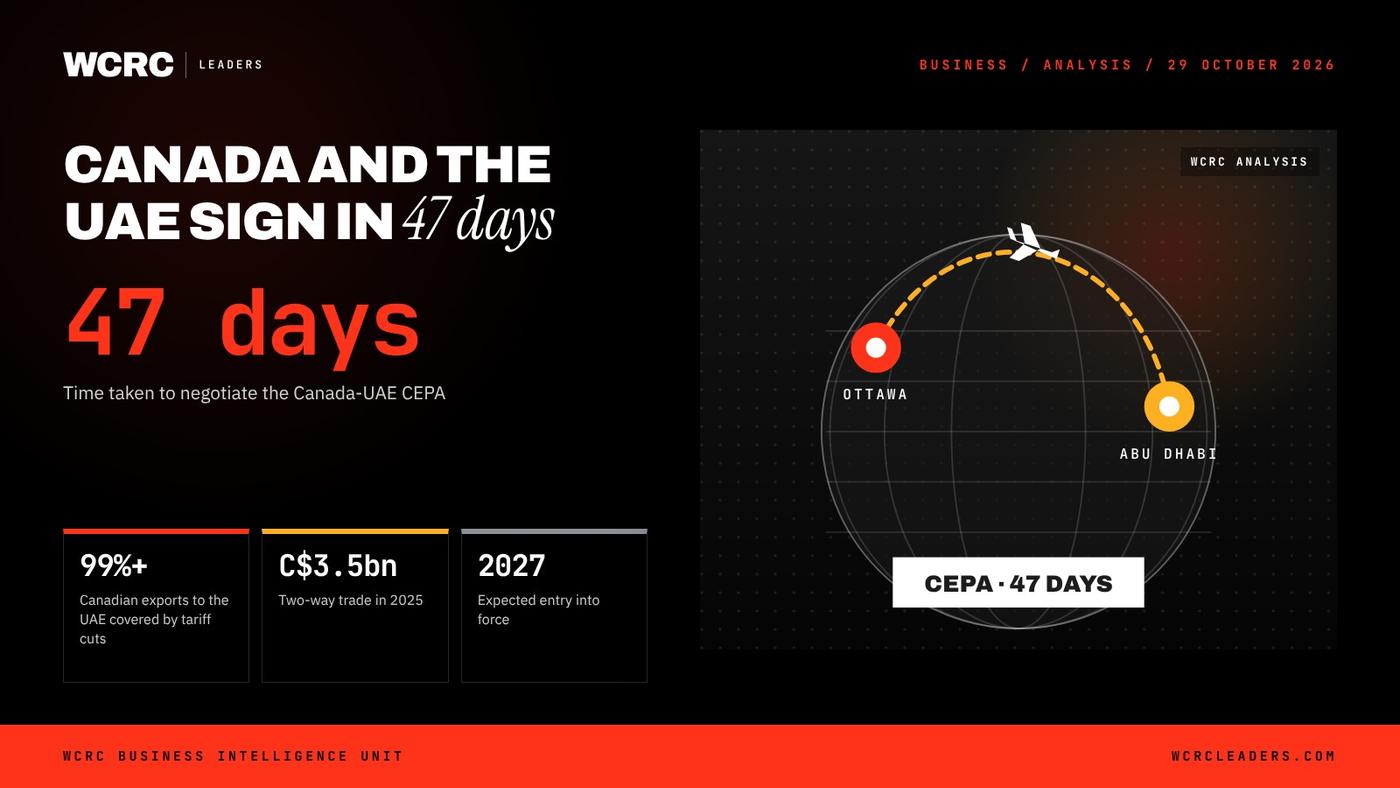
At a glance: WCRC Leaders' assessment: the Canada deal matters less for its modest trade numbers than as proof that the UAE can sign a G7 economy in weeks, which makes Abu Dhabi the fastest route into new markets for companies already based there. On 27 October in Ottawa, Canada and the UAE signed a Comprehensive Economic Partnership Agreement (CEPA) cutting or removing tariffs on over 99% of current Canadian exports to the UAE. It is expected to take effect in 2027, alongside new defence, logistics and energy agreements.
What did Canada and the UAE sign?
The agreement was signed on 27 October by Canada's Minister of International Trade, Maninder Sidhu, and the UAE's Minister of Foreign Trade, Thani bin Ahmed Al Zeyoudi. It came during a two-day visit to Ottawa by Sheikh Khaled bin Mohamed bin Zayed Al Nahyan, the first visit to Canada by a Crown Prince of Abu Dhabi. Prime Minister Mark Carney and the Crown Prince also launched a Strategic Partnership covering trade, energy, technology, education, defence, diplomacy and culture.
The Canadian government says negotiations took "a record 47 days", which it calls "the fastest either country has negotiated a free trade agreement". The talks concluded in July. Once fully in force, the CEPA will reduce or eliminate tariffs on more than 99% of current Canadian exports to the UAE. Ottawa names pulses, canola, industrial machinery, power generation equipment, aerospace and agri-food as the sectors set to gain, along with fewer non-tariff barriers.
"The UAE and Canada are building big," Carney said. In less than a year, he said, the two sides had "put an investment protection agreement in force" and "turned a historic $70 billion commitment into real investments in Canadian energy, infrastructure, and technology." That treaty, the Foreign Investment Promotion and Protection Agreement, entered into force this year, according to Global Affairs Canada.
How big is the trade, and why do the numbers differ?
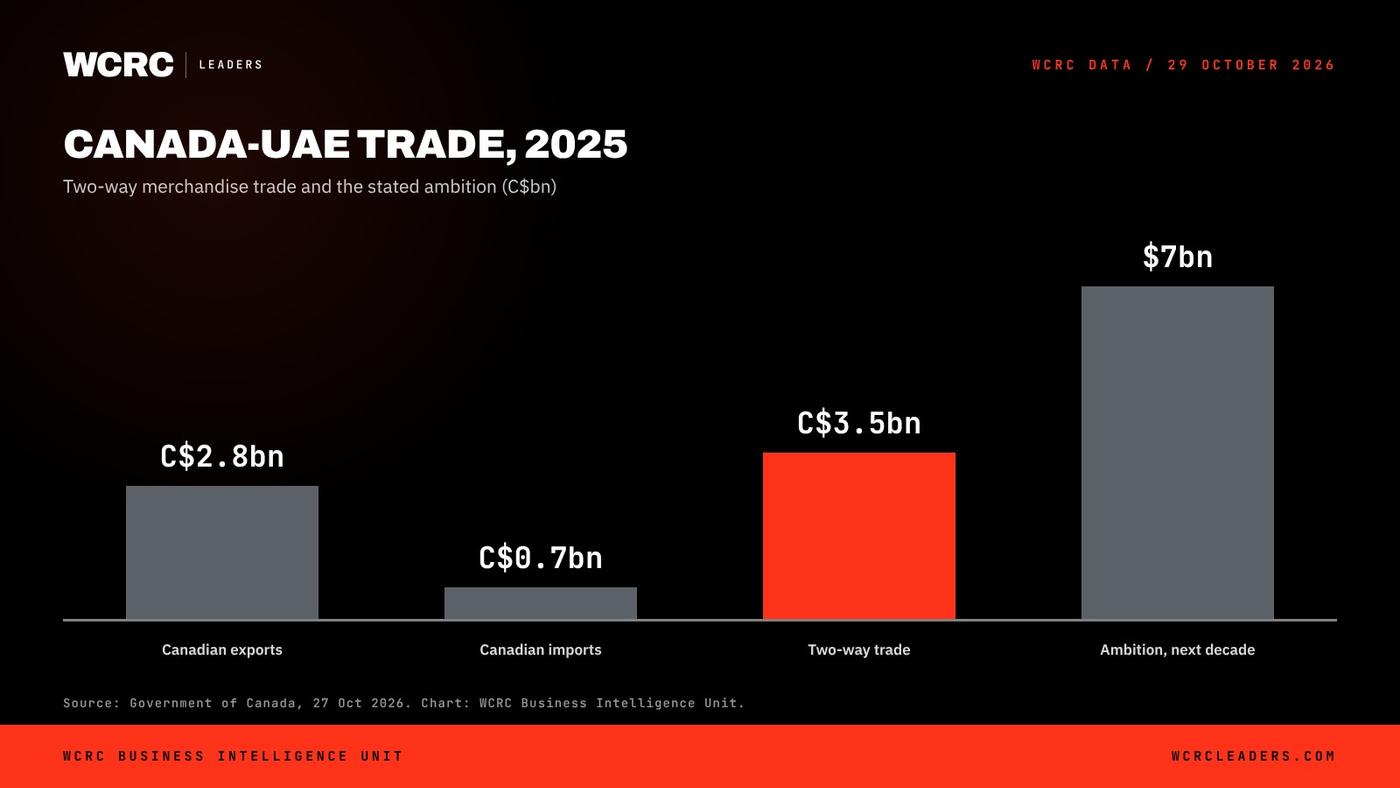
Canada puts two-way merchandise trade in 2025 at C$3.5 billion: C$2.8 billion of Canadian exports to the UAE and C$679.1 million of imports, with exports up more than 10% on the year. In the same release, Sidhu said the CEPA "will double our two-way trade, from $3.4 billion to $7 billion" over the next decade. The July joint announcement gave about US$4.2 billion for 2025, up 21%, in US dollars. Either way, it is a relationship worth a few billion dollars that both governments want to double, tiny next to India-UAE trade.
The bigger money is the UAE's US$70 billion investment commitment to Canada was first announced during Carney's visit to Abu Dhabi in November 2025.
What else came with the deal?
The side agreements say more about the strategy than the tariff schedule does.
- Logistics. DP World signed a memorandum of understanding with Arctic Gateway Group and CentrePort Canada for an integrated corridor linking the Port of Churchill on Hudson Bay, the Hudson Bay Railway and the CentrePort inland hub in Manitoba to DP World's global network.
- Energy. Masdar and Natural Resources Canada signed an Energy Cooperation Arrangement that sets a framework for working together, including on renewables.
- Investment promotion. Invest in Canada and the Abu Dhabi Chamber of Commerce and Industry agreed to share information, make introductions and coordinate visits.
- Defence. A Defence Cooperation MOU covers training, exercises, cyber security and industrial cooperation, and creates a Joint Military Committee.
- Justice. The two countries will open negotiations on an Extradition Treaty and a Mutual Legal Assistance Treaty.
Analysis. Read through WCRC's Promise Gap Model, part of its Brand & Marketing Codex, which measures the distance between what is claimed and what is delivered, this package carries a visible gap. The tariff schedule is a binding treaty. Almost everything around it is a memorandum, an arrangement, a framework or an agreement to start talking. The Churchill corridor has no published route, rates or funding. The energy deal sets out cooperation, not a project. Normal at signing, but the promise of a deep partnership is, for now, larger than what is on paper.
Is this part of a wider UAE network?
Yes. The UAE launched its CEPA programme in September 2021. When the Canada talks concluded in July, the joint announcement said the UAE had secured CEPAs with 38 countries since then, and that the Canada deal was the fastest the programme had concluded.
India was the first. The India-UAE CEPA was signed on 18 February 2022 and came into force on 1 May 2022. India's Commerce Ministry puts bilateral merchandise trade at US$100.06 billion in 2024-25, up from US$43.3 billion in 2020-21. The two governments are aiming for US$100 billion of non-oil, non-precious-metal trade by 2030.
The network keeps growing. On 21 October the UAE and Singapore said they intend to begin CEPA negotiations, and Temasek plans an Abu Dhabi office. A day later in Athens, the same Crown Prince announced a further €15 billion for Greece, with G42 group companies signing four AI memoranda.
Analysis. In the terms of WCRC's Category Command Model, which asks who leads a category and by how much, the UAE is building a lead as a brand in its own right: the Gulf's trade gateway. Its edge is not size but speed and reach. Thirty-eight CEPAs in about five years, and a G7 deal in 47 days, are a lead measured in how quickly a partner can be signed. That lead is defended by delivery, which brings the story back to the memoranda.
What does this mean for Indian, Gulf and Asian exporters?
Analysis. Three points stand out for companies outside Canada.
First, the UAE is becoming a place to sign deals from, not only a market to sell into. A company with real operations there can increasingly reach partners that have no deal with its home country. Canada has no free trade agreement with India, and talks on one have been on and off for more than a decade. Here SeeClear, a model in WCRC's Guru Management Codex built on Adi Shankaracharya's rope and snake, is the right discipline: separate fact from projection before a major decision. The fact is a signed agreement. The projection is that goods made or processed in the UAE will qualify for Canadian tariff cuts. That depends on rules of origin, and the text has not been published. Boards should read those rules before moving production or invoicing.
Second, logistics is where the work starts. The Churchill corridor points to a northern route into the Canadian interior that avoids crowded West Coast ports. Asian shippers of farm inputs and machinery should watch for a commercial service with published rates.
Third, competition cuts both ways. Canadian pulses and canola will enter the UAE at lower or zero tariffs. Indian traders in those Gulf flows may face cheaper Canadian supply, while Gulf food processors gain a stronger supplier base.
The WCRC View
The Business Intelligence Unit of WCRC reads the Canada CEPA as a signal of speed, not volume. A few billion dollars changes no balance sheet. A G7 economy agreeing a full trade deal in 47 days does change how boards should think about the UAE, and on the Category Command Model logic it widens Abu Dhabi's lead as the region's deal-signing hub.
The winners are clear. Companies already set up in the UAE gain a list of partners likely to grow faster than their home countries can manage. DP World and Masdar get state-backed routes into North American infrastructure and energy.
What leaders should do now. Apply SeeClear: CEOs of Indian and Asian exporters with UAE subsidiaries should map which UAE CEPAs reach markets their home country cannot, then test each against its rules of origin before acting. Gulf boards should price in stronger Canadian competition in food and agri-inputs from 2027. Logistics firms should open early talks on the Churchill corridor while terms are open.
The caution is the Promise Gap. Fast deals can be thin deals, and a memorandum is not a funded project. Until the legal text is out, nobody outside the two governments knows how deep the services and investment commitments go.
What WCRC will watch next: publication of the legal text and rules of origin; Canadian ratification and the 2027 entry into force; whether the Singapore talks begin on a timetable; and whether DP World's Churchill plan moves from a memorandum to a funded project, the clearest test of whether the gap closes.
WCRC models applied: Promise Gap Model and Category Command Model (Brand & Marketing Codex), SeeClear (Guru Management Codex).
Quick answers
Q: When was the Canada-UAE CEPA signed? A: On 27 October 2026 in Ottawa, by trade ministers Maninder Sidhu and Thani bin Ahmed Al Zeyoudi.
Q: How long did negotiations take? A: 47 days, the fastest either country has negotiated a free trade agreement, says Ottawa.
Q: When does it take effect? A: It is expected to enter into force in 2027.
Q: How many CEPAs has the UAE secured? A: 38 since September 2021, according to the July 2026 joint announcement. India's was the first.
Adani Ports raises FY27 capex by ₹3,000 crore as overseas ports surge
Vedanta doubles Gamsberg, and Ramaphosa now wants a zinc smelter
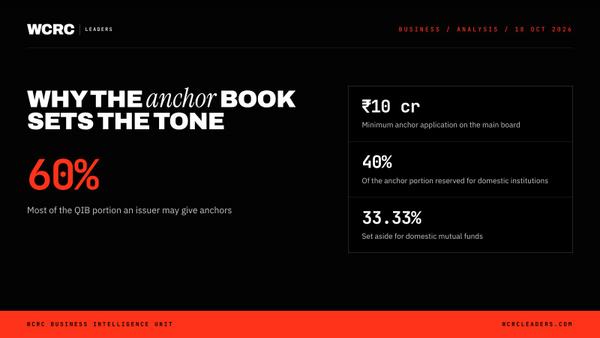
Anchor investors in Indian IPOs: why the 60% book sets the tone

Bajaj Finance lines up ₹17,500 crore as AI agents take on service

$133bn: what India's rupee defence is costing its biggest banks
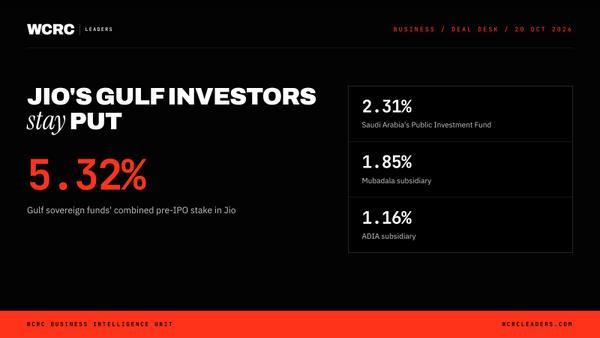
Jio Platforms IPO: Gulf funds hold 5.32% and are not selling
Filed under