Recognitions
Varun Beverages sells 354.4 mn cases and launches two new brands in Kenya
PepsiCo's main bottler in India grew volume 28.7% and revenue 33.2% in the September quarter. The quieter news is in Nairobi, where it has started selling two brands that are not on its PepsiCo list.
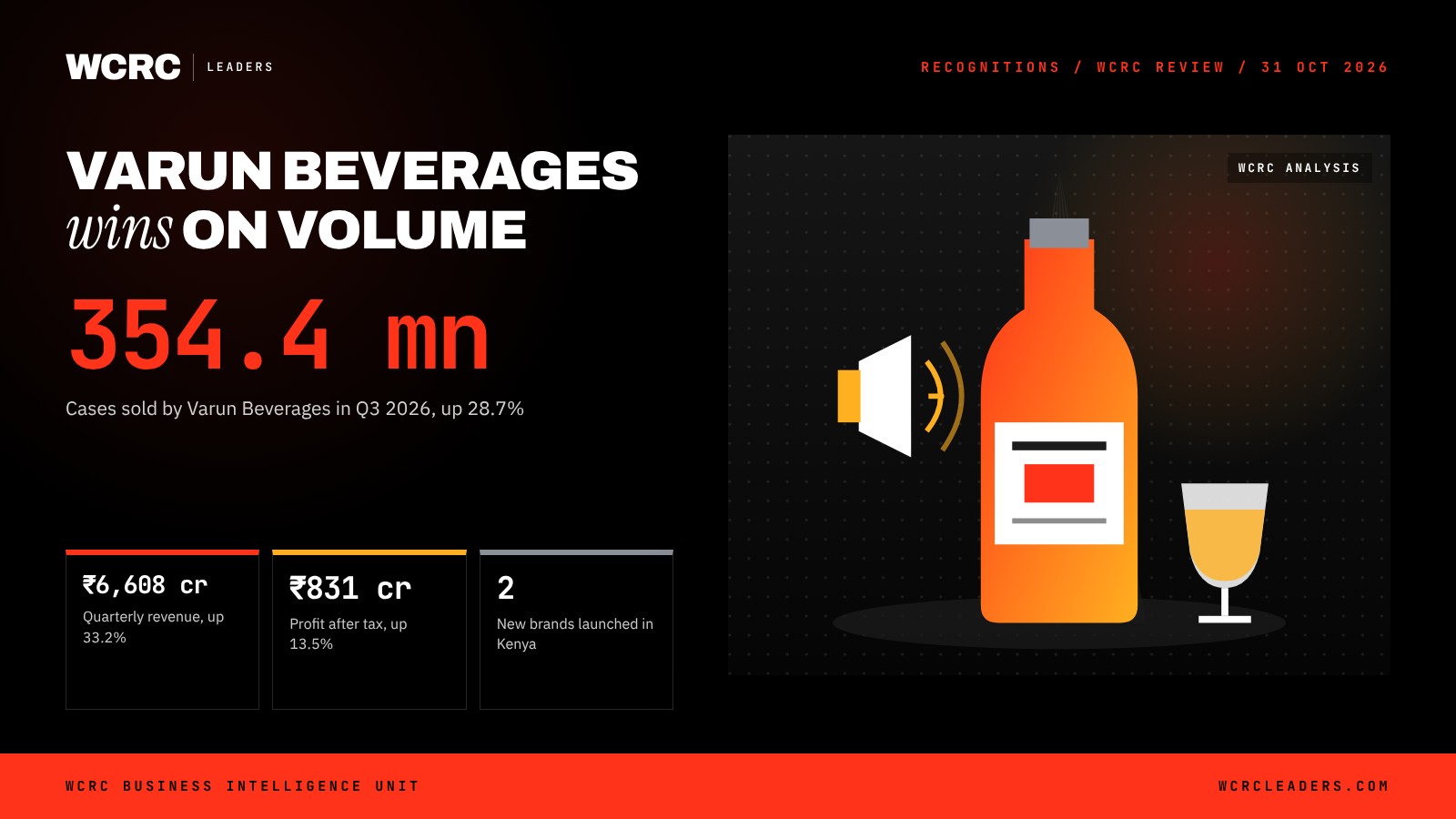
At a glance: WCRC Leaders' assessment: Varun Beverages is still winning on volume and reach rather than price, and its Kenyan launch shows a bottler beginning to test whether it can build brand equity of its own. On 30 October 2026 the company reported consolidated revenue from operations of ₹66,075.6 million for the quarter to 30 September, up 33.2%, on volume of 354.4 million cases. Profit after tax rose a slower 13.5% to ₹8,305.9 million as packaging costs and acquisition debt bit. It also started beverage operations in Kenya with two new brands, BOLT UP and XTREME FIZZ.
What did Varun Beverages report for the September quarter?
Varun Beverages, one of WCRC 1000, India's Most Valuable Enterprises 2026, reports on a calendar year, so the quarter to September is its third of 2026. Revenue from operations, net of excise and GST, rose to ₹66,075.6 million (about ₹6,608 crore) from ₹49,606.9 million a year earlier. Consolidated volume rose to 354.4 million cases from 275.3 million.
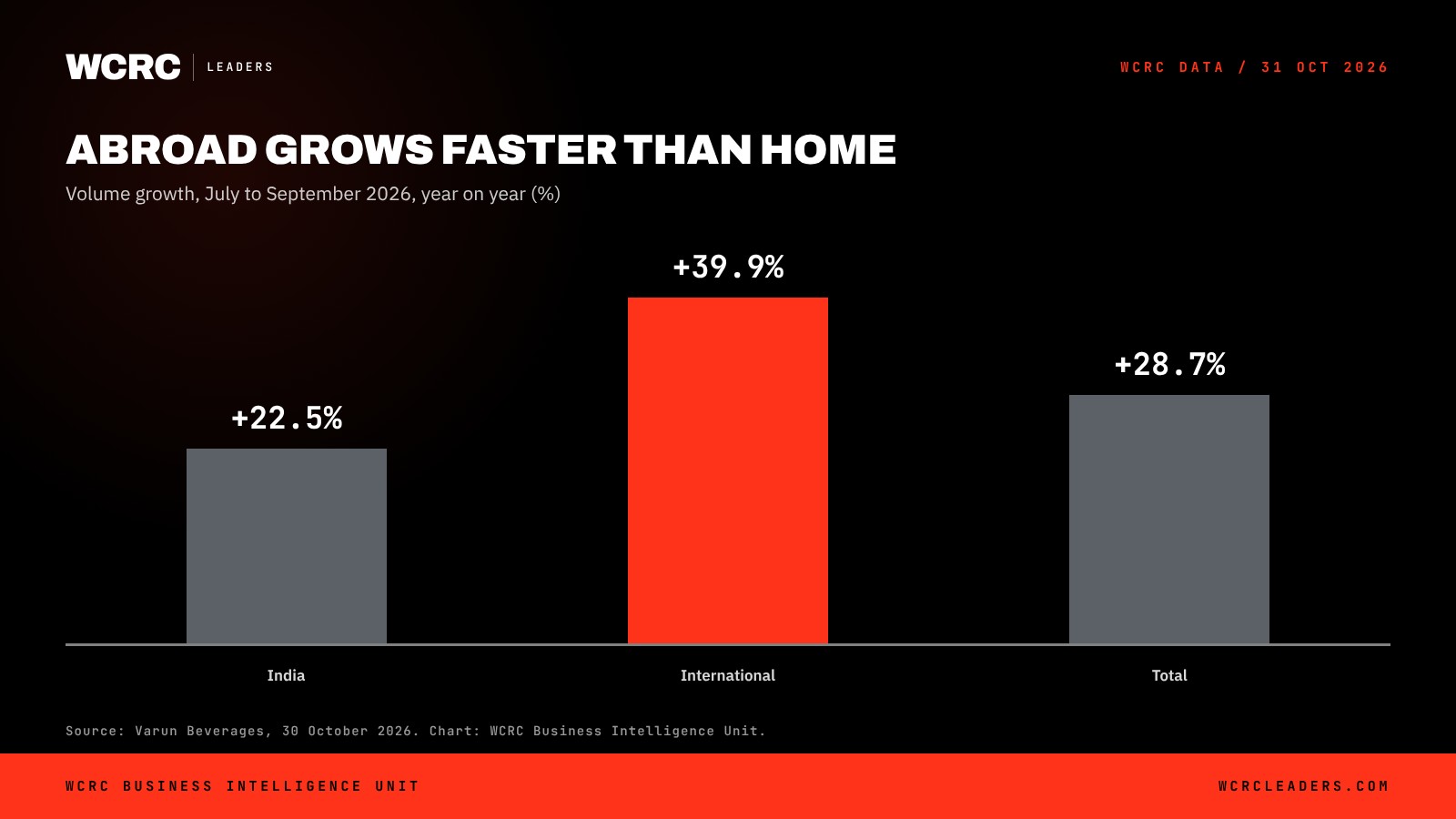
India volume grew 22.5%. International volume grew 39.9%, a figure that includes 15.3 million cases from Twizza, the South African business it acquired. EBITDA rose 25.1% to ₹14,267.1 million, a margin of 21.6%, down 140 basis points.
Profit after tax rose 13.5% to ₹8,305.9 million (about ₹831 crore), well behind revenue. Gross margin fell 334 basis points to 53.1%, mainly on higher costs for preforms, shrink film, closures and cans, which the company links to geopolitical disruption. Depreciation rose 34.5% and finance costs rose 53.5%, largely because of the Twizza acquisition and related debt. Other income fell 18.8%.
For the nine months to September, revenue rose 23.3% to ₹218,145.5 million and profit after tax rose 15.5% to ₹32,023.0 million. The board declared an interim dividend of ₹0.50 a share, a cash outflow of about ₹1,691 million.
Why is the Kenya launch more than a new territory?
For three decades Varun Beverages has been a franchise business. Its own website describes it as one of the largest franchisees of PepsiCo in the world outside the United States, associated with PepsiCo since the 1990s, and lists a portfolio of PepsiCo brands: Pepsi, Mountain Dew, Sting, 7UP, Mirinda, Tropicana, Gatorade and Aquafina among them.
In this quarter's release, Executive Vice Chairman Varun Jaipuria said the company had "started beverage operations in Kenya and introduced two new beverage brands 'BOLT UP' and 'XTREME FIZZ', marking another step towards strengthening our footprint in the fast-growing Africa region." Neither name appears on the PepsiCo list. Kenya also does not appear among the franchise territories or distribution rights the release sets out.
The route in was an acquisition. Its subsidiary VBL Industries (Kenya) bought the business of Devyani Food Industries (Kenya) for USD 32 million, effective 1 August 2026, treated as a combination under common control, with earlier periods restated.
Our analysis: a bottler that has spent its life building distribution, chilling and production for someone else's brands appears to be putting names that are not PepsiCo's on the shelf in a market where it holds no PepsiCo franchise. If so, it keeps what Varun Beverages does best, routes to market and cost, and adds the one thing a franchisee never owns: the brand.
Is this growth bought with price or earned with volume?
Volume did the work. Consolidated realisation per case rose only 2.2%, and India realisation rose just 0.5%. The company credits that small gain to higher-value categories such as dairy beverages, premium launches including Ad Rush and the Evervess mixers range, calibrated discounting and price-pack architecture.
Read through the Price Power Model in WCRC's Brand & Marketing Codex, which asks how much premium a brand can charge before buyers switch, Varun Beverages is choosing not to test that limit in India. Premium launches edge the mix upward while core packs stay cheap enough to keep cases moving. In a category where Coca-Cola, a WCRC MegaBrand in cola soft drinks, and Thums Up, a WCRC MegaBrand in Indian legacy soft drinks, compete for the same chiller, volume is the safer prize.
The mix has also moved sharply. Carbonated soft drinks were 73.3% of volume, juice-based drinks 4.8% and packaged water 21.9%. In India, low and no-sugar products rose from 44% of volume a year ago to 88%, which the company says offset a roughly 16% rise in sugar prices. That is a large reformulation, done at scale, and a defence against future sugar regulation.
What does WCRC's brand work say about a bottler building brands?
The Brand Stretch Model, also in the codex, asks whether a new product can credibly launch under an existing name. Varun Beverages is facing the harder version of that question. BOLT UP and XTREME FIZZ do not borrow PepsiCo's equity. They start from zero, and their only inherited asset is the company's execution.
That matters because the strongest brands in its own portfolio are not its own. Sting, a WCRC MegaBrand in energy and sports drinks, is a PepsiCo brand that Varun Beverages lists among the drinks it makes. Pepsi itself features in the world brands table of WCRC's India's Most Powerful Brands 2026. WCRC's MegaBrands work, which looks at perceived brand power rather than financial valuation, considers positioning and recall, consumer trust, product and delivery, governance and sustainability, and digital and financial soundness. A bottler is strong on product and delivery; recall and trust must be built from scratch in Nairobi.
The Distinctiveness Code in the same codex asks whether a brand is ownable or generic. That is the test for both new names: whether they earn a place in memory or simply fill a price slot.
How wide is the company's reach now?
The release lists franchises in 26 Indian states and six union territories, and international franchises in Nepal, Sri Lanka, Morocco, Zambia, Zimbabwe, South Africa, Lesotho, Eswatini and DR Congo, with distribution rights in Namibia, Botswana, Mozambique and Madagascar. India contributed about 67% of revenue in fiscal 2025.
Two further moves show the same instinct to use the route to market for more than PepsiCo products. In Zimbabwe, it signed an exclusive deal with Mondelez South Africa to distribute chocolate, biscuits, candy and gum from 1 October 2026. In India, it set up KIVA Spirits and Company on 29 August 2026 to pursue ready-to-drink, alcoholic beverages and allied products. Jaipuria described the approach as "measured steps towards diversifying our business into adjacent categories." The Twizza and BevCo merger in South Africa took effect on 1 August, and the company expects "significant operational synergies in the coming quarters."
The company is also an employer of note. Varun Beverages was selected among India's Most Loved 250 Workplaces 2026 by the Business Intelligence Unit of WCRC, as was its franchisor, PepsiCo India.
What does this mean for CEOs and boards in India, the Gulf and Asia?
For Indian consumer boards, the lesson is that distribution can carry more than one brand. As WCRC Leaders noted in its review of Tata Consumer's growth brands, the newer names are now doing more of the growing. Varun Beverages is reaching the same conclusion from the opposite end, as a supplier that wants a brand of its own.
For Gulf groups that run franchise, bottling and distribution businesses for global names, the Kenya move is a template worth studying: keep the franchise, use its scale, and build owned brands where the franchise does not reach.
For Asian consumer companies, the sugar shift is the more urgent signal: 88% low or no-sugar in India sets a bar for anyone selling soft drinks in the region.
The move into alcohol through KIVA also invites comparison with United Spirits, which lifted ad spend as it pushed premium. Brand building is expensive, and Varun Beverages has so far spent on plants and chillers.
The WCRC View
The WCRC Business Intelligence Unit reads this as a quarter of two stories: a volume machine running at full speed, and margin strain, with profit growing at less than half the pace of revenue.
Our analysis: the Kenya launch is the more important long-term signal. Read through the Brand Stretch Model and the Distinctiveness Code in WCRC's Brand & Marketing Codex, BOLT UP and XTREME FIZZ cannot lean on borrowed equity. Their success will show whether Varun Beverages can be a brand owner, not only a brand operator.
In the terms of SeeClear, a model in WCRC's Guru Management Codex, investors should separate fact from projection. The fact is two brands launched and a USD 32 million Kenyan business bought. The projection, that a franchisee becomes a brand house, is years away and unproven.
On Global Mindset, one of the seven WCRC leadership parameters, Jaipuria's team is making Africa its second home, not a side bet: international volume grew 39.9% and now spans more than a dozen markets.
What leaders should do now: franchise operators should map where their licences end and owned brands could begin; consumer boards should treat low-sugar reformulation as a growth lever, not a compliance cost.
What WCRC will watch next: early sales of the two Kenyan brands, whether packaging costs ease in the December quarter, and how fast Twizza synergies reach the margin.
WCRC models applied: Price Power Model, Brand Stretch Model, Distinctiveness Code (Brand & Marketing Codex), MegaBrands, SeeClear (Guru Management Codex), seven WCRC leadership parameters (Global Mindset).
Quick answers
Q: What were Varun Beverages' Q3 2026 results? A: For the quarter to 30 September 2026, revenue from operations was ₹66,075.6 million, up 33.2%, volume was 354.4 million cases, up 28.7%, and profit after tax was ₹8,305.9 million, up 13.5%.
Q: What are BOLT UP and XTREME FIZZ? A: They are two new beverage brands Varun Beverages introduced in the September quarter of 2026, when it started beverage operations in Kenya.
Q: Why did profit grow more slowly than revenue? A: Gross margin fell 334 basis points to 53.1% on higher packaging costs, while depreciation rose 34.5% and finance costs rose 53.5%, largely due to the Twizza acquisition and related debt.
Q: How did Varun Beverages enter Kenya? A: Its subsidiary VBL Industries (Kenya) acquired the business of Devyani Food Industries (Kenya) for USD 32 million, effective 1 August 2026.
Hindustan Unilever's 15% quarter: Priya Nair's volume-led reset
Maruti Suzuki sells a record 696,654 cars as quarterly profit falls 27%
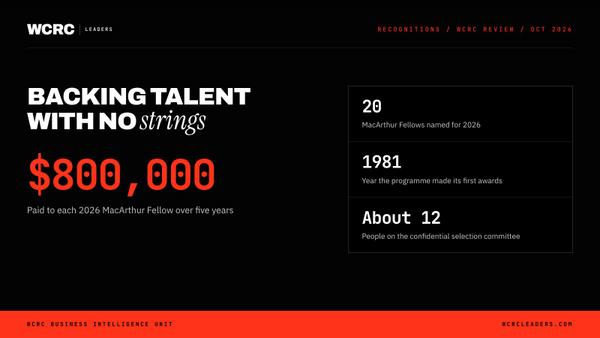
No strings attached: what the MacArthur model teaches about recognising talent
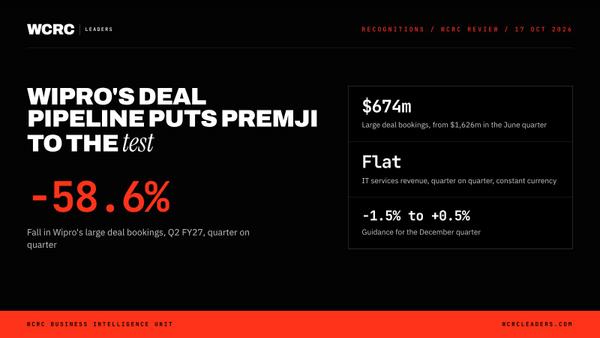
Wipro's 58.6% large-deal drop puts Rishad Premji to the test
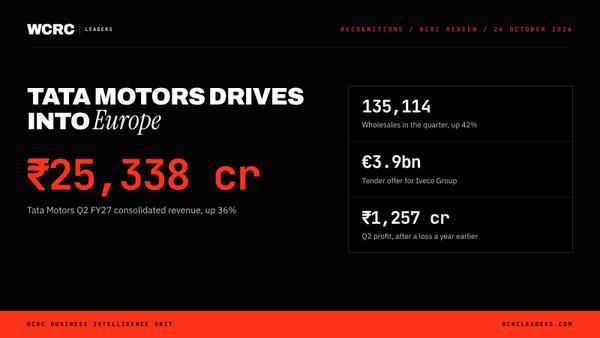
Tata Motors posts 42% volume jump as its €3.9bn Iveco bid nears close
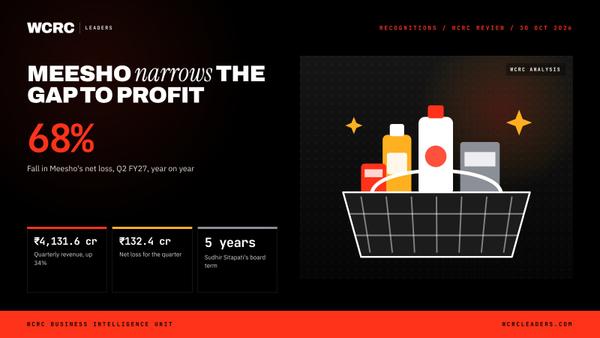
Meesho cuts its loss 68% and adds ex-Godrej CEO Sudhir Sitapati to board
Filed under