Recognitions
Meesho cuts its loss 68% and adds ex-Godrej CEO Sudhir Sitapati to board
Revenue rose 34% to ₹4,131.6 crore in the September quarter while the loss shrank to ₹132.4 crore. The bigger signal for India's value e-commerce brand may be the consumer-goods veteran now sitting on its audit committee.
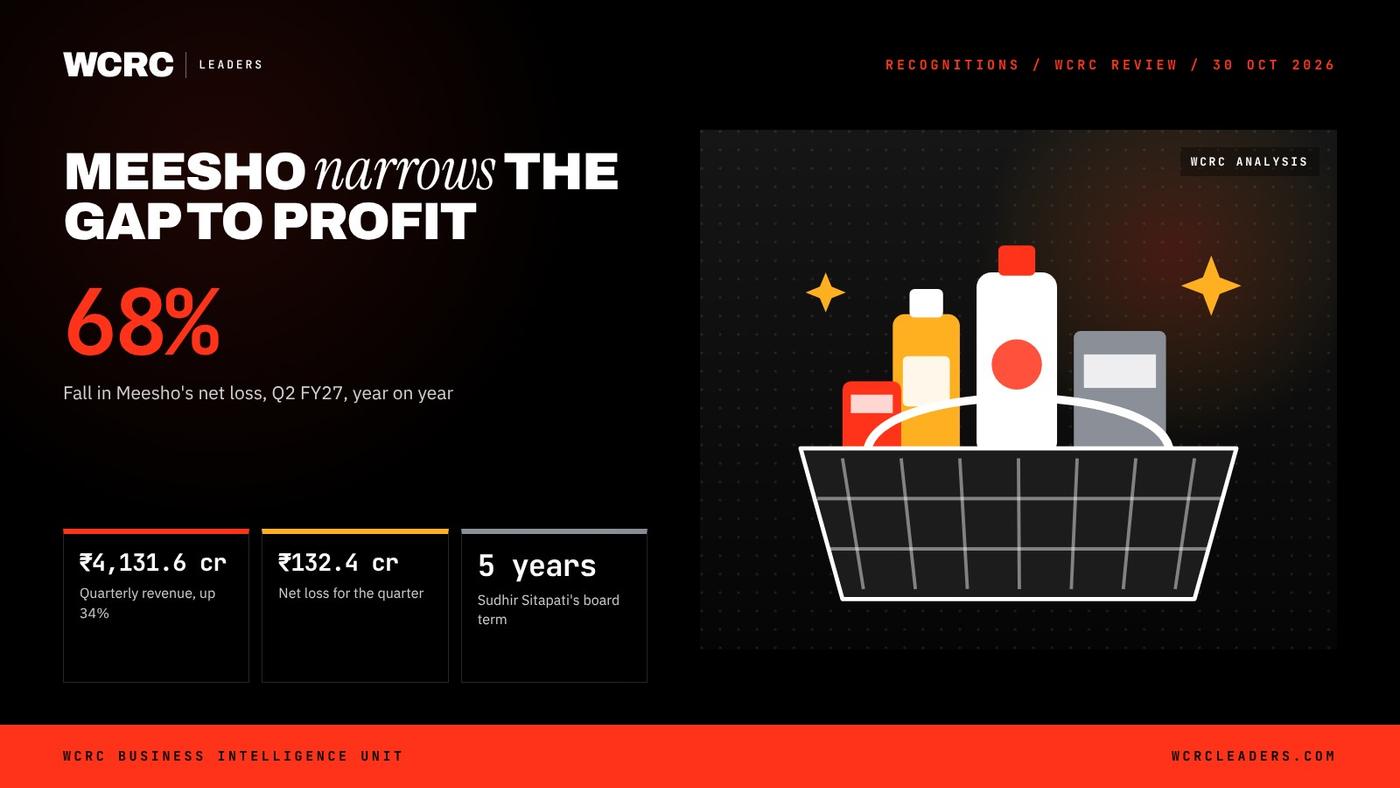
At a glance: WCRC Leaders' assessment: Meesho is closing the gap between a mass-market brand promise and a profitable business faster than its loss line suggests, and its new board appointment shows it wants to be judged as a consumer company, not a start-up. On 28 October 2026 the Bengaluru marketplace reported consolidated revenue from operations of ₹41,315.8 million for the quarter to 30 September, up 34% year on year and 11% on the June quarter. Its net loss fell 68% to ₹1,324.5 million. The board also appointed Sudhir Sitapati, former managing director and CEO of Godrej Consumer Products, as an independent director for five years.
What did Meesho report for the September quarter?
Meesho, a WCRC MegaBrand in value and social commerce, told the exchanges on 28 October 2026 that consolidated revenue from operations reached ₹41,315.8 million (₹4,131.6 crore) in the second quarter of FY27. That compares with ₹30,736.7 million a year earlier and ₹37,128.1 million in the June quarter. Total income, including other income, was ₹42,590.0 million.
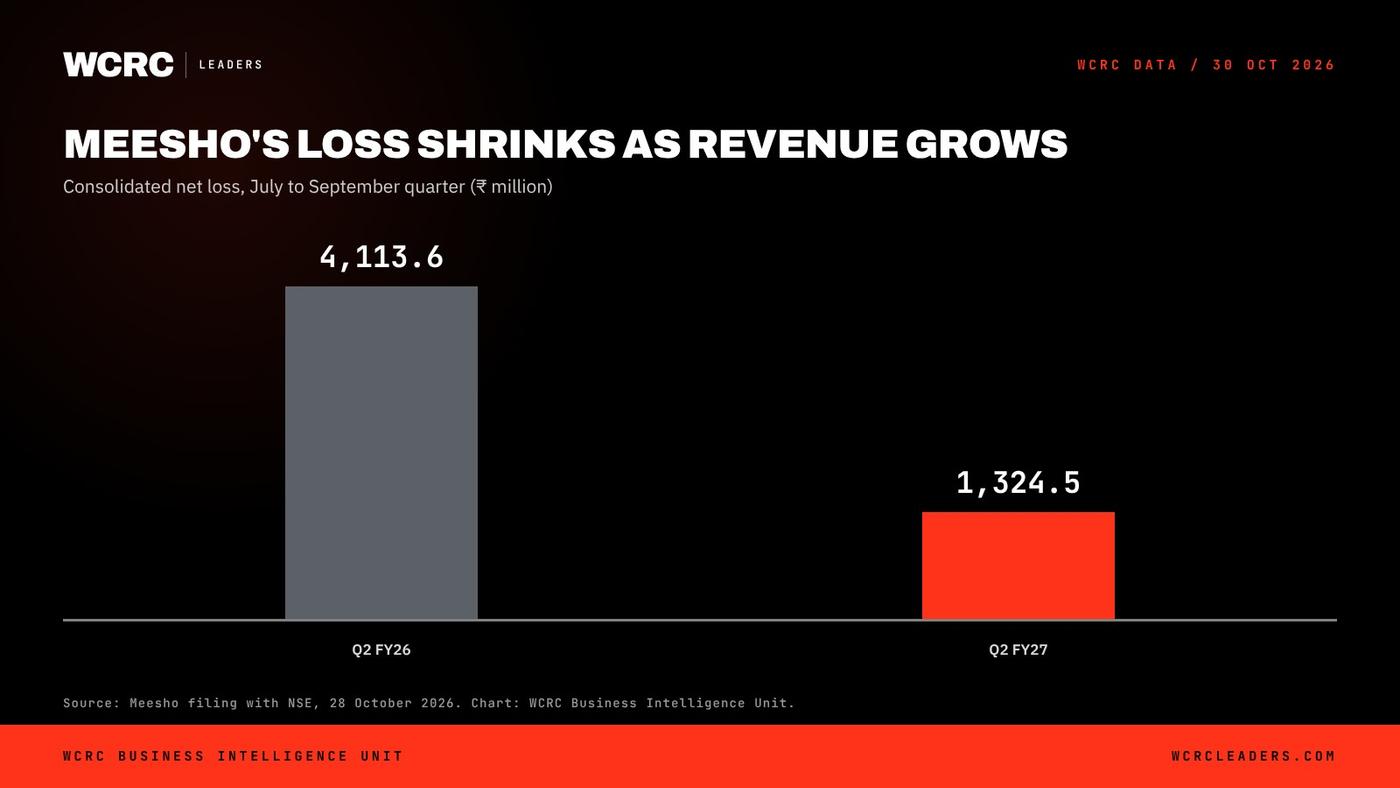
The loss is the headline that will travel. Meesho lost ₹1,324.5 million (₹132.4 crore) in the quarter, against ₹4,113.6 million a year earlier, a fall of 68%. For the six months to September, revenue rose 41% to ₹78,443.9 million and the net loss narrowed to ₹2,652.8 million from ₹7,007.2 million.
Two details in the filing deserve more attention than the year-on-year swing. First, the loss barely moved from the June quarter, when it was ₹1,328.4 million, even though revenue grew 11% between the two periods. Meesho added more than ₹4,000 million of quarterly revenue without adding to its loss, which suggests the cost base is now scaling more slowly than the top line. Second, the gap between total income and revenue from operations, about ₹1,274 million, is close to the size of the quarterly loss. On these figures, other income is doing much of the work of keeping losses small. The operating business is improving, but it is not yet paying its own way.
Who is Sudhir Sitapati and why does his appointment matter?
According to the company's disclosure, Sitapati brings more than 25 years in fast-moving consumer goods. He was managing director and CEO of Godrej Consumer Products, one of WCRC 1000, India's Most Valuable Enterprises 2026, from October 2021 to August 2026. Before that he spent more than two decades at Hindustan Unilever, one of WCRC 1000, India's Most Valuable Enterprises 2026, where he rose to executive director for foods and refreshments. He is currently an independent director of Asian Paints, one of WCRC 1000, India's Most Valuable Enterprises 2026.
His appointment as an additional, non-executive independent director runs from 28 October 2026 to 27 October 2031, subject to shareholder approval. He joins the audit committee, the nomination and remuneration committee and the corporate social responsibility committee with immediate effect.
That committee placement is the point. An independent director who sits on audit and remuneration is not decoration. He will see how Meesho books its numbers and how it pays its leaders. A marketplace that listed less than a year ago has chosen someone who spent his career selling soaps, foods and household brands to the same mass-market Indian households that Meesho courts.
What is Meesho's brand promise, and is it holding?
Meesho's proposition is value: low prices, a very wide catalogue from small sellers, and a focus that management has described as mass-market India and smaller towns. In its results for the December 2025 quarter, its first as a listed company, Meesho reported 251 million annual transacting users and more than 846,000 annual sellers. Founder and CEO Vidit Aatrey said then: "Our north star is Free Cash Flow per share, which captures the real cash generated after reinvestment."
Read through WCRC's Promise Gap Model, part of the WCRC Brand & Marketing Codex, the test for a value brand is the distance between what it claims and what arrives at the door. For Meesho, the claim is affordability and reach. The risk is that cheap goods slide into cheap experience: late parcels, poor quality, returns. Revenue growth of 34% in a quarter suggests buyers are still coming back. Whether they come back happy is what the next phase will reveal, and it is where a consumer-goods mind on the board can ask sharp questions.
The Price Power Model in the same codex asks how much premium a brand can charge before buyers switch. Meesho's answer has always been to charge no premium at all. Its power sits in volume and habit, not price. That makes it more exposed than most to a rival's price cut, and it makes the discipline of cost control, now visible in a flat loss on rising revenue, central to the brand rather than merely to the accounts.
How does Meesho compare with India's larger marketplaces?
Meesho competes for the same shopper's wallet as Flipkart, a WCRC MegaBrand in electronics and appliance e-commerce, and Amazon India, a WCRC MegaBrand in horizontal marketplace. Both are larger and better funded. Meesho's defence has been focus: it owns the value end of the market rather than trying to win every category.
WCRC's MegaBrands work, which looks at perceived brand power rather than financial valuation, considers positioning and recall, consumer trust, product and delivery, governance and sustainability, and digital and financial soundness. Meesho's latest quarter speaks to more than one of those areas at once. The financial line is improving. The governance line has just been strengthened. Product and delivery, the hardest to fix in value commerce, remains the area to watch.
The contrast with quick commerce is instructive. As WCRC Leaders reported, Swiggy's Instamart lost ₹895 crore at the adjusted EBITDA level in the same quarter as it chased scale. Meesho is moving the other way: slower, cheaper, and closer to break-even.
What does this mean for CEOs and boards in India, the Gulf and Asia?
For Indian consumer companies, Meesho is now a channel to the mass-market buyer that few brands can ignore. Its December-quarter release noted that Dabur was scaling on Meesho Mall to sell national brands at competitive prices. FMCG boards, including those reading Hindustan Unilever's volume-led quarter, should treat value marketplaces as a distribution question, not only a pricing threat.
For Gulf investors and family offices with exposure to Indian consumer growth, the governance signal matters as much as the loss figure. Seating a former FMCG chief executive on the audit committee is the kind of board choice that long-term capital tends to reward.
For founders across Asia preparing to list, Meesho offers a template: show the cost line flattening while revenue grows, then bring in directors who have run large consumer businesses through full economic cycles.
The WCRC View
The WCRC Business Intelligence Unit reads Meesho's quarter as a brand growing up in public. A 68% fall in the loss is welcome, but the more telling number is the flat loss on 11% sequential revenue growth. That is operating leverage arriving.
Our analysis: the Sitapati appointment is the strongest governance signal a young Indian consumer platform has sent this year. Read through the Governance Shield in WCRC's Brand & Marketing Codex, reputation is protected at board level, and a director with decades in mass-market brands and a seat on audit is a direct investment in that shield.
In the terms of SeeClear, a model in WCRC's Guru Management Codex, boards should separate fact from projection. The fact is a shrinking loss. The projection is profitability. With other income close to the size of the quarterly loss, investors should not mistake one for the other yet.
On Stakeholder Trust, one of the seven WCRC leadership parameters, Aatrey's stated focus on free cash flow per share gives shareholders a clear yardstick. Meesho should report against it plainly every quarter.
What leaders should do now: consumer brands should build a value-marketplace plan; boards of listed platforms should look at who sits on their audit committees.
What WCRC will watch next: whether Meesho turns operating profit without leaning on other income, how the festive quarter to December lands, and whether delivery quality keeps pace with growth.
WCRC models applied: Promise Gap Model, Price Power Model, Governance Shield (Brand & Marketing Codex), MegaBrands, SeeClear (Guru Management Codex), seven WCRC leadership parameters (Stakeholder Trust).
Quick answers
Q: What was Meesho's revenue in Q2 FY27? A: Consolidated revenue from operations was ₹41,315.8 million (₹4,131.6 crore) for the quarter to 30 September 2026, up 34% year on year and 11% on the previous quarter.
Q: How much did Meesho lose in the quarter? A: The consolidated net loss was ₹1,324.5 million, down 68% from ₹4,113.6 million a year earlier and almost unchanged from ₹1,328.4 million in the June quarter.
Q: Who has joined Meesho's board? A: Sudhir Sitapati, managing director and CEO of Godrej Consumer Products from October 2021 to August 2026, was appointed an independent director for five years from 28 October 2026, subject to shareholder approval.
Q: Is Meesho recognised by WCRC? A: Yes. Meesho is a WCRC MegaBrand in value and social commerce, selected by the Business Intelligence Unit of WCRC. The full report and evidence are available from WCRC on request.
Hindustan Unilever's 15% quarter: Priya Nair's volume-led reset
Maruti Suzuki sells a record 696,654 cars as quarterly profit falls 27%

No strings attached: what the MacArthur model teaches about recognising talent
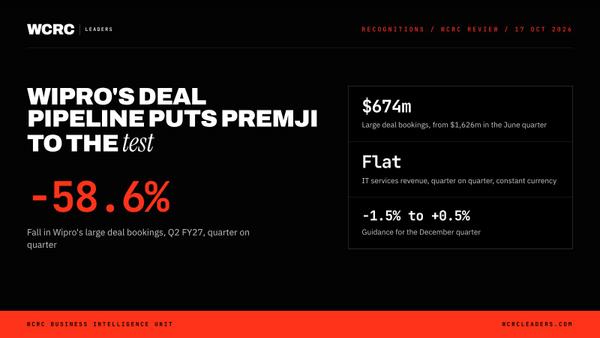
Wipro's 58.6% large-deal drop puts Rishad Premji to the test
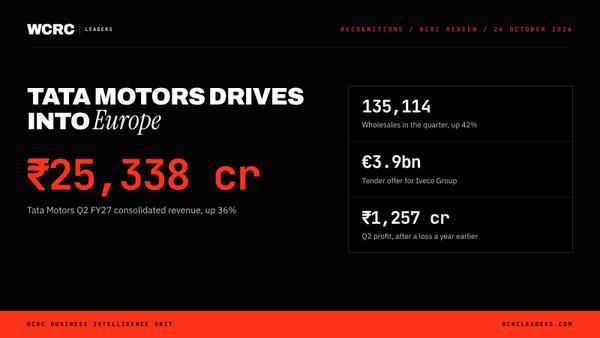
Tata Motors posts 42% volume jump as its €3.9bn Iveco bid nears close

The 'alternative Nobel' goes to an AI accountability pioneer
Filed under