Recognitions
United Spirits raises ad spend to 11.6% of sales as luxury tilt deepens
Diageo's Indian arm spent half as much again of every rupee of sales on its brands in the September quarter, and gave up some profit to do it. With premium labels now 94.1% of sales and its mass-market business shrinking under state policy changes, United Spirits is betting that brand investment, not volume, is where its future margin lies.
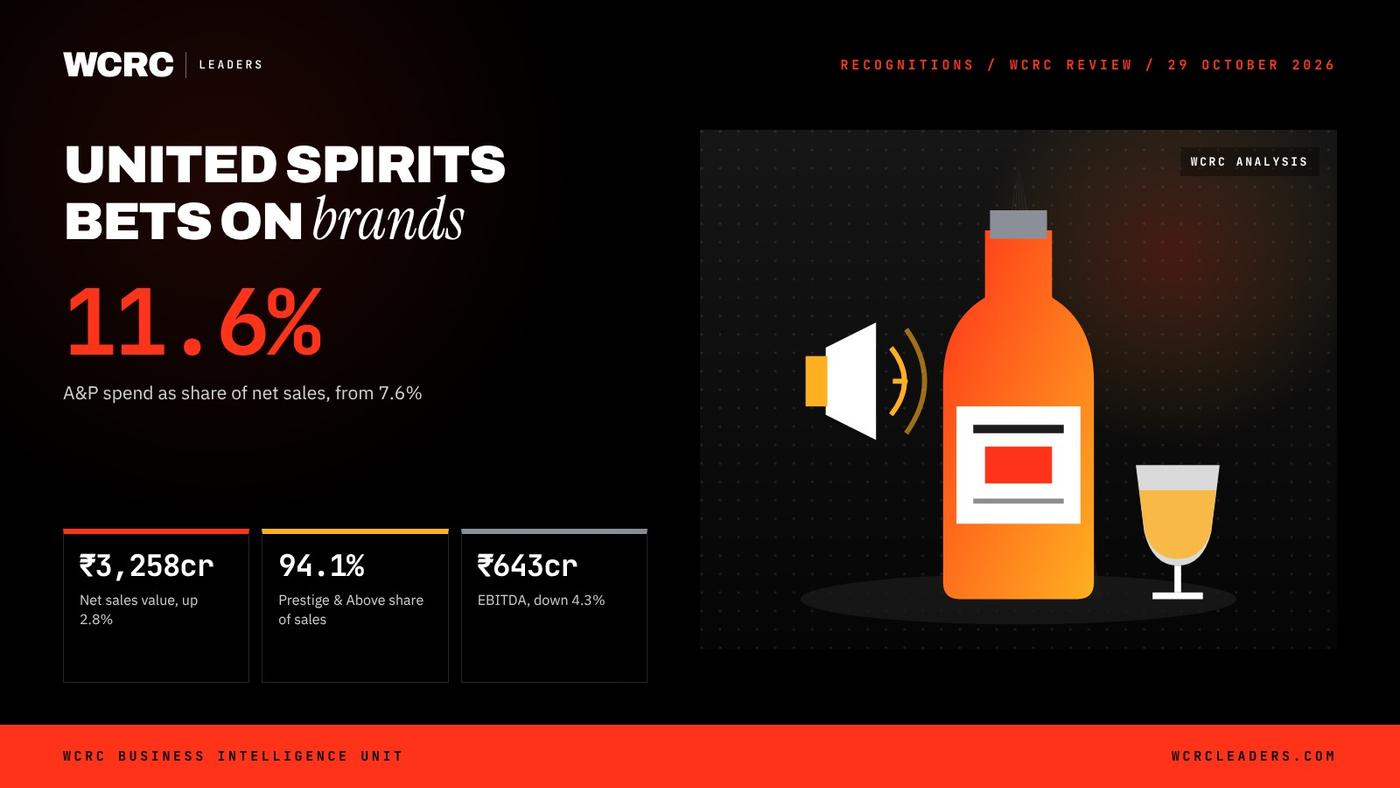
At a glance: WCRC Leaders' assessment: United Spirits has chosen to buy future brand strength with today's margin, and the quarter's profit dip is a deliberate investment rather than a sign of weakness, provided premium growth accelerates from here. On 28 October 2026, United Spirits reported standalone net sales value of ₹3,258 crore for the quarter to 30 September, up 2.8%. Prestige & Above sales rose 6.3% while Popular fell 22.7%. Advertising and promotion rose to 11.6% of net sales from 7.6%, pulling EBITDA down 4.3% to ₹643 crore.
What did United Spirits report?
United Spirits, one of WCRC 1000, India's Most Valuable Enterprises 2026, and the Indian subsidiary of Diageo plc, reported standalone net sales value (NSV) of ₹3,258 crore for the second quarter of FY27, up 2.8% on a year earlier.
The Prestige & Above (P&A) portfolio, its premium segment, delivered NSV of ₹3,065 crore, up 6.3%, and now makes up 94.1% of net sales. The Popular segment, its mass-market brands, fell 22.7% on a like-for-like basis to ₹181 crore.
Gross margin improved 88 basis points to 48.0%, and gross profit rose 4.7%. The company attributed this to "better mix, and productivity flow-through". But EBITDA fell 4.3% to ₹643 crore, and EBITDA margin narrowed 146 basis points to 19.7%. Profit after tax slipped 2.1% to ₹462 crore, a net margin of 14.2%.
For the first half, NSV was ₹5,961 crore, up 4.2%, with P&A up 7.8%. EBITDA for the half was down 1.1% at ₹1,075 crore, while profit after tax rose 16.8% to ₹853 crore.
CEO and Managing Director Praveen Someshwar said: "We delivered a resilient quarter despite a strong prior-year base and regulatory headwinds."
Where did the margin go?
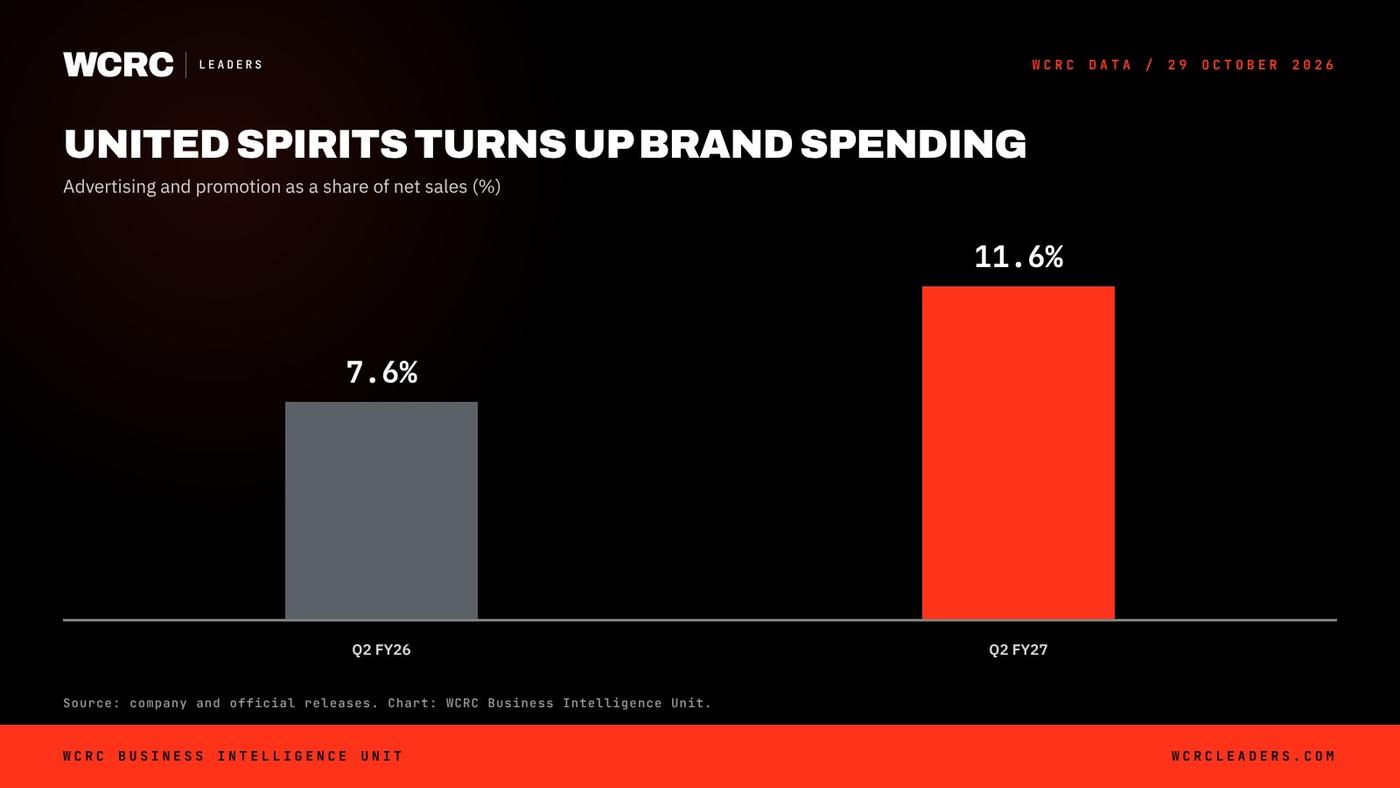
The single largest change on the income statement was brand investment. The company's A&P (advertising and promotion) re-investment rate rose to 11.6% of NSV from 7.6% a year earlier.
WCRC analysis: On the company's own figures, that is roughly ₹378 crore of A&P this quarter against about ₹241 crore a year ago, an increase of around ₹137 crore. Gross profit rose by roughly ₹70 crore over the same period. Put simply, United Spirits made more money on each bottle, then spent all of that gain and more on its brands. Had A&P stayed at last year's rate, EBITDA would have been about ₹130 crore higher and the margin well above 20%.
That makes this a choice, not a squeeze: gross margin rose, and the EBITDA decline is almost entirely the A&P decision.
Read through WCRC's Spend-to-Power Ratio, a Brand & Marketing Codex model that asks what brand power each unit of marketing spend buys, the test is not this quarter's margin but whether the extra spend lifts P&A growth above its current 6.3% in the quarters ahead. In the half year, P&A grew 7.8%. A rising spend rate alongside slowing premium growth would be the warning sign.
What is driving the premium tilt?
The company credited three things for P&A growth: Smirnoff local flavour innovation, the relaunch of J&B Scotch, and growth in its luxury portfolio.
On J&B, Someshwar said the relaunch, "enabled by the India-UK FTA, offers consumers a compelling proposition". In the company's own words, the trade agreement with the United Kingdom is what made the relaunch possible, and United Spirits is moving early to use it.
He also said the company is "entering the Ready-to-Drink (RTD) segment with Smirnoff Ice to give consumers a convenient new choice." Smirnoff, a WCRC MegaBrand in white and other spirits, is the brand carrying much of this innovation. MegaBrands reads brand power through areas including positioning and recall, consumer trust, and product and delivery.
WCRC analysis: In the terms of WCRC's Price Power Model, which asks how much premium a brand can charge before buyers switch, the J&B relaunch is a price-power play in reverse: rather than pushing an existing premium higher, it uses a trade agreement to bring imported Scotch within reach of more buyers, widening the premium pool United Spirits can sell into. Smirnoff Ice is a different bet. Read through the Brand Stretch Model, it asks whether a name trusted in one format can carry a new one; flavour innovation that already worked in vodka is a sensible base for that stretch.
Why is the Popular segment shrinking?
The Popular decline is policy-driven, on the company's own account. It said the fall "was driven by MML impact in Maharashtra as well as recent policy changes in Karnataka, which have adversely impacted the realisations and growth in the segment." The Maharashtra policy also weighed on P&A, and the company said the "continued adverse impact from the West Asia crisis" offset some of the gross margin gain. In the half year, it also cited "disruption in the Exports business".
At ₹181 crore, Popular is now under 6% of net sales. WCRC analysis: P&A added roughly ₹180 crore of sales year on year; Popular lost roughly ₹50 crore. The mass segment can still drag on headline growth, but it no longer decides the company's direction.
What do the brand models say about the risk?
WCRC analysis: Heavier spending creates two risks that boards should name.
The first sits in WCRC's Love-to-Loyalty Funnel, which asks where affection fails to turn into repeat buying. New flavours, a relaunched Scotch and an RTD entry generate trial. The return on ₹137 crore of extra spend depends on whether trial becomes repeat purchase.
The second is the Promise Gap Model, the distance between what a brand claims and what it delivers. A relaunch built on a "compelling proposition" has to hold up in availability and price at the shelf, state by state. If regulatory changes disrupt supply or pricing in key markets, the promise and the delivery can drift apart quickly.
This is a regulated category, and the question here is one of capital allocation: is the spend building durable preference, or renting attention?
What does it mean for CEOs and boards in India, the Gulf and Asia?
For Indian boards, United Spirits is a clean case of management accepting lower reported profit to fund brand building, and showing it in the numbers.
For Gulf and Asian groups with Indian consumer exposure, the lesson is about policy risk. Two states changed the rules this year and a whole segment fell by a fifth. Portfolios weighted to premium, brand-led products are less exposed to that kind of shock than those built on price. The same logic shows in Tata Consumer's growth brands outrunning tea and salt and in UltraTech's move into wires.
In the terms of SeeClear, a model in WCRC's Guru Management Codex that separates fact from projection before a major decision, the fact is a gross margin gain and a deliberate spend increase. The projection, that profit is under pressure, mistakes a decision for a decline.
United Spirits (Diageo India) was also named among India's Most Loved 250 Workplaces 2026 by the Business Intelligence Unit of WCRC, in the FMCG sector.
The WCRC View
The call. This is a premium brand business choosing growth investment over short-term margin. The 88-basis-point gross margin gain is the number that matters; the 146-basis-point EBITDA decline is the price of a strategy, not a symptom of strain.
Who gains. Brand owners with premium-weighted portfolios, and those able to use the India-UK trade agreement to bring imported Scotch closer to Indian consumers.
Who is exposed. Mass-market players reliant on single states, where policy can remove a fifth of a segment in a year.
What leaders should do now. Hold every step-up in brand spend to a Spend-to-Power test with a stated time frame. Track repeat purchase, not launch buzz, through the Love-to-Loyalty Funnel. Check, market by market, that delivery matches the claim, so the Promise Gap does not open unnoticed. And apply SeeClear to the quarter: separate the decision from the decline.
What WCRC will watch. Whether P&A growth accelerates above 6.3% in the December quarter as the higher spend works through; whether the A&P rate stays near 11.6% or eases; whether gross margin holds at 48% as West Asia pressures persist; and how quickly Smirnoff Ice and J&B build repeat buyers.
WCRC models applied: Spend-to-Power Ratio, Price Power Model, Love-to-Loyalty Funnel, Promise Gap Model and Brand Stretch Model (Brand & Marketing Codex); MegaBrands areas of positioning and recall, consumer trust, and product and delivery; SeeClear (Guru Management Codex).
Quick answers
Q: What were United Spirits' net sales in the September 2026 quarter? A: Standalone net sales value was ₹3,258 crore, up 2.8%, with Prestige & Above at ₹3,065 crore, up 6.3%, and 94.1% of net sales.
Q: Why did United Spirits' EBITDA fall? A: EBITDA fell 4.3% to ₹643 crore mainly because advertising and promotion rose to 11.6% of net sales from 7.6%. Gross margin actually improved 88 basis points to 48.0%.
Q: Why did the Popular segment decline? A: Popular NSV fell 22.7% like-for-like to ₹181 crore. The company attributed this to the MML impact in Maharashtra and recent policy changes in Karnataka.
Q: Who leads United Spirits? A: Praveen Someshwar is CEO and Managing Director of United Spirits, the Indian subsidiary of Diageo plc.
Hindustan Unilever's 15% quarter: Priya Nair's volume-led reset
Maruti Suzuki sells a record 696,654 cars as quarterly profit falls 27%
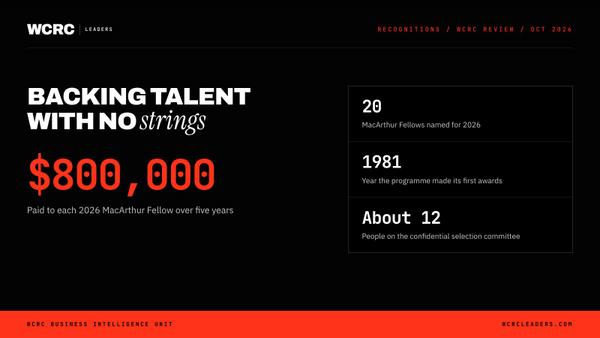
No strings attached: what the MacArthur model teaches about recognising talent
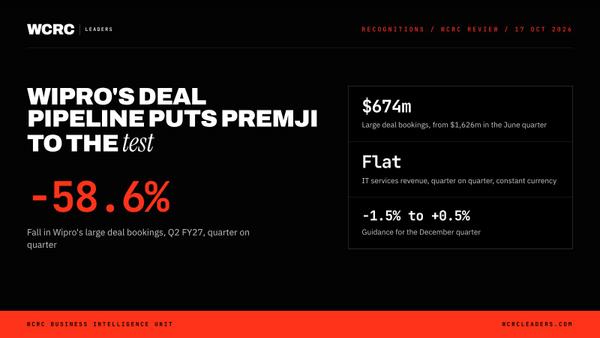
Wipro's 58.6% large-deal drop puts Rishad Premji to the test
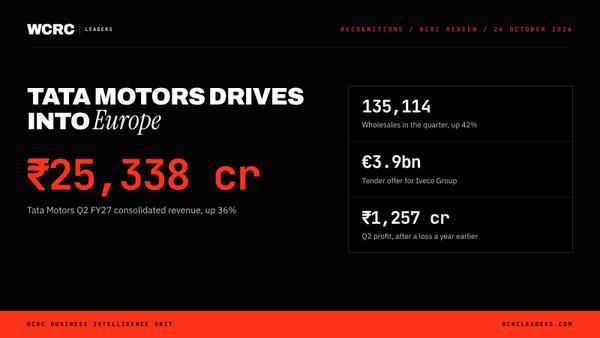
Tata Motors posts 42% volume jump as its €3.9bn Iveco bid nears close

The 'alternative Nobel' goes to an AI accountability pioneer
Filed under