Recognitions
Wipro's 58.6% large-deal drop puts Rishad Premji to the test
Wipro held its margin and its cash in the September quarter, but its biggest contracts dried up. For Executive Chairman Rishad Premji and CEO Srini Pallia, the question is now whether the AI bet can turn into bookings before the core business shrinks.
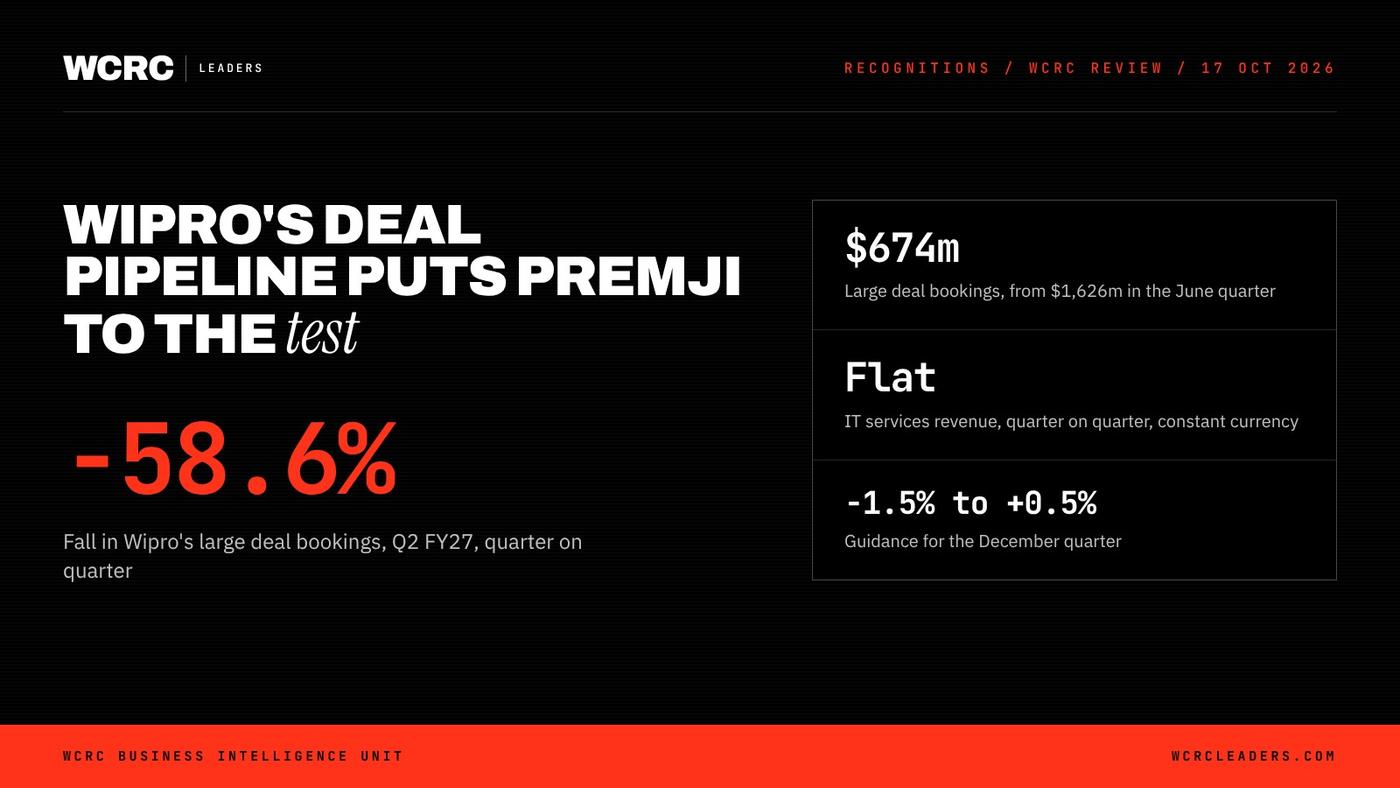
At a glance: WCRC Leaders' assessment: Wipro has fixed its costs faster than its growth, and the next two quarters of large deals, not margins, will decide whether its AI strategy is working. On 15 October 2026 Wipro reported IT services revenue flat quarter on quarter in constant currency and large deal bookings of $674m, down 58.6%. It guided to between -1.5% and +0.5% for the December quarter. Peers TCS and HCLTech grew faster and booked more.
What did Wipro actually report?
Wipro's gross revenue for the quarter ended 30 September 2026 was ₹247.5bn, up 9.1% year on year. That headline flatters the business. In dollars, IT services revenue was $2,611.5m, down 0.1% sequentially and up 0.3% year on year. In constant currency, the measure Wipro guides on, it was flat quarter on quarter and up 0.6% year on year.
Net income was ₹32.0bn, down 4.7% on the quarter and 1.9% on the year. Earnings per share rose 4.2% year on year to ₹3.23.
The better news sat lower in the table. The IT services operating margin rose to 16.5%, from 16.0% in the June quarter. Operating cash flow was ₹53.0bn, or 165.8% of net income. Voluntary attrition was 13.8% on a trailing twelve-month basis.
The weak number was bookings. Large deal bookings fell to $674m, down 58.6% quarter on quarter in constant currency. Total bookings were $2,595m, down 22.9%. In the June quarter, Wipro had booked $1,626m in large deals.
For the quarter to December, Wipro guided IT services revenue of $2,571m to $2,625m, a sequential change of -1.5% to +0.5% in constant currency. That is the same range it gave three months ago.
CEO and Managing Director Srini Pallia said in the release: "The strategic investments we have been making are beginning to deliver results."
Why are large deals falling?
One quarter of bookings is a noisy measure. Large contracts land unevenly, and a strong June quarter makes September look worse. Still, the drop matters because it feeds revenue for the next two to three years.
WCRC analysis: the pattern fits a wider change in how clients buy IT services. Enterprises are asking suppliers to pass on the productivity gains from generative and agentic AI. Contracts priced on headcount are being rewritten around outcomes and smaller teams, so a supplier can keep the client and still book less.
That shift favours firms that own platforms or price on results. Wipro's release lists twelve client wins, many built on its Wipro Intelligence platforms, including a lending platform for a large US bank, an AI global capability centre for a Fortune 500 Asian conglomerate, and a procurement and finance overhaul for a Middle East energy company. It gave no values for any of them.
How does Wipro compare with TCS, Infosys and HCLTech?
TCS reported revenue of ₹73,188 crore, or $7,642m, for the same quarter. In constant currency it grew 0.5% sequentially and 2.8% year on year, with an operating margin of 24% and total contract value of $9.6bn. TCS said annualised AI revenue had reached $3.1bn, more than 10% of its total.
HCLTech, reporting on 12 October, posted revenue of $3.7bn, up 2.6% year on year in constant currency, an EBIT margin of 18.2% and new bookings of $3.3bn, up 27% year on year. It reported advanced AI revenue of $219m for the quarter, an annualised run rate of $876m. It now guides full-year growth of 2.5% to 4% in constant currency.
Infosys reports its September quarter on 23 October. In the June quarter it grew 1.0% sequentially in constant currency, booked $3.6bn in large deals and guided full-year growth of 1.5% to 3.0%.
Wipro's large-deal haul was about a fifth of HCLTech's new bookings, and its margin trails both rivals. Nor does Wipro disclose an AI revenue figure, so investors cannot test its claims against the numbers peers now publish.
What has Wipro already done on AI?
On 1 April 2026 Wipro created an AI-Native Business & Platforms Unit under Nagendra Bandaru, who reports to Pallia. The unit owns and scales Wipro Intelligence's platform assets, from the NetOxygen lending platform to the WINGS and WEGA delivery platforms, and uses forward-deployed engineers. Pallia said at the time the move "sharpens Wipro Intelligence's ability to deliver tangible value to clients".
In June, Wipro opened an Applied AI Center of Excellence in Bengaluru for Anthropic's Claude models, with a plan to certify 10,000 front-line delivery staff over 18 months and to use the models in its own finance, HR and sales functions.
WCRC analysis: the architecture is sensible; the issue is timing. Platform deals tend to start small and fast, and do not yet fill the gap when large contracts fail to close.
What is the leadership test for Premji and Pallia?
Rishad Premji was selected among Asia's Top 100 Emerging Leaders 2026 by the Business Intelligence Unit of WCRC, and Wipro was selected among India's Most Loved 250 Workplaces 2026 by the same unit. Those selections reflect leadership and workplace qualities. They are not an endorsement of any quarter's results, and this review treats the numbers on their own terms.
Premji, as executive chairman, owns capital allocation and the long view. Pallia, as chief executive, owns execution and the order book. This quarter tests both.
WCRC analysis: four things now matter.
Rebuild the large-deal pipeline around outcomes. Wipro needs deals that are priced on results and bundled with its platforms, so that AI efficiency shows up as Wipro margin rather than as a client discount.
Publish an AI number. TCS and HCLTech now disclose AI revenue. Wipro's silence invites the market to assume the worst.
Use the cash. Operating cash flow at 166% of net income gives Premji room. Whether it goes to buybacks or to acquisitions of platform assets is the chairman's call; the next move should buy growth.
Protect the people while the model changes. Retraining delivery teams for AI-led work, rather than cutting first, is both the cultural test and the commercial one. Attrition at 13.8% leaves little margin for a misstep.
What does this mean for leaders in India, the Gulf and Asia?
WCRC analysis: for Indian boards, Wipro's quarter suggests AI price pressure in services is reaching the order book. Buyers of IT services should expect to renegotiate, and sellers should expect to be asked. For more on the jobs side of this shift, see WCRC's analysis of India's two-speed job market.
In the Gulf, Wipro's new procurement and finance contract with a Middle East energy company shows where demand is moving: national champions want AI-run back offices, often with global capability centres attached. Asian conglomerates are doing the same, as the AI centre win shows.
For incumbents everywhere, the lesson echoes WCRC's earlier work on the growth gap between AI-native and AI-retrofit firms. WCRC has also traced Wipro's longer reinvention.
The WCRC View
Wipro has done the defensive work well. Margins are up, cash is strong and the AI unit has a named leader. What it has not yet done is turn that work into growth. A flat quarter is survivable. A second weak quarter of large deals would be a pattern.
Who gains: TCS and HCLTech, which are booking more and disclosing AI revenue, and clients, who now have the leverage to demand outcome-based pricing. Who loses, if the trend holds: suppliers still selling capacity by the head.
What leaders should do now: CEOs buying IT services should reopen contracts that do not pass AI gains back to them. Boards of services firms should ask management for a separate AI revenue line and a bookings mix that shows how much is priced on outcomes.
For Premji and Pallia, the test is specific. Large deal bookings need to recover towards the June quarter's $1.6bn level, and Wipro should begin to report its AI revenue.
WCRC will watch three things next: Infosys's results on 23 October as a read on the sector, Wipro's December-quarter large deal bookings in January, and whether the AI-Native unit begins to report its own revenue.
Quick answers
Q: What was Wipro's revenue in Q2 FY27? A: Gross revenue was ₹247.5bn, up 9.1% year on year. IT services revenue was flat quarter on quarter and up 0.6% year on year in constant currency.
Q: How much did Wipro's large deal bookings fall? A: Large deal bookings were $674m, down 58.6% quarter on quarter in constant currency, from $1,626m in the June quarter.
Q: What is Wipro's guidance for Q3 FY27? A: IT services revenue of $2,571m to $2,625m, a sequential change of -1.5% to +0.5% in constant currency.
Q: What is Rishad Premji's WCRC record? A: He was selected among Asia's Top 100 Emerging Leaders 2026 by the Business Intelligence Unit of WCRC, and Wipro was selected among India's Most Loved 250 Workplaces 2026.
Filed under