Recognitions
Tata Consumer's 38% bet: growth brands now outrun tea and salt
Six years after it was formed from a tea company and a salt business, Tata Consumer Products earns more than a third of its India business from newer brands. The September quarter shows the strategy working, and shows where it still is not.
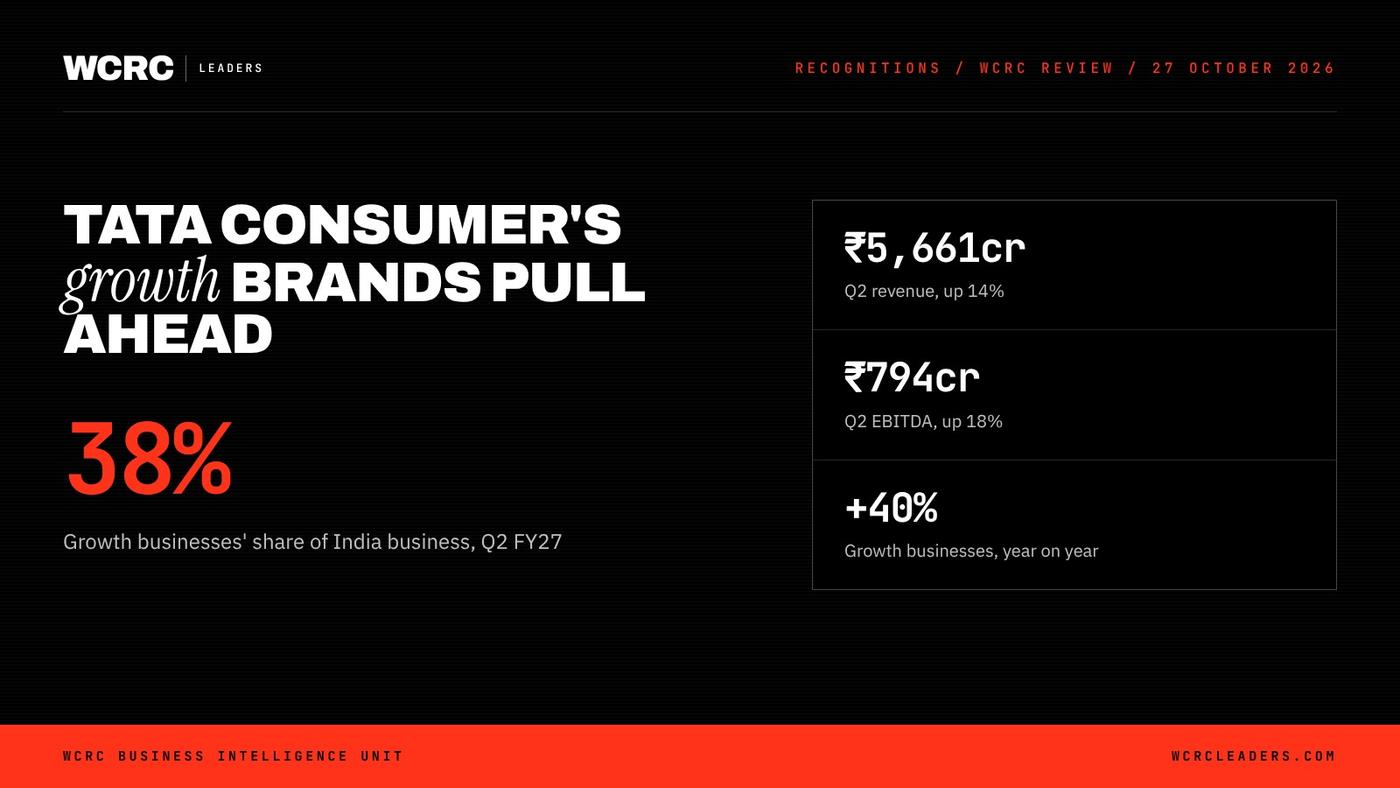
At a glance: WCRC Leaders' assessment: Tata Consumer has proved that an Indian heritage group can buy and build its way into growth categories, but its next test is making the newest acquisitions and its overseas tea business grow as reliably as Sampann and Starbucks. On 26 October 2026 the company reported revenue of ₹5,661 crore, up 14%, and EBITDA of ₹794 crore, up 18%, for the quarter to 30 September. Growth businesses rose 40% and are now 38% of the India business.
What did Tata Consumer report for the September quarter?
Tata Consumer Products, one of WCRC 1000, India's Most Valuable Enterprises 2026, reported consolidated revenue from operations of ₹5,661 crore for the second quarter of FY27, up 14% on a year earlier. EBITDA rose 18% to ₹794 crore, a margin of about 14% on WCRC's calculation, and group net profit rose 16% to ₹470 crore.
Volumes did the heavy lifting. The India branded business delivered underlying volume growth of 11%, led by salt, where revenue rose 15%. The company launched 22 new products in the quarter.
Sunil D'Souza, Managing Director and CEO, said in the results release: "This volume-led performance, together with disciplined execution, drove 18% EBITDA growth." He added that the company had delivered "our second consecutive quarter of double digit revenue growth in FY27". In the first quarter, revenue had grown 12% to ₹5,349 crore.
The headline number for brand watchers is the mix. "Growth businesses grew 40% and now account for 38% of the India business," D'Souza said. Tata Sampann revenue rose 57% and ready-to-drink beverages rose 47%.
How did a tea-and-salt company become a portfolio of growth brands?
Tata Consumer Products was formed in 2020 by merging the consumer products business of Tata Chemicals, one of WCRC 1000, India's Most Valuable Enterprises 2026, with Tata Global Beverages. That put Tata Salt alongside Tata Tea, a WCRC MegaBrand in tea, and Tetley, which Tata Tea had acquired in 2000. D'Souza took charge as Managing Director and CEO on 4 April 2020.
The inheritance was strong but slow. Tea and salt are large, household-penetrated categories where growth tracks population and price more than ambition. The company's answer was a steady run of category entries, some built and some bought:
- Tata Sampann, the in-house pulses, spices and staples brand, scaled on the Tata name and the salt distribution network.
- Soulfull, bought with the acquisition of Kottaram Agro Foods, announced on 2 February 2021, added millet-based cereals, snacks and mini meals.
- Capital Foods, owner of Ching's Secret and Smith & Jones, was announced on 12 January 2024, with 75% acquired upfront and the rest within three years. It brought Indian-Chinese sauces, noodles and condiments.
- Organic India, announced the same day, added organic "better for you" food, beverages and nutraceuticals.
- Tata Starbucks, the joint venture formed in 2012, gave the group a premium out-of-home coffee brand.
The company's own disclosures chart the result. Growth businesses were 8% of the India business in FY21, 15% in FY23, 28% in FY25 and 31% in FY26, according to its first-quarter FY27 investor presentation. They reached 36% in the June quarter and 38% in September.
Which brand bets are working?
Sampann is the standout. Revenue grew 58% in the first quarter and 57% in the second, rare consistency for a brand of its size. Its logic is simple: staples are bought weekly, branding is still thin in pulses and spices, and Tata already reaches the kirana shelf through salt.
Starbucks, a WCRC MegaBrand in coffee chains, is back in form in India. Tata Starbucks revenue rose 15%, which the release called a multi-quarter high, driven by same-store sales. D'Souza said the joint venture "recorded its fifth consecutive quarter of positive same-store sales growth." The chain ended the quarter with 505 stores in 81 cities after seven net new openings, up from 498 at the end of June. Starbucks is also among the world brands named in India's Most Powerful Brands 2026 by WCRC.
Ready-to-drink, up 47%, shows that the company can make its beverage know-how pay outside the teacup.
What is not working yet?
Tea in India. Volumes were flat and revenue declined marginally. In the first quarter, volumes grew 2% but revenue fell 4% as lower tea costs were passed on to consumers. Tea remains the core profit engine, and for now it is a cash generator rather than a growth one.
International. Revenue rose 7% in rupees but fell 2% in constant currency, against a high base. The company said a UK heatwave hurt category consumption, although Tetley outperformed the category. In the first quarter, international revenue grew 3% in constant currency, with the US up 7%, the UK down 2% and Canada flat.
The 2024 acquisitions are slowing. Capital Foods and Organic India together grew 15%, with domestic revenue up 24%, as exports were hit by shipping disruption. In the June quarter, Capital Foods had grown 40% to ₹232 crore and Organic India 27% to ₹118 crore. WCRC analysis: a single quarter of export disruption does not break the thesis, but these were the most expensive bets in the portfolio, and investors will want domestic growth to stay well above 20% to justify them.
What can leaders learn from the Tata Consumer playbook?
WCRC analysis: four lessons stand out for CEOs and boards in India, the Gulf and Asia.
First, use the core to fund and carry the new. Salt and tea gave Sampann both a trusted name and a distribution route. Many conglomerates in the Gulf and South-East Asia hold similar legacy consumer franchises that could carry adjacent brands far more cheaply than a start-up can.
Second, buy brands that fill a clear gap, then measure them in public. Soulfull filled millets and breakfast, Ching's filled sauces and noodles, Organic India filled wellness. Reporting growth businesses as a share of the India business, quarter after quarter, holds management to account.
Third, innovation needs a metric. Launches matter only if they sell. The first-quarter presentation put Sampann's innovation-to-sales ratio at 8%, which is the kind of number boards should ask for.
Fourth, the old core still sets the floor. A flat tea quarter and a soft UK market can absorb much of the gain from faster brands. Portfolio change is a long project, not a single deal.
People matter too. Tata Consumer Products is selected among the FMCG sector's Most Loved Workplaces 2026 by the Business Intelligence Unit of WCRC, and was named among India's Most Loved 250 Workplaces 2026 by WCRC. WCRC's FMCG workplaces report sets out how the sector's employers compare.
The quarter also sits within a busy Tata group results season. WCRC recently reviewed Tata Motors' 42% volume jump and its Iveco bid, and the cost of competing in fast new channels such as quick commerce, seen in Swiggy's ₹895 crore Instamart loss, a channel that matters to every packaged-food brand.
The WCRC View
The call: Tata Consumer has done the hard part. It has turned a slow-growth tea and salt company into a portfolio where 38% of the India business grows at about 40% a year. That is a structural change, not a cyclical one.
Who gains: Sampann, ready-to-drink and Tata Starbucks are the clear winners, and with them the distributors and modern channels that carry them. The kirana network built for salt is the hidden asset.
The risk: Tea at home and tea abroad are not growing, and the 2024 acquisitions have slowed from 40% and 27% in the June quarter to a combined 15%. If both trends persist, the group's overall growth will drift back towards single digits.
What leaders should do now: Boards running heritage consumer groups in India, the Gulf and Asia should set a public target for the share of revenue from growth brands, track it every quarter, and judge acquisitions by domestic growth after the second year, not by the headline at signing.
What WCRC will watch next: whether Capital Foods and Organic India exports recover once shipping normalises; whether India tea volumes return to growth; whether Tata Starbucks extends its same-store sales run into a sixth quarter; and whether growth businesses pass 40% of the India business in the second half of FY27.
Quick answers
Q: What were Tata Consumer Products' Q2 FY27 results? A: Revenue from operations rose 14% to ₹5,661 crore, EBITDA rose 18% to ₹794 crore and group net profit rose 16% to ₹470 crore for the quarter to 30 September 2026.
Q: What are Tata Consumer's growth businesses? A: They include Tata Sampann, Tata Soulfull, ready-to-drink beverages, Capital Foods (Ching's Secret and Smith & Jones) and Organic India. They grew 40% in the quarter and made up 38% of the India business.
Q: How is Tata Starbucks performing? A: Revenue rose 15%, with a fifth consecutive quarter of positive same-store sales growth. It had 505 stores in 81 cities at the end of September 2026.
Q: Which parts of Tata Consumer are weak? A: India tea volumes were flat and revenue dipped marginally. International revenue fell 2% in constant currency, and exports from Capital Foods and Organic India were hit by shipping disruption.

No strings attached: what the MacArthur model teaches about recognising talent

Wipro's 58.6% large-deal drop puts Rishad Premji to the test

Tata Motors posts 42% volume jump as its €3.9bn Iveco bid nears close

The 'alternative Nobel' goes to an AI accountability pioneer

What makes a business recognition credible

Navi Pillay and leadership through institutions
Filed under