WCRC Intelligence
FDI jumps 37% but new projects fall 15%: the factory gap for Asia
Global investment is rising on paper, but fewer companies are committing to new plants. UNCTAD's latest monitor shows the money moving through financial hubs and mergers, while the greenfield pipeline that India and ASEAN depend on is thinning.
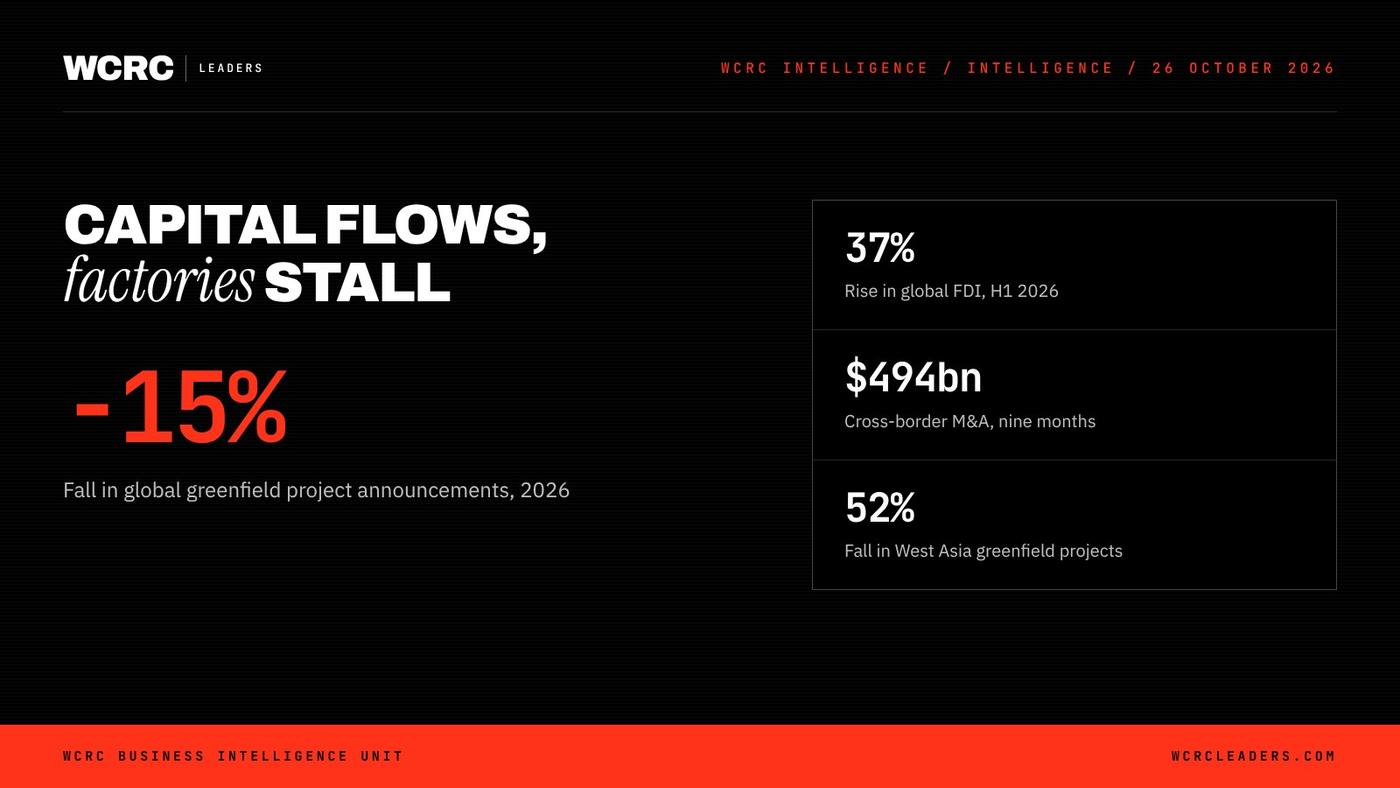
At a glance: WCRC Leaders' assessment: the 2026 investment rebound is a capital story, not a capacity story, and the countries that win the next round of factories will be those that cut the cost and risk of building, not those that post the biggest inflow numbers. UNCTAD's Global Investment Trends Monitor No. 51, published on 25 October 2026, finds global FDI up 37% in the first half against the 2025 half-year average, while greenfield project announcements fell 15% and international project finance deals fell 11%. For boards planning capacity in India and Asia, the gap matters more than the headline.
What did UNCTAD actually find?
The headline is strong. Global FDI reached $1,082bn in the first half of 2026, 37% above the average half-year level of 2025. But the gain is lopsided. Flows to developed economies rose 74% to $596bn, which UNCTAD attributes largely to financial flows through Belgium, the Netherlands and Luxembourg and a near doubling of inflows to the United States. Developing economies rose 8% to $486bn, with every developing region recording an increase.
Mergers did much of the lifting. Cross-border M&A values rose 57% to $494bn in the first nine months of the year, yet the number of deals fell 23%. Fewer, larger transactions are inflating the value line. In developing economies, M&A sales rose more than fivefold to $70bn, driven by a handful of large deals.
The real economy tells a different story. Greenfield project announcements fell 15% and international project finance deals fell 11%. In developing economies, greenfield announcements dropped by more than a fifth. Manufacturing project numbers fell 5% worldwide and 10% in developing economies. Renewable energy project finance in developing economies fell by about a third and announced greenfield data-centre investment there fell by $32bn.
The one bright spot in manufacturing is chips. UNCTAD reports that the value of projects in global value chain-intensive manufacturing rose 27%, driven by semiconductors, where project numbers rose 15%. AI-related sectors accounted for more than 40% of announced US greenfield value, with TSMC's announced $76.5bn US expansion among the examples. In Asia, the largest chip project UNCTAD lists is a $24bn semiconductor investment by Micron Technology in Singapore (its Indian arm, Micron India, is a WCRC MegaBrand in semiconductor design and fabrication).
How is Asia faring?
Asia remains the largest recipient region, and its flows are still rising. UNCTAD's figures show FDI into Asia of $344bn in the first half, up 7%. East Asia rose 15% to $137bn, South-East Asia 9% to $134bn and South Asia 31% to $31bn.
The project pipeline is weaker. On UNCTAD's annualised count, greenfield announcements across Asia fell 27%. South-East Asia fell 6% and South Asia 11%, while East Asia was up 3%. International project finance deals in South-East Asia fell 22%, and Viet Nam was among the countries with the largest falls in project numbers. South Asia went the other way, with project finance deals up 27%, and UNCTAD names India and Indonesia among the economies where project numbers rose.
The monitor does not break out China. The fuller picture sits in UNCTAD's World Investment Report 2026, published in July. It put China's FDI inflows at $104.7bn in 2025, down 10% and well below the $189bn of 2022. Announced greenfield investment into China fell 43% to $23.9bn, while greenfield investment announced by Chinese companies abroad rose 57% to $131.9bn. Chinese companies are building outside China, and ASEAN and India are competing to capture that wave, as WCRC's reading of China's export-led third quarter suggests.
In the Gulf, which a separate WCRC story covers today, UNCTAD records a 52% fall in West Asia's greenfield announcements and a halving of GCC investors' outward project finance in the second quarter, although the largest India project in its table, an $11.5bn metals investment, comes from a UAE-based investor.
What do India's own numbers show?
The DPIIT fact sheet for 2025-26, based on Reserve Bank of India data, records FDI equity inflows of $58.85bn, up 18%, and total FDI inflows, including reinvested earnings and other capital, of $94.53bn, up 17%. Singapore ($19.8bn) and the United States ($11.2bn) were the largest sources. Computer software and hardware took $13.9bn, or 24% of equity inflows, and services another $10.0bn, or 17%. Trading added 7%. The largest manufacturing-linked category in the top five was food processing at $3.0bn.
The RBI's own measure is less flattering. Its bulletin shows gross FDI inflows of $94.8bn in 2025-26, but repatriation and disinvestment of $54.0bn and outward investment by Indian companies of $33.8bn left net FDI at $6.9bn.
In April to June 2026, RBI data show gross inflows of $30.7bn, up 14.8% on a year earlier, and net FDI of $7.8bn against $4.8bn. Complete figures for the first half of 2026-27, April to September, have not yet been published by DPIIT or the RBI.
UNCTAD's longer view is supportive. Its World Investment Report put India's 2025 inflows at $38.9bn on its own measure, up 44%, and named India as the main driver of growth across South Asia.
Why are factories not following the money?
UNCTAD names the headwinds: geopolitical tension, rising borrowing costs, energy-price pressure and multinationals' supply chain de-risking. It expects conditions to "remain challenging throughout the remainder of 2026."
Analysis: these forces affect M&A and greenfield very differently. A cross-border acquisition buys existing capacity, revenue and people, with a known price. A new plant is a five-to-ten-year bet on tariffs, energy costs, interest rates and demand, all of which are moving at once. When uncertainty is high, buying is cheaper than building. The IMF's latest outlook, which WCRC examined in what boards should plan for in 2027, points to modest global growth and firmer inflation, which keeps that calculation in place.
India's rising project finance count and services-heavy FDI mix fit this pattern: capital favours software, services and infrastructure with contracted returns.
What does this mean for India's manufacturing push and for ASEAN?
Analysis: the competition is no longer for capital in general but for a shrinking set of factory decisions. Each greenfield project now has more countries chasing it, and the chip and electronics projects that are growing are highly concentrated by company and location.
India has real advantages. Inflows are rising, project finance is up, and electronics exports are growing quickly, as WCRC's review of India's $476bn export half-year showed. But a services-heavy FDI mix and modest net FDI mean India cannot assume the global rebound will translate into plants without effort on land, power, approvals and component ecosystems.
ASEAN faces a split. Singapore continues to draw high-value semiconductor projects, while Viet Nam's falling project numbers show that even the most successful China-plus-one destinations are not immune to a broad pause in new manufacturing commitments.
The WCRC View
The WCRC Business Intelligence Unit's call is that the 2026 rebound flatters the headline and hides the real signal for Asia's industrial planners. Money is moving, but it is moving through balance sheets, holding structures and large acquisitions. Factories, the investment that creates jobs, supplier networks and export capacity, are being committed more slowly.
Who gains: acquirers with strong balance sheets, financial hubs, and the few locations that win large semiconductor and AI projects. Who loses: developing economies that rely on a steady flow of mid-sized greenfield plants, and renewable energy developers who need project finance.
What leaders should do now: CEOs planning greenfield capacity in India or ASEAN should assume fewer competitors are building today, which can mean better terms on land, incentives and equipment for those who move. Boards should test whether a brownfield acquisition or a phased build with smaller first modules delivers the same market access at lower risk. Indian companies should treat the services-heavy FDI mix as a prompt to pursue foreign partners for manufacturing joint ventures, where state and central incentives can close the cost gap.
For policymakers, the lesson is that headline inflows are the wrong scorecard. Greenfield project counts, manufacturing commitments and net FDI are the numbers that show whether capacity is being built.
What WCRC will watch next: DPIIT's fact sheet for the July to September quarter, the RBI's monthly FDI data for the first half of 2026-27, UNCTAD's next Global Investment Trends Monitor for the full-year picture, and whether South Asia's rise in project finance turns into factory announcements.
Quick answers
Q: How much did global FDI rise in the first half of 2026? A: UNCTAD reports a 37% rise to $1,082bn against the 2025 half-year average, with developed economies up 74% and developing economies up 8%.
Q: Why does UNCTAD say new projects are declining? A: Greenfield project announcements fell 15% and international project finance deals fell 11%, while cross-border M&A values rose 57% to $494bn on 23% fewer deals.
Q: What were India's FDI inflows in 2025-26? A: DPIIT records FDI equity inflows of $58.85bn, up 18%, and total inflows of $94.53bn, up 17%. RBI data put net FDI at $6.9bn after repatriation and outward investment.
Q: How did Asia perform in UNCTAD's latest monitor? A: FDI into Asia rose 7% to $344bn in the first half, with South Asia up 31%, but greenfield announcements across Asia fell 27% on an annualised basis.
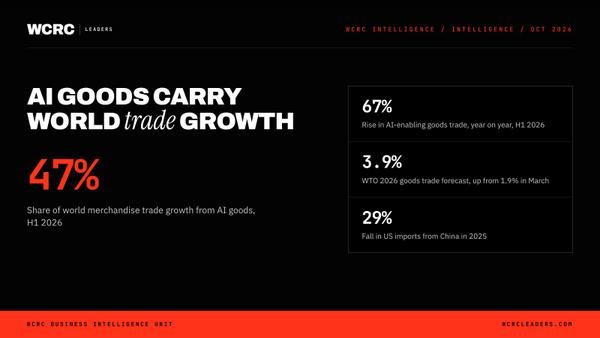
The AI trade economy: chips and servers now carry almost half of world trade growth
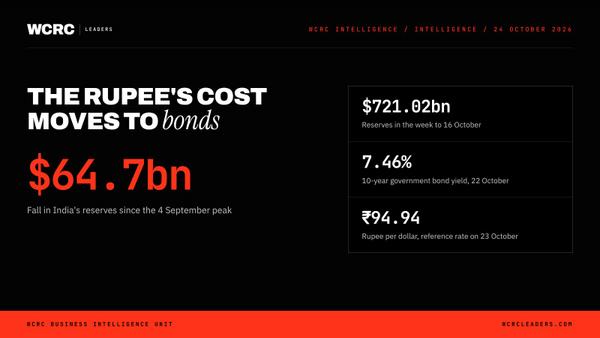
India's 10-year yield hits 7.46% as reserves fall $64.7bn from peak
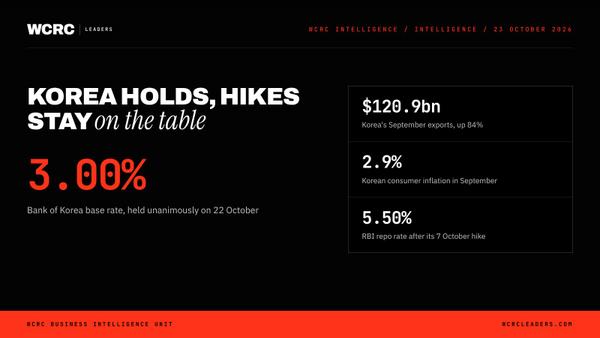
Bank of Korea holds at 3.00% and keeps more hikes on the table
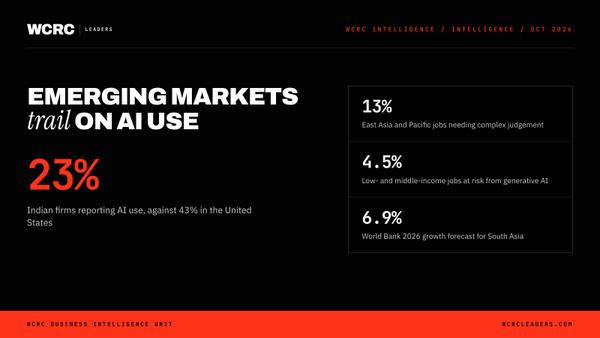
The AI adoption gap: what the World Bank's new numbers say about emerging markets
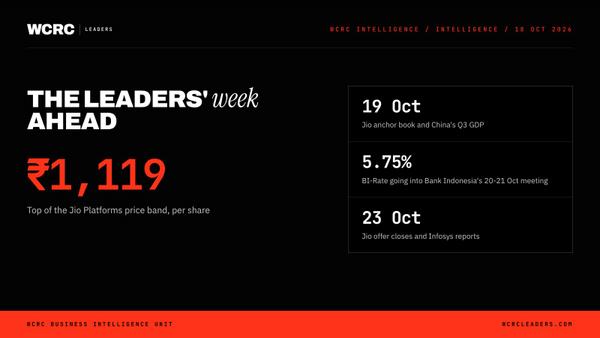
Jio's IPO, China's GDP: the leaders' week ahead, 19 to 25 October
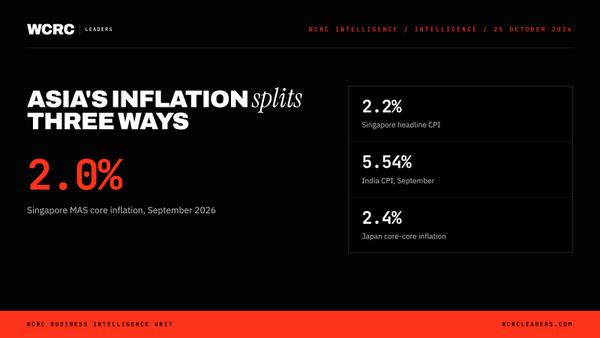
Singapore's core inflation cools to 2.0% as India and Japan heat up
Filed under