Business
IMF sees 3.4% world growth in 2027: what boards should plan for
The IMF's October 2026 World Economic Outlook describes a world economy that is still growing but leaning on shrinking buffers. For leaders in India, the Gulf and Asia, the forecast for 2027 depends on one shipping lane, one technology cycle and the bond market.
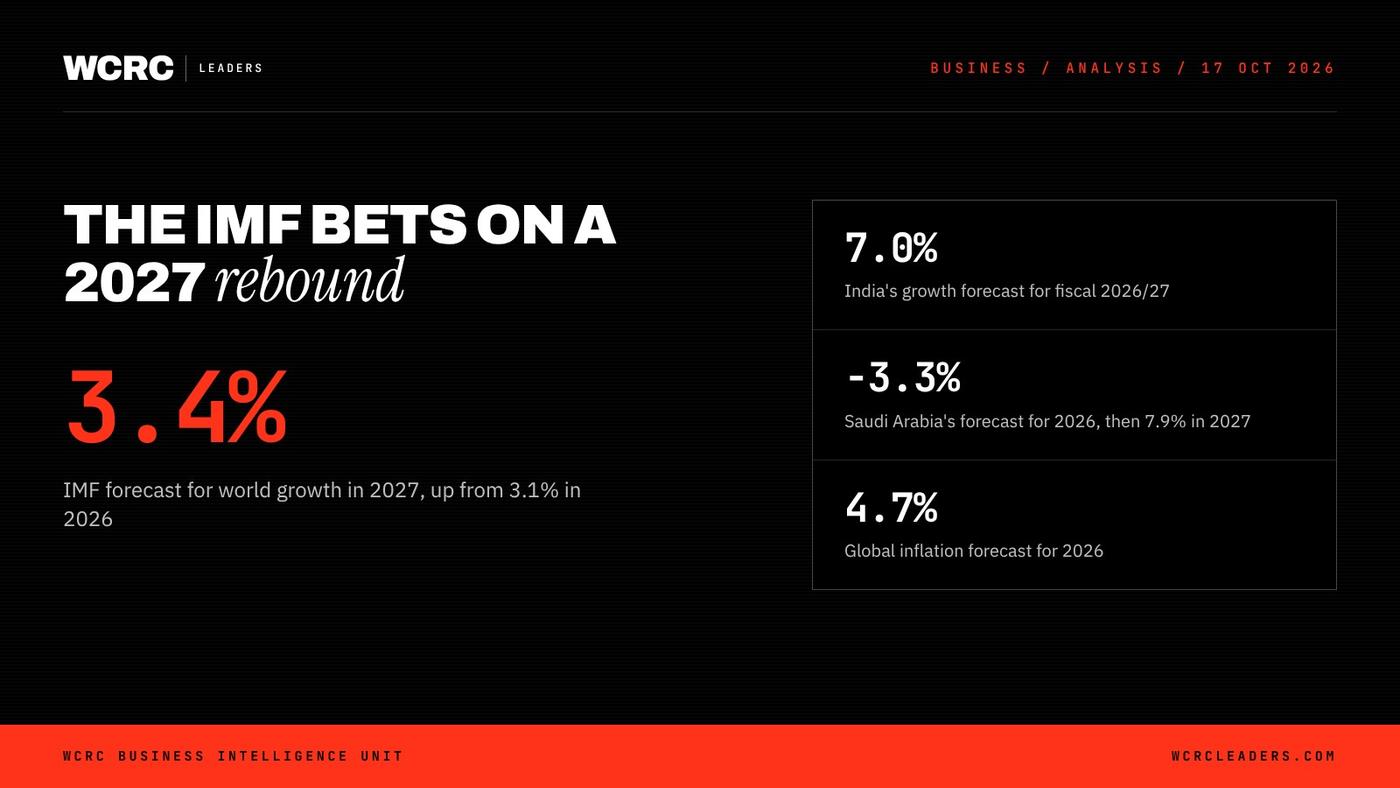
At a glance: WCRC Leaders' assessment: the IMF's 2027 rebound is a forecast built on assumptions, chiefly a reopened Strait of Hormuz and a durable AI investment cycle, and boards should budget for the base case while stress-testing both. The International Monetary Fund published its World Economic Outlook, titled "Resilience Under Strain, Urgent Choices", on 13 October 2026 at the IMF-World Bank Annual Meetings in Bangkok. It projects global growth of 3.1% in 2026 and 3.4% in 2027, with inflation at 4.7% this year.
What does the IMF forecast for the world economy in 2026 and 2027?
The IMF projects world output growth of 3.1% in 2026, down from 3.5% in 2025, rising to 3.4% in 2027.
Advanced economies are projected to grow 2.1% in 2026 and 1.8% in 2027, with the United States at 2.3% in both years and the euro area at 1.1% and 1.2%. Emerging market and developing economies slow to 3.7% in 2026, from 4.5% in 2025, before recovering to 4.4% in 2027.
Inflation has stopped falling. The report says global inflation "is expected to pause its steady decline, primarily because of the war-induced negative supply shock". Headline consumer prices are projected to rise from 4.1% in 2025 to 4.7% in 2026, then ease back to 4.1% in 2027. The IMF's oil price assumption, based on futures markets, is $95.74 a barrel for 2026 and $87.39 for 2027, after a projected 41.3% jump in oil prices this year.
World trade volume is projected to grow 4.6% in 2026 and 4.7% in 2027, revised up from July on "continued strength in technology-related trade".
Deniz Igan, Division Chief in the IMF Research Department, summed up the picture at the launch: "The global economy continues to prove resilient, but this resilience is becoming increasingly uneven."
What does the IMF forecast for India in 2027?
The IMF says India "remains among the fastest-growing major economies". The Fund projects growth of 7.0% for fiscal year 2026/27 and 7.0% for 2027/28. On a calendar-year basis, the figures are 7.4% for 2026 and 7.0% for 2027.
The direction of travel is upward. The fiscal 2026/27 forecast is 0.6 percentage points higher than in the IMF's July update and 0.5 points above April. The report attributes this to "stronger-than-expected momentum, supported by resilient domestic demand" and strong services activity, and notes that growth has held up "despite higher oil prices". India grew 7.8% in fiscal 2025/26, the IMF estimates.
Money is tighter at home: the Reserve Bank of India has raised rates for the first time since 2023, as WCRC examined in what it means for capex and the festive season.
What does the IMF forecast for Saudi Arabia and the Gulf?
Here the October outlook departs most sharply from earlier editions. The IMF projects the Middle East and Central Asia region to contract by 0.3% in 2026 before rebounding to 6.3% growth in 2027. The 2026 figure is 2.2 points below the April forecast, a revision the report describes as consistent with a longer closure of the Strait of Hormuz than it had assumed in April.
Saudi Arabia is projected to contract by 3.3% in 2026, after growth of 4.6% in 2025, and then grow 7.9% in 2027. The report says the Kingdom "is somewhat less affected, as an economy with more diversified export routes". Bahrain, Iraq, Kuwait and Qatar, which it describes as the producers most affected by disruptions to energy output and transport, are projected to suffer double-digit contractions in 2026.
The IMF's baseline assumes the Strait of Hormuz reopens from March 2027, with "a return to prewar conditions broadly by October 2027". The chapter text does not set out a separate headline figure for the United Arab Emirates.
Jihad Azour, Director of the IMF's Middle East and Central Asia Department, told a briefing in Bangkok on 15 October: "The war in the Middle East is imposing a highly uneven shock to the economies of the region." He added: "The most important risk is a more prolonged conflict."
WCRC's coverage of the UAE-Saudi rail and grid pact reads differently now that export routes separate a mild downturn from a severe one.
What does the IMF forecast for China and ASEAN?
China's growth is projected to slow to 4.5% in 2026, from 5.0% in 2025, and to 4.0% in 2027. The IMF says higher global oil prices, "together with protracted uncertainty and structural headwinds, are expected to weigh on activity", while policy support should prevent a sharper slowdown.
Emerging and developing Asia as a whole is projected to grow 5.1% in 2026 and 4.9% in 2027, both revised up slightly from July. The ASEAN-5 group is projected at 4.4% in 2026, up 0.3 points from July, and 4.3% in 2027. The report says several Southeast Asian economies "are projected to benefit from data center activity and the upturn in the global technology cycle", in some cases supported by emergency fiscal measures.
WCRC has examined how chips and servers now carry almost half of world trade growth; the IMF's numbers show the same dependency in national output.
What risks does the IMF name?
The report states that "risks are skewed to the downside". It names five.
- The Middle East conflict. A prolonged stalemate or escalation could keep energy and food prices high and volatile, revive inflation and weaken fiscal and external balances. The report warns that depleted energy inventories raise the risk of sudden, nonlinear price jumps.
- Shrinking buffers. "The margins of adjustment that made global economy resilient to the negative shocks are rapidly narrowing," Ms Igan said.
- Rising bond yields. The report notes that advanced-economy benchmark rates "have climbed to multidecade highs, pushing up borrowing costs also for emerging markets."
- Trade tensions. The executive summary warns that "renewed trade tensions could further weaken growth."
- AI, in both directions. "A reassessment of AI-related profitability and productivity prospects could sharply reduce investment," tightening financial conditions and hitting economies tied to technology supply chains. Yet the IMF also lists an upside: AI investment "could prove more persistent, productivity gains could materialize faster than assumed." WCRC has asked whether AI spending is outrunning AI revenue; the IMF now treats that question as a macroeconomic risk.
On policy, the Fund's advice is blunt. Monetary policy "should remain firmly focused on price stability", and Ms Igan said countries "need to rebuild fiscal space without further delay, given high debt levels and rising borrowing costs."
What should boards plan for in 2027?
This section is WCRC analysis.
On paper, 2027 is a recovery year: faster growth, lower inflation, cheaper oil and a Gulf rebound. Each depends on assumptions boards cannot control.
First, plan on two oil prices. The IMF's $87 assumption is the base case; a second scenario, with the strait closed longer and prices near this year's levels, belongs in every budget for energy-intensive or import-reliant businesses.
Second, assume capital costs more. High advanced-economy yields feed into emerging-market borrowing, so 2027 refinancing deserves board time now.
Third, know which revenue lines depend on continued data centre spending. They gain most in the upside case and lose most in a correction.
The WCRC View
From the WCRC Business Intelligence Unit.
This is a resilience story, and the IMF itself says that resilience is under strain. The 3.4% global figure for 2027 is plausible, but it is conditional on a reopened Strait of Hormuz from March 2027 and an AI investment cycle that keeps paying.
Who gains. India is the clearest winner in the IMF's tables, with 7% growth and a 0.6-point upgrade since July. Saudi Arabia is better placed than its Gulf neighbours because of its diversified export routes. ASEAN economies tied to data centres gain while the technology cycle holds.
Who is exposed. Gulf economies without alternative export routes, oil importers if the conflict drags on, and any economy whose growth leans heavily on AI hardware demand.
What leaders should do now. Build 2027 plans on the IMF base case, but approve them only with a stress test for a longer conflict and an AI correction. Lock in financing where terms allow, and review supply chains for single points of failure in shipping.
What WCRC will watch next. The pace of Strait of Hormuz reopening against the IMF's March 2027 assumption, the RBI's next policy moves, sovereign bond yields in the United States and Europe, and the IMF's January 2027 update, which will show whether this rebound is holding.
Quick answers
Q: What is the IMF's global growth forecast for 2027? A: 3.4%, up from 3.1% in 2026.
Q: What does the IMF forecast for India? A: 7.0% growth in fiscal 2026/27 and 7.0% in 2027/28. On a calendar-year basis, 7.4% in 2026 and 7.0% in 2027.
Q: Why does the IMF expect Saudi Arabia to contract in 2026? A: The Middle East war and a longer closure of the Strait of Hormuz. The IMF projects a 3.3% contraction in 2026 and 7.9% growth in 2027.
Q: What global inflation does the IMF expect? A: Headline inflation of 4.7% in 2026, up from 4.1% in 2025, easing to 4.1% in 2027.
Filed under