Business
India bets ₹10,000 crore on making its own shipping containers
The Union Cabinet has approved a 13-year scheme to raise India's container output about tenfold, a supply-chain hedge that lands while Gulf shipping still carries emergency surcharges.
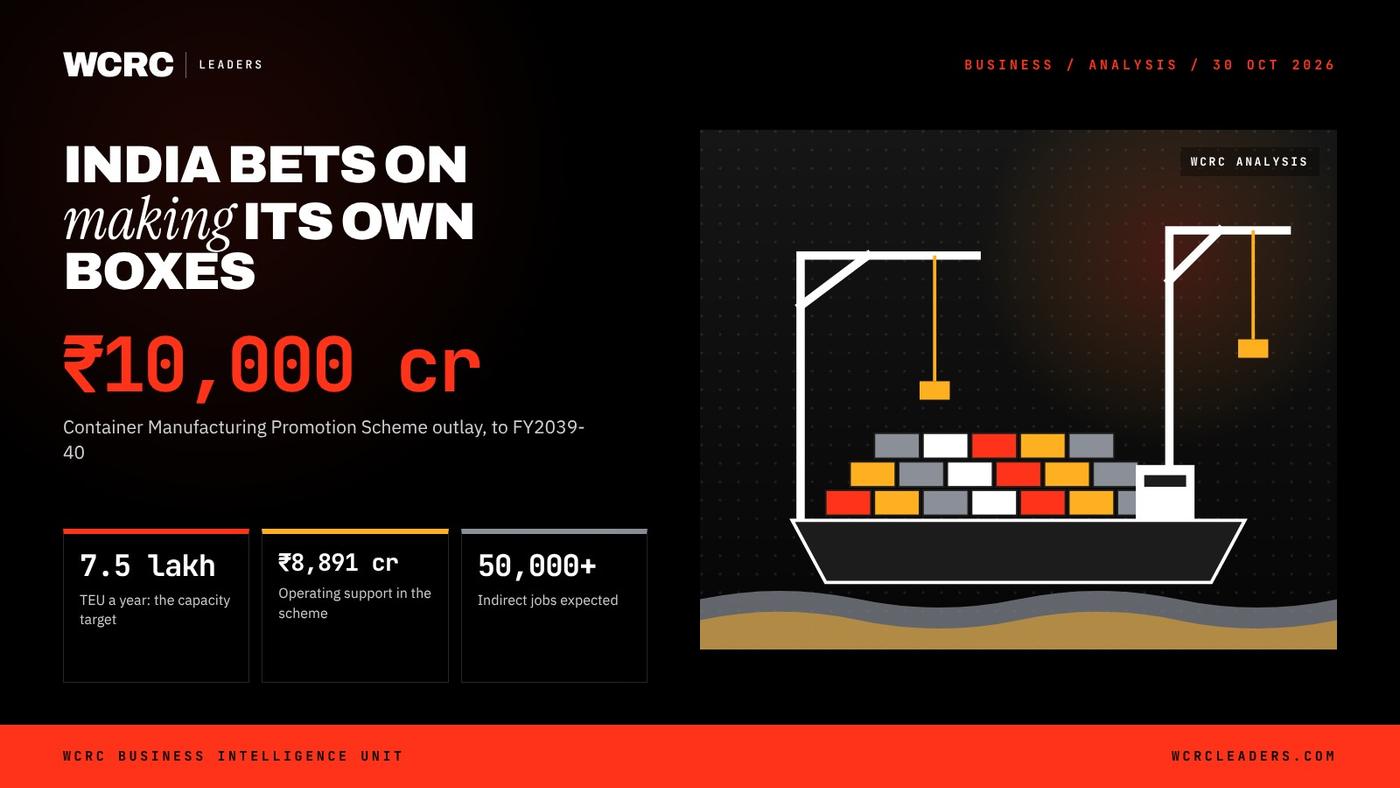
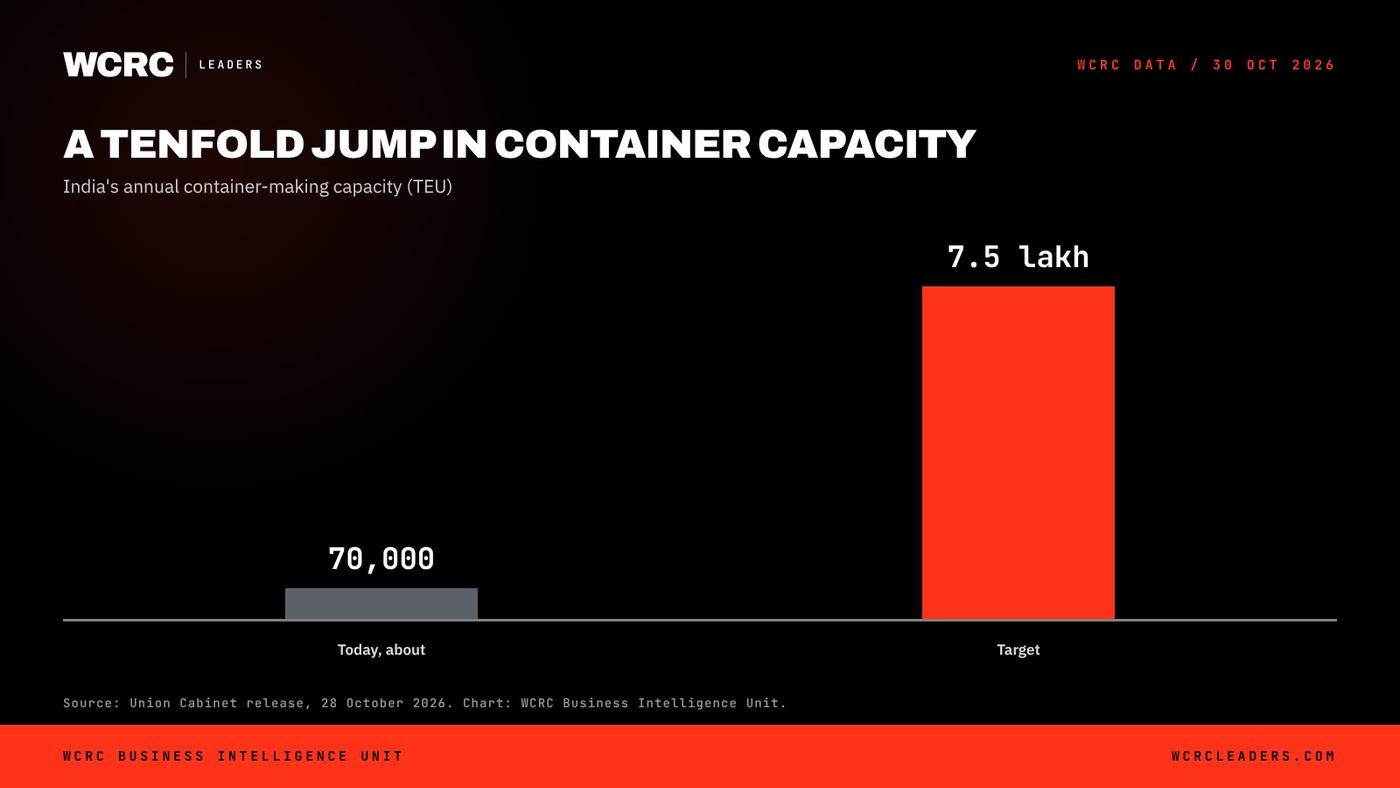
At a glance: WCRC Leaders' assessment: India is paying to own the humblest piece of its trade system, and the winners will be the firms that can meet global quality at scale before the subsidy runs out. On 28 October 2026 the Union Cabinet approved the ₹10,000 crore Container Manufacturing Promotion Scheme, running to FY2039-40. It aims to lift annual capacity from about 70,000 TEU to up to 7.5 lakh TEU, with 3,000 direct and more than 50,000 indirect jobs. For boards, it reshapes costs in steel, logistics and ports.
What exactly did the Cabinet approve?
The Union Cabinet, chaired by Prime Minister Narendra Modi, approved the Container Manufacturing Promotion Scheme (CMPS) on 28 October 2026. The scheme was first announced in the Union Budget 2026-27. Its stated aim is a "globally competitive container manufacturing ecosystem" that cuts import dependence and strengthens supply-chain resilience.
The ₹10,000 crore outlay is split four ways, according to the Ministry of Ports, Shipping and Waterways:
- Operational expenditure assistance, ₹8,891 crore: support for each container built to global shipping standards and sold by an eligible manufacturer, to close the cost gap with imports.
- Interest subvention, ₹859 crore: 3% a year on eligible term loans for new plants and expansions.
- Testing and certification, ₹150 crore: common facilities such as dynamic longitudinal impact testing, so makers rely less on testing abroad.
- Scheme management, ₹100 crore: administration, monitoring and capacity building.
The scheme runs from FY2027-28 to FY2039-40: three years to build factories, then ten years of production support. Greenfield plants must offer at least 1,00,000 TEU a year, and brownfield expansions at least 25,000 TEU. Domestic content must rise from 70% to 90%, and major ports will lease land at 25% of the notified rate. An inter-ministerial steering committee chaired by the shipping secretary will approve guidelines and sanction support.
Why is India building boxes now?
The ministry's own line is blunt: "India's trade depends on containers, but almost all of them are made abroad." A government backgrounder published in August 2026 says India imports nearly 2 million empty containers every year for domestic demand and repositioning. Most of the world's boxes are built in China, which leaves Indian exporters exposed whenever freight markets tighten and empty boxes pile up in the wrong ports.
The timing sharpens the case. Gulf shipping has been under strain since early 2026. On 27 April, Maersk told customers that safe transit of the Strait of Hormuz "cannot be assured at this time" and advised them to plan for variable transit times, routing and costs. Six months on, the disruption is still priced in (see WCRC's analysis of what Gulf and Indian boards must price in). On 27 October, Maersk revised its Emergency Operational Cost Recovery surcharge to $2,000 per container on cargo into Bahrain, Qatar, Kuwait, Iraq and the UAE, effective 9 November.
A domestic container industry does not reopen a shipping lane. It can shorten one link: the wait for empty boxes stranded far from Indian factories.
Ports and Shipping Minister Sarbananda Sonowal made the same case. "Containers are the backbone of our trade," he said. "By making them in India, we strengthen the maritime logistics supply chain." He called the scheme "a strong step to reduce import dependence."
Is there a real industry to build on?
There is a start. On 3 July 2026, Maersk became the first international shipping line to buy an export-import container made in India. The unit, built by DCM Shriram, one of WCRC 1000, India's Most Valuable Enterprises 2026, was unveiled at the Inland Container Depot in Dadri run by Maersk and Container Corporation of India (CONCOR), one of WCRC 1000, India's Most Valuable Enterprises 2026. Maersk said the prototype passed ISO 1496 structural tests and full safety approval, and ordered 1,000 more units.
That is one order of 1,000 boxes against a target of 7.5 lakh TEU a year. The gap between the two is the real story. Operating support, almost 89% of the money, is meant to bridge it while volume builds.
Demand, on the ministry's reading, will come from fleet replacement, the planned Bharat Container Shipping Line and the new mega ports at Vadhavan and Galathea Bay. It projects India's container traffic rising from about 24 million TEU in 2024 to 175 million TEU by 2047, and expects about ₹75,000 crore of economic output by FY2039-40, more than seven times the public support.
Who gains, and who carries the risk?
Steel. A container is mostly steel, and the government names specialised steel among the ancillary industries that benefit, alongside corner castings, wooden floors and paints. Integrated producers such as Tata Steel, one of WCRC 1000, India's Most Valuable Enterprises 2026 and JSW Steel, one of WCRC 1000, India's Most Valuable Enterprises 2026 gain a new domestic buyer if container plants reach scale. The 90% domestic content rule makes that link explicit. Analysis: the open question is whether Indian specialised steel can match imported grades on price.
Logistics and rail. CONCOR already hosts the first made-in-India box at its joint depot. Domestic supply could cut the cost of moving empty containers inland.
Ports. Major port authorities become landlords to a new industry through the land leasing support. Private operators such as Adani Ports and Special Economic Zone, one of WCRC 1000, India's Most Valuable Enterprises 2026 stand to benefit from steadier equipment supply at their terminals (see WCRC's coverage of Adani Ports' FY27 capex plans). Tata Steel, JSW Steel and Adani Ports & SEZ were also selected among India's Most Loved 250 Workplaces 2026 by the Business Intelligence Unit of WCRC.
Gulf port groups. DP World runs terminals at Nhava Sheva and container freight stations across India. Analysis: Indian box supply would reduce the need to reposition empties through Gulf hubs, a modest shift in flows but a real one for groups that earn on India-Gulf transhipment.
Who carries the risk. The government does, through a 13-year subsidy commitment, and so do early manufacturers, who must build plants of at least 1,00,000 TEU before the market proves it will buy Indian boxes at scale.
What should CEOs and boards in India, the Gulf and Asia do?
Read through WCRC's Corporate Value Intelligence lens, the question is who captures the margin when a subsidised industry matures. Boards should ask management for a view of container demand by FY2030, not FY2047.
In the terms of SeeClear, a model in WCRC's Guru Management Codex, leaders must separate fact from projection before committing capital. The facts are the outlay, the scale floors, the content rule and one 1,000-unit order. The 7.5 lakh TEU and ₹75,000 crore figures are targets, not forecasts.
For Gulf boards, India is pulling more of its trade infrastructure onshore. For Asian manufacturers, it is a long-dated challenge on price, not an immediate threat to volume.
The WCRC View
India has chosen to subsidise the least glamorous asset in global trade, and the choice is sound. A country that expects container traffic to grow sevenfold by 2047 cannot depend on imported empties during every shipping shock. The Gulf disruption of 2026, still visible in emergency surcharges this week, makes the case.
Read through WCRC's Promise Gap Model, the risk is the distance between "Made in India" as a claim and as a delivered standard. Carriers will buy Indian boxes only if they match imported supply on tests, price and delivery. The ₹150 crore for testing is small but may matter most.
The early winners are likely to be firms that already hold steel, land and logistics in one system. In the terms of Resilience Factor, one of WCRC's seven leadership parameters, CEOs who lock in steel supply, port land and anchor customers in the three-year build window will be best placed when the subsidy tapers.
What leaders should do now: steel and logistics boards should test whether container demand fits their capacity plans; port operators should price the land offer; Gulf groups should map how fewer empty repositioning moves would change India-Gulf flows.
WCRC will watch three things: the scheme guidelines from the steering committee, the first sanctioned greenfield plant of 1,00,000 TEU or more, and whether a second global carrier follows Maersk with a firm order.
WCRC models applied: Corporate Value Intelligence, SeeClear (Guru Management Codex), Promise Gap Model (Brand & Marketing Codex), Resilience Factor (WCRC seven leadership parameters).
Quick answers
Q: What is India's Container Manufacturing Promotion Scheme? A: A ₹10,000 crore scheme approved by the Union Cabinet on 28 October 2026 to build a domestic shipping container industry, running from FY2027-28 to FY2039-40.
Q: How is the ₹10,000 crore split? A: ₹8,891 crore for operating support per container, ₹859 crore for a 3% interest subvention, ₹150 crore for testing and certification, and ₹100 crore for scheme management.
Q: How much capacity will India add? A: The government aims to raise annual capacity about tenfold, from roughly 70,000 TEU to up to 7.5 lakh TEU, creating about 3,000 direct and over 50,000 indirect jobs.
Q: Who qualifies for support? A: New plants of at least 1,00,000 TEU a year and expansions of at least 25,000 TEU a year, with domestic content required to rise from 70% to 90%.
Adani Ports raises FY27 capex by ₹3,000 crore as overseas ports surge
Vedanta doubles Gamsberg, and Ramaphosa now wants a zinc smelter
Anchor investors in Indian IPOs: why the 60% book sets the tone

Bajaj Finance lines up ₹17,500 crore as AI agents take on service

$133bn: what India's rupee defence is costing its biggest banks
Jio Platforms IPO: Gulf funds hold 5.32% and are not selling
Filed under