WCRC Intelligence
India's bank credit grows 19.1% as services lending jumps 28.3%
India's banks are lending at almost twice last year's pace, to factories, traders, shadow banks and property developers alike. The money is plentiful today. The question for boards is how much of it to take, and at what price, before the rate cycle catches up.
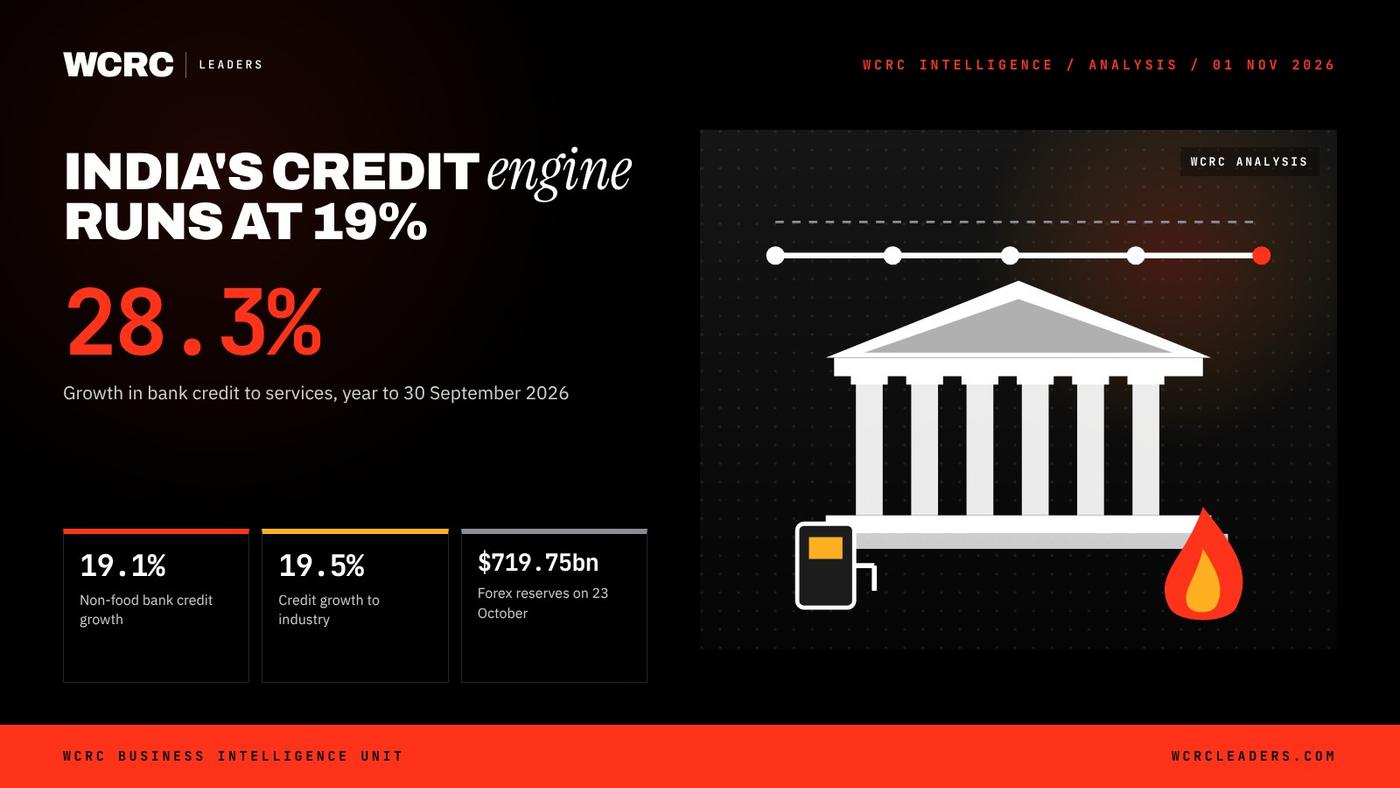
At a glance: WCRC Leaders' assessment: India's credit upcycle is real and broad, but part of the headline is built on cheap, one-off dollar funding, so boards should borrow for capacity with signed demand and lock in terms while banks are still competing to lend. On 30 October 2026 the Reserve Bank of India (RBI) reported non-food bank credit up 19.1% in the year to 30 September, against 11.2% a year earlier. Services credit rose 28.3% and industry 19.5%. Reserves stood at $719.75bn on 23 October.
What did the RBI report?
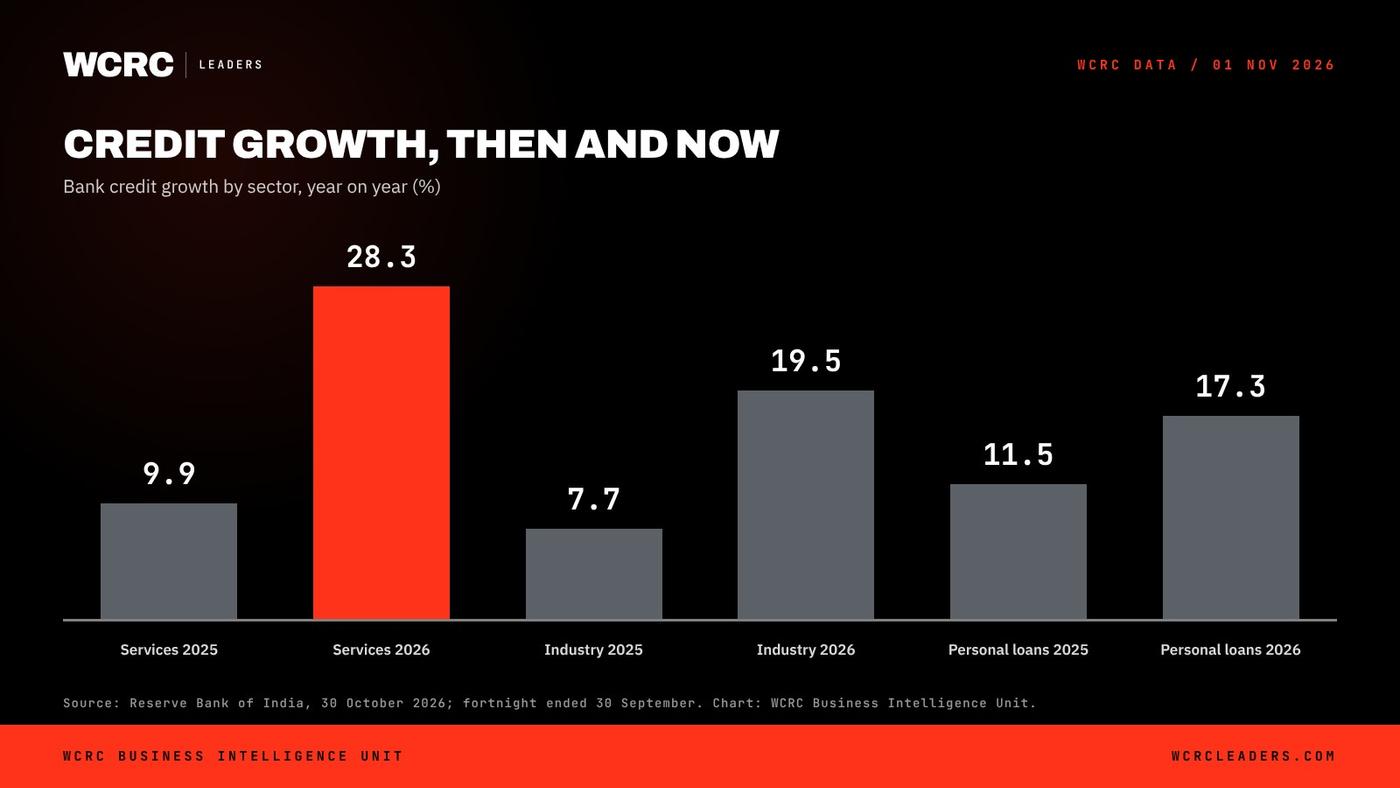
The RBI's release on sectoral deployment of bank credit for September 2026 covers 41 scheduled commercial banks that account for about 95% of all non-food credit extended by scheduled commercial banks. In the fortnight ended 30 September 2026, non-food bank credit grew 19.1% year on year. In the corresponding fortnight a year earlier, ended 3 October 2025, the rate was 11.2%.
Every major segment grew faster than a year ago:
| Segment | Year to Sep 2026 | Year to Oct 2025 |
|---|---|---|
| Non-food credit | 19.1% | 11.2% |
| Agriculture and allied | 19.5% | 8.9% |
| Industry | 19.5% | 7.7% |
| Services | 28.3% | 9.9% |
| Personal loans | 17.3% | 11.5% |
Within industry, the RBI said credit to large and medium industries "grew at an accelerated pace", while lending to micro and small industries was steady. Infrastructure, metals, engineering, chemicals, food processing and textiles were buoyant. In services, it pointed to non-banking financial companies (NBFCs), trade, commercial real estate, transport operators and professional services. In personal loans, advances against fixed deposits accelerated, while gold and education loans slowed but stayed strong.
A technical point matters for comparisons. Since December 2025, under the Banking Laws (Amendment) Act 2025, the reporting date is the last day of the month. The RBI notes that year-on-year rates now compare a month-end with the last reporting fortnight of the previous year.
Is the growth still accelerating?
Not in a straight line. The RBI's monthly releases show non-food credit growth of 19.1% in July, 18.8% in August and 19.1% in September. Industry grew 20.0% in July, 18.2% in August and 19.5% in September. Services is the segment that keeps climbing: 22.9%, then 24.3%, then 28.3%.
WCRC analysis: the picture is a high plateau for total credit, with the mix tilting towards services and big companies. That fits the other evidence of an investment cycle. WCRC reported that India's factory output grew 6.7% in September as capital goods outran consumer goods, and that L&T's order book reached a record. Credit to large and medium industry is what a capex upcycle looks like on a bank balance sheet.
How much of this is cheap dollar money?
This is where leaders need to separate fact from projection. Between June and August, banks raised $132.98bn of foreign currency non-resident (FCNR(B)) deposits through a special RBI swap window that took the currency risk off their hands, as WCRC set out in $133bn: what India's rupee defence is costing its biggest banks. Much of that money was lent straight back to the depositors against their deposits.
The bank results show the scale. Kotak Mahindra Bank, one of WCRC 1000, India's Most Valuable Enterprises 2026, grew advances 25%, or 19% excluding FCNR(B)-linked loans and its vehicle finance arm, as WCRC reported in its September-quarter analysis. IDFC FIRST Bank, one of WCRC 1000, lent ₹24,885 crore against ₹34,390 crore of FCNR(B) deposits, as WCRC found in its review of the bank's quarter. HDFC Bank, one of WCRC 1000, carries ₹54,800 crore of FCNR-linked loans.
WCRC analysis: the RBI's own note that "advances against fixed deposits accelerated" is consistent with this. These are thin-spread, secured loans. They lift reported credit growth without funding a single new plant. In the terms of SeeClear, a model in WCRC's Guru Management Codex, the rope here is a genuine rise in industrial and services borrowing, and the snake is a headline partly inflated by a one-time funding window. The FCNR(B) deposit leg closed on 31 August, so this boost will fade from the year-on-year numbers through 2027.
What is money actually costing?
Less than the rate cycle suggests, for now. The RBI's lending and deposit rate data, also released on 30 October, put the weighted average lending rate on fresh rupee loans at 8.51% in September, down from 8.61% in August. The one-year median marginal cost of funds based lending rate was 8.55% in October, against 8.61% in September. Fresh term deposits paid 5.61%.
That is striking, because the Monetary Policy Committee raised the repo rate by 25 basis points to 5.50% on 7 October, its first increase since February 2023, as WCRC covered in India's first rate hike since 2023. The September lending data predate the hike, and banks are flush: the RBI's weekly supplement shows it absorbing between ₹72,437 crore and ₹1,71,858 crore a day from the banking system in the week to 25 October.
The strain shows elsewhere. On 15 October, scheduled commercial bank credit was up 18.2% year on year and deposits only 16.7%. WCRC analysis: when loans outgrow deposits for long, banks either raise deposit rates or slow lending. Bond markets have already moved, with the 10-year government yield at 7.46% in late October, as WCRC reported in India's 10-year yield hits 7.46%. The state is borrowing more too: India's fiscal deficit jumped 24.7% in the first half.
How should banks and boards use growth capital?
For bank boards, the 28.3% surge in services lending deserves the closest look. NBFCs and commercial real estate are where credit cycles have gone wrong in India before. WCRC analysis: lending to shadow banks moves risk one step further from the bank's own underwriting, and property lending is the most rate-sensitive book a bank holds. Boards should ask management for concentration limits by NBFC group and by developer, and stress tests at a repo rate of 6%, not 5.50%.
Read through WCRC's Trust Equity Model, a bank's franchise rests on how much pressure its depositors' trust can absorb. Banks growing loans faster than deposits are spending that trust. Those with cheap, sticky retail deposits will price loans from strength when the FCNR(B) money matures.
For corporate boards, the case is the mirror image. Banks want to lend, and fresh lending rates have not yet caught up with policy. WCRC analysis: this is the window to fix long-term funding for capacity that has demand behind it, through term loans with fixed or capped rates, rather than rolling short-term paper into a rising cycle.
What does the Gulf see?
India is growing its credit book at close to 20% while many central banks hold rates high, which supports bank and infrastructure earnings. But the reserve cushion has thinned since its $785.71bn record of 4 September. Reserves fell $1.27bn to $719.75bn in the week to 23 October. Foreign currency assets rose $1.36bn, but gold holdings fell $2.65bn to $103.15bn. WCRC calculation: the rupee and dollar values in the RBI's reserves table imply about ₹94.94 to the dollar.
WCRC analysis: for Gulf capital, high-growth Indian credit is attractive when paid for in rupees and hedged with discipline. Lending through Indian NBFCs, private credit and infrastructure trusts pays more than the 7.46% on a 10-year government bond, but currency moves can erase a year's spread. The most rewarding place may be equity in the lenders with the strongest deposit franchises, rather than direct exposure to the fastest-growing loan books.
The WCRC View
India's credit upcycle is broad and, outside the FCNR(B) effect, genuine. Credit to large and medium industry, infrastructure and engineering is the clearest sign yet that private capex is moving.
But the headline flatters. Read through Corporate Value Intelligence, WCRC's framework for interpreting enterprise value, growth creates value only when returns on new lending and new capacity beat a cost of capital that is now rising. Volume alone does not.
Who gains: banks with deep retail deposits, large companies with signed order books, and Gulf investors who buy the strongest lenders rather than the fastest. Who is exposed: lenders with stretched credit-to-deposit ratios and heavy NBFC or property books, and borrowers relying on short-term money.
What leaders should do now: CEOs should lock in long-term funding for committed capex this quarter. Bank boards should set hard concentration limits on NBFC and commercial real estate exposure and test them at a 6% repo rate. Gulf investment committees should hedge the rupee before they chase yield. In the terms of Resilience Factor, one of WCRC's seven leadership parameters, the leaders who win this cycle will be those who borrow for the downturn, not for the boom.
What WCRC will watch: the October sectoral credit data due at the end of November, whether deposit growth closes the gap with credit, the RBI's next policy decision in December, and how fast FCNR(B)-backed loans run off bank balance sheets.
WCRC models applied: SeeClear (Guru Management Codex), Trust Equity Model (Brand & Marketing Codex), Corporate Value Intelligence, Resilience Factor (WCRC seven leadership parameters).
Quick answers
Q: How fast is Indian bank credit growing? A: Non-food bank credit grew 19.1% in the year to 30 September 2026, against 11.2% a year earlier, according to RBI data released on 30 October 2026.
Q: Which sector is growing fastest? A: Services, at 28.3%, led by NBFCs, trade, commercial real estate, transport operators and professional services. Industry and agriculture each grew 19.5%, and personal loans 17.3%.
Q: Are borrowing costs rising? A: Not yet on fresh bank loans. The weighted average lending rate on fresh rupee loans fell to 8.51% in September from 8.61% in August, although the RBI raised the repo rate to 5.50% on 7 October.
Q: What were India's foreign exchange reserves? A: $719.75bn on 23 October 2026, down $1.27bn on the week. Gold holdings were $103.15bn.

India's factory output grows 6.7% as capital goods outrun consumers

AI-native vs AI-retrofit: the growth gap incumbents should study

The AI trade economy: chips and servers now carry almost half of world trade growth
ECB holds at 2.50% as 18.9% energy inflation sets the world's rates
China's profits jump 14.4%: chips and metals boom, steel and cars bleed
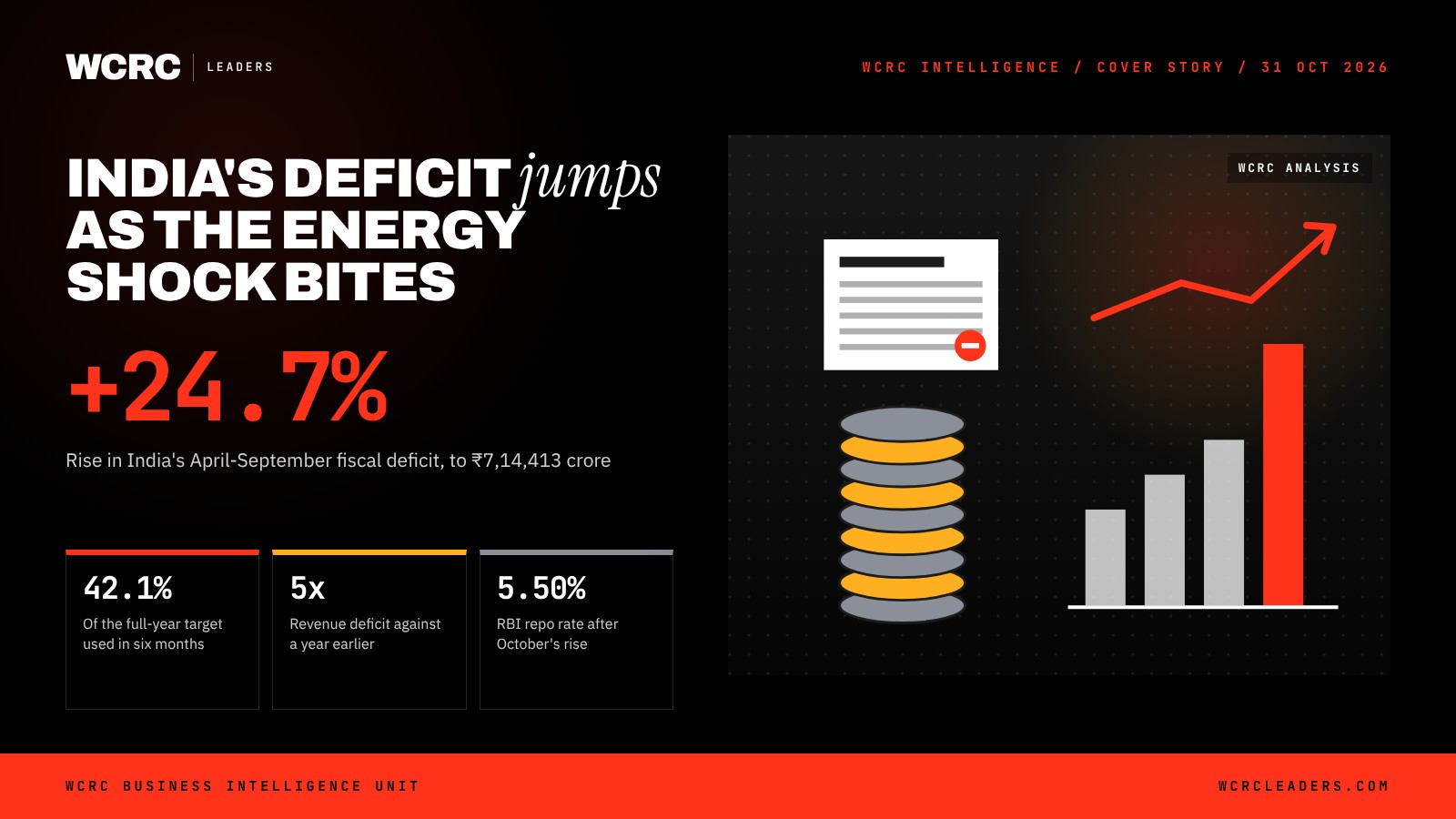
India's fiscal deficit jumps 24.7% as the energy shock eats its room
Filed under