Recognitions
IDFC FIRST Bank's ₹1,044.6cr quarter: a retail brand comes of age
Profit has nearly tripled, deposits have passed ₹3.4 lakh crore and the bank's dollar deposit drive has dented its headline margin. Eight years after the merger that created it, IDFC FIRST Bank is being judged as a mainstream retail franchise.
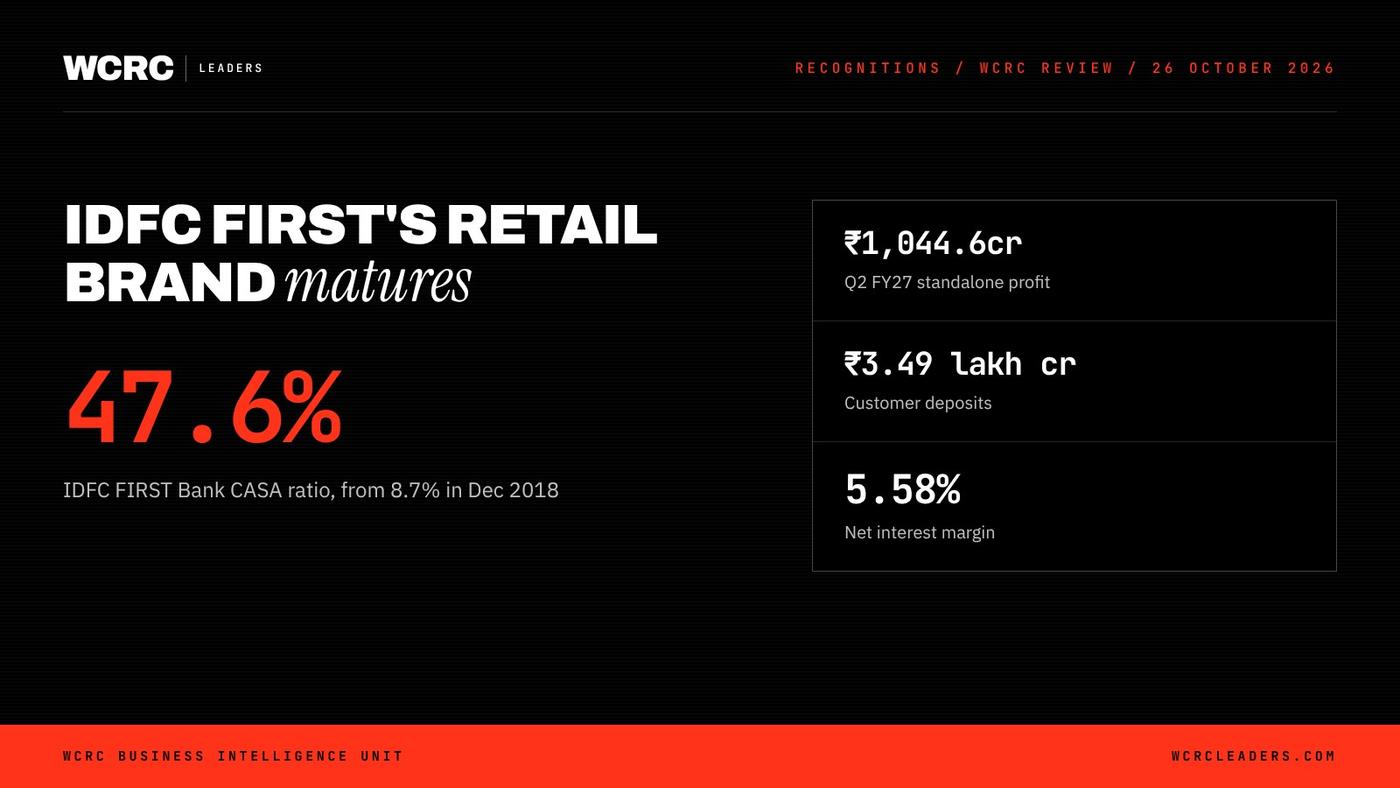
At a glance: WCRC Leaders' assessment: IDFC FIRST Bank has turned a wholesale lender into a deposit-led retail brand, and its next test is converting cheap, sticky customer money into returns that match its reach. On 24 October 2026 the board approved September-quarter results showing standalone profit of ₹1,044.6 crore, against ₹352.3 crore a year earlier. Deposits reached ₹3.49 lakh crore. The net interest margin fell to 5.58% as foreign currency deposits swelled the balance sheet. The bank's best estimate is about 5.8% by the fourth quarter.
What did IDFC FIRST Bank report for the September quarter?
IDFC FIRST Bank, one of WCRC 1000, India's Most Valuable Enterprises 2026, reported standalone profit after tax of ₹1,044.6 crore for the quarter to 30 September 2026, up 196.5% from ₹352.3 crore a year earlier and 2.8% below the June quarter. The board approved the numbers on 24 October.
Total deposits stood at ₹3,48,583 crore, up 25.9% year on year, and advances at ₹3,35,642 crore. Asset quality improved again: gross non-performing assets fell to 1.32% from 1.51% in June, and net NPAs to 0.40% from 0.44%. Capital adequacy was 14.67%, with common equity tier 1 at 13.00%, both lower than a year earlier as the loan book grew 30.1%. Return on assets was 0.93% for the quarter and return on equity 8.45%.
Net interest income rose 21.0% to ₹6,184 crore. Core operating profit, which strips out trading gains, rose 38.5% to ₹2,527 crore, and the core cost-to-income ratio improved to 70.2% from 73.7% a year earlier. Provisions fell 21.7% year on year to ₹1,137 crore.
The year-on-year jump flatters the trend because the base was weak. In October 2025, MD and CEO V. Vaidyanathan said in the bank's results release: "The stress in the MFI business was an MFI industry issue and looks like it is behind us." The latest quarter suggests that call has held.
How far has the bank travelled since the 2018 merger?
IDFC FIRST Bank was created on 18 December 2018 when IDFC Bank, a lender built on infrastructure finance, merged with Capital First, the consumer and small-business financier Mr Vaidyanathan had built after a 2012 management buyout. The logic was simple: marry a banking licence to a retail lending engine, then replace expensive wholesale money with customer deposits.
The bank's own figures show how far that has gone. At the merger, customer deposits were ₹38,455 crore. They are now ₹3,41,415 crore. The current and savings account (CASA) ratio was 8.7%; it is 47.6%. Retail customers supplied 27% of customer deposits then and 82% now. The cost of funds has fallen from 7.80% to 5.97% in the first half of FY27.
The asset side has been rebuilt too. Retail, agriculture and MSME loans, including foreign currency deposit-backed loans, make up 80% of the book, and wholesale 20%. The bank now runs 1,200 branches. Its credit card business has grown from 0.1 million cards in March 2021 to 5 million, with a card book of ₹9,875 crore.
The capital structure has been simplified along the way. The boards approved the merger of IDFC Limited into the bank in July 2023, removing the holding layer so shareholders own the bank directly. Domestic agencies rate the bank AA+, and it has added a debut BBB- international rating from S&P Global and a US$950 million debut bond.
What brand has IDFC FIRST built, and does it work?
The brand rests on one proposition: fair, transparent banking for ordinary customers. The bank markets "ZERO Fees On All Essential Savings Account Services", credits savings interest monthly rather than quarterly, and advertises savings rates of up to 7% a year on balances between ₹3 lakh and ₹25 lakh. Its stated aspiration is "A World Class Bank in India with Principles of Ethical, Digital & Social Good."
Analysis: in Indian retail banking, fee income from small charges is a quiet profit pool. Giving it up was a deliberate trade, paying for deposit growth with lower fee income and a higher savings rate. The CASA climb suggests the trade worked. It also explains the cost problem. A cost-to-income ratio of about 70% is high for a bank of this size, because acquiring and serving millions of retail customers is expensive before they become profitable. The bank's incremental cost-to-income ratio of 55.0% in the first half points the right way.
Digital is the second leg. The bank reports more than 31.4 million app registrations and ratings of 4.9 on Android and 4.8 on iOS. Wealth management assets reached ₹79,200 crore in September, from ₹57,000 crore in March.
The brand also shows up on the people side. IDFC FIRST Bank was selected among India's Most Loved 250 Workplaces 2026 by the Business Intelligence Unit of WCRC, in the private banking sub-sector.
Why did the margin fall, and does it matter?
The net interest margin fell to 5.58% from 5.90% in the June quarter, which excluded interest on an income tax refund. A year ago it was 5.59%, so the margin is flat year on year.
The cause is the foreign currency non-resident (bank) deposit window. The Reserve Bank of India opened a special dollar-rupee swap facility in June to support the rupee, and banks raised $132.98bn of FCNR(B) deposits before the deposit leg closed on 31 August, as WCRC reported on what the rupee defence is costing banks. IDFC FIRST mobilised ₹34,390 crore, about US$3.6bn, without any branch, subsidiary or representative office outside India, and lent ₹24,885 crore against those deposits through its International Banking Unit.
Those loans earn a thin spread on a large base. The bank says FCNR(B) money adds to net interest income, profit and earnings per share, but dilutes the margin optically because it enlarges the balance sheet. It puts the steady-state effect on return on assets at about 2 basis points. Excluding FCNR(B), customer deposits grew 14.1% year on year rather than 26.9%, and the CASA ratio would be 52.8%.
The same pattern ran through the sector. Axis Bank, one of WCRC 1000, India's Most Valuable Enterprises 2026, reported a margin of 3.36% against 3.47% excluding FCNR(B) effects, and ICICI Bank, one of WCRC 1000, grew deposits 27.1%, or 17.0% without them. Meanwhile, deposits finally outran loans at India's largest private lender.
What happens to margins and funding next?
The bank's investor presentation sets out a best estimate of a 5.80% margin in the fourth quarter of FY27. It is not formal guidance. It assumes excess liquidity from the FCNR(B) inflow is deployed, the day-count effect reverses and the bank gains from higher rates. The presentation assumes a further 25 basis points of repo increases in FY27 and in FY28.
The rate cycle is now an important variable. The RBI raised the repo rate by 25 basis points to 5.50% on 7 October, its first increase since 2023, and the next policy meeting runs from 2 to 4 December. The 10-year government bond yield reached 7.46% on 22 October as reserves fell from their September peak. A bank with a large floating-rate retail book can reprice faster than its deposits, but higher rates also test borrowers in unsecured credit.
The WCRC View
The WCRC Business Intelligence Unit's reading is that IDFC FIRST Bank has passed its first test and is starting its second. The first was proving that a former infrastructure lender could become a retail deposit brand. A CASA ratio of 47.6%, up from 8.7%, and an 82% retail share of deposits settle that question.
The second test is returns. A return on assets of 0.93% and return on equity of 8.45% are below what a bank with this deposit franchise should deliver. The path runs through cost: the core cost-to-income ratio must keep falling from 70%, and the 55% incremental ratio is the number to track.
Analysis: the FCNR(B) episode matters for the Gulf as well as India. Non-resident Indians, many of them in the Gulf, were the natural savers for three-to-five-year dollar deposits. Raising US$3.6bn without overseas branches shows how far a digital, fee-light brand can reach. Banks across Asia building deposit franchises should note that brand trust can now be bought with transparency rather than branches.
For CEOs and boards: treat the headline margin with care this year. Several Indian lenders' margins are distorted by FCNR(B) balances, so compare returns on assets and margins excluding FCNR(B). Corporate treasurers should expect banks to compete hard for retail and NRI money as rates rise.
WCRC will watch three things: whether the margin recovers towards 5.8% by March 2027, whether cost-to-income falls below 70%, and whether capital adequacy holds near 14.7% while loans grow at about 30%.
Quick answers
Q: What was IDFC FIRST Bank's profit in Q2 FY27? A: Standalone profit after tax was ₹1,044.6 crore for the quarter to 30 September 2026, up from ₹352.3 crore a year earlier.
Q: Why did IDFC FIRST Bank's margin fall? A: The net interest margin fell to 5.58% from 5.90% because ₹34,390 crore of FCNR(B) deposits and related loans enlarged the balance sheet at thin spreads. The bank says the effect on return on assets is about 2 basis points.
Q: What is IDFC FIRST Bank's CASA ratio? A: 47.6% at 30 September 2026, or 52.8% excluding FCNR(B) deposits, against 8.7% at the December 2018 merger.
Q: When was IDFC FIRST Bank formed? A: On 18 December 2018, through the merger of IDFC Bank and Capital First.

No strings attached: what the MacArthur model teaches about recognising talent
Wipro's 58.6% large-deal drop puts Rishad Premji to the test
Tata Motors posts 42% volume jump as its €3.9bn Iveco bid nears close

The 'alternative Nobel' goes to an AI accountability pioneer

What makes a business recognition credible

Navi Pillay and leadership through institutions
Filed under