WCRC Intelligence
China's PMI falls to 49.3 as construction orders sink to 40.0
China's factories slipped back into contraction in October and new orders on its building sites fell by 5.7 points in a single month. For Gulf exporters and Indian buyers of commodities, the message is that China's demand is softer than its profits suggested.
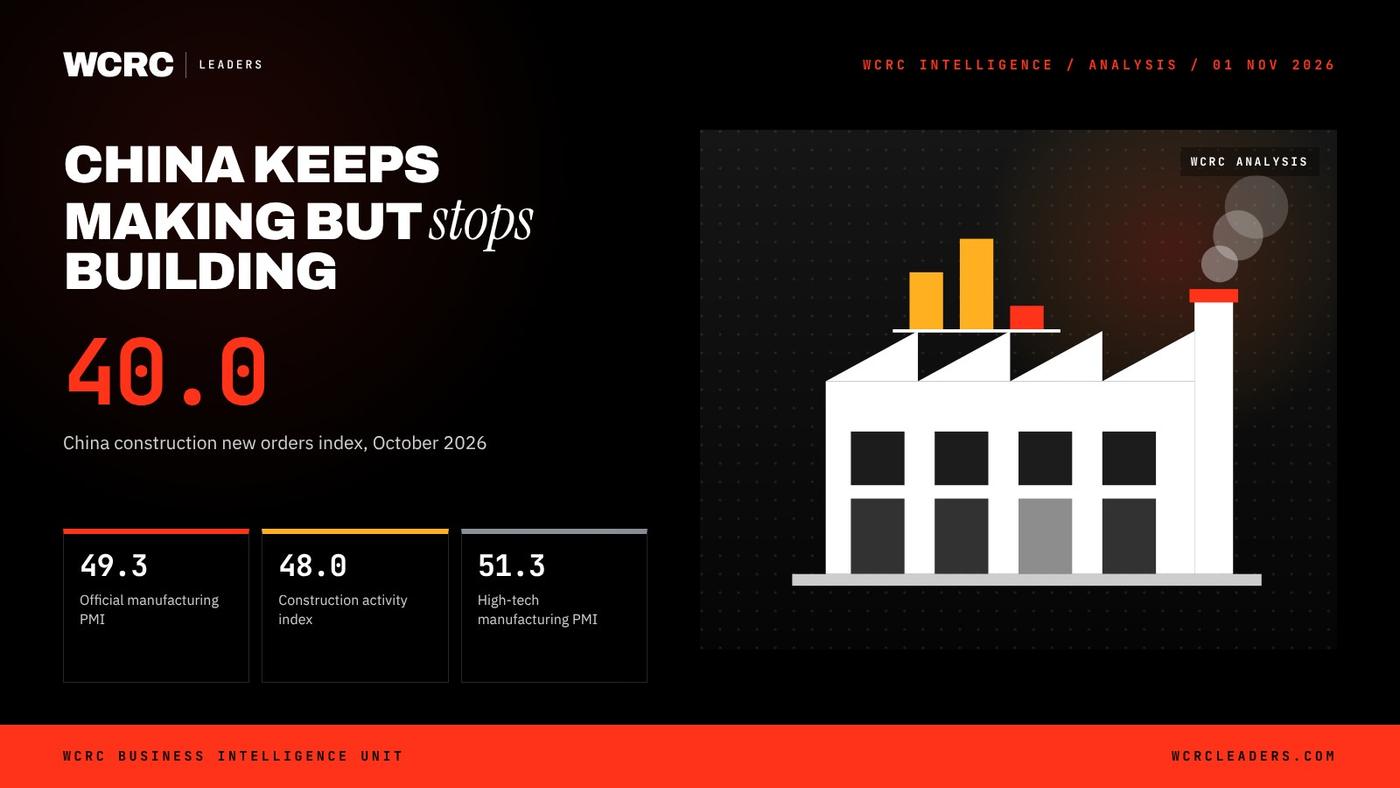
At a glance: WCRC Leaders' assessment: October's figures show a China that is still making things but no longer building much, which caps the upside for bulk commodities and Gulf petrochemicals and gives Indian manufacturers some relief on input costs. The National Bureau of Statistics said on 31 October that the official manufacturing PMI fell to 49.3 from 50.1, the non-manufacturing index to 49.7 and the composite output index to 49.7. Construction new orders fell 5.7 points to 40.0.
What did China's October PMI show?
The National Bureau of Statistics (NBS) and the China Federation of Logistics and Purchasing published the October purchasing managers' indices on 31 October. A reading above 50 signals expansion; below 50, contraction.
The manufacturing PMI fell 0.8 points to 49.3, undoing September's return to expansion at 50.1. Production dropped 1.9 points to 49.8 and new orders fell 1.1 points to 49.4. Raw material inventories edged up to 48.4 and employment held at 48.4.
The split by company size was sharp. Large manufacturers stayed in expansion at 50.2, down 0.4 points. Medium firms fell 1.3 points to 48.4 and small firms fell 1.4 points to 47.5. The squeeze is landing hardest on the smaller suppliers that make up much of China's industrial base.
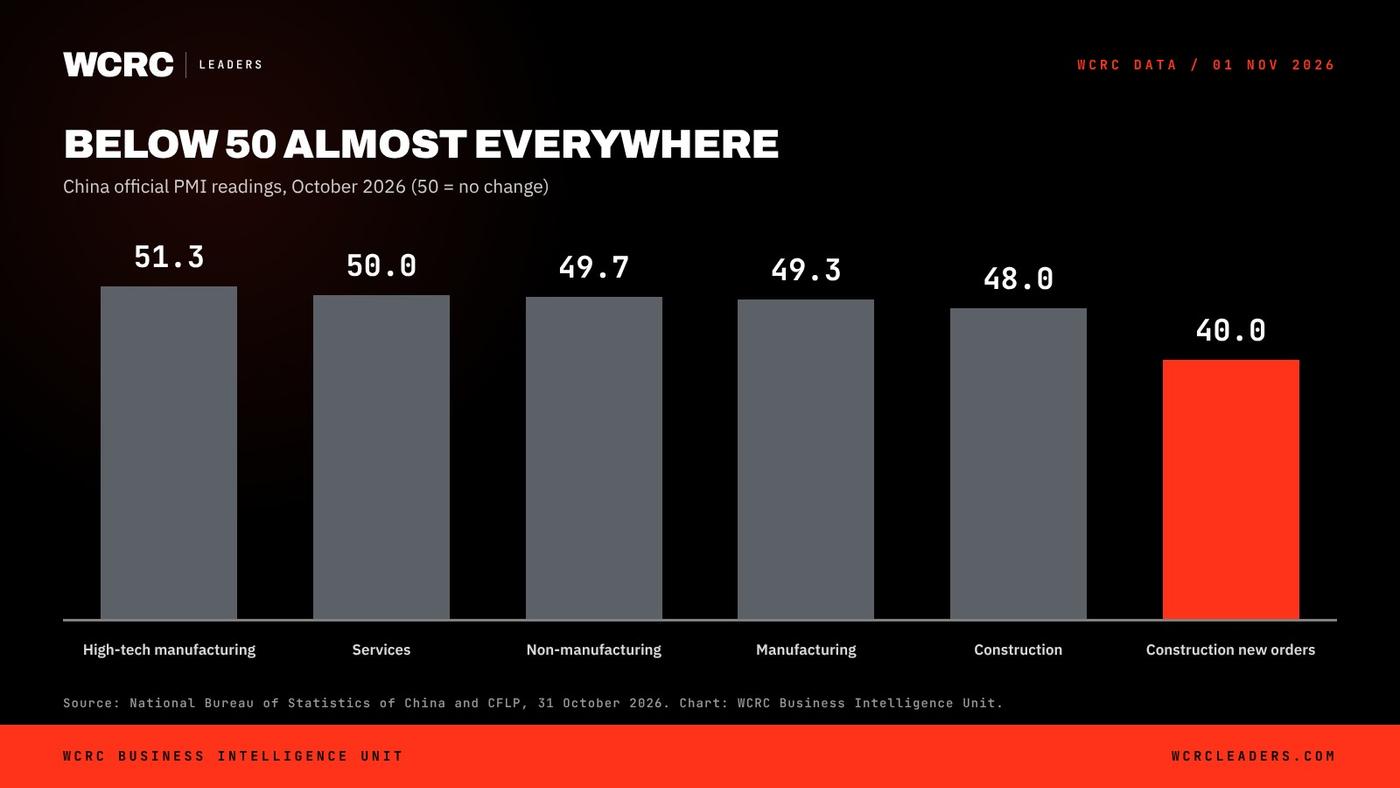
Outside factories, the non-manufacturing business activity index fell 0.5 points to 49.7. Services held exactly at 50.0. Construction dropped 2.3 points to 48.0, down from 50.3 in September. The composite output index, which combines both, fell a full point to 49.7.
There were bright spots. The NBS put high-tech manufacturing at 51.3 and equipment manufacturing at 50.6. Production and new orders in railway, shipbuilding and aerospace equipment, and in computers, communications and electronics, were both at 53 or above. NBS chief statistician Huo Lihui linked the slowdown partly to demand pulled forward before the National Day holiday and to a complex international environment, and said the strength of high-tech and equipment manufacturing showed emerging industries were still growing.
Why does the construction number matter most?
Because it is the forward indicator for the commodities China buys in bulk. Construction new orders fell 5.7 points to 40.0, from 45.7 in September. Construction employment fell 2.3 points to 42.0, and builders' business expectations dropped 3.1 points to 52.3. Across the whole non-manufacturing sector, new orders fell 2.1 points to 44.4, and real estate services were among the activities in contraction.
A building sector with order books this thin uses less steel, cement, glass, copper, PVC and diesel in the months ahead. That fits the picture in China's September industrial profits, where China's profits jumped 14.4% while steel and cars bled: steel profits fell 73.3% in the first nine months and non-metallic minerals, which include cement and glass, fell 46.9%. The October PMI suggests that weakness is spreading from margins into volumes.
What does this mean for commodity prices?
The PMI price gauges show inflation pressure easing, not reversing. The NBS said the manufacturing purchase price index fell 4.0 points to 56.8 and the factory-gate price index fell 2.3 points to 51.7. Both are still above 50, so prices are rising, but more slowly. In September the readings were 60.8 and 54.0.
Oil is where the global price shock sits. The US Energy Information Administration's October outlook put Brent at an average of $114 a barrel in September, with a peak of $131 on 15 September, after attacks on oil infrastructure and on the Saudi East-West pipeline that bypasses Hormuz. The agency expects $105 in the fourth quarter and about $84 on average in 2027. Its tables show China's liquid fuels consumption falling from 16.58 million barrels a day in 2025 to 16.02 million in 2026.
WCRC analysis: a weaker Chinese building cycle will not by itself bring oil down while Gulf supply is disrupted. But it removes one source of upward pressure on industrial metals, construction materials and polymers, where China is the swing buyer. When Gulf supply normalises, soft Chinese demand will make the fall in prices faster.
What does it mean for Gulf petrochemical sellers?
Gulf producers sell China polymers, aluminium and refined products. September's profit data showed Chinese chemical raw materials up 49.2% and refining back in profit, which supported Gulf prices. October's numbers point the other way for construction-linked products: PVC pipe, insulation, aluminium for buildings and diesel for site machinery.
There is a second risk. Large Chinese firms are still expanding while domestic orders weaken. Plants that keep running into a soft home market tend to push surplus product abroad, into the same Indian and South-East Asian markets the Gulf supplies. WCRC set out the security side of this for boards in 135 attacks since February: what Gulf and Indian boards must price in.
Read through WCRC's Price Power Model, which asks how much premium a seller can charge before buyers switch, the Gulf's pricing strength this year has come from supply scarcity, not from Chinese demand. That kind of pricing power is temporary. A Gulf seller whose premium rests on disrupted shipping lanes should expect it to fade once Chinese surplus and normal shipping return together.
What does it mean for India's input costs?
India's problem this year has been cost, not demand. Wholesale inflation reached 11.39% in September, with fuel and power up 25.85%, according to the Office of the Economic Adviser, as WCRC reported in India's WPI at 11.39%. Chemicals and basic metals were each up close to 17%.
A slower Chinese building cycle is, on balance, welcome news for Indian buyers of steel, chemicals, polymers and intermediates. Softer Chinese factory-gate prices tend to reach India through imports within a quarter or two. The cost is borne by Indian producers that compete with China. Tata Steel and JSW Steel, each one of WCRC 1000, India's Most Valuable Enterprises 2026, face the risk of cheaper Chinese steel in export markets and pressure on domestic prices. Reliance Industries, also one of WCRC 1000, India's Most Valuable Enterprises 2026, whose Reliance Polymers, a WCRC MegaBrand in petrochemicals and polymers, sells into the same polymer market, faces the same question on spreads.
In the terms of SeeClear, a model in WCRC's Guru Management Codex that asks leaders to separate fact from projection, the fact is a one-month fall in construction orders to 40.0. The projection to avoid is a lasting collapse in Chinese commodity demand. The NBS blamed part of the drop on holiday timing, and one month does not make a trend.
How does Korea's chip boom fit in?
It is the other half of the same story. Asia's export economy is splitting in two. Korea's goods exports rose 2.4% in the third quarter, led by semiconductors, as WCRC noted in Korea's chips lift GDP 1.0% as households pull back. China's own computer and electronics producers reported production and new orders at 53 or above in October.
The money in Asian manufacturing is flowing to chips and electronic equipment. Commodity-heavy sectors linked to building are losing it. For Gulf and Indian boards, demand for AI hardware is no substitute for demand from Chinese construction: the two use very different inputs.
The WCRC View
Our call: October confirms what September's profit data hinted at. China is in a two-speed economy: technology and equipment manufacturing are expanding while construction contracts sharply. For commodity sellers, that is a cap on prices. For commodity buyers, it is relief, as long as Gulf supply recovers.
Who gains, who loses: Indian downstream manufacturers, which buy steel, chemicals and polymers, gain the most from cheaper Chinese supply. Indian steel and petrochemical producers, and Gulf exporters of polymers and aluminium, lose pricing room. Large Chinese manufacturers will hold up better than small ones, which means more aggressive exporting from the firms with the scale to do it.
What Gulf boards should do now: Treat today's prices as a supply premium, not a demand signal. Use the window to lock in long-term offtake with Indian and ASEAN buyers before Chinese surplus arrives. Read through WCRC's Corporate Value Intelligence framework for enterprise value, earnings built on a temporary premium deserve a lower multiple than contracted volume.
What Indian boards should do now: Re-tender input contracts for the first half of 2027 with Chinese price moves in mind, and avoid fixing long-term prices at September's peak. Steel and chemical producers should prepare for trade-remedy cases if Chinese export volumes jump.
What WCRC will watch: China's November PMIs on 30 November, especially whether construction new orders recover from 40.0; any new Chinese property or infrastructure stimulus; the EIA's next outlook on Brent; and India's October wholesale inflation figures in mid-November.
WCRC models applied: SeeClear (Guru Management Codex), Price Power Model (Brand & Marketing Codex), Corporate Value Intelligence.
Quick answers
Q: What was China's official manufacturing PMI for October 2026? A: The National Bureau of Statistics put it at 49.3, down from 50.1 in September, which signals contraction.
Q: How weak was China's construction sector in October? A: Construction business activity fell to 48.0 from 50.3, and construction new orders fell 5.7 points to 40.0, according to the NBS.
Q: Are Chinese input prices still rising? A: Yes, but more slowly. The manufacturing purchase price index fell to 56.8 and the factory-gate price index to 51.7, both still above 50.
Q: Which parts of Chinese industry are still growing? A: High-tech manufacturing at 51.3, equipment manufacturing at 50.6 and large firms at 50.2, with electronics, rail, shipbuilding and aerospace equipment showing production and new orders at 53 or above.
India's factory output grows 6.7% as capital goods outrun consumers

AI-native vs AI-retrofit: the growth gap incumbents should study
India's bank credit grows 19.1% as services lending jumps 28.3%
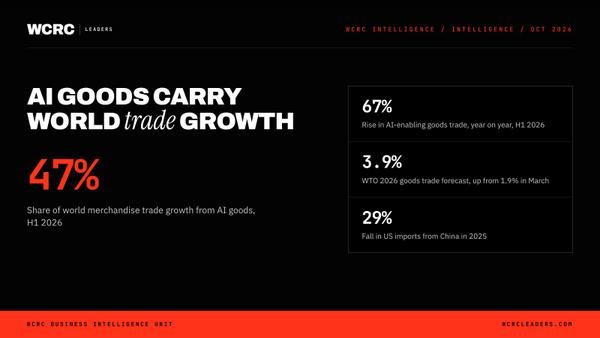
The AI trade economy: chips and servers now carry almost half of world trade growth
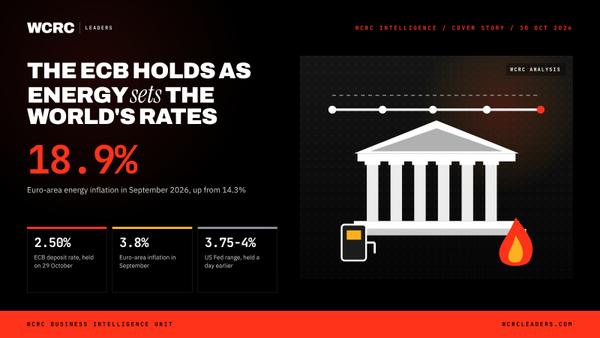
ECB holds at 2.50% as 18.9% energy inflation sets the world's rates
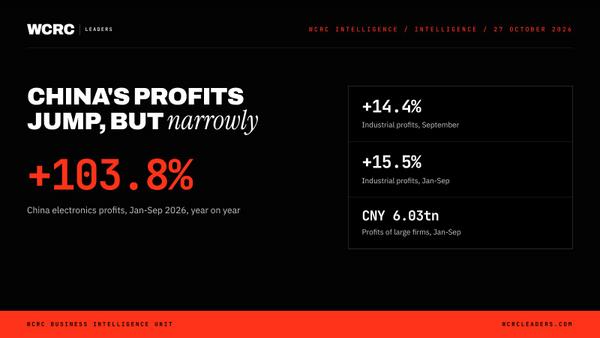
China's profits jump 14.4%: chips and metals boom, steel and cars bleed
Filed under