WCRC Intelligence
Bank of Japan holds at 1.25%, but a hawk and ETF sales signal more
The Bank of Japan became the third major central bank in three days to hold through the energy shock. One board member wanted 1.5%, and the Bank will sell its equity hoard far faster from January. For capital that has leaned on cheap yen, the direction of travel is now clear.
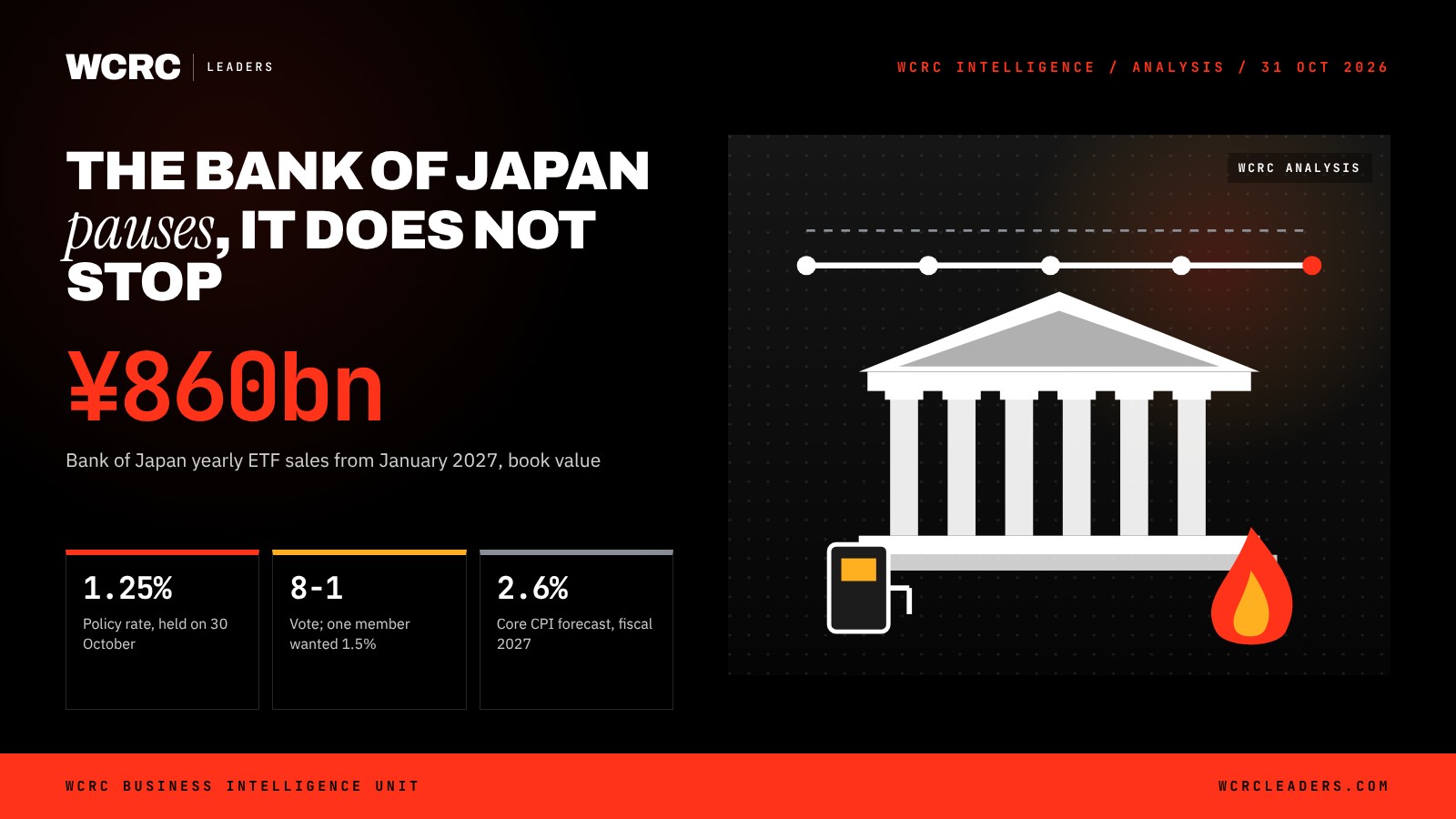
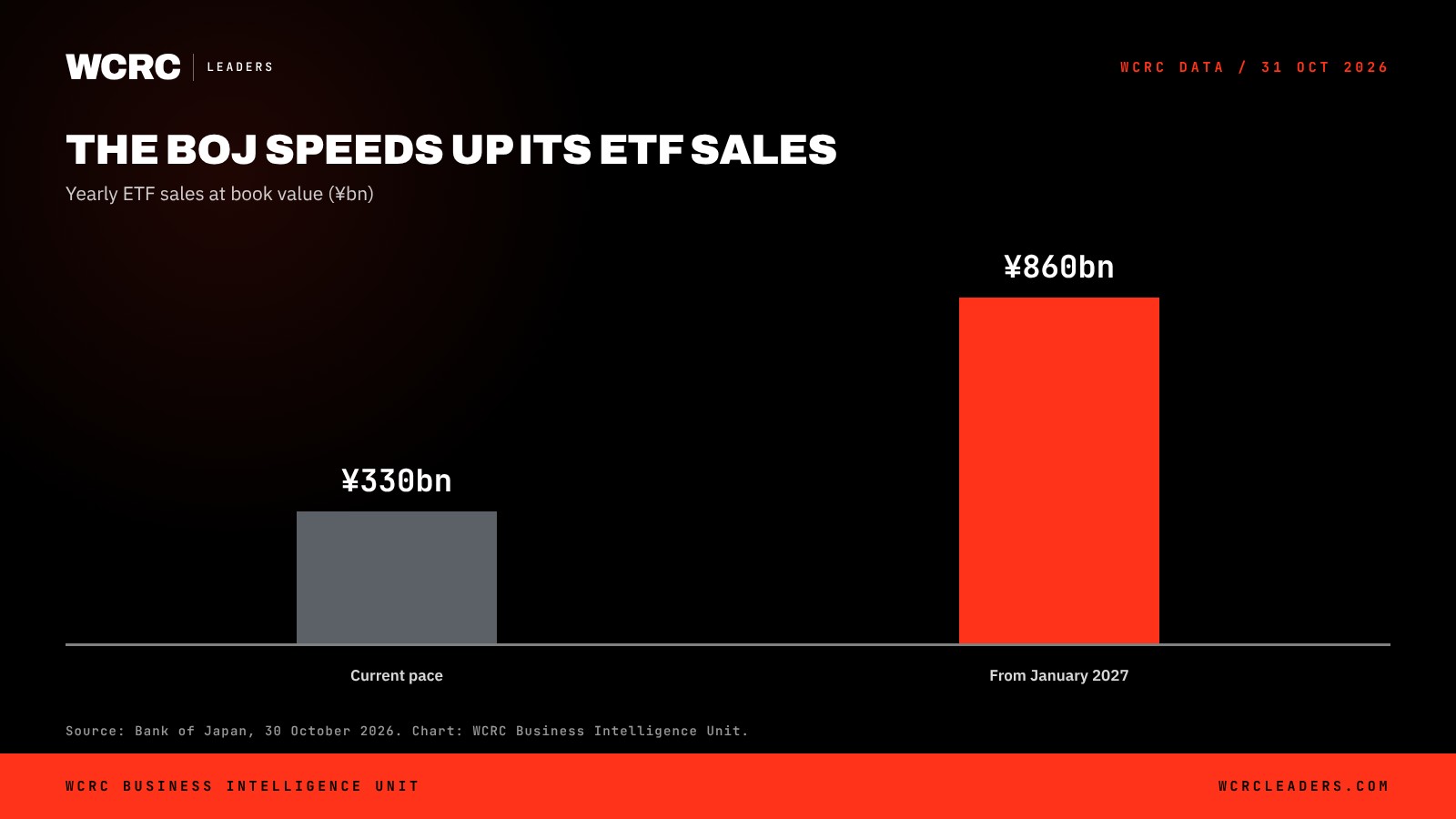
At a glance: WCRC Leaders' assessment: the Bank of Japan paused, it did not stop, and boards in India, the Gulf and Asia should plan for a yen that costs more to borrow in 2027. On 30 October 2026 the Policy Board kept its overnight call rate target at around 1.25% on an 8-1 vote. TAKATA Hajime proposed 1.5% and lost. The Board also voted to raise yearly ETF sales from about ¥330bn to about ¥860bn at book value from January 2027, cutting the time to clear the portfolio from about 112 years to about 43.
What exactly did the Bank of Japan decide?
Three decisions came out of the 29 to 30 October Monetary Policy Meeting. First, the Board will encourage the uncollateralised overnight call rate to remain at around 1.25%. The vote was 8-1. TAKATA Hajime dissented and proposed around 1.5%, arguing that underlying CPI inflation had reached the price stability target and that the Bank needed to step up the pace at which it moves the policy rate towards neutral.
Second, by a unanimous vote, the Bank will sell exchange-traded funds faster. From January 2027 the pace rises from about ¥330bn a year to about ¥860bn a year on a book value basis. The Bank puts that at about ¥2.46tn a year at market value. As a share of market trading value, sales move from about 0.05% to about 0.1%. J-REIT sales stay at about ¥5bn a year. The Bank kept two principles: it should avoid incurring losses as much as possible, and it may adjust or suspend sales temporarily if markets turn.
Third, the October Outlook Report gave the Board's new medians. Real GDP growth is forecast at 0.7% in fiscal 2026, 0.7% in fiscal 2027 and 0.8% in fiscal 2028. CPI excluding fresh food is forecast at 2.5% in fiscal 2026 and 2.6% in fiscal 2027, the second figure up 0.2 points from July, before easing to 2.0% in fiscal 2028. These numbers exclude the effect of a proposed cut in the consumption tax on food and beverages. The Bank judges risks to activity as generally balanced and risks to prices as skewed to the upside.
Why does the single dissent matter so much?
Because six weeks ago the dissent ran the other way. On 18 September the Board raised the rate from around 1.0% to around 1.25% on a 7-2 vote, with Asada Toichiro and Sato Ayano voting against the rise. In June it had moved to 1.0% on a 7-1 vote, with Asada dissenting. October is the first meeting at this rate level where the minority voice argues for going faster, not slower.
Takata has made the case before. In a speech on 2 September 2026 he said: "Today, the norm of prices not increasing easily has already been dispelled." He added: "Japan's policy interest rate has yet to reach the neutral zone." His proposal on Friday puts a number on that view.
WCRC analysis: a hold with a hawkish dissent, an upgraded inflation path for 2027 and a faster exit from equity holdings is not a neutral package. It tells markets that the next move is up, and that the debate is about timing.
How does this fit with the Fed and the ECB this week?
The week has produced one pattern. On 28 October the Federal Reserve held at 3.75% to 4% with two officials voting for a hike. On 29 October the ECB held its deposit rate at 2.50% as euro-area energy inflation reached 18.9%. On 30 October the Bank of Japan held at 1.25% with one member wanting more. Three central banks paused, and two of them recorded votes for tightening.
The Bank of Japan's own report explains the bind. It lists the situation in the Middle East among its risks, describes a rise in energy and raw material prices since early spring, and names higher crude oil prices, higher semiconductor prices and yen depreciation as upside risks to prices. Japan feels the oil shock through its import bill: in September the crude bill rose 51.1% and the trade deficit nearly doubled. The Bank of Korea held at 3.00% on 23 October with further hikes on the table. Asia's policy makers are pausing with a hand on the brake.
What does a dearer yen mean for India, the Gulf and Asia?
WCRC analysis. Japan has been the world's cheapest major source of funding for most of three decades, and that cheap money has flowed into higher-yielding assets abroad, including Indian bonds and equities, Gulf project finance and Asian credit. Each step up in Japanese rates narrows the gap that makes that trade pay. A rate path that points to 1.5% and beyond, read with a 2.6% core inflation forecast for 2027, raises the cost of holding yen-funded positions.
The ETF decision adds a second channel. Selling about ¥2.46tn of equities a year at market value is small against Tokyo's daily trading, which is why the Bank set it at about 0.1% of trading value. But it is a steady supply of Japanese shares into the market for the first time at this scale.
For India, the exposure is in the bond market and the rupee. Indian borrowing costs are already elevated: India's 10-year yield reached 7.46% as reserves fell from their peak. A narrower interest gap between Japan and India does not by itself drive money out, but it removes a cushion just as oil strains India's import bill. Companies with yen loans, from infrastructure developers to non-bank lenders, should check what a stronger yen does to their repayments.
For the Gulf, the picture is mixed. Higher oil prices fill Gulf treasuries, and Japan remains a major customer: it imported ¥815.2bn of goods from the Middle East in September alone. But the cost of Japanese bank lending for Gulf projects and the appetite of Japanese investors for Gulf assets both depend on the yen funding gap.
What happens next, and when?
The full text of the October decision is due on 2 November, the Summary of Opinions on 10 November and the minutes on 23 December. The next meeting is on 17 and 18 December 2026, followed by 21 and 22 January 2027, the month the faster ETF sales begin. The proposed food consumption tax cut matters too: the Bank's forecasts exclude it.
Read through WCRC's Corporate Value Intelligence framework, enterprise value rests partly on the cost of capital, and the yen has been a hidden subsidy to that cost for companies and investors across Asia. In the terms of SeeClear, a model in WCRC's Guru Management Codex, boards should separate the fact (a hold) from the projection (that Japan will stay cheap). The rope here is a pause. Mistaking it for the end of tightening is the snake.
The WCRC View
The call: The Bank of Japan has paused, not finished. A hawkish dissent, a higher 2027 inflation forecast and an ETF exit almost three times faster all point the same way. WCRC expects the debate in December and January to centre on when, not whether, the rate moves towards 1.5%.
Who gains and who loses: Japanese savers and banks gain from higher domestic returns. Borrowers who funded abroad in yen, and investors who relied on the yen gap to hold Indian, Gulf and Asian assets, lose a cushion. Asian exporters competing with Japanese rivals may gain from a firmer yen.
What leaders should do now: CFOs in India, the Gulf and Asia should stress-test any yen-denominated debt for a stronger currency and higher base rates in 2027, and review hedge ratios before January. Boards with Japanese investors on the register should expect more questions about returns at home versus abroad.
The trust lens: Read through WCRC's Trust Equity Model, a central bank's credibility is its brand. The Bank of Japan is spending that trust carefully: selling ETFs slowly, keeping a loss-avoidance principle and an option to suspend. The lesson for any board unwinding a legacy position: exit gradually, say so publicly, keep a pause button.
What WCRC will watch: the Summary of Opinions on 10 November for how many members lean towards Takata; early signals for Japan's spring wage talks; crude prices through the Middle East situation; and the December meeting. A second hawkish vote would make January the live date.
WCRC models applied: Corporate Value Intelligence, SeeClear (Guru Management Codex), Trust Equity Model (Brand & Marketing Codex).
Quick answers
Q: What did the Bank of Japan decide on 30 October 2026? A: It kept the overnight call rate target at around 1.25% on an 8-1 vote and decided to raise yearly ETF sales from about ¥330bn to about ¥860bn at book value from January 2027.
Q: Who dissented, and why? A: TAKATA Hajime proposed around 1.5%, arguing that underlying CPI inflation had reached the price stability target and that the Bank should move faster towards a neutral rate.
Q: How long will it take the Bank to sell its ETFs? A: At the new pace, about 43 years, down from about 112 years at the old pace. The Bank can adjust or suspend sales temporarily if markets turn.
Q: What are the Bank's new inflation forecasts? A: Board medians put CPI excluding fresh food at 2.5% in fiscal 2026 and 2.6% in fiscal 2027, up 0.2 points from July, then 2.0% in fiscal 2028, excluding a proposed food consumption tax cut.

India's factory output grows 6.7% as capital goods outrun consumers

AI-native vs AI-retrofit: the growth gap incumbents should study

The AI trade economy: chips and servers now carry almost half of world trade growth
ECB holds at 2.50% as 18.9% energy inflation sets the world's rates
China's profits jump 14.4%: chips and metals boom, steel and cars bleed
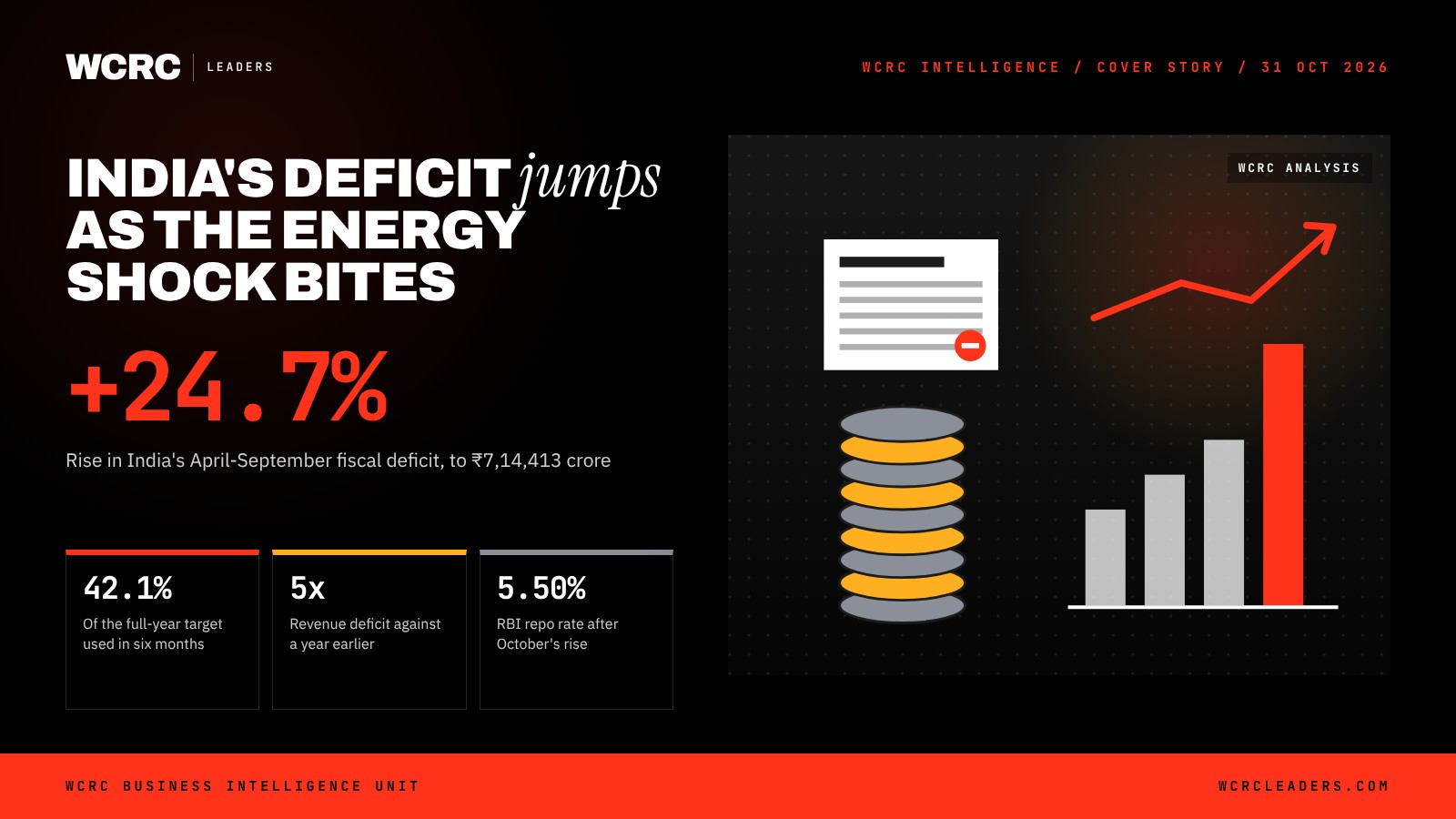
India's fiscal deficit jumps 24.7% as the energy shock eats its room
Filed under