Business
Bank of Baroda's 39.7% overseas loan jump: what sits beneath it
One of India's largest state lenders has posted what it calls its highest ever quarterly profit, three months after paying $600 million in Abu Dhabi to end the NMC Health litigation. The overseas book is growing at twice the pace of the bank, but much of the jump rests on a single dollar-deposit campaign.
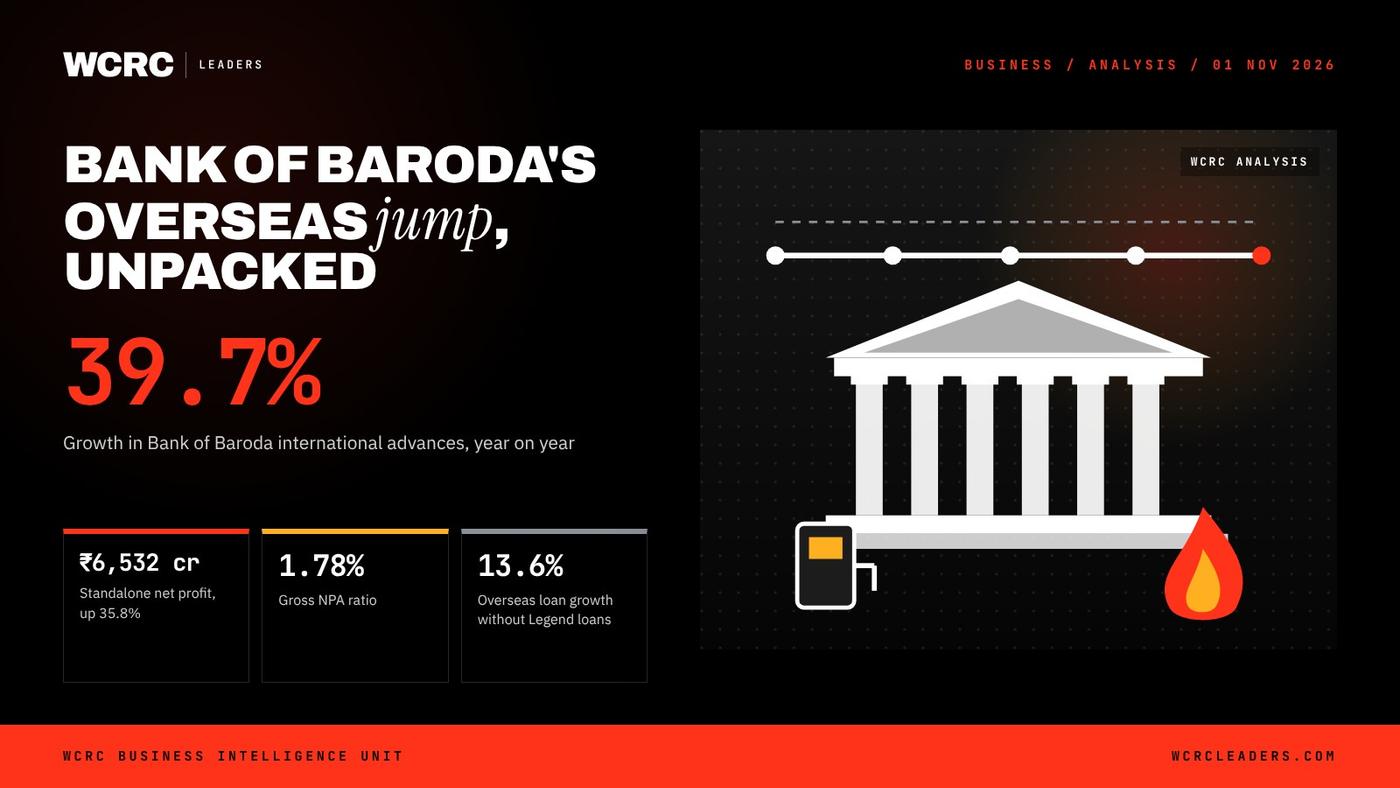
At a glance: WCRC Leaders' assessment: Bank of Baroda's international surge is real but narrower than the headline, with about a fifth of the overseas book tied to one NRI dollar-deposit scheme, and Gulf readers should judge it on margins and governance rather than on growth. On 30 October the bank reported a standalone net profit of ₹6,532 crore for July to September 2026, up 35.8%, with international advances up 39.7% to ₹3,24,504 crore. That matters to every Indian lender chasing growth abroad, and to Gulf firms that bank with them.
What did Bank of Baroda report for the September quarter?
Bank of Baroda, one of WCRC 1000, India's Most Valuable Enterprises 2026, reported a standalone net profit of ₹6,532 crore for the second quarter of FY27, up 35.8% from ₹4,809 crore a year earlier. The bank's press release calls it the highest ever quarterly net profit and the highest ever quarterly operating profit. On a consolidated basis, which includes subsidiaries, net profit was ₹6,737 crore, up 31.2% from ₹5,134 crore.
Operating profit rose 50.9% to ₹11,430 crore. Net interest income, the core earnings from lending, grew a slower 9.0% to ₹13,026 crore. Global net interest margin was 2.74%, down from 2.96% a year earlier.
Asset quality kept improving. The gross non-performing asset ratio fell to 1.78% from 2.16% and the net ratio stood at 0.37%. Provision coverage including technical write-offs was 94.65%. Standalone capital adequacy was 16.61%, with a common equity tier 1 ratio of 14.20%.
The balance sheet grew quickly. Global advances rose 18.3% to ₹15,12,448 crore and global deposits rose 16.4% to ₹17,45,435 crore. Domestic advances grew 13.5%; within that, organic retail lending rose 18.6%, agriculture 19% and organic MSME lending 21.3%. Corporate lending grew only 6.3% and slipped slightly from June.
Why did profit jump when core income rose only 9%?
The answer sits in treasury. Non-interest income nearly doubled to ₹6,881 crore from ₹3,515 crore, and treasury income rose to ₹4,093 crore from ₹1,086 crore. Profit on the sale of investments alone was ₹1,824 crore, against ₹654 crore a year earlier. Fee income actually fell, to ₹1,637 crore from ₹1,790 crore. The cost-to-income ratio dropped to 42.58% from 51.02%.
The comparison with the previous quarter also flatters. In April to June, the bank booked an exceptional item of $600 million, equal to ₹5,680 crore in its results, and net profit fell to ₹1,278 crore. The bank said profit would have been ₹5,528 crore without the payout. As a result, first-half standalone profit of ₹7,810 crore is still 16.5% below the same period last year.
WCRC analysis: a quarter carried by bond gains is a good quarter, not yet a new run-rate. Margins are the better guide, and they are slipping. Domestic net interest margin fell to 2.89% from 3.10%, domestic yield on advances fell to 8.03% from 8.31%, and the domestic CASA ratio, the share of cheap current and savings deposits, dropped to 36.37% from 38.42%.
What is driving the 39.7% rise in international loans?
International gross advances rose to ₹3,24,504 crore from ₹2,32,341 crore a year earlier, and by 22.0% in the September quarter alone. They now make up about 21% of global advances. International deposits grew a slower 14.9% to ₹2,61,915 crore.
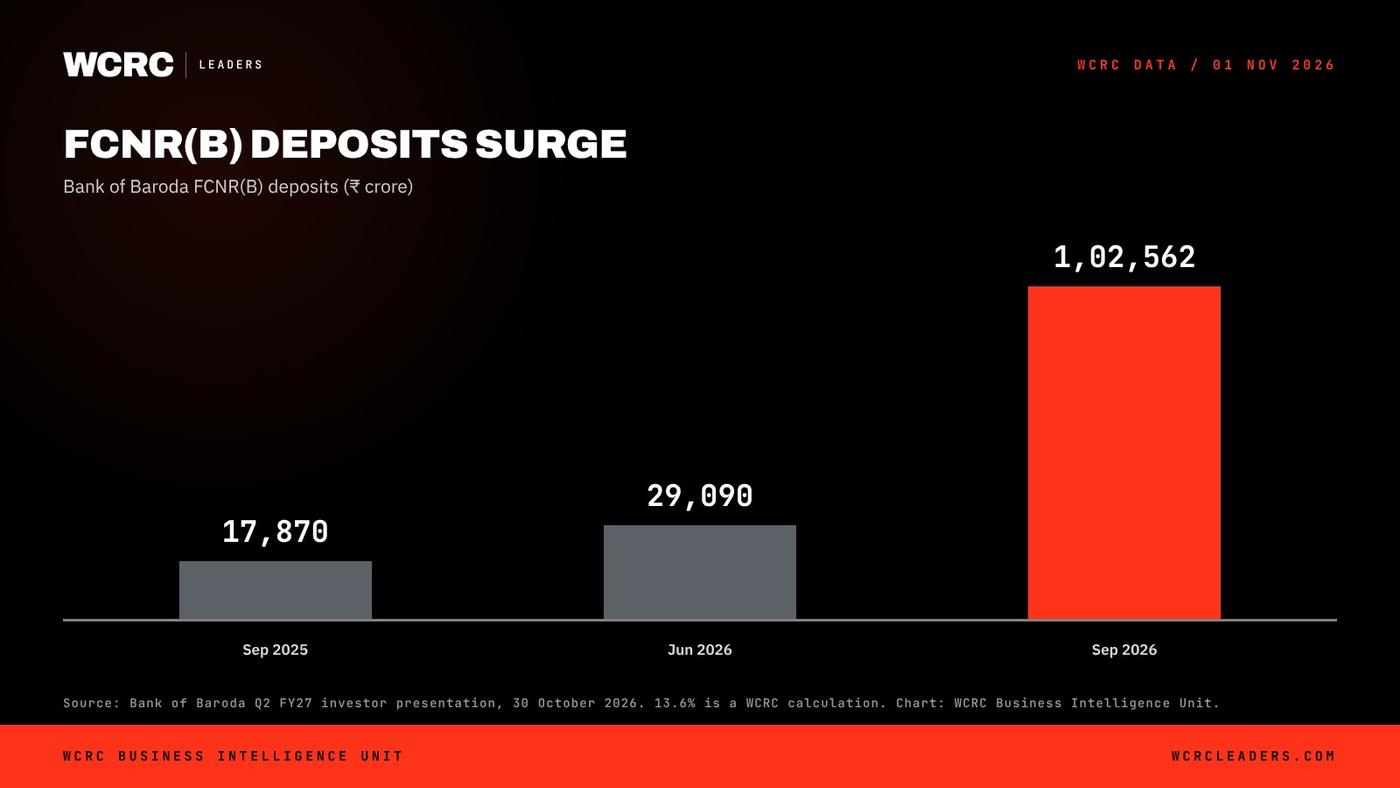
The bank's investor presentation carries a footnote that changes the picture. The international advances figure "includes self-leverage on BOB Legend FCNR (B) deposits of amount INR 60,527 crore". FCNR(B) accounts are foreign-currency term deposits for non-resident Indians. The bank's FCNR(B) deposits rose to ₹1,02,562 crore at the end of September, from ₹17,870 crore a year earlier and ₹29,090 crore in June. Of that, ₹77,270 crore came through the bob Legend scheme.
The timing is not chance. On 8 June 2026 the Reserve Bank of India opened a special USD-INR swap facility for fresh FCNR(B) deposits, external commercial borrowings and overseas foreign-currency borrowings, as part of its effort to draw in dollars. The FCNR(B) window closed on 31 August. RBI data published on 2 September showed provisional FCNR(B) inflows of $127.2 billion across the system. A separate RBI direction of 7 August let banks exclude advances made against eligible FCNR(B) and NRE deposits mobilised between June and September from the base used for priority sector targets.
WCRC calculation: strip out the ₹60,527 crore of Legend-linked loans and the rest of the international book is about 13.6% larger than a year ago. That is healthy, but it is not 39.7%. The bank does not say whether the year-earlier base held any similar loans; the deposit figures suggest little, since the scheme ran from June.
The price shows up in margins. On the bank's figures, international net interest margin fell to 1.49% from 1.81%, as yields on overseas loans dropped to 5.09% from 5.52%. Overseas asset quality is better: international NPAs fell to ₹2,908 crore from ₹3,600 crore, with fresh slippages of just ₹10 crore in the quarter.
Bank of Baroda was not alone. Kotak Mahindra Bank, one of WCRC 1000, India's Most Valuable Enterprises 2026, raised about ₹55,344 crore of FCNR(B) deposits in the same quarter, as WCRC reported in its Kotak Q2 analysis. We set out the system-wide cost in what India's rupee defence is costing its biggest banks.
Why should UAE and GCC readers pay attention?
Two reasons. First, FCNR(B) money comes from non-resident Indians, a community deeply rooted in the Gulf. When Indian banks compete for three- to five-year dollar deposits, Gulf-based savings become part of how India defends its currency and how its banks grow abroad.
Second, the Gulf is where Bank of Baroda carried its largest legal risk. In a filing to the National Stock Exchange on 2 July, the bank said its Abu Dhabi branch had paid $600 million, about ₹5,700 crore, in an out-of-court settlement with the joint administrators of NMC Health PLC and related entities. The claims were heard in the Abu Dhabi Global Market Court and the High Court of England and Wales. The bank said they were settled "without admission of liability or wrongdoing", that its liability "is limited to this sum", and that the ADGM case had been discontinued. With that settled, the bank's Gulf franchise moves from a contingent risk to a growth line.
For Gulf corporates, a large Indian state lender with a cleaner overseas book and ample capital is a more willing counterparty for trade and project finance. For Gulf regulators and auditors, the lesson of NMC remains: a lender's links to a failed client can surface years later, in more than one court.
What should Indian boards take from this?
Growth abroad is now easy to report and harder to read. Several Indian banks booked large FCNR(B)-linked balances in the quarter, which lift loans and deposits but squeeze margins. Audit committees should ask for growth figures with and without these flows, and for when they mature.
IDFC First Bank, one of WCRC 1000, India's Most Valuable Enterprises 2026, took a different path, building retail at home, as our IDFC First Q2 review set out. Domestic retail growth earns more; growth tied to a central bank window is quicker but thinner.
Read through Corporate Value Intelligence, WCRC's framework for interpreting enterprise value, the market will reward the profit beat only if it believes the earnings mix holds once treasury gains fade. Bank of Baroda's value case rests on its domestic retail, agriculture and MSME engines, which grew at 18% to 21%, more than on its overseas numbers.
The WCRC View
This was a strong quarter with a soft core. Profit was lifted by treasury gains and lower provisions, and overseas growth was lifted by one deposit scheme. Neither is a reason to doubt the bank; both are reasons to read past the headline.
In the terms of SeeClear, a model in WCRC's Guru Management Codex, leaders should separate the rope from the snake. The fact is a 13.6% rise in the underlying international book and falling overseas NPAs. The projection is that a state bank has suddenly found a 40% growth engine abroad.
Read through WCRC's Governance Shield, the model that asks whether reputation is protected at board level, the NMC settlement shows how long a claim tied to a failed client can weigh on a bank's name. Paying to close it, without admitting liability, removes an overhang; the test now is whether the board explains how it watches such risks in the Gulf.
Who gains: Gulf-based NRIs earning dollar returns, Gulf corporates seeking Indian bank credit, and shareholders spared further NMC uncertainty. Who should be careful: any bank whose margins depend on funding that came in through a time-bound central bank window.
What leaders should do now: Indian bank boards should publish growth both including and excluding FCNR(B)-linked flows, and set targets on margin as well as on volume. Gulf treasurers should price Indian bank deposits and loans with the eventual maturity of these flows in mind.
What WCRC will watch: the bank's December-quarter international margin, whether treasury income normalises, and how the FCNR(B) balances behave through 2027.
WCRC models applied: SeeClear (Guru Management Codex), Governance Shield (Brand & Marketing Codex), Corporate Value Intelligence (WCRC 1000).
Quick answers
Q: What was Bank of Baroda's Q2 FY27 net profit? A: Standalone net profit was ₹6,532 crore, up 35.8% year on year. Consolidated net profit was ₹6,737 crore, up 31.2%.
Q: How fast did Bank of Baroda's international loans grow? A: International gross advances rose 39.7% to ₹3,24,504 crore. That includes ₹60,527 crore of what the bank calls "self-leverage" on bob Legend FCNR(B) deposits; without it, WCRC calculates growth of about 13.6%.
Q: What was the NMC Health settlement? A: In July 2026 the bank's Abu Dhabi branch paid $600 million to settle claims by NMC Health's administrators in the ADGM and English courts, without admitting liability.
Q: How is Bank of Baroda's asset quality? A: Gross NPA fell to 1.78% from 2.16% and net NPA was 0.37%, with provision coverage including technical write-offs of 94.65%.
Adani Ports raises FY27 capex by ₹3,000 crore as overseas ports surge
Vedanta doubles Gamsberg, and Ramaphosa now wants a zinc smelter
Anchor investors in Indian IPOs: why the 60% book sets the tone

Sun Pharma's profit falls 36% as it pays for Organon and a US lawsuit

Bajaj Finance lines up ₹17,500 crore as AI agents take on service

$133bn: what India's rupee defence is costing its biggest banks
Filed under