Business
Apollo buys into Mubadala Capital as $5bn of commitments follow
Abu Dhabi's sovereign investor is letting outsiders own part of its asset manager. For Indian and Asian companies that raise private credit and equity in the Gulf, the counterparty is changing shape.
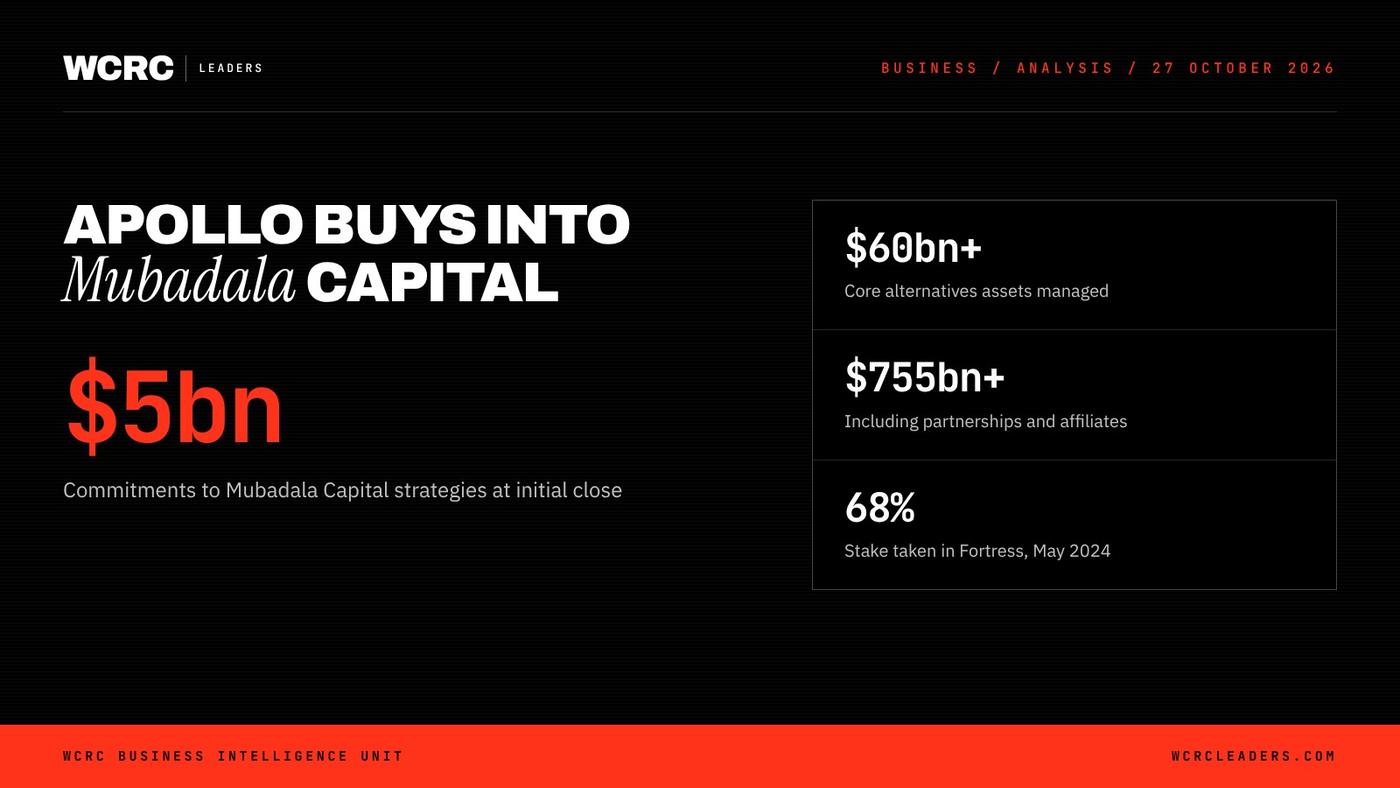
At a glance: WCRC Leaders' assessment: Mubadala Capital is being run as a business that outsiders can own, and Asian borrowers should expect Gulf money to come with fund-manager discipline rather than sovereign patience. On 26 October 2026, Mubadala Capital said Apollo will take a minority equity stake, with Apollo and other new minority investors expected to commit $5bn across its strategies at initial close. Mubadala Investment Company stays majority owner. Size and valuation were not disclosed. Closing is expected in the fourth quarter of 2026, subject to approvals.
What did Mubadala Capital and Apollo announce?
Mubadala Capital, the alternative asset management arm of Mubadala Investment Company, said on 26 October that Apollo will acquire a minority equity stake and commit capital across its investment strategies. Additional strategic investors will also become minority shareholders. Together with Apollo, they are expected to commit an aggregate of $5bn to Mubadala Capital's strategies at initial close.
Neither side disclosed the size of the stake or the valuation it implies. Mubadala Investment Company remains the majority shareholder. Apollo joins the founders of Silver Rock Financial as an equity holder in Mubadala Capital. The firm keeps its own governance structure, and its management team retains full authority over investment decisions and operations. The deal is expected to close in the fourth quarter of 2026, subject to regulatory and legal approvals.
Hani Barhoush, chief executive of Mubadala Capital, called Apollo "one of the most respected institutions in our industry". John Zito, co-president of Apollo Asset Management, said the investment "will deepen our alignment and strengthen our mutual commitment to each other's success".
Goldman Sachs and Jefferies advised Mubadala Capital, with Skadden as legal counsel. Morgan Stanley advised Apollo, with Paul, Weiss as legal counsel.
How big is Mubadala Capital now?
Founded in 2011, Mubadala Capital says its core alternatives business manages more than $60bn across five strategies: private equity, special opportunities with a Brazil focus, credit, venture capital, and a solutions and co-investment platform. Including its partnerships and affiliates, it manages, advises or administers more than $755bn. It employs more than 250 professionals across Abu Dhabi, London, New York, Rio de Janeiro and San Francisco. Apollo itself had about $1.05tn of assets under management at 30 June 2026.
The jump to $755bn reflects two years of acquisitions:
- Fortress Investment Group (closed 15 May 2024). A Mubadala Capital-led consortium took 68% of Fortress, with Fortress management holding 32% in a class that lets it appoint a board majority. Fortress managed about $48bn at the time.
- Silver Rock Financial (announced 5 December 2024, closed 1 October 2025). Mubadala Capital bought 42% of the Los Angeles credit manager, paid partly in cash and partly in stock, and pledged more than $1bn to Silver Rock vehicles over time.
- CI Financial (completed 12 August 2025). Mubadala Capital took the Toronto-listed wealth and asset manager private at C$32 a share, valuing its equity at about C$4.7bn and the enterprise at about C$12.1bn. It then put combined assets managed, advised and administered at over $430bn.
The stock component of the Silver Rock deal matters. It made Mubadala Capital's own equity a currency, and Apollo now joins those founders on the shareholder register.
Why would a sovereign fund sell part of its own manager?
Analysis. Selling a minority stake does three things. It puts an outside price on the business, even if that price is not published. It brings in third-party money, here $5bn of commitments, which is the step that separates an in-house investment office from a fund manager. And it binds a large partner to the platform's results through equity rather than through fee arrangements alone.
The approach mirrors the Fortress structure, where management kept board control under Mubadala ownership. The Apollo terms follow the same pattern: the sovereign parent keeps a majority, management keeps the investment decisions, and outsiders take an economic interest. For a state investor, this is a way to grow a manager faster than its own balance sheet allows without giving up control.
How deep do Apollo's Gulf ties already run?
Apollo has been building in Abu Dhabi for six years. In September 2020, an Apollo-led consortium bought 49% of an ADNOC real estate leasing company holding assets valued at $5.5bn, giving ADNOC $2.7bn of upfront proceeds while it kept 51% and operational control. In 2022, Apollo and Mubadala set up a partnership focused on global origination, extended in November 2024 to support Apollo's Capital Solutions business, alongside a separate $2.5bn joint venture to co-invest in global private credit. In January 2025, Apollo funds agreed to buy $500m of subordinated notes from Aldar Properties, its fourth Aldar transaction since 2022, taking its total investment in the developer to about $1.9bn.
Zito's comment in the release, that Mubadala "has been a trusted partner in seeding and scaling a number of our strategies over the years", describes the relationship in reverse: Mubadala money helped build Apollo strategies, and now Apollo money goes into Mubadala's manager.
What does this mean for Indian and Asian companies raising Gulf money?
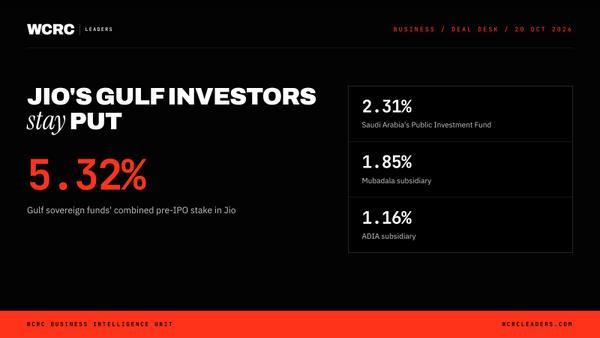
Gulf sovereign capital is already embedded in India's largest private deals. Mubadala is one of three Gulf sovereign investors that together hold 5.32% of Jio Platforms, the digital business of Reliance Industries, one of WCRC 1000, India's Most Valuable Enterprises 2026, and WCRC has reported that they are keeping their shares through the Jio Platforms IPO. Jio, a WCRC MegaBrand in mobile network operators, shows the kind of long-dated holding sovereign balance sheets can carry.
That is the parent's capital, not the manager's. Mubadala Capital invests through funds with outside commitments, return targets and fund lives. Analysis: As more Gulf money flows through manager platforms with external shareholders, Indian and Asian borrowers should expect pricing, covenants and exit timetables closer to those of a global private credit or buyout fund. The upside is scale and speed: a platform with Apollo's origination links and a credit strategy can write larger cheques, and can syndicate them.
The timing makes this sharper. UNCTAD's Gulf Cooperation Council Investment Report, published on 25 October 2026, found GCC outward FDI rose 11% to $130bn in 2025, while inflows rose 18% to about $99bn, a decade high. But it warned that the Strait of Hormuz crisis is testing that expansion, that preliminary indicators for the first half of 2026 show a sharp, region-wide weakening of investment activity, and that prolonged disruption could push state-linked investors towards domestic resilience projects and delay overseas spending. The same report notes that India and China have grown in importance as sources of investment into the GCC.
Analysis: If sovereign balance sheets turn inward, the manager platforms, funded partly by outsiders, become the more reliable channel for Gulf money to keep reaching Asia. The Gulf-Asia corridor is also widening through trade, as the UAE-Singapore move to CEPA talks shows, even as security risks have disrupted the region's deal calendar, including the postponement of FII10 to 2027.
The WCRC View
The WCRC Business Intelligence Unit reads this as a structural shift, not a one-off sale. Abu Dhabi is turning its in-house investment capability into a fund management business with outside owners, outside commitments and an implied market value. Control stays with the state, but the economics are now shared with one of the world's largest alternative managers.
The gainers are clear. Mubadala Capital gets a validating shareholder and $5bn of fresh commitments. Apollo deepens a relationship that already spans ADNOC, Aldar and Mubadala itself. Asian companies with credible credit stories gain access to a larger, faster platform.
The trade-off falls on borrowers who have relied on sovereign patience. Fund money has a clock. CFOs in India and South-East Asia should price Gulf private credit and growth equity against global fund terms, not against the softer expectations attached to direct sovereign stakes.
What leaders should do now: map which Gulf capital in your cap table or debt stack comes from a sovereign balance sheet and which comes from a manager platform; build relationships with the platforms' credit and special situations teams, not only with the parent; and stress-test refinancing plans against the slower Gulf outflows that UNCTAD has flagged for 2026.
What WCRC will watch next: the names of the other minority investors, whether a valuation emerges at closing in the fourth quarter, whether other Gulf sovereign investors follow with stakes in their own managers, and the first Asian deals Mubadala Capital writes after closing.
Quick answers
Q: What is Apollo buying? A: A minority equity stake in Mubadala Capital, the alternative asset management arm of Mubadala Investment Company. The size and valuation were not disclosed.
Q: How much new capital is involved? A: Apollo and other new minority investors are expected to commit $5bn in aggregate to Mubadala Capital's investment strategies at initial close.
Q: Who controls Mubadala Capital after the deal? A: Mubadala Investment Company remains majority shareholder, and Mubadala Capital's management keeps full authority over investment decisions and operations.
Q: When will the deal close? A: In the fourth quarter of 2026, subject to regulatory and legal approvals.
Vedanta doubles Gamsberg, and Ramaphosa now wants a zinc smelter
Anchor investors in Indian IPOs: why the 60% book sets the tone

Bajaj Finance lines up ₹17,500 crore as AI agents take on service

$133bn: what India's rupee defence is costing its biggest banks
Jio Platforms IPO: Gulf funds hold 5.32% and are not selling
Détente in two-month instalments: planning for China after the Washington summit
Filed under