Business
UltraTech's Ultravolt: why a cement giant is selling wires to homeowners
UltraTech Cement grew profit by a fifth in a monsoon quarter, but the more telling line in its 19 October results was a new consumer brand. With Ultravolt, India's largest cement maker is asking homeowners and electricians to trust it with the wiring inside their walls, in a market Polycab and Havells have spent decades building.
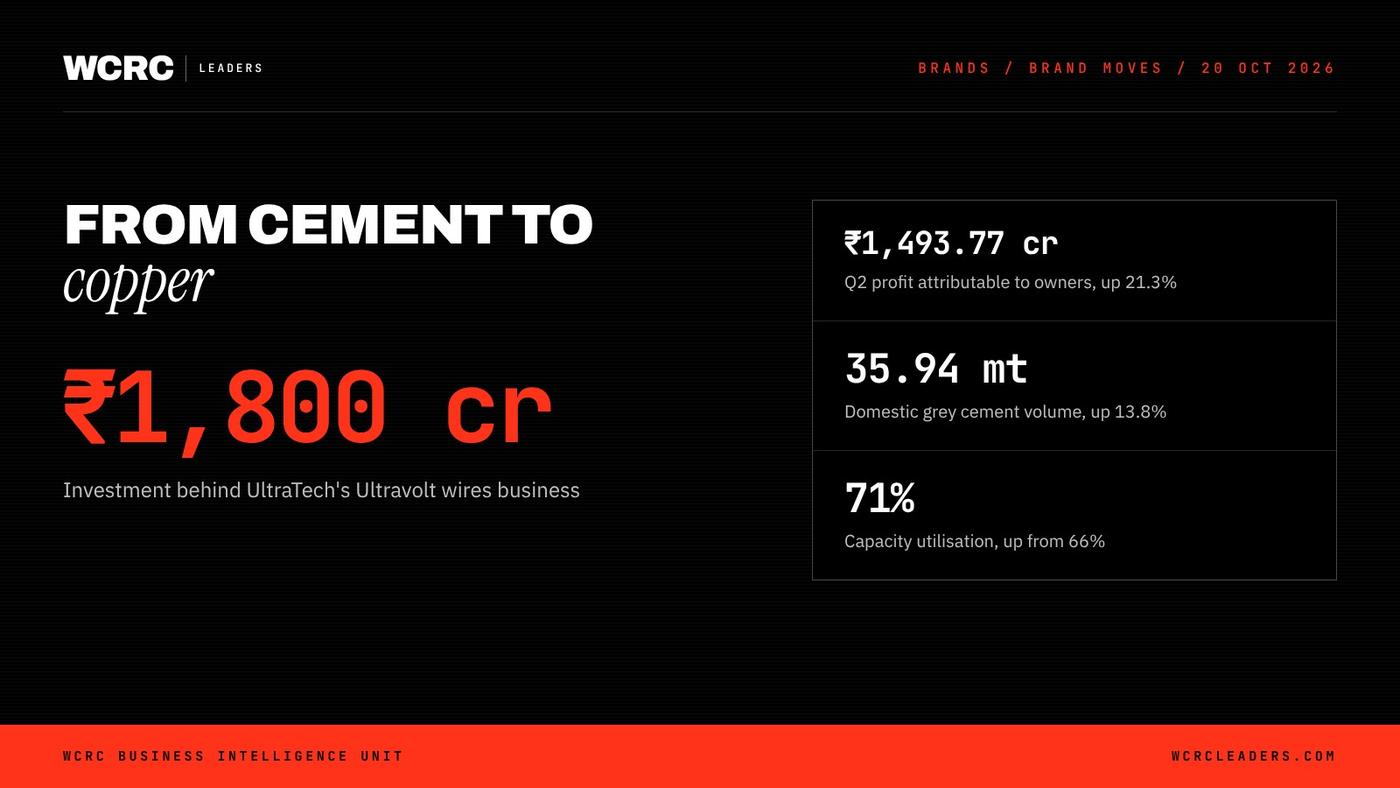
At a glance: WCRC Leaders' assessment: Ultravolt is a distribution bet dressed as a product launch, and it will succeed or fail on whether UltraTech can turn a contractor's cement brand into a name an electrician recommends. UltraTech reported consolidated net profit attributable to owners of ₹1,493.77 crore for the September quarter, up 21.3%, on revenue from operations of ₹23,295.07 crore. In the same quarter it commissioned its wires and cables plant at Jhagadia, Gujarat, and launched Ultravolt nationally. For leaders weighing brand extensions, it is a live test of how far a trusted name can travel.
What did UltraTech report for the September quarter?
The board approved results for the quarter ended 30 September 2026 on 19 October. In the consolidated statement filed with the stock exchanges, revenue from operations rose 18.8% to ₹23,295.07 crore from ₹19,606.93 crore a year earlier. Net profit for the period was ₹1,501.38 crore, up from ₹1,237.98 crore. Of that, ₹1,493.77 crore was attributable to owners of the parent, against ₹1,231.58 crore, and ₹7.61 crore to non-controlling interests. Both measures rose 21.3%. The company's press release uses the larger ₹1,501 crore figure as "PAT"; the owners' share is the cleaner measure of what shareholders earned.
The release puts consolidated net sales at ₹23,024 crore, up 18.9%, and EBITDA at ₹3,832 crore, up 17.3% from ₹3,268 crore. By WCRC's calculation, that is a margin of about 16.6% of net sales, slightly below the 16.9% of a year earlier. Domestic grey cement volumes rose 13.8% to 35.94 million tonnes, and capacity utilisation climbed to 71% from 66%. The company credited execution, market reach and premium products, and named a monsoon-hit quarter and the West Asia crisis as headwinds.
Capacity kept growing. UltraTech commissioned a 3.6 mtpa greenfield integrated plant at Petnikota in Andhra Pradesh and added 1.0 mtpa through debottlenecking at Visakhapatnam, Patratu and Nathdwara. Domestic grey cement capacity stood at 204.7 mtpa at 30 September, with 5.4 mtpa overseas, for 210.1 mtpa globally. The company says it remains on track for more than 240 mtpa by March 2028. Green power, from waste heat recovery and renewables, made up 48% of its power mix in the quarter.
What is Ultravolt, and how big is the bet?
Ultravolt is the Aditya Birla Group's wires and cables business, housed inside UltraTech. The group announced it on 3 September 2026, two days after commercial production began at Jhagadia in Bharuch district, with an investment of ₹1,800 crore. The investor presentation says about ₹1,100 crore had been committed or spent so far.
The plant's planned capacity consumes 78,000 tonnes of copper and 24,000 tonnes of aluminium a year. On that basis, UltraTech says it is the second-largest player in house wires by capacity on day one. The range covers house wires, flexible cords, multi-core and submersible cables, solar DC cables, CCTV and LAN cables. Copper comes from Hindalco, the group's metals company.
The stated goal is a place among the top two in wires and cables within five years. The rollout was national from the start: more than 500 districts, over 15,000 serviceable PIN codes and more than 80,000 retailers and electricians already onboarded, per the presentation, with over 5,000 UltraTech Building Solutions outlets in support. Dilip Gaur, Director of Ultravolt, said: "We are venturing at pan India scale rather than testing the market region by region."
Why would a cement leader build a consumer electrical brand?
Kumar Mangalam Birla, Chairman of the Aditya Birla Group, framed the case around demand. "Wires and cables are becoming central to India's next phase of development," he said at launch, pointing to new homes, energy infrastructure and data centres. The group puts the Indian wires and cables market at ₹1,24,085 crore.
There is also a structural logic. UltraTech already sells to the same house through ready-mix concrete, waterproofing, tile adhesives and mortars. Wiring goes into the walls at roughly the same stage as cement and plaster, often chosen by the same contractor or bought from the same counter. Every new category raises the value of a dealer relationship UltraTech has already paid for.
And there is the group pattern. Birla described Ultravolt as the group's fourth new business in three years, adding: "I increasingly see the Aditya Birla Group as providing the platform and engine for new bets." That is a holding company telling markets it now treats capital, metals supply and distribution as shared assets to be put to work in new consumer categories.
Who is UltraTech up against?
The incumbents are large and still growing fast. Polycab, the market leader, reported wires and cables revenue of ₹25,179 crore for FY26, up 33%, sold through more than 3,900 authorised dealers and 190,000 retail outlets. Its chairman said domestic market share rose by roughly three to four percentage points during the year. Havells reported cables revenue of ₹2,456 crore in the June 2026 quarter, up 27%, and says its FY27 capital spending of ₹1,400 crore is mainly for cables capacity.
That is the hard part of the story. Capacity can be bought in two years. Electrician loyalty, the habit of asking for a brand by name at the counter, takes much longer. Sriram Rangarajan, CEO of Ultravolt, put the brand problem plainly: "Wires are the lifeline of a house but often go unnoticed." Ultravolt's answer is a training programme with the Electronics Sector Skills Council of India to certify more than 40,000 electricians over the next year. That is a direct move on the influencer who decides most house-wire purchases.
What does brand extension mean for leaders in India, the Gulf and Asia?
In India, the lesson is that the strongest extensions now travel along the channel rather than the logo. UltraTech's cement name gives Ultravolt credibility with builders. What it does not give is consumer pull at the electrical counter, so the group is spending on electricians and retailers first.
In the Gulf, UltraTech is already present: its filings list Star Cement in Dubai, Al Nakhla Crusher in Fujairah and Arabian Cement Industry in Abu Dhabi among its subsidiaries. Overseas volumes slipped 1.4% to 1.75 million tonnes this quarter, and the company cited the West Asia crisis. Gulf conglomerates with building-materials arms and large housing pipelines face the same question UltraTech has answered: whether to sell more products to the customers they already reach.
Across Asia, group-led adjacency moves are familiar, from Japanese trading houses to Korean chaebol. India's version is now being tested in public, with quarterly disclosure, against listed specialists. That gives every board a benchmark to watch.
UltraTech's parent, Grasim Industries, and group company Hindalco Industries were both selected for India's Most Loved 250 Workplaces 2026 by the Business Intelligence Unit of WCRC. For more on the group, read WCRC's profiles of Grasim and Hindalco, and our analysis of India's 11.39% wholesale inflation and the margin squeeze, which bears directly on copper-heavy businesses.
The WCRC View
This is a credible entry, not yet a credible brand. The WCRC Business Intelligence Unit's analysis is that UltraTech has solved the problems money can solve: capacity, captive copper, national warehousing and day-one reach. The problem it has not solved is preference at the counter, and that is where Polycab and Havells are strongest.
The cement business gives Ultravolt time. A 21.3% profit rise, 71% utilisation and a clear path to 240 mtpa mean the core can fund a patient build. Ultravolt is small against UltraTech's balance sheet, so early margins matter less than early share.
Incumbents gain from the noise, at least first. A well-funded entrant validates the category's growth and forces sharper dealer terms, but in our view leaders with deep electrician networks are better placed than their share prices sometimes suggest.
What leaders should do now: treat channel overlap, not brand fame, as the test for any extension. Ask who decides the purchase, and whether you already reach that person. If not, budget for building that relationship before building the plant.
What WCRC will watch next: Ultravolt's disclosed revenue and retailer count in UltraTech's December-quarter results, how copper prices affect the new business's pricing, and whether Polycab or Havells respond with electrician incentives or price moves before the end of FY27.
Quick answers
Q: What was UltraTech's net profit for Q2 FY27? A: Consolidated net profit attributable to owners of the parent was ₹1,493.77 crore, up 21.3%. Total net profit including non-controlling interests was ₹1,501.38 crore.
Q: What is Ultravolt? A: The Aditya Birla Group's wires and cables brand, housed in UltraTech Cement, launched on 3 September 2026 with a ₹1,800 crore investment and a plant at Jhagadia, Gujarat.
Q: How large is the Jhagadia plant? A: Its planned capacity uses 78,000 tonnes of copper and 24,000 tonnes of aluminium a year, which UltraTech says makes it the second-largest house-wire player by capacity.
Q: What is UltraTech's cement capacity? A: 204.7 mtpa in India and 210.1 mtpa globally at 30 September 2026, with a target of more than 240 mtpa by March 2028.
Filed under