Business
Swiggy's ₹895 crore Instamart loss: the price of catching Blinkit
Swiggy's food business posted its best margins yet in the September quarter, and its quick-commerce arm absorbed all of it and more. The results set out, in Swiggy's own numbers, how far Instamart still has to travel.
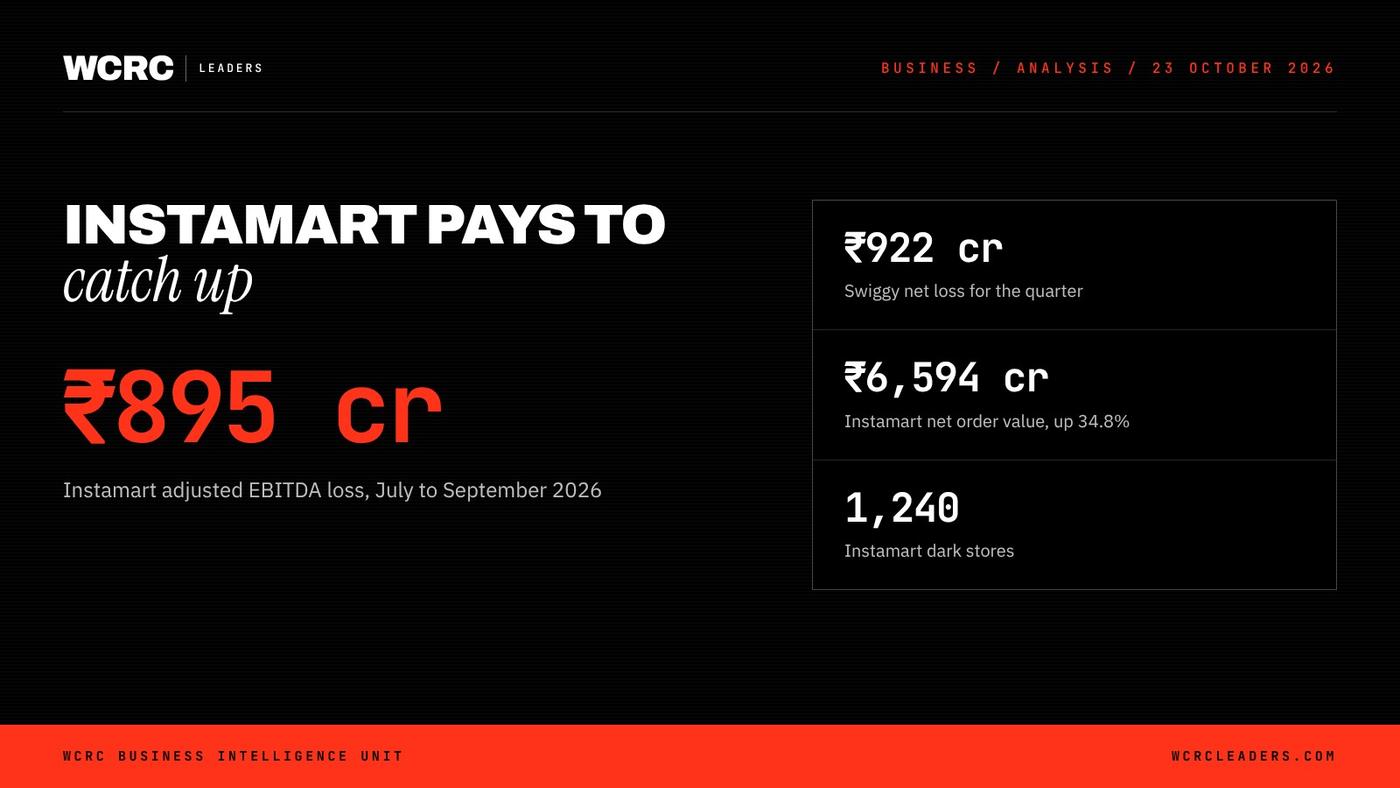
At a glance: WCRC Leaders' assessment: Swiggy has a profitable food business funding a quick-commerce catch-up that, on its own maths, needs more than twice today's scale to break even, so the race with Blinkit will be decided by capital and patience, not speed. On 22 October Swiggy reported a consolidated loss of ₹922 crore for July to September 2026, down from ₹1,092 crore a year earlier but up from ₹791 crore in the June quarter. Instamart lost ₹895 crore at the adjusted EBITDA level. For FMCG boards, retailers and investors in India, the Gulf and Asia, the gap between the two leaders now shapes pricing, distribution and valuations.
What did Swiggy report for the September quarter?
Revenue from operations rose 36.1% year on year to ₹7,571 crore, according to Swiggy's shareholder letter and the financial statements it contains. Total income was ₹7,783 crore. The headline figure in Swiggy's press release, ₹7,909 crore up 33.8%, is a different measure: "Consolidated Adjusted Revenue", which the company defines as revenue from operations plus user delivery charges and certain user fees.
The loss after tax of ₹922 crore was 15.6% narrower than a year ago and 16.6% wider than the previous quarter. Consolidated adjusted EBITDA was a loss of ₹760 crore, against ₹695 crore a year earlier and ₹651 crore in the June quarter. B2C gross order value (GOV) across food delivery, Instamart and out-of-home dining reached ₹20,793 crore, up 24.6%.
Swiggy ended the quarter with a closing cash balance of ₹13,662 crore on its management reconciliation, down from ₹14,367 crore three months earlier.
How strong is the food delivery business?
Stronger than at any point in its history. Food delivery GOV grew 17.7% to ₹10,054 crore, and Swiggy said September growth ran above 20%. Adjusted EBITDA rose by ₹101 crore year on year to ₹341 crore, a margin of 3.4% of GOV, up 58 basis points. Monthly transacting users reached 19.8 million.
"Our Food delivery business delivered its highest ever profits and margins," said Sriharsha Majety, MD and Group CEO, in the press release. The shareholder letter credits "advertising-led monetisation" for lifting the food take rate to 26.1%. Swiggy kept its full-year food GOV growth guidance of 18 to 20% and its steady-state margin target of 5%.
Why is Instamart still losing so much money?
Instamart's GOV rose 31.4% year on year and 16.7% on the quarter to ₹9,230 crore. Net order value (NOV), the measure Swiggy uses for its break-even maths, was ₹6,594 crore, up 34.8% year on year and 13.4% on the quarter, according to the shareholder letter.
Contribution margin was minus 1.0% of GOV, 157 basis points better than a year ago but 82 basis points worse than the June quarter. Adjusted EBITDA was a loss of ₹895 crore, or minus 9.7% of GOV, compared with a loss of ₹849 crore a year earlier and ₹778 crore in the June quarter. Swiggy added 69 dark stores, taking the network to 1,240 stores in 133 cities, covering 5.2 million square feet.
The letter names two causes: "targeted investments of 100 bps in habit formation and dormant-user reactivation", and the cost of new stores that are not yet fully used. It is blunt about the market. "Competitive intensity in the sector remains high, and we do not expect it to ease in the near-term," management wrote.
The arithmetic is stark: food delivery earned ₹341 crore and Instamart lost ₹895 crore.
How far behind Blinkit is Instamart?
Eternal's results filing of 21 October gives the comparison. Blinkit, Eternal's quick-commerce business, reported NOV of ₹20,940 crore for the same quarter, up 79.3%, from 2,751 stores, and a positive adjusted EBITDA of ₹184 crore.
WCRC analysis of the two filings: Blinkit's quarterly NOV is a little over three times Instamart's, from a little over twice the number of stores, and it is growing more than twice as fast. Blinkit is already making money at the adjusted EBITDA level; Instamart is losing close to ₹10 for every ₹100 of goods it sells.
Swiggy sets out its own route to break-even. "We need ~2.3x today's scale (INR 60,000 Cr of annualised NOV, from INR 26,400 Cr today)," the letter says, together with ₹30 of contribution per order. WCRC calculation: Blinkit's September-quarter NOV, annualised, is already above the ₹60,000 crore mark Swiggy has set for itself.
Swiggy argues that speed alone will not settle the contest. "As speed and price become table stakes, we believe differentiated assortment will decide the winners," Mr Majety wrote in the letter, adding that Swiggy views assortment "as a curation game rather than a volume game".
What changes next for Instamart?
Three things, with dates. First, Swiggy expects Instamart's contribution margin to stay between zero and minus 100 basis points in the December quarter, then improve. Second, it expects the adjusted EBITDA margin to improve by about 100 basis points quarter on quarter in Q3 FY27, and says: "We believe the Adjusted EBITDA losses to have peaked out in Q2FY27." It gives no date for break-even. Third, from mid-Q3 Instamart begins moving to what the letter calls an "India owned and controlled structure", which "will allow Instamart to own inventory". Swiggy expects this to add up to about 80 basis points to contribution margin over two to three quarters and to shorten its working capital cycle by eight to ten days.
The December quarter, which spans the festive and wedding season, is the first test of the "peaked out" claim; Swiggy reports it in early 2027.
What does it mean for FMCG brands, retail jobs and investors?
For FMCG companies, two well-funded platforms competing hard on price, speed and range means more negotiating power for the brands both want on their shelves, and more pressure to pay for visibility. Swiggy's own disclosures show advertising is now central to how it earns money. Inventory ownership will also change the relationship: a platform that buys stock behaves more like a retailer, with a say on terms, private labels and placement. Swiggy's clean-food private brand, No!ce, already appears in more than one in eight orders, according to the letter.
For jobs, Swiggy averaged 756,000 monthly transacting delivery partners across its businesses in the quarter, and every new dark store adds packing and store staff. WCRC analysis: quick commerce is creating flexible, urban work at scale while drawing basket share from neighbourhood grocers, a trade-off that state governments and labour regulators will keep under review.
For Gulf and Asian investors, the question is cost of capital. A ₹13,662 crore cash balance gives Swiggy time, but a quarterly Instamart loss near ₹900 crore is not open-ended. With India's interest-rate cycle turning (see WCRC's analysis of the RBI's first rate hike since 2023) and input costs rising, as our wholesale inflation analysis shows, patient capital is getting dearer. Sovereign and long-only funds weighing India's consumer-internet listings, alongside large issues such as the Jio Platforms IPO, will judge Swiggy on how quickly the Instamart loss falls, not on how fast GOV grows.
Swiggy is named among India's Most Loved 250 Workplaces 2026 by WCRC.
The WCRC View
The call. Swiggy now has a dependable profit engine in food delivery and a quick-commerce business that is still buying its way into a two-player market. Management says Instamart losses have peaked. That is plausible on margins, but the scale gap with Blinkit is wide and widening, and Swiggy's own break-even target sits well above where Instamart is today.
Who gains. In the near term, consumers and FMCG brands gain from two leaders spending heavily on price, range and visibility. Blinkit gains from being able to fund growth out of profit while its rival funds it from cash.
What leaders should do now. FMCG boards should model quick commerce as a channel with retailer-like power, plan for inventory-owning platforms and price ad spend into trade terms. Retailers should treat near-instant delivery as the new baseline for convenience categories. Investors should track Instamart's contribution per order and the absolute EBITDA loss, not GOV growth.
What WCRC will watch. Whether Instamart's margin improves by the promised 100 basis points in the December quarter; how the move to owned inventory affects supplier terms; and whether Swiggy's store additions pick up or slow as it chases density over footprint.
Quick answers
Q: What was Swiggy's net loss in Q2 FY27? A: ₹922 crore for July to September 2026, against ₹1,092 crore a year earlier and ₹791 crore in the June quarter.
Q: Is Swiggy's revenue ₹7,909 crore or ₹7,571 crore? A: Both are correct but measure different things. Revenue from operations was ₹7,571 crore, up 36.1%. Adjusted revenue, which adds user delivery charges and certain fees, was ₹7,909 crore, up 33.8%.
Q: How much did Instamart lose? A: An adjusted EBITDA loss of ₹895 crore, or minus 9.7% of its ₹9,230 crore GOV, with 1,240 dark stores at quarter end.
Q: When does Swiggy expect Instamart to break even? A: It gives no date. It says losses peaked in Q2 FY27 and break-even needs about ₹60,000 crore of annualised NOV, around 2.3 times today's ₹26,400 crore.
Vedanta doubles Gamsberg, and Ramaphosa now wants a zinc smelter
Anchor investors in Indian IPOs: why the 60% book sets the tone

Bajaj Finance lines up ₹17,500 crore as AI agents take on service

$133bn: what India's rupee defence is costing its biggest banks
Jio Platforms IPO: Gulf funds hold 5.32% and are not selling

Détente in two-month instalments: planning for China after the Washington summit
Filed under