People
Mohit Joshi's Tech Mahindra: 14.8% margin, one step short of 15%
Ten quarters after taking charge, Tech Mahindra's chief executive has doubled the company's operating margin and kept deal wins above $1bn for a year. The final test of his FY27 promise comes in the next two quarters.
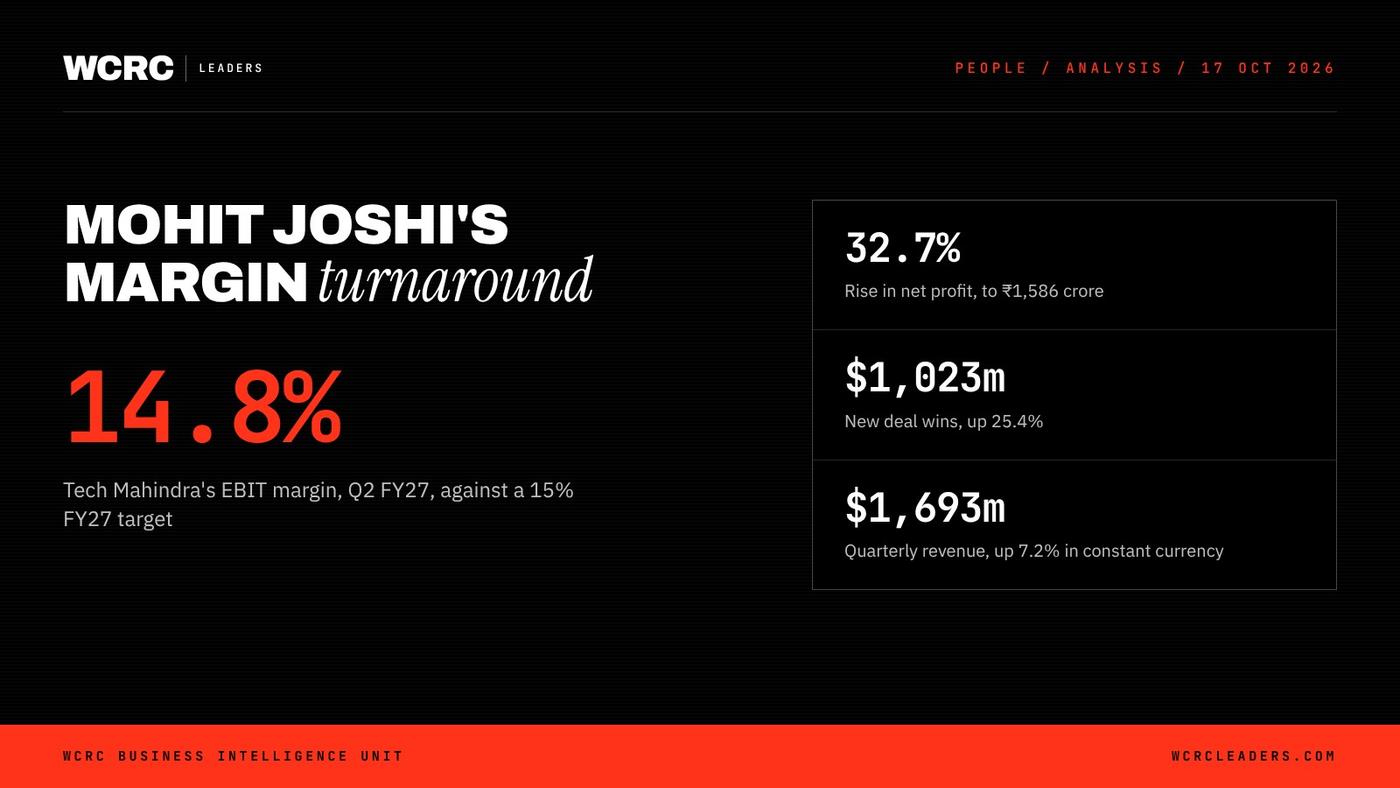
At a glance: WCRC Leaders' assessment: Mohit Joshi has rebuilt Tech Mahindra's profitability faster than its growth, and the turnaround will only count as complete if the 15% margin arrives without starving the top line. Tech Mahindra reported on 15 October 2026 revenue of $1,693m for the July to September quarter, up 7.2% year on year in constant currency, with an EBIT margin of 14.8%. Net profit rose 32.7% to ₹1,586 crore. Joshi's public target, set in April 2024, is a 15% margin in FY27, which ends on 31 March 2027.
What did Mohit Joshi inherit?
Joshi became managing director and chief executive in December 2023, succeeding C.P. Gurnani, who retired on 19 December. The Mahindra Group had announced his appointment in March 2023 after what T.N. Manoharan, chair of the company's nomination and remuneration committee, called "a rigorous selection process". Joshi came from Infosys, where he had worked since 2000 and rose to president, running financial services, healthcare and software, and holding executive responsibility for large deals. Earlier he worked in banking at ABN AMRO and ANZ Grindlays.
The business he took over was in poor shape. In the quarter to March 2024, his first full quarter in charge, revenue was $1,548m, down 6.4% year on year in constant currency, and the EBIT margin was 7.4%, according to the company's earnings call. Joshi called that quarter the low point of the company's growth path and labelled FY25 a turnaround year.
What did he change?
On that April 2024 call, Joshi set out a three-year plan with numbers attached. He said the company had "a very clear ambition of reaching 15% EBIT by FY27", with revenue growth above the peer average. Chief financial officer Rohit Anand added that return on capital employed was expected to exceed 30% by FY27.
The plan had four parts.
- A cost programme with a name and a number. Project Fortius was meant to deliver what Joshi called "average annual benefits of $250 million annually".
- Account focus. A "Turbocharge" programme for the top 80 accounts, a strategic solutions unit to chase multi-tower deals, and a private equity team to sell into portfolio companies.
- A sharper map. Faster growth in the Americas, continued work in Europe, and priority markets in Australia and New Zealand, Japan, Singapore and Indonesia. Communications stayed core, alongside manufacturing and automotive, financial services, hi-tech and healthcare.
- Culture. A transformation built on four ideas: simplify, clarify, innovate and a stronger performance orientation.
By July 2026, management was presenting Project Helix, an AI-led programme, as the next phase. On that call the company said Helix was meant to do for AI-led transformation what Fortius had done for margins.
What do the Q2 FY27 numbers show?
The 15 October results show a company that has largely fixed its profit engine.
| Measure, Q2 FY27 | Figure | Change |
|---|---|---|
| Revenue | $1,693m | +2.4% QoQ, +7.2% YoY (constant currency) |
| EBIT margin | 14.8% | up about 40bps QoQ, about 260bps YoY |
| EBIT | $250m | +30.4% YoY in dollars |
| Net profit | ₹1,586 crore | +32.7% YoY |
| New deal wins (TCV) | $1,023m | +25.4% YoY |
| Free cash flow | $135m | DSO 88 days |
| Headcount | 152,206 | LTM IT attrition 11.7% |
| Interim dividend | ₹15 per share |
First, the margin has doubled from 7.4% to 14.8% in ten quarters, and Anand said it had expanded for the twelfth quarter in a row. Second, Joshi said deal wins had exceeded $1bn "in each of the last four quarters", after $1,078m in the June quarter. Third, growth has returned: revenue is about 9% higher in dollar terms than in the March 2024 quarter, and Joshi said that "with 7.2% year-on-year constant currency growth, we continue to sustain business momentum."
The contrast with Wipro, which reported the same day, is sharp. Wipro's IT services revenue was flat sequentially and up 0.6% year on year in constant currency, though its operating margin of 16.5% remains higher. Tech Mahindra is growing faster from a lower profit base.
What is still unproven?
The 15% itself. At 14.8%, the company is 20 basis points short with two quarters left. In July, Anand said the margin "has to be upwards of 15% for the fourth quarter", while Joshi said: "For the year, I think 15 is a number we're comfortable with." A full-year average of 15% would need the second half to run above that level. The release gives no update on the target.
Growth above peers. Joshi said in July that the company would "more than achieve the targets that we've set for ourselves in terms of beating peer average." Against Wipro, the case is clear this quarter. Against the full peer set, it is yet to be shown across a full year.
Deal wins into revenue. Four quarters of $1bn-plus total contract value is a real change, but total contract value spreads over several years. Revenue grew 2.4% this quarter. The question for FY28 is whether the order book lifts quarterly growth, or whether the company won deals by pricing hard. Joshi said in July that the company would stay "very competitive in the deals where we think it makes long-term economic sense."
Cash and concentration. Free cash flow of $135m against EBIT of $250m, with receivables at 88 days, is worth watching. In July Joshi also flagged "volatility in a large US telecoms client", in the vertical the company was built on.
Life after FY27. Joshi said in July that "for beyond FY27, we will have to spell out a path." Helix, the AI programme, has no public numbers yet. Return on capital was 28.3% in the June quarter, against the 30% the CFO had set for FY27.
What does this mean for leaders in India, the Gulf and Asia?
For boards, the clearest lesson is about how the plan was set. Joshi gave the market a named programme, a dollar figure and a dated margin target within months of arriving. That made the turnaround measurable every quarter. Analysis: boards hiring an outside chief executive into a weak business should ask for the same, with a date, a number and a cost programme that has its own name and owner.
For CEOs buying IT services in the Gulf and across Asia, a supplier under margin pressure prices differently from one that has hit its target. Tech Mahindra's deal list this quarter included an Australian telecom operator and an ASEAN financial institution. Analysis: buyers in the region should expect sharper bids on large AI and network programmes, and should write productivity sharing into contracts now.
For India's talent market, the company still employs more than 152,000 people, and Joshi said in July that he expected hiring for the rest of the year. That sits against a market where IT services hiring has been falling while AI and capability-centre roles grow. On the workplace side, Tech Mahindra was selected by the WCRC Business Intelligence Unit for India's Most Loved 250 Workplaces 2026.
The WCRC View
The WCRC Business Intelligence Unit's call: Joshi's turnaround is real on profit and on order intake, and it is now a growth story that has to prove itself. Doubling the margin in ten quarters, with a named cost programme behind it, is clean execution.
Shareholders have gained most so far. Clients may gain next if the stronger margin funds harder bidding for large deals.
The risk is the familiar one in services turnarounds: hitting a margin target in the final quarter by holding back investment or hiring. The board should judge FY27 on whether 15% arrives alongside steady growth of around 2% a quarter, not on the margin alone.
Leaders should study the method more than the number. A public target with a deadline, a programme with a name, and a short list of accounts and markets made Tech Mahindra's progress easy to track. The same discipline now needs to be applied to AI, where incumbents face a growth gap with AI-native rivals.
WCRC will watch three things: the December and March quarter margins against 15%; whether $1bn-plus quarterly deal wins lift revenue growth above 2.4% a quarter; and what targets Joshi sets for the years after FY27, including any numbers for Project Helix.
Quick answers
Q: When did Mohit Joshi become CEO of Tech Mahindra? A: In December 2023, after C.P. Gurnani retired. His appointment was announced in March 2023.
Q: What were Tech Mahindra's Q2 FY27 results? A: Revenue of $1,693m, up 7.2% year on year in constant currency; an EBIT margin of 14.8%; net profit of ₹1,586 crore, up 32.7%; and new deal wins of $1,023m, up 25.4%.
Q: What is Tech Mahindra's FY27 target? A: In April 2024 Joshi set an ambition of a 15% EBIT margin by FY27 and revenue growth above the peer average. The CFO said return on capital employed should exceed 30%.
Q: What is Project Fortius? A: Joshi's cost and margin programme, which he said would deliver average annual benefits of $250m.
Filed under