People
Anup Bagchi starts at HDFC Bank with a ₹35.9cr target pay package
India's largest private bank hands its top job to a career ICICI executive on 27 October, on a pay design set at the regulator's ceiling. The shareholder vote closes on 6 November, and the agenda he inherits is mostly about funding.
At a glance: WCRC Leaders' assessment: HDFC Bank has paid at the regulatory maximum to buy an outsider, and has tied most of that pay to its own share price, so Bagchi's reward now rides on fixing the funding problem the merger left behind. Anup Bagchi, 56, becomes managing director and chief executive on 27 October 2026 for three years, to 26 October 2029. The Reserve Bank of India approved him and his pay on 1 October. Shareholders vote by postal ballot until 6 November.
Sashidhar Jagdishan's term as head of HDFC Bank, one of WCRC 1000, India's Most Valuable Enterprises 2026, ends at the close of business today, 26 October. Anup Bagchi takes over tomorrow. WCRC has covered why the board went outside and the September quarter he inherits. This piece looks at day one: the pay, the vote, the record and the agenda.
What is HDFC Bank paying Anup Bagchi?
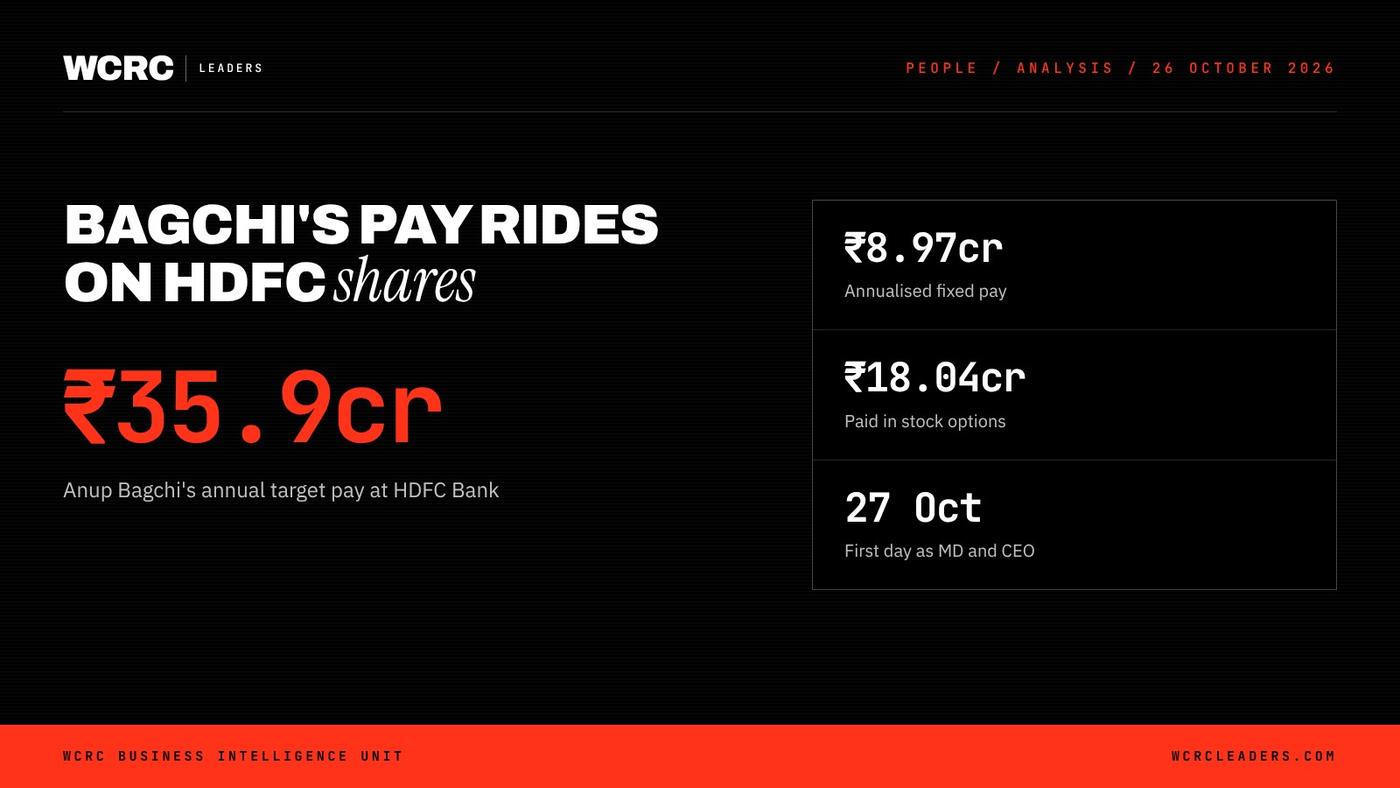
The postal ballot notice sets out the package. Annualised fixed pay is ₹8.97 crore, of which basic salary is ₹3.32 crore and housing ₹1.66 crore. Target variable pay for 2026-27 is ₹26.92 crore, exactly 300% of fixed pay. That takes target total compensation to ₹35.90 crore.
The mix matters more than the total. Only ₹8.88 crore of the variable pay is cash, and half of that is deferred, paid in three equal instalments of about ₹1.48 crore. The remaining ₹18.04 crore comes as 7,11,801 stock options, valued at an indicative Black Scholes figure of ₹253.42 each, vesting over four years. The notice puts the split at 33% cash and 67% non-cash.
On top sits a one-time joining grant: 44,796 restricted stock units worth ₹3.19 crore at a grant price of ₹1 each, and 1,64,207 options worth ₹4.16 crore at the market price. Together that is ₹7.35 crore, also vesting over four years. The notice describes it only as a joining or sign-on bonus and gives no further reason. Bagchi holds no HDFC Bank shares today.
What does the pay design signal?
Analysis: this is a package built to the edge of the rulebook. The Reserve Bank's 2019 compensation guidelines cap variable pay at 300% of fixed pay and require at least 67% of it in non-cash instruments once it passes 200%. Bagchi's design sits on both limits. The same guidelines require deferral of at least three years and malus and clawback on deferred pay, so a weak year can cost him promised money.
The useful comparison is with HDFC Bank's own last hire. When Jagdishan was appointed in 2020, the bank's notice proposed fixed pay of ₹6.50 crore, with variable pay "limited to a maximum of 300% of the fixed pay". Bagchi's fixed pay is about 38% higher. The bank says whole-time directors' fixed pay has risen 4% to 8% a year over the past five years, which would explain much of that gap. The bigger change is precision: in 2020 the ceiling was stated; in 2026 the target is the ceiling, counted in options.
For boards, the signal is clear: a proven chief hired from a rival now gets the regulatory maximum, loaded into equity. About half of Bagchi's target pay, and close to 60% once the joining grant is counted, depends on HDFC Bank stock. That is a market test written into the contract.
What are shareholders being asked, and when?
One ordinary resolution: to appoint Bagchi as director and as managing director and chief executive for three years, on the remuneration the RBI approved. E-voting opened on 8 October and closes at 5pm IST on Friday 6 November, with results within two working days. The joining grants follow within 30 to 45 days of approval.
Bagchi has been an additional director since 2 October, so he starts tomorrow regardless; the vote is the ratification the Companies Act, 2013 requires. Precedent suggests little drama: when Kotak Mahindra Bank, one of WCRC 1000, India's Most Valuable Enterprises 2026, put its own outside hire, Ashok Vaswani, to a postal ballot in December 2023, 99.34% of votes cast were in favour. Analysis: the number to watch is not whether it passes but the share of institutional votes against the pay, where investors register discomfort with sign-on awards.
What record does Bagchi inherit from Jagdishan?
Jagdishan took charge in October 2020. On 2 December 2020, the RBI told the bank to stop launches under its Digital 2.0 programme and to stop sourcing new credit card customers, after repeated outages including a power failure at its primary data centre. By March 2026 the bank had 26.3 million cards in circulation and ran 14 critical applications on an active-active architecture, its US filing shows.
Scale changed most. At March 2021, his first year-end, HDFC Bank had deposits of ₹13.34 lakh crore, loans of ₹11.70 lakh crore and 5,608 branches. At 30 September 2026 deposits stood at ₹33.27 lakh crore, gross advances at ₹32.20 lakh crore and branches at 9,706. Standalone profit for 2025-26 was ₹74,670 crore, up 10.9%.
The defining event was the merger with its former parent, HDFC Ltd, on 1 July 2023, which brought a housing portfolio of ₹5.24 lakh crore. It also brought the funding strain. On WCRC's calculation from the bank's US filings, loans were about 111% of deposits at March 2024, about 104% at March 2025 and about 100% at March 2026. On the bank's quarterly figures, gross advances were 96.8% of deposits at September 2026. The price was paid in deposit mix: current and savings accounts were 46.1% of deposits in March 2021 and 31.6% in September 2026.
What is on Bagchi's agenda?
Deposits and their cost. Deposits grew 18.8% in the year to September, but time deposits rose 22.8% against 10.8% for current and savings accounts. Some came from foreign currency deposits drawn in under the RBI's dollar swap window. Rebuilding low-cost deposits is the slowest and most valuable job on the list.
Margin. Net interest margin was 3.16% on total assets in the September quarter, against 3.38% in the March quarter. With the RBI having raised rates on 7 October, deposit repricing will test that margin again.
The loan-to-deposit ratio. The ratio is now below 100%, but the bank grew advances 5.2% in the September quarter. Bagchi must decide how fast to lend while the funding base catches up.
Technology. The bank barred from digital launches in 2020 now competes for customers who live on their phones. Bagchi's ICICI career spanned digital financial services, and he led retail when ICICI Bank became the first private Indian lender to pass ₹2 lakh crore in retail mortgages, HDFC Bank notes.
He arrives from ICICI Prudential Life Insurance, one of WCRC 1000, India's Most Valuable Enterprises 2026, which he has run since June 2023, after a career from 1992 in the ICICI Bank group, also one of WCRC 1000. ICICI Bank kept its own insider: shareholders reappointed Sandeep Bakhshi for two years from 4 October 2026, with 96.81% of votes in favour.
Why should boards in the Gulf and Asia care?
Analysis: three lessons travel. First, where regulators approve pay, as the RBI does under Section 35B of the Banking Regulation Act, boards should design to the rules from the start; HDFC Bank's board approval and the RBI's letter carry the same date. Second, a large equity weighting turns pay into a public scorecard, which helps an outsider earn trust with investors and staff. Third, buying a leader from a rival is a statement about the internal bench. Gulf banks and Asian lenders that rely on long-serving insiders should ask whether their own succession would survive a few weeks' notice.
HDFC Bank is a WCRC MegaBrand in private-sector banking, and was named among India's Most Loved 250 Workplaces 2026 by WCRC, with a BFSI workplace profile for HDFC Bank. ICICI Bank is a WCRC MegaBrand in corporate and institutional banking, with its own BFSI workplace profile.
The WCRC View
- The call. HDFC Bank has priced its new chief at the ceiling and made him a shareholder by design. That is the right structure for a slow fix: the reward arrives over four years, and so should the results.
- Who gains. Shareholders gain alignment; Bagchi gains a contract that pays most if the stock rerates. ICICI's group loses a leader but proves its bench. Internal HDFC Bank contenders lose the most, and their retention is the first test.
- What leaders should do now. Boards hiring from outside should state the target, not just the cap, and explain any sign-on grant in writing. HDFC Bank's notice does not say what the ₹7.35 crore joining grant replaces; investors will ask.
- The funding test. The measure of Bagchi's first year is not profit but the deposit mix. A current and savings share climbing back from 31.6% would show the merger is being digested.
- What WCRC will watch. The 6 November vote and the share against; his first senior appointments; and the December quarter's loan-to-deposit ratio and margin.
Quick answers
Q: When does Anup Bagchi become HDFC Bank's chief executive? A: On 27 October 2026, for three years to 26 October 2029. The RBI approved the appointment and his pay on 1 October 2026.
Q: How much will Bagchi be paid? A: Annualised fixed pay of ₹8.97 crore and target variable pay of ₹26.92 crore, a total of ₹35.90 crore, plus a one-time joining grant of RSUs worth ₹3.19 crore and options worth ₹4.16 crore.
Q: When does the shareholder vote close? A: E-voting on the postal ballot closes at 5pm IST on 6 November 2026. It is an ordinary resolution, and results are due within two working days.
Q: Where has Bagchi worked before? A: In the ICICI group since 1992, including as chief executive of ICICI Securities, executive director of ICICI Bank from 2017 to 2023, and managing director and chief executive of ICICI Prudential Life Insurance from June 2023.

Boston Dynamics picks an AI-model leader to run a robot company
Bajaj General picks Deepak Reddy as 15-year cap ends Singhel era
Noel Tata wants Tata Trusts to build institutions, not just fund them
DP World hands Asia Pacific to its CFO, Jason Varsamidis
The executive-chair handover is becoming the default
Mohit Joshi's Tech Mahindra: 14.8% margin, one step short of 15%
Filed under