People
Noel Tata wants Tata Trusts to build institutions, not just fund them
Tata Trusts disbursed ₹1,556.31 crore in 2025-26, about 72% more than a year earlier, and its chairman says the next phase is about owning outcomes: a planned network of forty to fifty not-for-profit general hospitals and new places of learning.
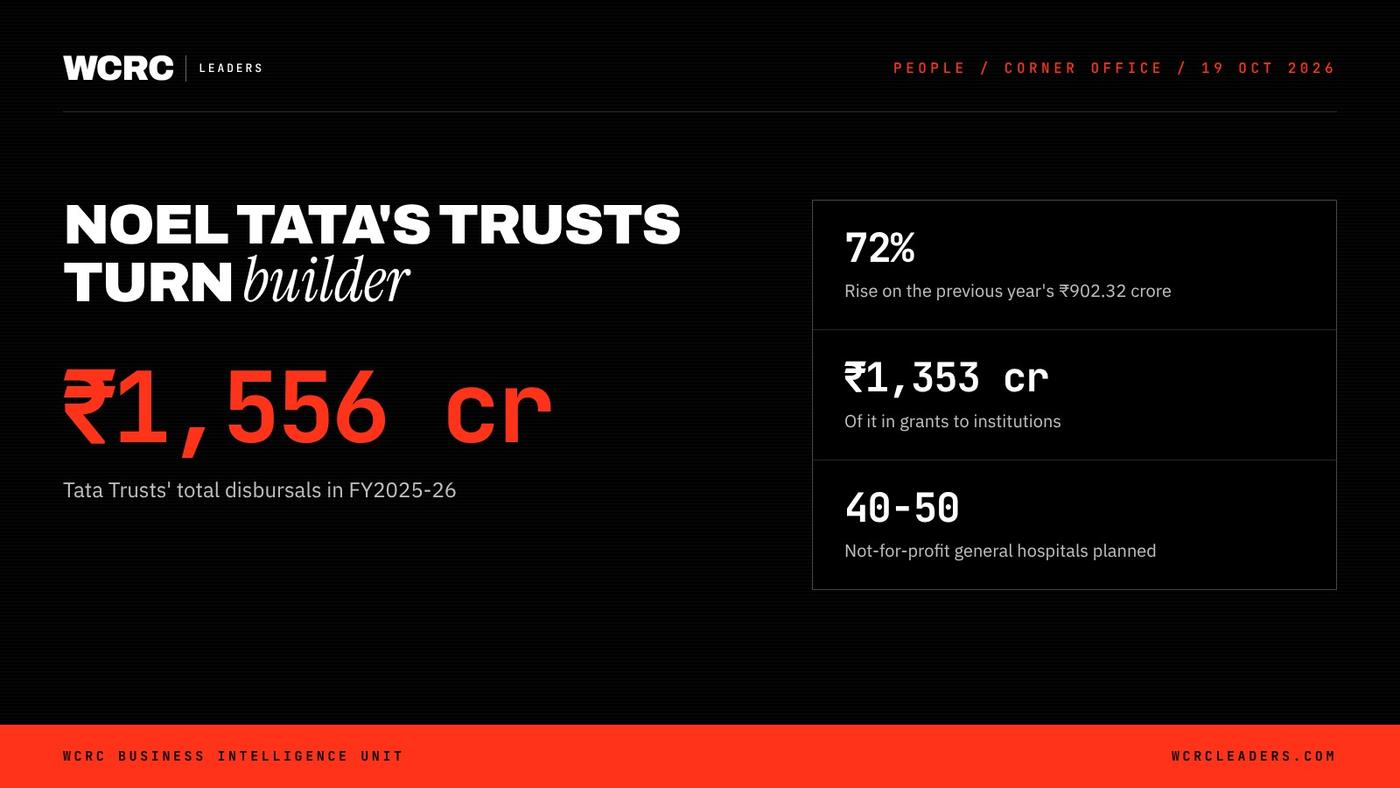
At a glance: WCRC Leaders' assessment: Tata Trusts is turning from India's best-known grant-maker into an institution-builder, and the shift raises the bar on governance as much as on spending. In his chairman's message in the Trusts' Annual Report 2025-26, Noel Tata sets out a plan to build "enduring public assets", including a hospital network, while warning against chasing size. The strategy lands as the Trusts and Tata Sons disagree over the holding company's future, which matters because the Trusts fund their work largely from Tata Sons dividends.
What has Noel Tata actually decided?
The decision is one of method. In the chairman's message of the Annual Report 2025-26, Noel Tata writes that the Trusts are "increasingly identifying areas where the need is not simply to support an existing effort, but to build institutions and models that can become enduring public assets in their own right."
That is a change of role. Much of the Trusts' work has run through grants to partner organisations, programmes and individuals. The new emphasis is on creating institutions that last; the message cites the Indian Institute of Science, the Tata Institute of Fundamental Research and Tata Memorial Hospital as the models.
The flagship is healthcare. Mr Tata writes that the Trusts are "working towards a network of forty to fifty not-for-profit general hospitals across the country." The model he describes is one where "those who can afford to pay for care, help make quality treatment accessible to those who cannot." The report does not give locations, a timeline or a capital budget for the network.
How much money is behind the shift?
The numbers show a sharp step up. According to the annual report, total disbursals in 2025-26 were ₹1,556.31 crore (about US$167.35 million at the report's rate of roughly ₹93 to the dollar). Of this, institutional grants accounted for ₹1,353.32 crore and grants to individuals for ₹202.99 crore.
The previous year's report put total disbursals at ₹902.32 crore, with ₹753.13 crore in institutional grants and ₹149.19 crore to individuals. On those figures, total disbursals rose about 72% year on year, institutional grants by close to 80% and individual grants by about 36%. The growth is concentrated in the institutional channel, which fits the strategy.
The hospital plan has a base to build on. The Tata Cancer Care Foundation runs the Trusts' Cancer Care Programme, with facilities that include the Sri Venkateswara Institute of Cancer Care and Advanced Research in Tirupati and the Ranchi Cancer Hospital and Research Centre.
Why does "biggest before best" matter to a board?
The most quotable line in the message is a warning about ambition. "Trying to become the biggest before becoming the best rarely ends well," Mr Tata writes. The message frames the goal as doing better rather than simply doing more, with clearer focus, greater discipline in the use of resources and a long-term view.
He also sets an accountability test that many corporate foundations would struggle to meet. "We must be able to show, in meaningful and measurable terms, what has changed as a result of our efforts," he writes. The message argues that impact should be judged by sustained change, not by reach or by the amount spent.
For boards, this separates scale from quality and makes evidence the condition for growth. The message also says the Trusts may seek out other philanthropies and like-minded organisations to share the load.
What does education look like under the new model?
Education is the second pillar. The message says what India needs is "more institutions in India capable of nurturing that talent," and the Trusts have already acted on that. On 21 August 2026, Tata Trusts and IIM Bangalore signed a memorandum of understanding to establish the Indian Institute of Management Bangalore – Dorabji Tata School of Undergraduate Studies, with the Sir Dorabji Tata Trust as philanthropic partner.
According to the Trusts' release, the school's first batch of 80 students, 40 in each of two four-year BSc (Hons) programmes in data sciences and economics, was due to begin on 31 August 2026, drawn from about 12,000 applications. The size of the gift was not disclosed. "India's next phase of growth will require institutions that can be ranked amongst the best in the world," Mr Tata said at the signing.
Why does the Tata Sons dispute matter here?
The Trusts' spending power depends on the holding company. They state that they hold about 66% of Tata Sons Private Limited, and in a 17 September release they describe the majority shareholder as a charity that funds hospitals, universities and research from dividends.
The verified facts from primary sources are these. On 12 August 2026, Tata Consultancy Services filed with the stock exchanges a statement from N Chandrasekaran, chairman of Tata Sons, saying his term ends on 20 February 2027 and that he had decided not to offer himself for reappointment. The Sir Dorabji Tata Trust said the next day that it respected the decision and would set up a selection committee under the Tata Sons Articles of Association.
On 17 September, the Tata Sons board met. In releases that day and on 20 September, the Trusts said a resolution to reappoint Mr Chandrasekaran had not been validly passed, because one of the two Trusts-nominated directors did not support it, and that a casting vote could not cure that. The same releases said the Trusts had not agreed to list Tata Sons and that the board had agreed to assess options other than listing. Mr Tata told the board, according to the Trusts' release, that "a listing will destroy its character." The Trusts also referred to a Reserve Bank of India communication dated 11 September 2026, without publishing its contents.
On 28 September, the Trusts proposed a reorganisation in which Tata Electronics Systems Solutions (TESS) and Tata Consulting Engineers (TCE) would merge into Tata Sons, which would then surrender its registration as a core investment company, subject to a no-objection from the RBI. The outcome is not settled.
The WCRC View
Analysis by the WCRC Business Intelligence Unit.
- This is the right call, and the harder one. Funding is easy to start and stop; institutions carry payrolls, regulators and patients for decades. By choosing to build, Tata Trusts accepts operating risk that grant-makers usually pass to others.
- The cross-subsidy hospital is a business model, not just a charity. Forty to fifty general hospitals where paying patients help fund those who cannot pay will need pricing discipline, clinical governance and management depth comparable to a listed hospital chain. Family foundations in the Gulf and South-East Asia building hospitals and universities should watch how the Trusts staff and measure it.
- Promoter trusts need governance as strong as the companies they own. The Trusts' dispute with Tata Sons shows that when a charity is the controlling shareholder, its board decisions shape the group's leadership and capital structure. Boards of family-owned groups in India, the Gulf and Asia should check now that their trust deeds, nominee-director rights and succession rules are written down, tested and understood by every party.
- "Biggest before best" is a test leaders can use tomorrow. Any CEO approving a CSR budget, a foundation's expansion or a new campus can ask the same question: have we proved quality before we chase scale? Tie further funding to evidence of what has changed, as Mr Tata's message requires.
- What WCRC will watch next: the first named sites and capital plan for the hospital network; whether the Tata Sons board and the RBI act on the 28 September reorganisation proposal; the selection or confirmation of the Tata Sons chairman ahead of 20 February 2027; and whether 2026-27 disbursals keep the institutional share rising.
On WCRC's own record, Tata Consultancy Services, Titan Company, Tata Steel and other Tata group companies were selected by the Business Intelligence Unit of WCRC for India's Most Loved 250 Workplaces 2026. For more on leadership through institutions, see Navi Pillay and leadership through institutions, The Investment Banker Who Judges Philanthropy on Cash Flow and The executive-chair handover is becoming the default.
Quick answers
Q: How much did Tata Trusts disburse in 2025-26? A: ₹1,556.31 crore in total, of which ₹1,353.32 crore went in institutional grants and ₹202.99 crore to individuals, according to the Annual Report 2025-26.
Q: What is the hospital plan? A: Noel Tata's chairman's message says the Trusts are working towards a network of forty to fifty not-for-profit general hospitals across India, where patients who can pay help fund care for those who cannot.
Q: Who wrote "Trying to become the biggest before becoming the best rarely ends well"? A: Noel Tata, chairman of Tata Trusts, in his chairman's message in the Annual Report 2025-26.
Q: What have the Trusts proposed for Tata Sons? A: On 28 September 2026, they proposed merging TESS and Tata Consulting Engineers into Tata Sons so it would no longer be a core investment company, subject to RBI approval.
Filed under