People
Bajaj General picks Deepak Reddy as 15-year cap ends Singhel era
Bajaj General Insurance has named a former group HR head and gold-loan chief to succeed Tapan Singhel, one of Indian insurance's longest-serving chief executives. The handover was set by a regulatory clock, and the board named a successor more than five months before the deadline.
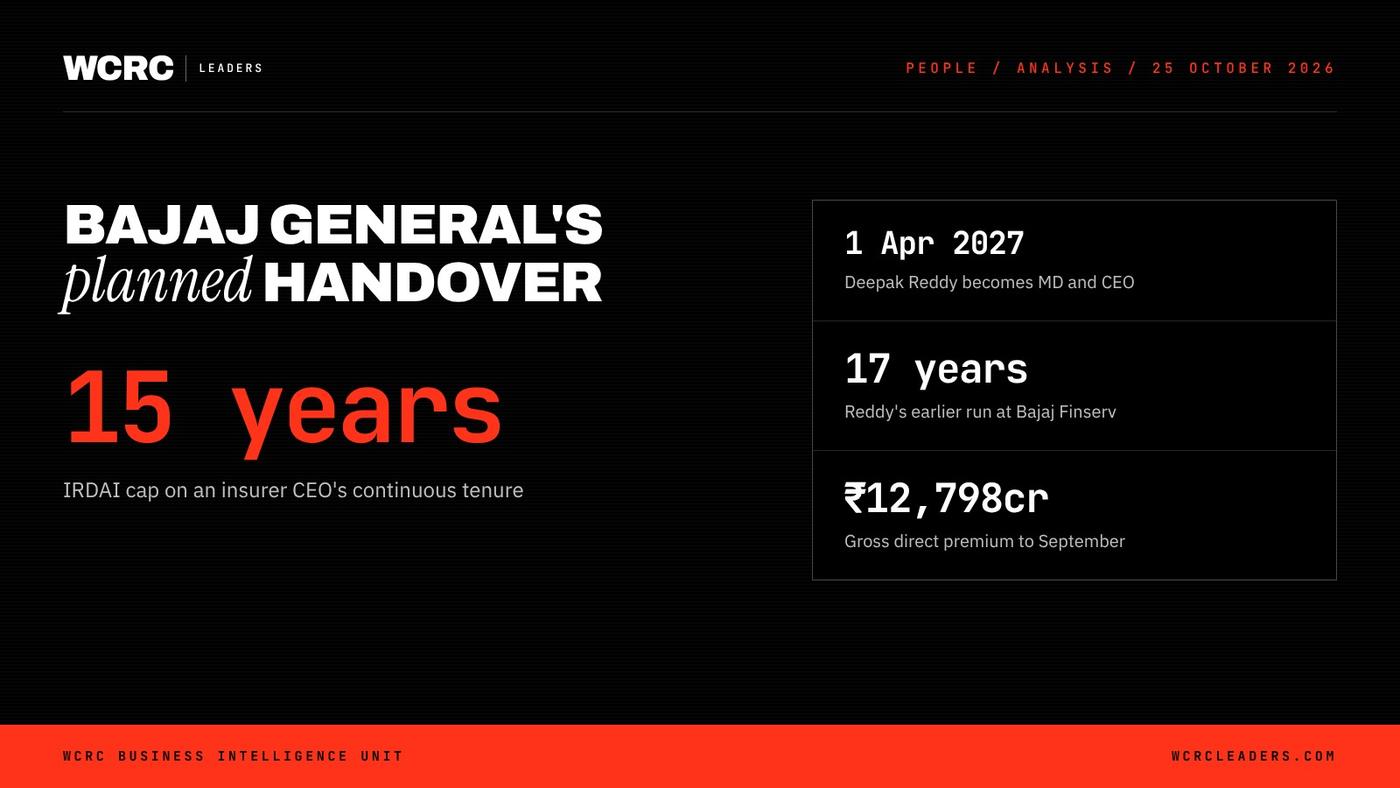
At a glance: WCRC Leaders' assessment: Bajaj has turned a forced exit into a model succession, but the real test is whether a people-first operator can keep an underwriting-led insurer as disciplined as its founder-era CEO made it. On 23 October 2026 the Bajaj General Insurance board approved Deepak Reddy as CEO Designate from 1 January 2027. Subject to IRDAI approval, he becomes MD and CEO on 1 April 2027. Tapan Singhel stays until 31 March 2027, when the regulator's 15-year limit on continuous tenure ends his run.
What did Bajaj General announce?
Bajaj Finserv, one of WCRC 1000, India's Most Valuable Enterprises 2026, told the stock exchanges on 23 October 2026 that the board of its material unlisted subsidiary, Bajaj General Insurance, had approved Deepak Reddy's appointment as CEO Designate with effect from 1 January 2027. Subject to approval from the Insurance Regulatory and Development Authority of India (IRDAI), he will take charge as managing director and CEO on 1 April 2027.
Dr Tapan Singhel continues as MD and CEO until 31 March 2027. The company said the transition is in line with IRDAI's maximum continuous tenure of 15 years for managing directors, CEOs and whole-time directors.
That gives the insurer a three-month overlap in which the incoming and outgoing chiefs sit side by side, and the regulator a full quarter to clear the appointment before the change takes effect.
Sanjiv Bajaj, chairman and managing director of Bajaj Finserv, said in the company's release: "Few leaders have the distinction of building an institution from the ground up. Tapan is one of them." He added: "His legacy is not just a successful business, but a strong institution built to endure." On the successor, he said: "We are delighted to welcome Deepak to lead Bajaj General into its next chapter."
Who is Deepak Reddy?
Reddy has more than three decades in financial services. According to Bajaj Finserv's filing, he spent 17 years with Bajaj Finserv helping to build and scale several businesses, most recently leading the rural, insurance and gold loan businesses at Bajaj Finance, the group lender WCRC covered this week as it lined up ₹17,500 crore in new capital. He was Bajaj Finserv's first Group Head of Human Resources. Earlier senior roles were at American Express, Standard Chartered Bank and MIRC Electronics, the company behind the Onida brand.
He left the group in 2025. Manappuram Finance, one of WCRC 1000, India's Most Valuable Enterprises 2026, announced on 9 May 2025 that he would become its chief executive from 1 August 2025, reporting to managing director V.P. Nandakumar.
The Bajaj move did not come out of nowhere. Manappuram disclosed on 3 July 2026 that Reddy had resigned "to pursue other personal and professional interests". He is on garden leave and will be relieved at the close of business on 31 December 2026, the day before his Bajaj appointment begins. On 11 August 2026 Manappuram's board appointed Ashish Singh, formerly head of retail liabilities at IDFC FIRST Bank, as MD and CEO for five years from 1 January 2027, subject to shareholder approval, with Nandakumar becoming non-executive chairperson from the same date.
Why does an insurer want an HR-led leader?
This is WCRC analysis. Indian general insurance is a distribution and claims business as much as a pricing one. Policies are sold through agents, banks, motor dealers and digital platforms, and customers judge the company at the moment of a claim. Both depend on large, dispersed workforces and partner networks. A leader who built the group's HR function from scratch, then ran rural and gold-loan businesses with heavy field operations, brings a skill set suited to that.
The risk sits on the other side of the ledger. Singhel's record has been built on underwriting. The company's March 2022 release on his last reappointment credited his first decade as MD and CEO with a cumulative underwriting profit of more than ₹350 crore, a revenue compound annual growth rate of 16%, net profit growth above 30% a year and a solvency ratio that rose from 156% to close to 350%. Reddy will inherit a strong technical bench, but he will be judged on whether that discipline holds.
The business is still growing. Bajaj Finserv's monthly filing shows Bajaj General wrote gross direct premium of ₹12,798 crore up to September 2026, against ₹11,554 crore a year earlier, a rise of about 11%. The insurer, set up in 2001 and formerly Bajaj Allianz General Insurance, is now wholly owned by the Bajaj group. Its consumer brand, Bajaj Allianz, is a WCRC MegaBrand in private general and multiline insurance.
There is also a group logic. Bajaj Finserv has been named among India's Most Loved 250 Workplaces 2026 by WCRC Culture Crest. Bringing back an alumnus who knows the culture lowers integration risk at a moment when the insurer has just lost its foreign partner and must stand on the Bajaj name alone.
How is the 15-year cap reshaping Indian financial services?
The rule is explicit. Paragraph 2.4(c) of IRDAI's Master Circular on Corporate Governance for Insurers, 2024 (IRDAI/F&I/CIR/MISC/82/5/2024, issued on 22 May 2024 under the IRDAI (Corporate Governance for Insurers) Regulations, 2024) says the post of MD, CEO or whole-time director "shall not be held" by the same person for a continuous period of more than 15 years. After a cooling-off period of at least one year, the board may reappoint the same person. Nobody may continue in those roles beyond the age of 70. Where the CEO is appointed by a promoter or major shareholder, the limit is 12 years, which the regulator may extend to 15 on application.
Banks have lived with a similar rule since the Reserve Bank of India's circular of 26 April 2021, which capped MD and CEO tenure in private banks at 15 years, with a three-year cooling-off period and a 12-year limit for promoter CEOs.
Analysis: together these rules end an era. India's private insurance industry opened up around the turn of the century, and many founding leaders took the top job in its first decade. A 15-year clock means a whole cohort must hand over within a few years of each other. Boards that treated succession as something to think about later now have a fixed date. The ones that move early, as Bajaj has, get to choose. The ones that leave it late risk a rushed appointment, a regulatory gap or an acting CEO.
The same pressure is visible in banking. HDFC Bank's choice of an ICICI Group veteran, Anup Bagchi, as its next CEO shows how far boards will now look for experienced successors.
What can boards in India and the Gulf learn?
Analysis: three points stand out. First, the Bajaj timeline is generous. The board named a successor more than two months before the CEO Designate role begins and more than five months before the regulatory deadline, built in a quarter of overlap and left time for IRDAI approval.
Second, the group used its own talent pipeline, even though the successor had left it. Alumni networks are an underused succession pool, and a returning executive needs less time to learn the culture.
Third, the cap takes the personal sting out of the decision. When the regulator sets the end date, the board's job is the plan, not the politics of asking a successful founder to step aside.
Gulf boards face a different problem. WCRC's coverage of Q3 2026 C-suite churn in the Gulf found several state-linked companies and regulators ending long acting periods only recently. Without a hard tenure limit, the risk is the reverse of India's: leaders stay too long, or roles sit vacant too long. Either way, a written plan with dates is the remedy.
The WCRC View
- The call: Bajaj has handled a forced exit about as well as it can be handled. Early notice, a named successor, an overlap period and clear credit to the outgoing CEO add up to a template other Indian insurers should copy.
- Who gains: Bajaj Finserv gains continuity at a wholly owned insurer that now carries the group's brand alone. Reddy gains a larger platform after a short spell at Manappuram. Manappuram, which named its own successor in August, loses little because it planned for the gap.
- The risk: a people-and-distribution leader taking over from an underwriting-led founder. Investors in Bajaj Finserv should watch the insurer's combined ratio and solvency in the first year after April 2027, not the premium growth line.
- What leaders should do now: every Indian insurer and private bank should map when its CEO and whole-time directors reach 12 or 15 years, and name successors at least a year ahead. Gulf boards without a tenure rule should set one in their own charters.
- What WCRC will watch: IRDAI's approval before 1 April 2027, whether Bajaj General's senior team stays intact through the handover, and which other insurance CEOs hit the 15-year limit next.
Quick answers
Q: Who will lead Bajaj General Insurance after Tapan Singhel? A: Deepak Reddy, former CEO of Manappuram Finance. He becomes CEO Designate on 1 January 2027 and MD and CEO on 1 April 2027, subject to IRDAI approval.
Q: Why is Tapan Singhel stepping down? A: IRDAI's corporate governance rules cap continuous tenure for an insurer's MD, CEO or whole-time director at 15 years. He continues until 31 March 2027.
Q: What is Deepak Reddy's background? A: More than 30 years in financial services, including 17 at Bajaj Finserv, where he was the first Group Head of Human Resources and later led Bajaj Finance's rural, insurance and gold loan businesses. He also worked at American Express, Standard Chartered Bank and MIRC Electronics.
Q: Who replaces Reddy at Manappuram Finance? A: Ashish Singh, formerly of IDFC FIRST Bank, becomes MD and CEO from 1 January 2027 for five years, subject to shareholder approval.

Boston Dynamics picks an AI-model leader to run a robot company

Noel Tata wants Tata Trusts to build institutions, not just fund them

Anup Bagchi starts at HDFC Bank with a ₹35.9cr target pay package
DP World hands Asia Pacific to its CFO, Jason Varsamidis

The executive-chair handover is becoming the default
Mohit Joshi's Tech Mahindra: 14.8% margin, one step short of 15%
Filed under