Business
HDFC Bank Q2: deposits finally outrun loans, but profit rises just 4.7%
HDFC Bank has done the hard part of its post-merger repair: deposits are now growing faster than loans. The price is showing up in profit, and it is the inheritance Anup Bagchi takes on when he becomes chief executive on 27 October.
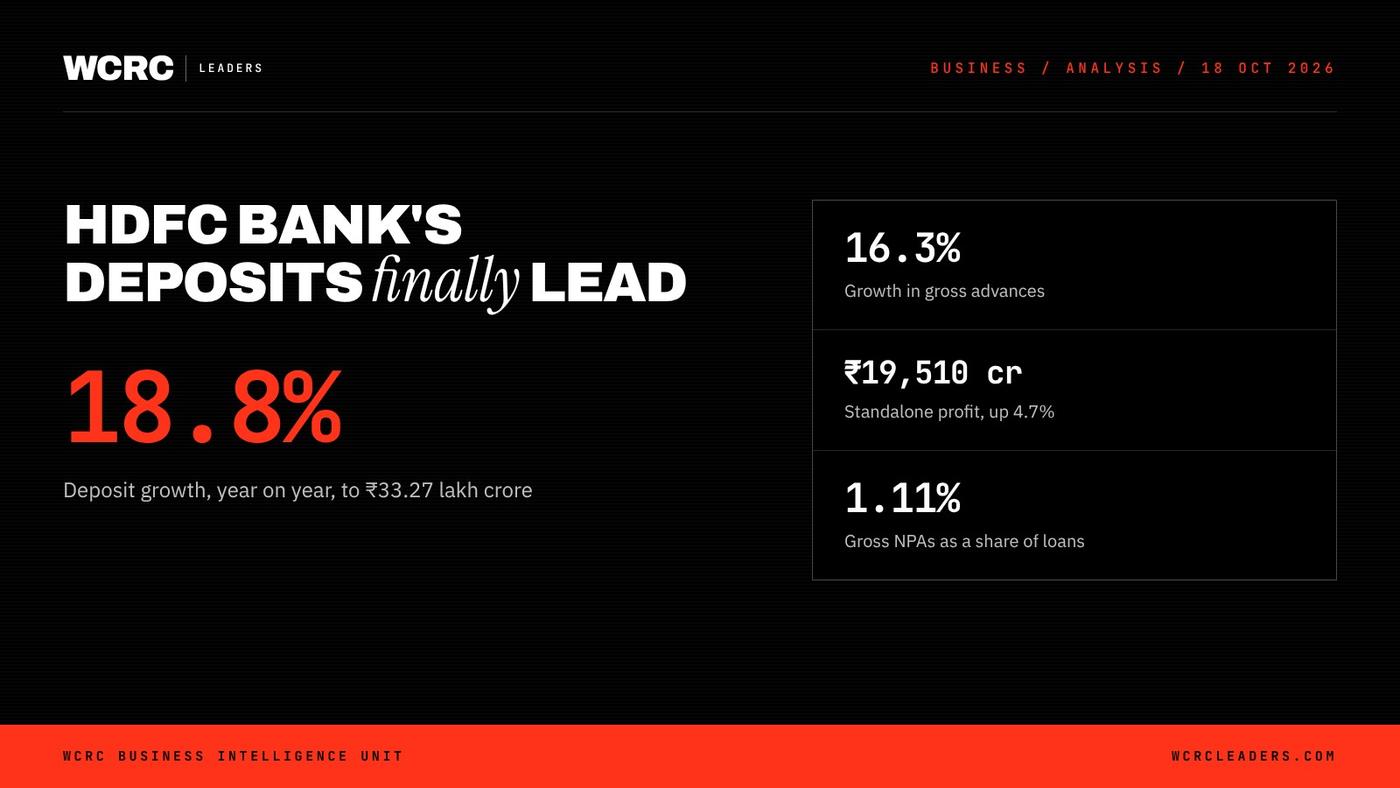
At a glance: WCRC Leaders' assessment: HDFC Bank has bought balance-sheet safety with earnings growth, and its new chief executive must now prove the bank can have both. In the quarter to 30 September 2026, India's largest private lender grew deposits 18.8% to ₹33.27 lakh crore and gross advances 16.3% to ₹32.20 lakh crore. Standalone profit rose 4.7% to ₹19,510 crore. These are the last results under Sashidhar Jagdishan, who retires on 26 October.
What did HDFC Bank report for the September quarter?
HDFC Bank's earnings presentation for the second quarter of 2026-27 shows standalone profit after tax of ₹19,510 crore, up 4.7% from ₹18,640 crore a year earlier and 2.4% higher than the June quarter. Net interest income (NII), the gap between what the bank earns on loans and pays on deposits, rose 9.7% to ₹34,620 crore.
The headline is the balance sheet. Period-end deposits rose 18.8% to ₹33.27 lakh crore, from ₹28.02 lakh crore in September 2025. Gross advances rose 16.3% to ₹32.20 lakh crore, from ₹27.69 lakh crore. On those figures, gross loans now equal about 96.8% of deposits, against about 98.8% a year ago (WCRC calculation from the bank's figures).
Asset quality remains clean. Gross non-performing assets (NPAs) stood at 1.11% of loans and net NPAs at 0.37%. Capital adequacy was 18.9%, with a common equity tier 1 ratio of 17.1%. The net interest margin (NIM) was 3.16% on total assets and 3.32% on interest-earning assets.
The bank ended the quarter with 9,706 branches, 161 more than a year earlier, and 2,10,109 employees.
Why does deposits outgrowing loans matter so much?
Since HDFC Limited merged into HDFC Bank on 1 July 2023, the bank has carried a large book of housing loans funded by the mortgage lender's bonds and borrowings rather than by deposits. Loans ran ahead of deposits, and the bank slowed lending until deposits caught up.
This quarter shows that strategy working. Deposits grew 2.5 percentage points faster than loans, and loan growth itself is no longer being held back: at 16.3% year on year and 5.2% quarter on quarter, lending is expanding briskly. Small and mid-market loans grew 23.5% to ₹7.06 lakh crore, corporate and other wholesale loans 16.4% to ₹8.64 lakh crore, and retail loans 11.7% to ₹17.38 lakh crore.
Deposits are steadier and usually cheaper than market borrowings, and that matters more now. The Reserve Bank of India (RBI) raised its repo rate by 25 basis points to 5.50% on 7 October and moved its stance to "calibrated tightening", as WCRC reported in its analysis of India's first rate hike since 2023. In a rising-rate cycle, the bank that already has the deposits is in the stronger spot.
So why is profit growth stuck in single digits?
Three lines in the presentation explain most of it.
First, the mix of deposits. The current account and savings account (CASA) ratio, the share of cheap deposits, was 32% at the end of September. It was 34% in March 2026, 35% in March 2025 and 38% in March 2024. A falling ratio means most new deposits have come as costlier term deposits, the main reason NII grew 9.7% while loans grew 16.3%.
Second, other income fell 3.6% year on year to ₹13,830 crore, although it rose 7.9% on the June quarter.
Third, costs and provisions kept rising. Operating expenses grew 5.5% to ₹18,970 crore. The core cost-to-income ratio was 39.1%. Provisions were ₹3,570 crore, up only 2.1% on a year ago but 16.8% higher than in the June quarter.
HDFC Bank is growing its balance sheet in the high teens and profit in low single digits. The gap is the cost of rebuilding its deposit franchise.
How does HDFC Bank compare with ICICI Bank and Axis Bank?
ICICI Bank's own performance review for the same quarter, released on 17 October, shows standalone profit after tax of ₹14,843 crore, up 20.1% from ₹12,359 crore. Its NII rose 17.7% to ₹25,339 crore and its NIM was 4.18%, down from 4.30% a year earlier. Period-end deposits grew 27.1% to ₹20.50 lakh crore, or 17.0% excluding foreign currency non-resident (FCNR (B)) deposits. Advances grew 30.0% to ₹18.32 lakh crore, or 24.1% excluding loans booked by international branches against those FCNR (B) deposits. Gross and net NPAs were 1.20% and 0.30%.
Axis Bank has so far published only its provisional business update, filed with the exchanges on 5 October. It shows gross advances up 22.7% to ₹13.85 lakh crore and deposits up 20.7% to ₹14.52 lakh crore. Axis also said that excluding loans from international branches backed by FCNR (B) deposits, advances would have grown 18.8% and deposits 17.0%. WCRC has not yet been able to confirm Axis Bank's quarterly profit from the bank's own release, so it is not compared here.
WCRC analysis: Three patterns stand out. HDFC Bank is now the most conservatively funded of the three on growth, with deposits ahead of loans, while ICICI Bank and Axis Bank are growing loans faster than deposits. ICICI Bank's margin of 4.18% is well above HDFC Bank's 3.16% on total assets, though the two are not calculated on identical bases. And both rivals' headline growth is lifted by FCNR (B) deposits. Excluding them, ICICI Bank's and Axis Bank's deposit growth falls to 17.0%, below HDFC Bank's 18.8%.
What does Anup Bagchi inherit on 27 October?
HDFC Bank's 1 October filing to the exchanges confirms that Anup Bagchi takes office as managing director and chief executive "for a period of 3 years w.e.f. October 27, 2026 to October 26, 2029", after the RBI approved the appointment on 1 October. He succeeds Sashidhar Jagdishan, whose tenure ends at the close of business on 26 October. WCRC covered the succession in HDFC Bank hires its next chief executive from its biggest rival. Bagchi joined the ICICI Group in 1992 and most recently led ICICI Prudential Life Insurance.
He inherits a bank with the hardest structural work done: the funding gap has closed, capital is ample and bad loans are low. He also inherits a cheaper-funding problem: a CASA ratio six points below its level of March 2024, and a margin that leaves less room for error as rates rise.
WCRC analysis: The task now shifts from defence to earnings. The choices in front of the new chief executive are about pricing and mix: how hard to compete for savings balances, how fast to grow higher-yielding small business and retail loans, and how to lift other income, which fell this quarter. Investors will judge him against the rival where he spent three decades, now growing profit at 20%.
What does this mean for leaders in India, the Gulf and Asia?
For Indian chief financial officers, a bank with deposits ahead of loans and capital at 18.9% has room to lend; its 23.5% growth in small and mid-market loans suggests credit for mid-sized companies remains available despite the RBI's tightening.
For Gulf-based investors and the non-resident Indian community, the FCNR (B) figures at ICICI Bank and Axis Bank show Indian banks actively competing for foreign currency deposits. Axis Bank alone reported FCNR (B) deposits of USD 10.62 billion mobilised as at 30 September.
For boards across Asia, HDFC Bank is a live lesson in post-merger integration: the balance sheet is rebuilt, but profit is still paying for it.
HDFC Bank, ICICI Bank and Axis Bank were also each selected by the Business Intelligence Unit of WCRC among India's Most Loved 250 Workplaces 2026.
The WCRC View
- The call: HDFC Bank's balance-sheet repair is largely complete. The next two years are about earnings quality, and that is now the new chief executive's test, not the merger's.
- What it means: Deposits growing 2.5 points faster than loans removes the bank's biggest structural constraint. But a 32% CASA ratio and the RBI's 7 October rate rise mean growth now costs more.
- Who gains: In the near term, borrowers, especially mid-sized companies, and term depositors. Shareholders gain only if Bagchi can turn faster loan growth into faster profit growth.
- What leaders should do now: Treasurers should use the fight for deposits to win better rates. Boards weighing mergers should note how long HDFC Bank's integration has weighed on returns.
- What WCRC will watch: Bagchi's first public remarks after 27 October, the RBI's 2 to 4 December policy meeting, the CASA ratio in the December quarter, and whether HDFC Bank's NII growth begins to close the gap with its loan growth.
Quick answers
Q: What was HDFC Bank's profit in Q2 FY27? A: Standalone profit after tax was ₹19,510 crore for the quarter to 30 September 2026, up 4.7% year on year and 2.4% on the June quarter.
Q: Are HDFC Bank's deposits growing faster than its loans? A: Yes. Deposits rose 18.8% to ₹33.27 lakh crore, while gross advances rose 16.3% to ₹32.20 lakh crore.
Q: When does Anup Bagchi become HDFC Bank's chief executive? A: On 27 October 2026, for three years, according to the bank's 1 October exchange filing.
Q: How did ICICI Bank's profit compare? A: ICICI Bank reported standalone profit of ₹14,843 crore, up 20.1% year on year.
Filed under