People
Vijay Sankar takes FICCI's chair in a year of trade deals and tariffs
FICCI has named Vijay Sankar, Chairman of the Chennai-based Sanmar Group, as its President-Elect for 2026-27. He takes over from Anant Goenka at the chamber's AGM in New Delhi on 18-19 November, as Indian business adjusts to a run of new trade agreements and shifting tariffs.
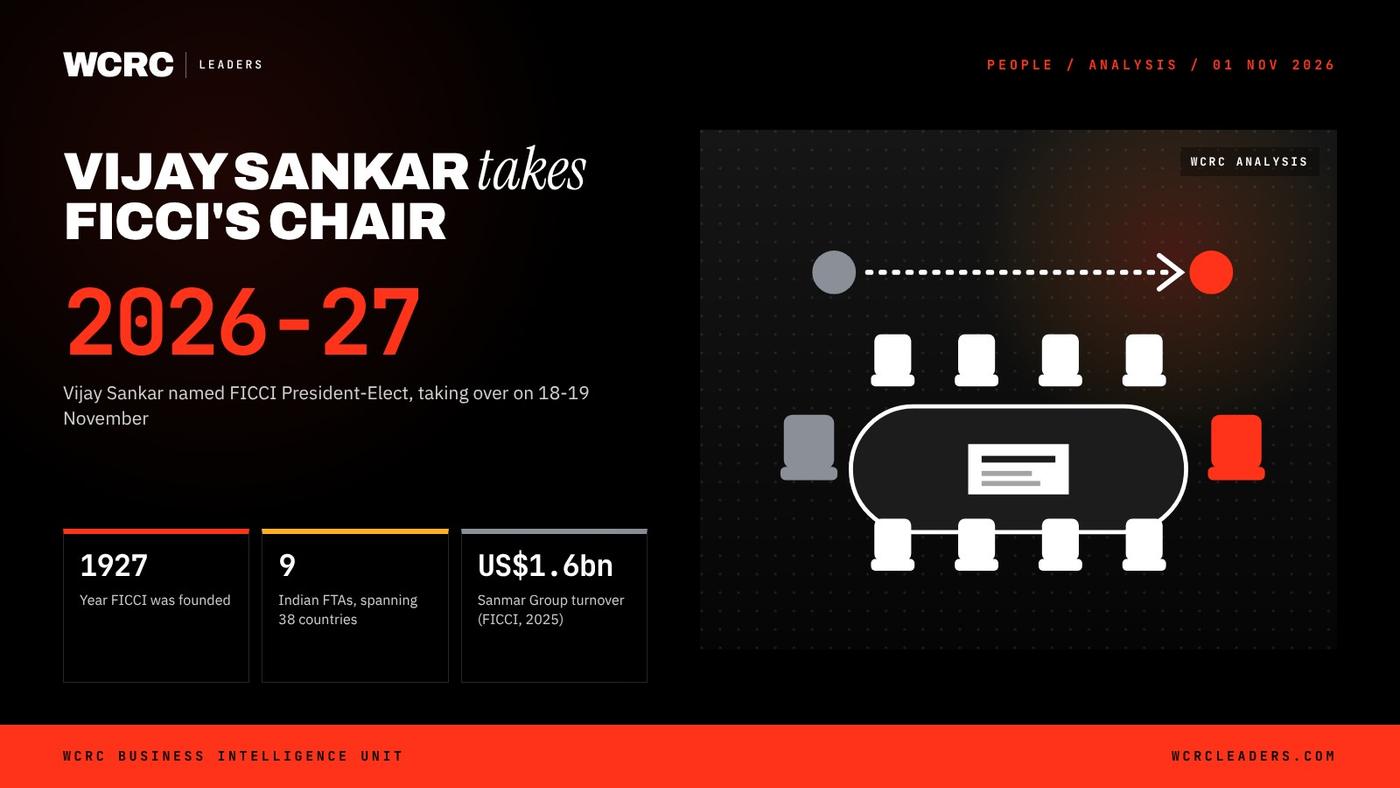
At a glance: WCRC Leaders' assessment: FICCI is handing its top job to a manufacturer whose businesses live on export markets, chemicals feedstock and global joint ventures, which makes trade execution, not trade announcements, the natural test of his year. FICCI's National Executive Committee announced the choice in Mumbai on 29 October 2026. Sankar, currently Senior Vice President, succeeds Anant Goenka, Vice Chairman of the RPG Group, at the close of the AGM and Annual Convention. His term runs into 2027, the year FICCI marks a century since its founding in 1927.
What exactly did FICCI announce?
The Federation of Indian Chambers of Commerce and Industry said on 29 October that its National Executive Committee, meeting in Mumbai, had named Vijay Sankar President-Elect for 2026-27. Sankar is the chamber's Senior Vice President. He will succeed Anant Goenka as President at the close of FICCI's Annual General Meeting and Annual Convention, scheduled for 18-19 November 2026 in New Delhi.
The succession follows FICCI's established ladder. A year ago, at the 98th AGM on 29 November 2025, Goenka took over from Harsha Vardhan Agarwal of Emami, Sankar was elevated to Senior Vice President, and Puneet Dalmia, Managing Director of Dalmia Bharat, joined the leadership as Vice President. FICCI's executive committee page now lists Goenka as President, Sankar as President-Elect, Dalmia as Vice President and Agarwal as Immediate Past President.
The release carries no statement from Sankar and sets out no agenda. For now, boards can read only his record and the businesses he runs.
Who is Vijay Sankar, and what is the Sanmar Group?
Sankar is Chairman of The Sanmar Group, which FICCI describes as a billion-dollar industrial conglomerate headquartered in Chennai, with interests in chemicals, engineering, steel foundries and shipping. In its November 2025 release, FICCI put the group's turnover at about US$1.6 billion.
He is also Chairman of Chemplast Sanmar, one of WCRC 1000, India's Most Valuable Enterprises 2026. The company's specialty paste PVC resin operations began at Mettur in May 1967, and it makes caustic soda, chlorochemicals, hydrogen peroxide, refrigerant gas and industrial salt, along with custom manufactured intermediates for agrochemical, pharmaceutical and fine chemical customers. Its plants sit at Mettur, Cuddalore, Berigai and Vedaranyam in Tamil Nadu and at Karaikal in Puducherry.
The wider group runs joint ventures with foreign partners. Its speciality chemicals arm includes Cabot Sanmar, a joint venture with Cabot Corporation of the US that makes fumed silica. Its engineering businesses include Flowserve Sanmar. Its steel foundries operate in India, the US and Mexico, and Sanmar Shipping began operations in September 1994.
Sankar sits as an independent director on the boards of TVS Motor Company, one of WCRC 1000, India's Most Valuable Enterprises 2026, and Larsen & Toubro, one of WCRC 1000, India's Most Valuable Enterprises 2026. Both TVS Motor and L&T are also selected among India's Most Loved 250 Workplaces 2026 by the Business Intelligence Unit of WCRC.
He is Honorary Consul General of Denmark in Chennai and holds the Knight's Cross of the Order of Dannebrog from the King of Denmark. He serves on the boards of several healthcare institutions, holds an MBA from Northwestern University's Kellogg school and is a qualified Chartered Accountant.
Why does the timing matter for Indian business?
Sankar takes the chair as India's trade map is being redrawn. The Ministry of Commerce and Industry lists the India-EFTA Trade and Economic Partnership Agreement in force since 1 October 2025, the India-UK Comprehensive Economic and Trade Agreement signed in July 2025, the India-Oman CEPA signed in December 2025, and the India-EU Free Trade Agreement concluded on 27 January 2026. A framework for an interim trade agreement with the US was delivered on 7 February 2026. The government counts nine FTAs spanning 38 countries.
The newest deal is already live. New Zealand's foreign ministry confirms that the India-New Zealand FTA entered into force on 20 October 2026, covering two-way trade of NZ$3.95 billion a year. Talks with Washington continue, with US Secretary of State Marco Rubio calling a deal "very, very close" in Mumbai on 20 October.
Analysis: for an industry chamber, this changes the job. Signing season rewards access to ministers. Implementation season rewards detail: rules of origin, standards, customs procedure, safeguard triggers and the sector-by-sector work of telling member companies what a tariff schedule actually means for their costs. A chamber head from manufacturing, whose group runs chemicals plants, foundries abroad and foreign joint ventures, has lived on the receiving end of exactly those rules.
What does a chemicals industrialist from the south bring?
Read through WCRC's seven leadership parameters, the record points to two in particular. The first is Global Mindset. Sankar runs businesses with US partners, foundries in the US and Mexico, and holds a long-standing diplomatic role for Denmark. In a year when India is opening markets in Europe, the UK, Oman and New Zealand, that is directly relevant experience for representing Indian industry abroad.
The second is Stakeholder Trust. A chamber president speaks for members who compete with one another and who sometimes want opposite things from the same trade deal. Chemicals is a case in point: downstream users want cheaper imported inputs, while domestic producers want protection from dumping. A leader who chairs a listed chemicals company and sits on the boards of an automaker and an engineering major sees both sides of that table. The parameter asks whether he can hold the trust of each.
Analysis: the regional point is practical too. A President whose plants sit in Tamil Nadu, from Mettur to Cuddalore, brings the operating reality of state-level industrial policy, power and ports into the chamber's national voice.
What should boards expect from FICCI in 2026-27?
FICCI has published no agenda for the new term, and WCRC will not guess one. What will shift is the questions the chamber is asked to answer. Members will want to know how to use the EU, UK, Oman and New Zealand agreements, how an interim deal with the US would affect their tariff exposure, and how to defend domestic markets where trade opens.
In the terms of SeeClear, a model in WCRC's Guru Management Codex, the useful discipline is to separate fact from projection. The fact is a series of signed, concluded or in-force agreements with dates. The projection is everything said about deals still under negotiation. Boards that plan capacity, sourcing and export bets on the first, and keep options open on the second, will make fewer expensive mistakes. A chamber that helps its members draw that line is doing its job.
Read through WCRC's Leadership Equity Matrix, WCRC's leadership equity research, the question for any industry body is whose voice it carries. FICCI's leadership rotates among large business groups. The test of the coming year is whether smaller exporters and suppliers, who feel rules of origin and compliance costs most sharply, get equal weight in what the chamber tells government.
The WCRC View
WCRC Leaders' Business Intelligence Unit reads Sankar's elevation as a sign that India's business lobby is moving from the politics of trade to the plumbing of it. The choice follows FICCI's usual ladder, but the profile fits the moment.
Who gains: manufacturers and exporters who need practical help using the new agreements, and sectors such as chemicals, engineering and auto components where tariff lines, standards and anti-dumping questions decide margins. Sankar's record maps directly onto those concerns.
On the seven leadership parameters, Global Mindset and Stakeholder Trust are the two to watch: FICCI will speak for Indian industry in markets that have just opened, and the trade agenda pits importers against producers inside the same membership.
What leaders should do now: CEOs and boards in India, the Gulf and Asia should map their exposure to each agreement that is signed or in force, use SeeClear discipline to keep deals still under negotiation out of base-case plans, and engage the chamber early on sector-specific implementation issues. Gulf companies should note the India-Oman CEPA and the wider Gulf trade track, where Indian industry's chamber leadership will shape the business input.
What WCRC will watch next: Sankar's first address as President at the 18-19 November convention, the agenda FICCI sets for its centenary year, and whether the chamber's work in 2027 gives smaller members the equal voice that WCRC's Leadership Equity Matrix asks of any leadership.
WCRC models applied: Seven leadership parameters, Leadership Equity Matrix, SeeClear (Guru Management Codex).
Quick answers
Q: Who is FICCI's President-Elect for 2026-27? A: Vijay Sankar, Chairman of The Sanmar Group and FICCI's current Senior Vice President. FICCI announced the choice on 29 October 2026.
Q: When does Vijay Sankar take over as FICCI President? A: At the close of FICCI's Annual General Meeting and Annual Convention, scheduled for 18-19 November 2026 in New Delhi.
Q: Whom does he succeed? A: Anant Goenka, Vice Chairman of the RPG Group, who took over as FICCI President for 2025-26 on 29 November 2025.
Q: What does the Sanmar Group do? A: It is a Chennai-headquartered industrial group with interests in chemicals, engineering, steel foundries and shipping. Its listed company, Chemplast Sanmar, makes specialty paste PVC resin, caustic soda, chlorochemicals and custom manufactured chemicals.

Boston Dynamics picks an AI-model leader to run a robot company
Bajaj General picks Deepak Reddy as 15-year cap ends Singhel era
Noel Tata wants Tata Trusts to build institutions, not just fund them
Firsts and exits: women at the top this month
The Gulf's C-suite churn
Anup Bagchi starts at HDFC Bank with a ₹35.9cr target pay package
Filed under