Business
India-New Zealand FTA is live: 100% duty-free access, dairy kept out
India's trade agreement with New Zealand took effect on 20 October 2026, giving every Indian export duty-free entry and opening a talent corridor for students and skilled workers. India paid for it without opening its dairy market, and that bargain now sets the template for its talks with the Gulf and the United States.
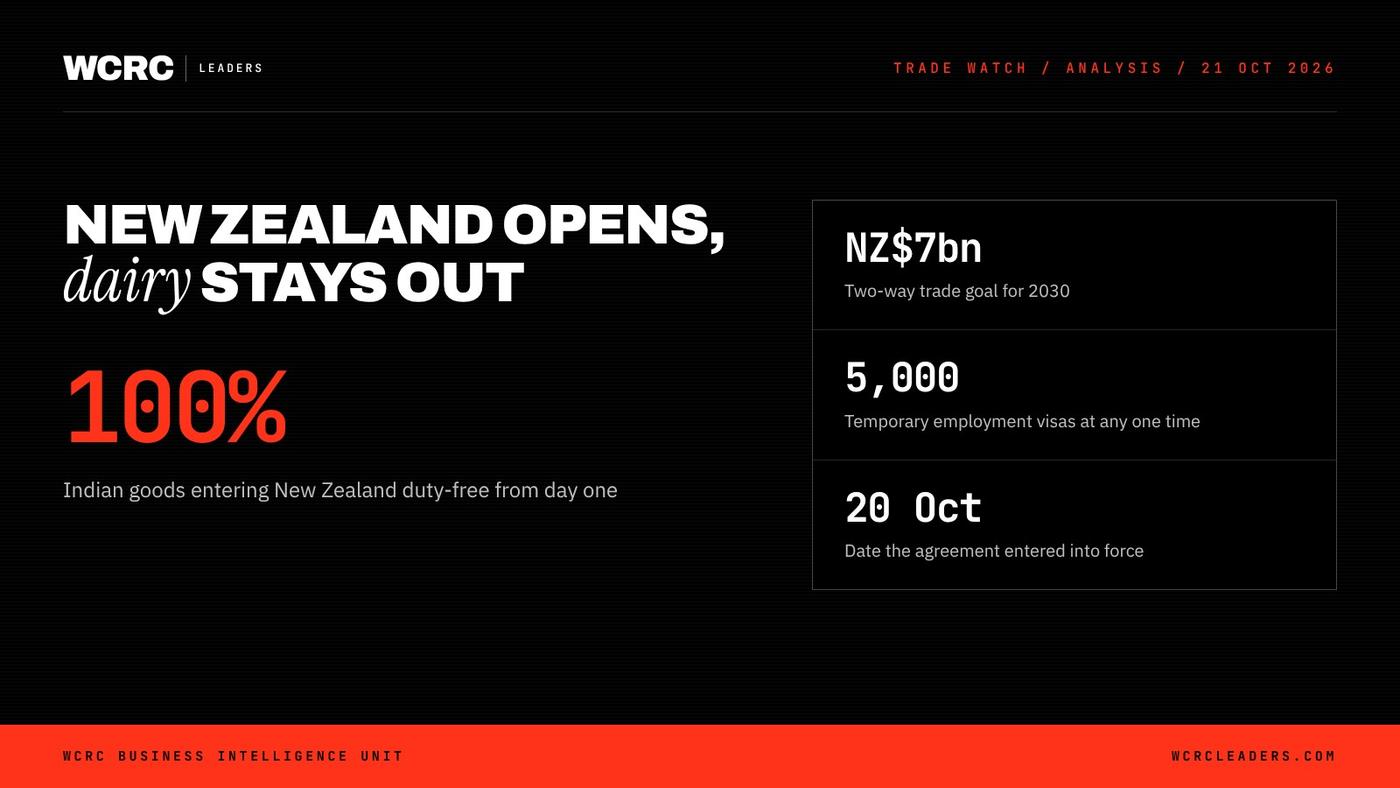
At a glance: WCRC Leaders' assessment: the New Zealand deal is small in trade terms but large in precedent, because it shows a developed economy will sign with India on India's terms on dairy. The India-New Zealand Free Trade Agreement entered into force on 20 October 2026, after talks that ran from 16 March to 22 December 2025 and signature on 27 April 2026. New Zealand has removed duties on all tariff lines for Indian goods. India has excluded dairy, sugar and edible oils. Both sides aim to double two-way trade to NZ$7 billion by 2030.
What changed on 20 October?
From Vijay Dashmi, Indian goods enter New Zealand without customs duty. The Ministry of Commerce and Industry says New Zealand has removed duties on all tariff lines covering Indian exports, eliminating peak tariffs of up to 10%. It is India's first agreement with full duty-free access on every line from day one.
Union Commerce Minister Piyush Goyal said "100% duty-free access to the New Zealand market opens significant new opportunities for our exporters". New Zealand's Minister for Trade and Investment, Todd McClay, called it "a watershed moment in the relationship between our two countries". To mark the day, the first JCB machine exported from India to New Zealand was flagged off.
The base is modest. New Zealand's Ministry of Foreign Affairs and Trade (MFAT) puts two-way trade at NZ$3.68 billion in the year to June 2025. New Zealand's own exports to India were NZ$1.79 billion, more than half of it services. The NZ$7 billion target for 2030 is an aspiration set under the two governments' Strategic Partnership Roadmap, not a forecast.
Access is not symmetrical. India offered concessions on 70.03% of its tariff lines, about 95% of current trade by value. MFAT says 57% of New Zealand's exports to India are tariff-free from day one, including sheep meat, wool and coal, rising to 82% over time. A second round of Indian tariff cuts is due on 1 January 2027.
Who gains among exporters and MSMEs?
The Commerce Ministry expects textiles, apparel, leather, footwear, gems and jewellery, engineering goods, auto components, chemicals, pharmaceuticals and processed foods to gain. Drug and medical device makers also get simpler regulatory processes.
Zero duty and faster customs clearance lower the cost of a first shipment for MSMEs, women-led enterprises, artisans and first-generation exporters. An SME chapter sets up a contact point and a free information website, and New Zealand will help register Indian Geographical Indications. Indian producers keep bilateral safeguards for up to 14 years after a duty cut if imports surge.
WCRC analysis: a 10% tariff is not what has kept most Indian MSMEs out of New Zealand. Distance, small orders and unfamiliar standards matter more. The first winners will be firms already selling to Australia under India's 2022 agreement, who can serve both markets from one supply chain.
What do services firms and talent gain?
New Zealand calls its services offer its best in any trade agreement. It covers about 118 sectors, from computer and professional services to education and finance, with most-favoured-nation commitments in about 139 sub-sectors. For the first time New Zealand has given dedicated access for health and traditional medicine services, including Ayurveda, Yoga and other AYUSH systems.
The mobility terms are the part Indian families will notice:
- Skilled workers: a Temporary Employment Entry visa pathway capped at 5,000 visas at any one time, each for stays of up to three years. The Commerce Ministry's breakdown is healthcare 1,200, IT 1,000, engineering 1,000, construction 700, education 500 and "iconic Indian occupations" such as yoga instructors, chefs and Ayurveda practitioners 600.
- Young people: 1,000 Working Holiday visas a year, valid for 12 months.
- Students: no numerical cap, with work rights of at least 20 hours a week during study.
- Post-study work: up to two years for bachelor's graduates, up to three years for STEM bachelor's and master's graduates, and up to four years for doctoral graduates.
The numbers are small. Their value is that a treaty makes them hard for a future government to tighten.
Why did India keep dairy out?
India excluded milk, cream, whey, yoghurt and cheese, along with sugar, artificial honey and edible fats and oils. The Commerce Ministry describes these products as sensitive and says the exclusions protect farmers and rural economies. India is the world's largest milk producer: official data put output at 247.87 million tonnes in 2024-25.
For New Zealand, one of the world's leading dairy exporters, this was the hardest point. MFAT lists what it secured instead: duty-free supply of dairy ingredients that India processes for re-export, a commitment that India will consult New Zealand if it offers dairy access to a comparable economy, and a review one year after entry into force.
India also tied quotas for New Zealand apples, kiwifruit and Mānuka honey to an Agricultural Productivity Partnership, including kiwifruit Centres of Excellence in Nagaland and Uttarakhand.
Is the $20 billion investment pledge real?
India says New Zealand will facilitate US$20 billion of investment into agriculture, manufacturing, infrastructure and start-ups, with no timeframe given. MFAT's summary says New Zealand will promote investment "aiming for US$20 billion in private sector investment over 15 years", and India will set up a New Zealand Investment Desk. India's signing release cites a rebalancing clause if investment falls short.
WCRC analysis: this is a promotion target, not a government cheque. Spread over 15 years it averages about US$1.3 billion a year. Boards should read it as a signal of where New Zealand capital is being encouraged to look, not as committed money.
What does it signal for India's other trade talks?
By the Commerce Ministry's count, New Zealand is India's ninth trade agreement, and the pattern is consistent. India concluded its agreement with the European Union on 27 January 2026 with no market access on dairy. The India-Oman agreement, signed on 18 December 2025, took effect on 1 June 2026. India and the Gulf Cooperation Council signed terms of reference on 5 February 2026 and launched negotiations on 24 February. A framework for an interim India-US agreement was announced on 7 February 2026.
WCRC analysis: New Zealand matters beyond its size because a dairy-exporting nation still signed without dairy access. That weakens any partner's argument that a deal with India must include farm access. The GCC was India's largest trading bloc in 2024-25 at US$178.56 billion, 15.42% of India's trade, and Gulf interests lie in energy, investment and services rather than dairy, much as the UAE-Saudi rail and grid pact shows the Gulf building its own integrated market. The New Zealand model of occupation-specific visa quotas is a likely reference point for Gulf talks on professional access. For Asian exporters such as Vietnam and Thailand, India is quietly building preferential access to developed markets that they lack, while, as WCRC has noted, chips and servers carry almost half of world trade growth.
The WCRC View
The WCRC Business Intelligence Unit's call: the New Zealand agreement will not move India's export totals in the near term, but it is the clearest proof yet that India can trade full access for its manufacturers against protection for its farmers, and get developed partners to accept it.
Who gains first. Indian apparel, leather, engineering and pharmaceutical exporters with Australian business already, IT and healthcare firms that place staff abroad, and New Zealand's wool, sheep meat, forestry and coal exporters.
What leaders should do now. Exporters should check rules of origin for their products before quoting duty-free prices, since the savings depend on meeting them. Services and staffing firms should map their roles against the six visa categories, because the 5,000 places will fill by sector. Promoters seeking capital should approach the New Zealand Investment Desk early.
For the Gulf and Asia. Gulf boards negotiating with India through the GCC should expect India to hold its line on sensitive farm goods and to offer services and mobility in return.
What WCRC will watch. The second tranche of Indian tariff cuts on 1 January 2027, the first-year review due around October 2027, the pace of the US$20 billion investment target, and whether India's EU and GCC texts copy the New Zealand dairy consultation clause.
Quick answers
Q: When did the India-New Zealand FTA come into force? A: On 20 October 2026. Negotiations ran from 16 March to 22 December 2025 and the agreement was signed on 27 April 2026.
Q: Does New Zealand charge any duty on Indian goods now? A: No. New Zealand has removed customs duties on all tariff lines for Indian exports, including peak tariffs of up to 10%.
Q: Did India open its dairy market? A: No. Dairy, sugar and edible oils are excluded. India has agreed to consult New Zealand if it gives dairy access to a comparable economy, and to a review after one year.
Q: How many Indian professionals can work in New Zealand under the deal? A: Up to 5,000 on Temporary Employment Entry visas at any one time, for stays of up to three years, plus 1,000 Working Holiday visas a year. There is no cap on students.
Filed under