Business
HSBC's $9.6bn quarter: India deposits, Gulf caution, Asia bet
HSBC lifted third-quarter profit before tax by 32% and committed to returns of at least 17% to 2028, with Indian dollar deposits and Hong Kong inflows doing much of the lifting. For corporates in India, the Gulf and Asia, the results show where one of the region's biggest lenders is putting its balance sheet, and where it is holding back.
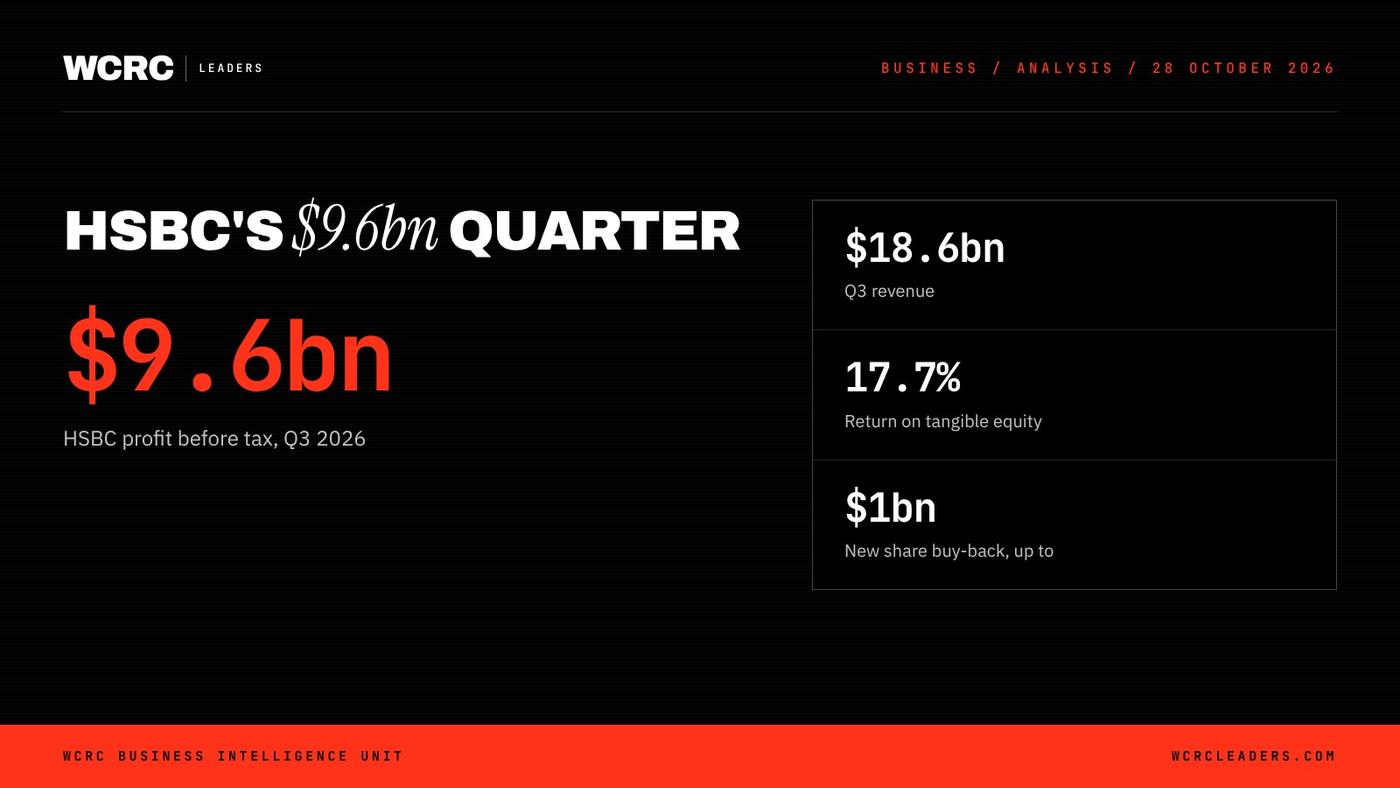
At a glance: WCRC Leaders' assessment: HSBC is now a bank whose growth comes from Asian deposits and wealth, and whose caution is aimed at the Middle East, so Asian and Gulf boards should expect more competition for their cash and a careful approach to their credit. HSBC Holdings reported on 27 October 2026 profit before tax of $9.6bn for July to September, revenue of $18.6bn, a 17.7% return on tangible equity and a 13.9% CET1 ratio. It announced a new buy-back of up to $1bn and a third interim dividend of $0.10 a share.
What did HSBC report for the third quarter?
Profit before tax rose $2.3bn, or 32%, to $9.6bn in the three months to 30 September 2026. Most of the jump came from a $1.4bn net favourable effect of notable items, chiefly the absence of legal provisions taken a year earlier. Stripping those out at constant currency, profit before tax was $10.0bn, up $0.9bn.
Revenue rose $0.8bn to $18.6bn, led by banking net interest income, which reached $11.7bn. Net interest margin held at 1.57%. Fees rose in Corporate and Institutional Banking (CIB) and Wealth. Operating expenses fell 12% to $8.8bn.
Return on tangible equity (RoTE) was 17.7%, against 12.3% a year earlier, and 18.2% excluding notable items. HSBC now targets a RoTE of at least 17% in each of 2026, 2027 and 2028, excluding notable items, with revenue growth rising to 5% in 2028 and a 50% dividend payout ratio.
Group Chief Executive Georges Elhedery said the quarter "reflects consistent execution of our strategic priorities with pace, precision and discipline", adding: "As we simplify HSBC, we are creating greater capacity to invest, grow and deliver strong returns for our shareholders."
Why did India show up so clearly in HSBC's balance sheet?
India's Foreign Currency Non-Resident (FCNR) deposit scheme is the most visible country effect in the release. HSBC said lending rose $7.8bn on the quarter on a reported basis, driven by customers taking part in the FCNR scheme, plus growth in the UK and Hong Kong. Customer accounts rose $9.1bn, driven by Hong Kong inflows and India FCNR deposits. In International Wealth and Premier Banking (IWPB), customer accounts grew $9.8bn at constant currency, mainly from the scheme, which also drove most of an $18.7bn rise in risk-weighted assets from asset size.
The scheme was the Reserve Bank of India's special dollar-rupee swap window, opened on 8 June 2026. Banks raised fresh FCNR(B) deposits from non-resident Indians and swapped the dollars with the central bank. The FCNR(B) leg closed on 31 August, after inflows across the system of $132.98bn, as WCRC reported in $133bn: what India's rupee defence is costing its biggest banks.
HSBC is not alone. Kotak Mahindra Bank, one of WCRC 1000, India's Most Valuable Enterprises 2026, mobilised about ₹55,344 crore of FCNR(B) deposits in its September quarter and linked a fall in its margin largely to that effort, as covered in Kotak Mahindra Bank Q2 profit jumps 29% to ₹4,212cr as loans grow 25%. HDFC Bank, one of WCRC 1000, India's Most Valuable Enterprises 2026, ICICI Bank, also one of WCRC 1000, and Axis Bank, one of WCRC 1000 reported faster deposit growth with thinner margins over the same months.
Analysis: for Indian lenders it swells deposits at the cost of margin. For HSBC, whose network serves the non-resident Indian diaspora in the Gulf, the UK and Asia, it shows the value of being on both ends of the remittance corridor. HSBC India, a WCRC MegaBrand in treasury and capital-raising services, sits at the receiving end of that flow.
What do the credit charges say about Hong Kong and the Middle East?
Expected credit losses (ECL) fell 17% to $0.8bn in the quarter. HSBC cited a lower stage 3 charge on Hong Kong commercial real estate and lower charges in the UK and Mexico. The Hong Kong segment's quarterly ECL was $248m, down from $302m a year earlier.
The nine-month picture is less benign. ECL was $3.2bn, up $0.2bn, and included a $0.5bn charge on a fraud-related UK securitisation exposure in CIB, $0.3bn for Hong Kong commercial real estate, and allowances for uncertainty arising from the Middle East conflict. HSBC did not disclose the size of the Middle East allowances. It guides to a 2026 ECL charge of about 45 basis points of average gross loans, above its medium-term planning range of 30 to 40 basis points.
Analysis: HSBC is signalling that stress in Hong Kong property is easing, while it builds a buffer against a risk it cannot yet size. For Gulf corporates, that usually means lenders keep lending but price for uncertainty, ask for more collateral or shorten tenors until the outlook clears.
Where is HSBC putting its capital, and where is it pulling back?
The release reads as a map of a narrower, more Asian bank. HSBC completed the privatisation of Hang Seng Bank on 26 January 2026 and expects annualised revenue and cost synergies of $0.5bn by end-2028. It is exiting Australian retail banking while keeping corporate, institutional and private banking in Sydney. It is selling its 70.03% stake in HSBC Bank Malta.
Wealth is the growth engine. Group wealth balances reached $1.6tn at 30 September. Net new money was $105bn in nine months, of which $95bn was booked in Asia. IWPB earned a nine-month RoTE of 23.4%.
The corporate franchise is the other pillar. CIB profit before tax rose 14% to $10.9bn for nine months, with wholesale transaction banking fees up 7% to $7.7bn. HSBC's capital in India also runs beyond banking: HSBC Technology India GCC is named among India's Most Loved Workplaces in BFSI by WCRC.
The CET1 ratio slipped 0.2 points to 13.9%, below the 14% to 14.5% target range, because of higher risk-weighted assets and buy-backs. HSBC expects Basel 3.1 to add about 40 to 50 basis points from 1 January 2027.
What does this mean for CEOs and boards in India, the Gulf and Asia?
For Indian corporates, global banks now compete hard for diaspora dollars and the trade and treasury business attached to them. Treasurers should test whether that appetite translates into better pricing on foreign currency facilities and hedging. Rivals such as Standard Chartered India, a WCRC MegaBrand in banking, chase the same business.
For Gulf corporates, the Middle East allowances are a reminder that international lenders are stress-testing the region. Boards should expect sharper questions on supply chains, insurance and counterparties, and should line up committed facilities before conditions tighten.
For Asian groups, HSBC's focus on Hong Kong, wealth and transaction banking means more product and more competition for cash management. It also means a lender that has shown, in Australia and Malta, that it will leave markets that do not meet its return targets.
The WCRC View
The WCRC Business Intelligence Unit reads this quarter as confirmation that HSBC's centre of gravity is Asian deposits, Asian wealth and cross-border corporate flows. The headline 32% rise flatters the trend, but underlying profit and a returns floor running to 2028 show a bank confident in that model.
India is the clearest winner in the short term. The FCNR window pulled diaspora dollars into domestic and global banks alike. The cost appears in Indian banks' margins and in HSBC's own risk-weighted assets.
The Gulf is where HSBC is most cautious. Undisclosed conflict allowances, combined with a full-year credit guide above the medium-term range, tell Gulf boards that bank risk appetite there is being managed, not expanded.
What leaders should do now: Indian treasurers should use the competition for dollar business to renegotiate pricing; Gulf CFOs should secure committed lines and diversify banking partners; Asian boards should benchmark wealth and cash management offers across lenders that are all chasing the same deposits.
What WCRC will watch next: the size of any further Middle East provisions, whether CET1 returns to the 14% to 14.5% range after Basel 3.1 on 1 January 2027, and how India deposit growth holds up when HSBC reports annual results on 23 February 2027.
Quick answers
Q: How much profit did HSBC make in the third quarter of 2026? A: Profit before tax was $9.6bn, up 32%, on revenue of $18.6bn. Excluding notable items at constant currency, it was $10.0bn.
Q: What is HSBC's return target? A: A return on tangible equity of at least 17% in each of 2026, 2027 and 2028, excluding notable items. The third-quarter RoTE was 17.7%.
Q: How did India's FCNR scheme affect HSBC? A: HSBC said customers taking part in the India FCNR deposit scheme drove lending growth and, with Hong Kong inflows, deposit growth in the quarter, and lifted risk-weighted assets.
Q: What is HSBC returning to shareholders? A: A third interim dividend of $0.10 a share and a new share buy-back of up to $1bn, expected to complete by the 2026 full-year results.
Vedanta doubles Gamsberg, and Ramaphosa now wants a zinc smelter
Anchor investors in Indian IPOs: why the 60% book sets the tone

Bajaj Finance lines up ₹17,500 crore as AI agents take on service

$133bn: what India's rupee defence is costing its biggest banks
Jio Platforms IPO: Gulf funds hold 5.32% and are not selling
Détente in two-month instalments: planning for China after the Washington summit
Filed under