Tech and AI
Gemini and ChatGPT pass a billion users: AI tools are the decade's new household brands
In the space of three months this year, two AI assistants crossed a mark only a handful of consumer products have ever reached. ChatGPT reached 1 billion monthly users on 3 June and 1 billion weekly users in late July. Google's Gemini app passed 1 billion monthly users on 11 August. Brands that did not exist in most households four years ago are now used by more people than most of the world's best-known names.
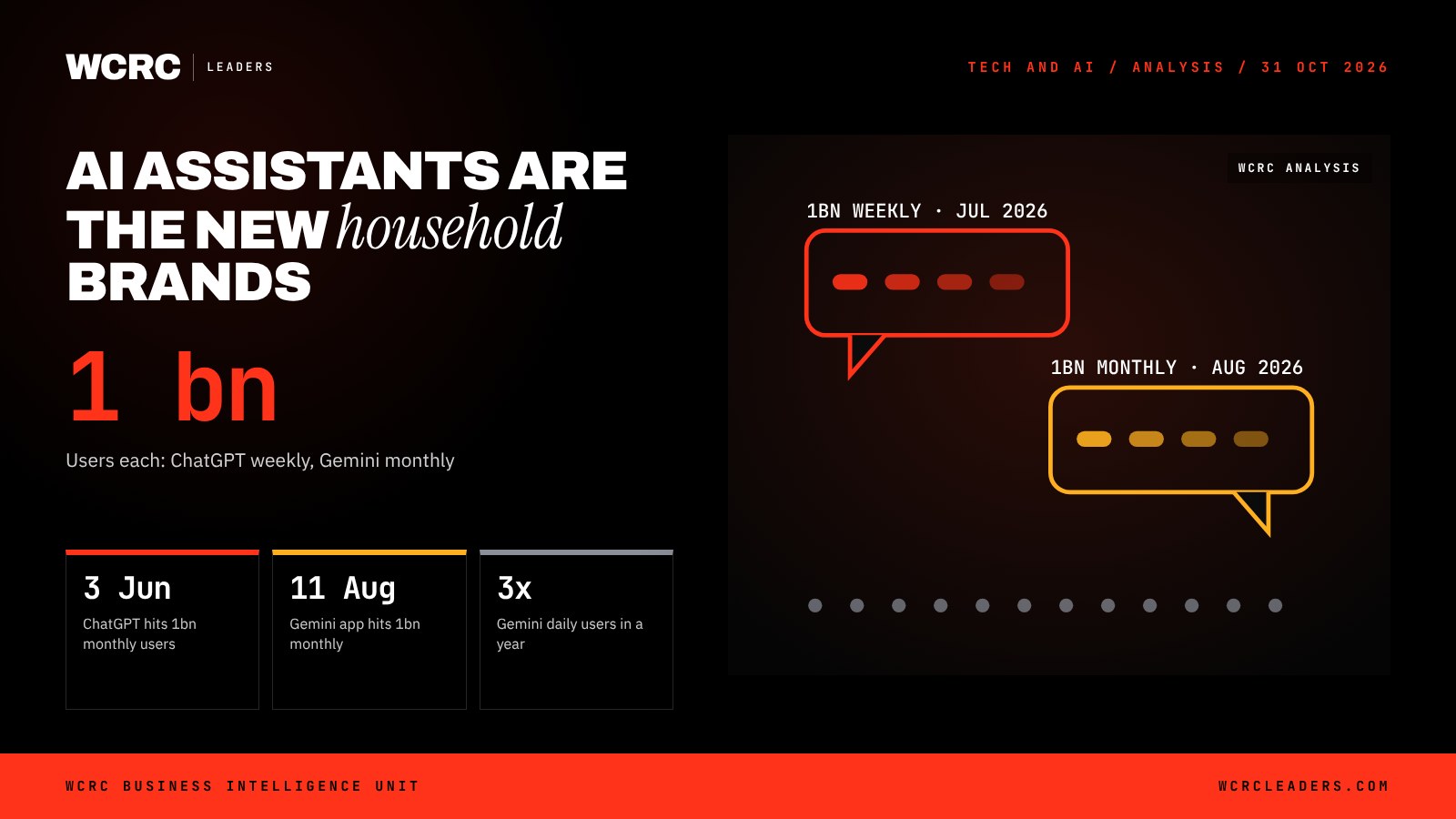
At a glance: WCRC Leaders' assessment: AI assistants have become mass consumer brands faster than any product category before them. ChatGPT leads on frequency of use, with a billion people using it every week; Gemini has closed the gap on reach by building into products people already use. For every other brand, the shift matters because these assistants increasingly decide what consumers see first.
| Milestone | Date |
|---|---|
| Gemini: about 400 million monthly users | May 2025 |
| ChatGPT: about 900 million weekly users | February 2026 |
| Gemini: 750 million monthly users | February 2026 |
| ChatGPT: 1 billion monthly users | 3 June 2026 |
| ChatGPT: 1 billion weekly users | late July 2026 |
| Gemini: over 950 million monthly users | late July 2026 |
| Gemini app: 1 billion monthly users | 11 August 2026 |
| Google's AI Mode in Search: 1 billion monthly users | 11 August 2026 |
Two routes to a billion
The two leaders got there differently. ChatGPT built a destination: people open it on purpose, and a billion do so every week. Weekly use is a demanding measure; it means the product has become a habit.
Gemini built on distribution. Google's chief executive Sundar Pichai called it the company's "fastest growing product ever" when it passed a billion monthly users. Its daily users tripled in a year, helped by its place inside Android, Search and Google's other products. Google's AI Mode in Search passed a billion monthly users on the same day.
Why this is a brand story
Read through WCRC's MegaBrands lens, which looks at positioning and recall, consumer trust, product and delivery, and digital soundness, AI assistants have done in four years what most consumer brands take decades to do: build recall across ages and countries.
WCRC's Brand & Marketing Codex sharpens the picture. The Recall Ladder asks whether attention builds lasting memory or just noise; a billion weekly users is memory. The Category Command Model asks who leads a category and by how much; this is a two-brand race at the top, with ChatGPT ahead on habit and Gemini on reach. The Trust Equity Model is the open question. Assistants that give wrong answers or mishandle data can lose trust quickly, and trust is what keeps people asking.
What it means for every other brand
The assistants are becoming the first place many people ask for advice: what to buy, where to eat, which company to trust. That changes how brands are found. WCRC's Digital Authority Model asks whether a brand owns its category online. In an AI-first world, that increasingly means whether assistants mention the brand, describe it accurately and link to it.
Brands that publish clear, factual, well-sourced information about themselves are easier for assistants to read and cite. Brands that rely only on advertising may find themselves left out of the answer.
The leadership view
For boards, the speed of this shift is the lesson. On WCRC's leadership parameters, Innovation Score and Global Mindset are in play: few leadership teams planned in 2022 for an assistant with a billion weekly users. The Guru Management Codex model Kayaka-Dasoha Value Loop, built on workforce strategy in an automated economy and the dignity of honest work, is a timely frame for how companies bring these tools into their own workplaces without losing the trust of their people.
The WCRC View
AI assistants are now household brands on the scale of the world's biggest consumer names, and they reached that scale faster than anything before them. The race between habit and reach will shape the next few years. For every other company, the practical question is simpler: when a billion people ask an assistant about your category, does your brand appear in the answer?
WCRC models applied: MegaBrands; Brand & Marketing Codex (Recall Ladder, Category Command Model, Trust Equity Model, Digital Authority Model); WCRC leadership parameters (Innovation Score, Global Mindset); Guru Management Codex (Kayaka-Dasoha Value Loop).
SK hynix shelves the Solidigm IPO: what it says about the AI capex cycle
Junior hires fall to 9% at Anthropic: a warning for India's IT pyramid
Supplier-funded compute: what CFOs should read into the AI financing loop
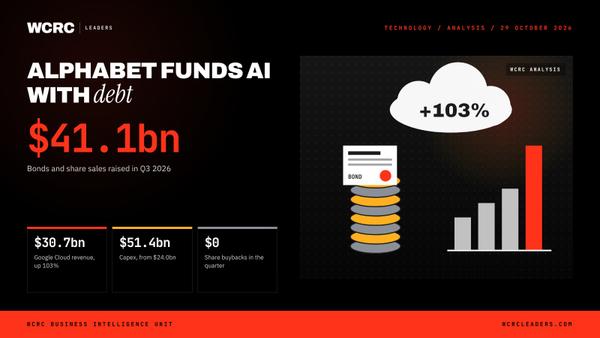
Google Cloud doubles revenue as Alphabet funds AI with debt

China's 40-technology export list puts India's solar push on notice
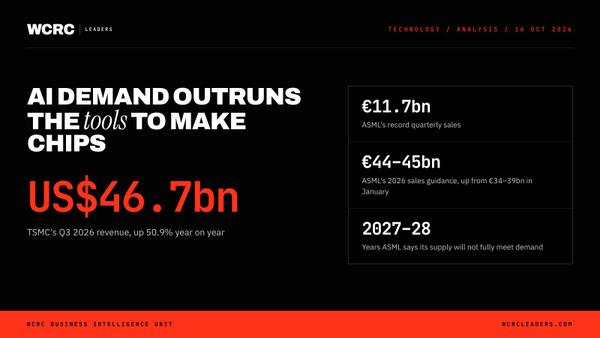
TSMC and ASML post records, and ASML says supply falls short to 2028
Filed under