Tech and AI
The AI price war: why intelligence keeps getting cheaper, and who pays for it
On 26 October, OpenAI launched GPT-6.1 Terra at $1 per million input tokens and $5 per million output tokens, half the price of its premium tier. Three months earlier it had cut the prices of its cheaper models by up to 80%, days after a Chinese company released a giant open-weight model for free download. The cost of artificial intelligence is falling faster than almost any technology before it. For businesses, that changes what is affordable to automate. For the companies selling AI, it changes how they can make money.
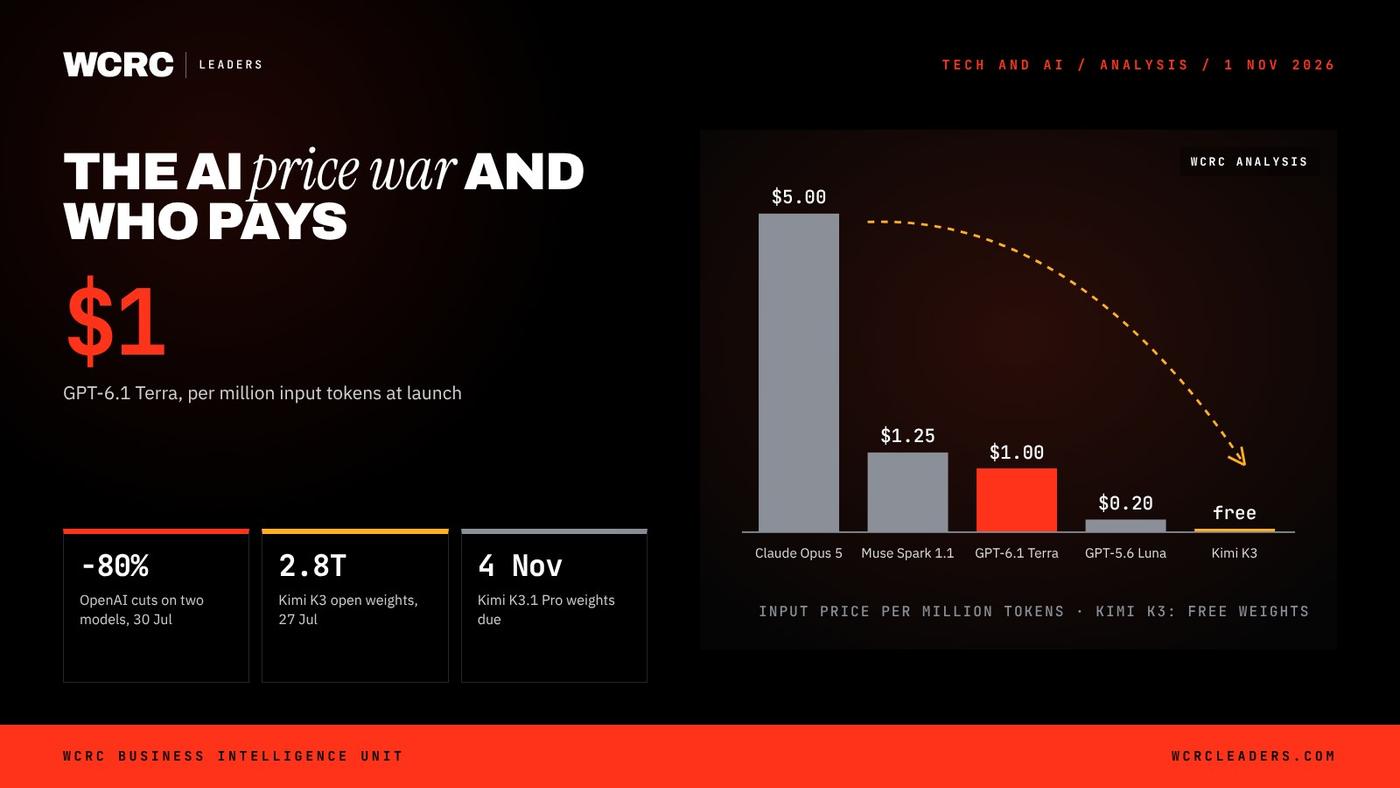
At a glance: WCRC Leaders' assessment: the AI price war is driven by two forces, open-weight models that set a floor near zero and frontier labs racing to win business customers. Cheaper models make AI practical for routine work at scale. But price alone will not decide the winners. Trust, reliability and how well a model fits a company's work will matter more as prices converge.
| Fact | Detail |
|---|---|
| Kimi K3 (Moonshot AI) | Open weights released 27 Jul 2026, 2.8 trillion parameters |
| OpenAI price cut, 30 Jul 2026 | Up to 80% on two lower-cost GPT-5.6 models |
| GPT-5.6 Luna after the cut | $0.20 input, $1.20 output per million tokens |
| GPT-6.1 Terra, 26 Oct 2026 | $1 input, $5 output per million tokens |
| Meta Muse Spark 1.1 | $1.25 input, $4.25 output per million tokens |
| Claude Opus 5 | $5 input, $25 output per million tokens |
| Kimi K3.1 Pro | Open weights due by 4 Nov 2026 |
Prices are list prices per million tokens for developers using each company's API, as published at the time. A token is roughly three-quarters of an English word.
How the price war started
The current round began on 27 July, when Moonshot AI released Kimi K3, a model with 2.8 trillion parameters, as full weights that anyone could download for free. An open-weight model can be run by any company on its own servers, paying only for computing power.
Three days later, on 30 July, OpenAI cut prices by up to 80% on its two lower-cost GPT-5.6 models. GPT-5.6 Luna fell to 20 cents per million input tokens and $1.20 per million output tokens. OpenAI also gave about 100,000 researchers free access to its frontier models through 2027.
The latest move came on 26 October with GPT-6.1 Terra, aimed at everyday workplace tasks and AI agents. At $1 per million input tokens and $5 per million output tokens, it costs half as much as OpenAI's premium GPT-6.1 Sol. OpenAI says it is far more capable than the Terra model it replaces: it solves 50.3% of tasks on the Terminal-Bench 4.0 coding test at maximum effort, against 21.5% for GPT-5.6 Terra. These are the company's own figures.
Open-weight competition has not stopped. Moonshot's Kimi K3.1 Pro, with a one-million-token context window, is due to have its full weights released by 4 November.
Why prices keep falling
Three forces are pushing prices down at once.
- Open weights set a floor. When a capable model is free to download, a paid model has to justify its price with better quality, reliability or service.
- Efficiency gains. Each new generation of models and chips does more work per unit of computing power. Labs pass some of that saving on.
- The race for business customers. AI companies are competing to become the default tool inside large organisations. Lower prices win pilots; pilots become contracts.
The result is a market with a wide spread. At one end, models such as GPT-5.6 Luna cost cents per million tokens. At the other, premium models such as Claude Opus 5, at $5 input and $25 output per million tokens, charge for top-end capability on the hardest tasks. Between them sit mid-tier models such as Meta's Muse Spark 1.1 and GPT-6.1 Terra.
What it means for businesses
For companies using AI, falling prices change the calculation in three ways.
- Routine work becomes cheap to automate. Summarising documents, sorting customer queries, drafting standard replies and extracting data from forms can now cost a fraction of what they did a year ago.
- Agents become affordable. AI agents, which carry out multi-step tasks on their own, use many more tokens than a single question. Lower prices make them practical for everyday work, not just experiments.
- Choosing the right model matters. Paying premium prices for simple tasks wastes money; using the cheapest model for complex work produces errors that cost more to fix. Smart buyers now match each task to the right tier.
For Indian companies, especially IT services firms and start-ups building on top of these models, lower prices widen margins on AI-based services. They also lower the barrier for competitors, which means the advantage shifts from access to AI towards knowing how to apply it well.
The WCRC lens: price is not the only power
Read through WCRC's MegaBrands lens, which looks at areas such as positioning and recall, consumer trust, product and delivery, and digital and financial soundness, AI companies are becoming brands in the full sense, and a price war tests brands as much as technology.
Three models from WCRC's Brand & Marketing Codex frame the contest:
- Price Power Model. It asks how much premium a brand can charge before buyers switch. Premium models are betting that businesses will pay more for reliability on important work. The price war is a live test of how much price power each AI brand really has.
- Trust Equity Model. It asks how much trust a brand holds and how much pressure it can absorb. For businesses handing sensitive data and real decisions to AI, trust in accuracy, security and safety can matter more than a lower token price.
- Category Command Model. It asks who leads a category and by how much. Cutting prices is one way to win command of the business market quickly; keeping it requires a product that customers do not want to leave.
The leadership and workforce view
Cheaper AI also raises a people question. WCRC's Guru Management Codex model Kayaka-Dasoha Value Loop, which is about workforce strategy in an automated economy built on the dignity of honest work, is a useful frame. When routine tasks become almost free to automate, leaders have to decide how to redeploy and retrain the people who did them, and how to share the gains.
In the terms of WCRC's leadership parameters, the moment calls for Innovation Score, the ability to turn new tools into better products and services, and Vision Quotient, the ability to see where the market is heading rather than reacting to each price cut.
What to watch
- Kimi K3.1 Pro's full release, due by 4 November, and whether it pushes prices down again.
- Responses from other labs to GPT-6.1 Terra's pricing.
- Enterprise contracts, where real prices are negotiated and often differ from list prices.
- Reliability data, as businesses report how cheaper models perform on real work.
The WCRC View
The AI price war is good news for businesses that use AI and hard news for those that sell it. Open-weight models have set a floor close to zero, and frontier labs are cutting prices to win customers. But as prices converge, the winners will be decided by trust, reliability and fit with real work, not by the lowest token price. For companies adopting AI, the opportunity is to automate more for less; the responsibility is to choose models wisely and to bring their people along.
WCRC models applied: MegaBrands; Brand & Marketing Codex (Price Power Model, Trust Equity Model, Category Command Model); WCRC leadership parameters (Innovation Score, Vision Quotient); Guru Management Codex (Kayaka-Dasoha Value Loop).
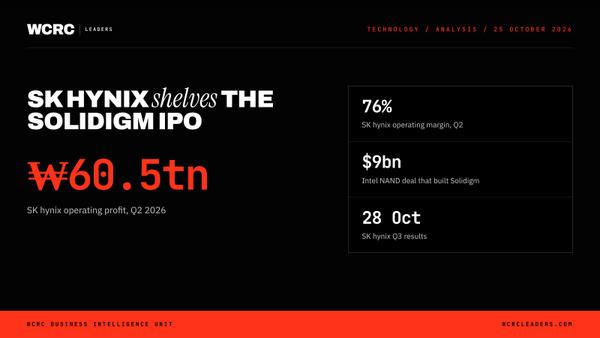
SK hynix shelves the Solidigm IPO: what it says about the AI capex cycle
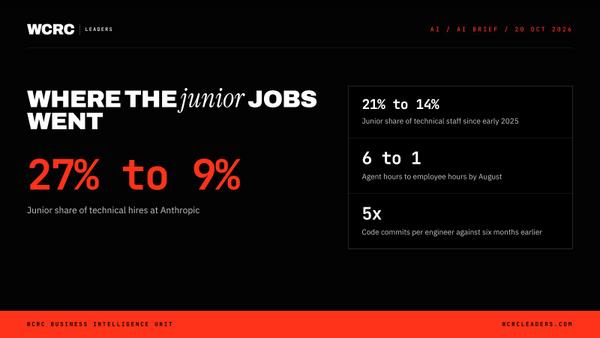
Junior hires fall to 9% at Anthropic: a warning for India's IT pyramid
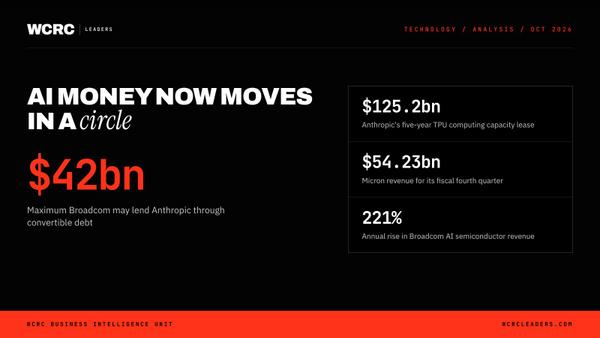
Supplier-funded compute: what CFOs should read into the AI financing loop
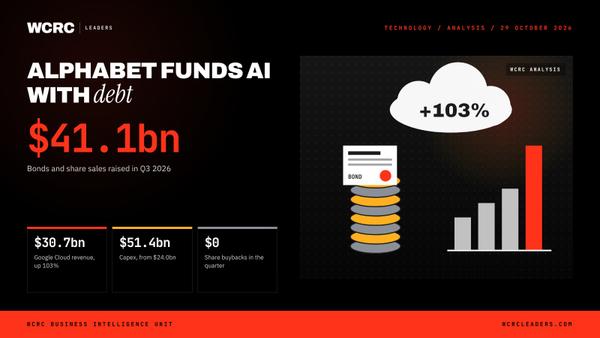
Google Cloud doubles revenue as Alphabet funds AI with debt

China's 40-technology export list puts India's solar push on notice
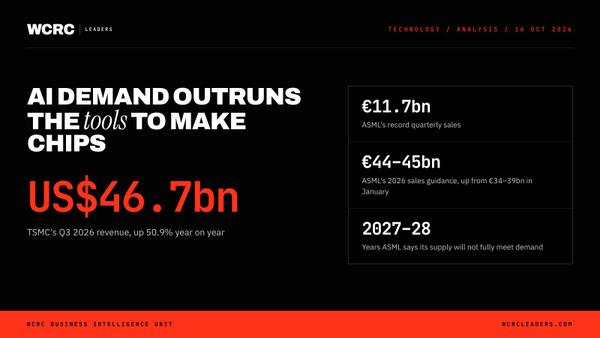
TSMC and ASML post records, and ASML says supply falls short to 2028
Filed under