Workplaces
UAE firms have until 31 December to hit 2% Emiratisation for 2026
The Ministry of Human Resources and Emiratisation has given private employers with 50 or more workers eight weeks to close their 2026 gap. For Indian and Asian companies in the UAE, the cheapest answer is no longer a hire made in December.
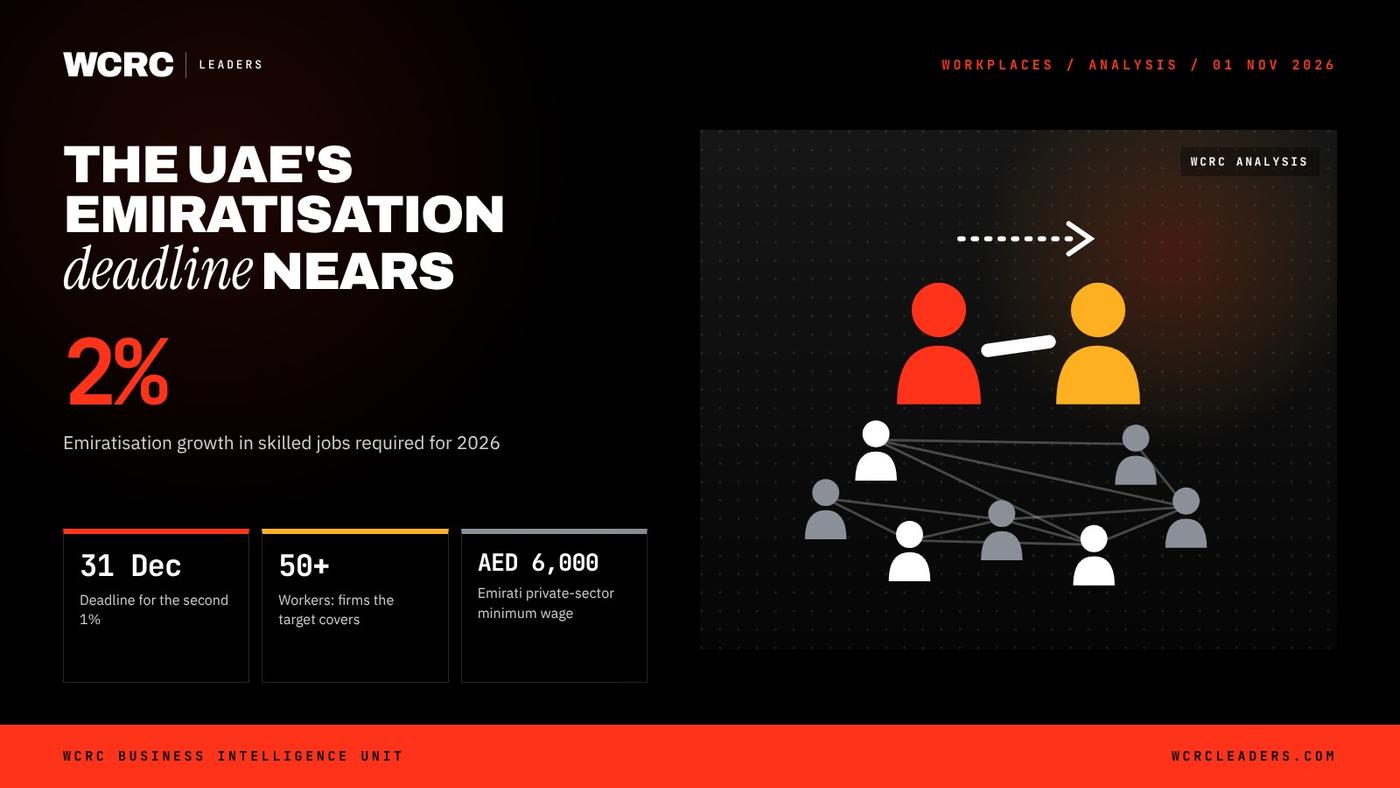
At a glance: WCRC Leaders' assessment: the 31 December deadline rewards employers who treat Emirati hiring as a talent pipeline and punishes those who treat it as a headcount to be filled at year end. On 30 October 2026 the UAE Ministry of Human Resources and Emiratisation (MoHRE) told private firms with 50 or more workers to add a further 1% of Emiratis in skilled roles in the second half of 2026, taking the year to 2%. Hiring should run through the Nafis platform, and the ministry warned again against fake Emiratisation. This is the final year of the national 10% path.
What exactly did MoHRE say on 30 October?
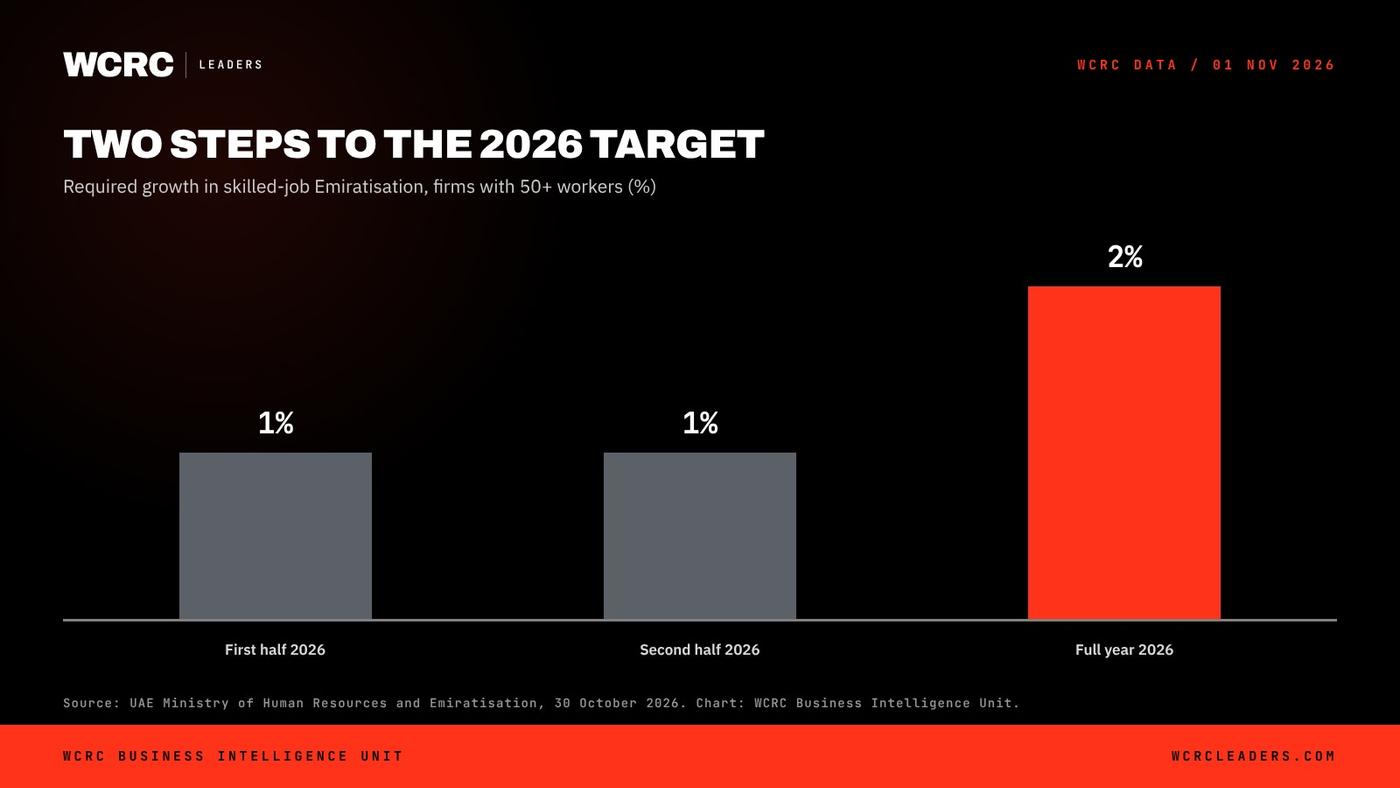
MoHRE called on private-sector establishments with 50 or more workers to meet their 2026 Emiratisation targets before the final deadline of 31 December 2026. The requirement for the second half of the year is an additional 1% growth in the Emiratisation rate of skilled jobs. Added to the 1% due by 30 June, that makes 2% for the year.
The ministry urged firms to post vacancies on Nafis, the federal Emirati talent programme, and to use its direct messaging tools to reach candidates ranging from fresh graduates to experienced specialists. It set out three conditions that make a hire count: the job must be genuine, the Emirati employee must be registered in the pension and social security system, and wages must be paid through approved procedures. MoHRE also asked UAE citizens to reject fake employment schemes and to report violations through its call centre on 600590000, its website or its smart app. It praised companies that had already met their first-half targets.
Why does this deadline matter more than earlier ones?
Because 2026 closes a cycle. The UAE Cabinet set the rule that companies with 50 or more workers raise their Emiratisation rate in skilled jobs by 2% a year, to reach an overall increase of 10% by 2026. A firm that has kept pace is completing its final step this year. A firm that has fallen behind is carrying the shortfall of several years into one December.
The money follows the same timetable. Since 2023, non-compliant companies have paid a monthly contribution of AED 6,000 for each Emirati position they failed to fill, and that amount has risen by AED 1,000 each year until 2026, according to the UAE government's official portal. Smaller firms are not exempt. Since 2024, companies with 20 to 49 workers in 14 sectors, including manufacturing, construction and hospitality, have had to hire one Emirati by the end of 2024 and a second by the end of 2025, with annual contributions of AED 96,000 and AED 108,000 for missing each step.
Most of the market is keeping up. MoHRE said in July that 95% of companies covered by Emiratisation policies met their first-half 2026 targets, and that more than 190,000 Emiratis now work in the private sector across nearly 32,000 companies. The ministry also announced that the Nafis programme would be extended to 2040. That last point matters for boards: this is not a policy cycle that will fade. It is a permanent feature of operating in the UAE.
What counts as a skilled Emirati hire?
Getting the definition wrong is how well-meaning employers end up out of compliance. MoHRE classifies jobs into nine professional levels based on the International Labour Organization's occupational classification. For work to count as skilled, the role must sit in levels one to five, which run from senior managers through professionals, technicians and writing roles to service and sales work. The worker must hold an attested qualification above secondary level, and the monthly salary, excluding commission, must be at least AED 4,000.
There is a second floor that sits above that one. MoHRE set the minimum monthly wage for Emiratis in the private sector at AED 6,000 with effect from 1 January 2026. Finance teams budgeting for December hires should plan on that figure as the starting point, not the skilled-job threshold.
What does this mean for Indian and Asian employers?
Many Indian and Asian groups in the UAE run lean regional head offices with workforces drawn heavily from home markets. Those are the firms most likely to treat a quota as a line item rather than a strategy.
Three risks stand out. The first is the late scramble: hiring several Emiratis in December into roles with no manager, no training plan and no career path. That meets the letter of the target and sets up a resignation in March. The second is the shortcut. MoHRE's repeated warnings about fake Emiratisation, which it treats as a violation under Cabinet Resolution No. 95 of 2022 and Ministerial Resolution No. 296 of 2023, make clear that ghost roles and paper registrations are being looked for. The third is cost drift: a firm that pays contributions year after year is buying nothing that lasts.
Analysis: the employers that do well under this regime tend to do the opposite. They put Emirati hiring into the annual workforce plan in January, not the compliance calendar in November. They identify roles in client-facing, government-facing and supervisory work where local knowledge has real commercial value. And they hire in cohorts, so new joiners have peers and a visible route upward.
How do leaders build a real Emirati pipeline?
Read through WCRC's CultureCrest 5-Parameter Framework, the test is whether an Emirati hire touches each of its five areas: impact on people, innovation, environment, career development and engagement. A role that offers a salary and nothing else fails on career development and engagement before the first appraisal. A role with a named mentor, a 12-month learning plan and a stake in a live project meets the policy and builds the business.
The WCRC Workplace Equity Index, the lens behind India's Most Loved 250 Workplaces, adds a sharper question for expatriate-led firms. Its themes include psychological safety, equitable opportunity, and trust and belonging. A lone Emirati in an office where every manager shares one language and one home country is unlikely to feel any of the three. In the terms of Make-It-Your-Own Belonging, a model in WCRC's Guru Management Codex drawn from Sri Sarada Devi, belonging is something leaders build on purpose: the newcomer has to be treated as an owner of the place, not a guest in it.
The same page sets out WCRC's seven leadership parameters, and two of them carry this deadline. People Leadership asks whether managers develop the talent they are given. Stakeholder Trust asks whether the company keeps its word to the people it answers to, and in the UAE the state is one of those stakeholders. A chief executive who signs off a paper hire to clear a quota is spending that trust.
Practical steps for the next eight weeks are simple. Check the current Emirati count against the skilled-job definition, role by role. Confirm pension registration and approved payroll for every Emirati already employed. Post open roles on Nafis now, not in mid-December. And give each new Emirati joiner a named manager accountable for their first year.
For a parallel case from the region, see WCRC's guide to Saudi Arabia's 50% accountant quota, and for the investment context behind Gulf hiring, Gulf FDI's $99bn high.
The WCRC View
The Business Intelligence Unit of WCRC reads the 30 October statement as a closing bell, not a fresh rule. The 2% annual path and the 10% goal have been public for years, so firms that are short today have chosen to be short.
Who gains: employers that already hire Emiratis in cohorts, with mentors and promotion routes, will meet the target at little extra cost and will hold the talent they hired. In the terms of CultureCrest and the Workplace Equity Index, they are building a workforce, not filling a register.
Who loses: firms that rely on December hiring or paper roles. With Nafis extended to 2040 and MoHRE watching pension and payroll records, the shortcut is getting harder to hide.
What leaders should do now: move Emiratisation from the HR compliance team to the chief executive's workforce plan, and judge it as People Leadership and Stakeholder Trust, two of WCRC's seven leadership parameters. Boards of Indian and Asian groups with UAE operations should ask for a role-by-role compliance check before the end of November.
What WCRC will watch: MoHRE's first-quarter 2027 compliance figures, any new targets beyond the 10% path, and whether the 190,000 Emiratis in private-sector jobs grows on the back of real careers or quick fixes.
WCRC models applied: CultureCrest 5-Parameter Framework, WCRC Workplace Equity Index, WCRC seven leadership parameters, Make-It-Your-Own Belonging (Guru Management Codex).
Quick answers
Q: What is the UAE Emiratisation deadline for 2026? A: Private firms with 50 or more workers must meet their 2026 targets by 31 December 2026, adding 1% Emiratis in skilled roles in the second half for 2% across the year, according to MoHRE.
Q: How should companies hire Emiratis? A: MoHRE urges firms to post vacancies on the Nafis platform and use its direct messaging tools to reach candidates, from fresh graduates to experienced specialists.
Q: What is the minimum wage for Emiratis in the private sector? A: MoHRE set it at AED 6,000 a month, effective 1 January 2026.
Q: What makes an Emirati hire count towards the target? A: The job must be genuine and skilled, the employee must be registered with the pension and social security system, and wages must be paid through approved procedures.
Hyundai's 27% home slump: the boardroom price of a labour dispute

Saudi Arabia's 50% accountant quota starts 27 October: a CFO checklist
Singapore adds 27,700 jobs as restructuring cuts climb to 4,800
Leading in a low-hire, low-fire market
The great flattening: companies are cutting managers, not just jobs
AI layoffs: cause or cover story?
Filed under