Workplaces
Saudi Arabia's 50% accountant quota starts 27 October: a CFO checklist
From next Tuesday, half of the accounting workforce at larger private employers in the Kingdom must be qualifying Saudi nationals. For Indian, Gulf and Asian firms, the test is not headcount alone but wages, accreditation and payroll data.
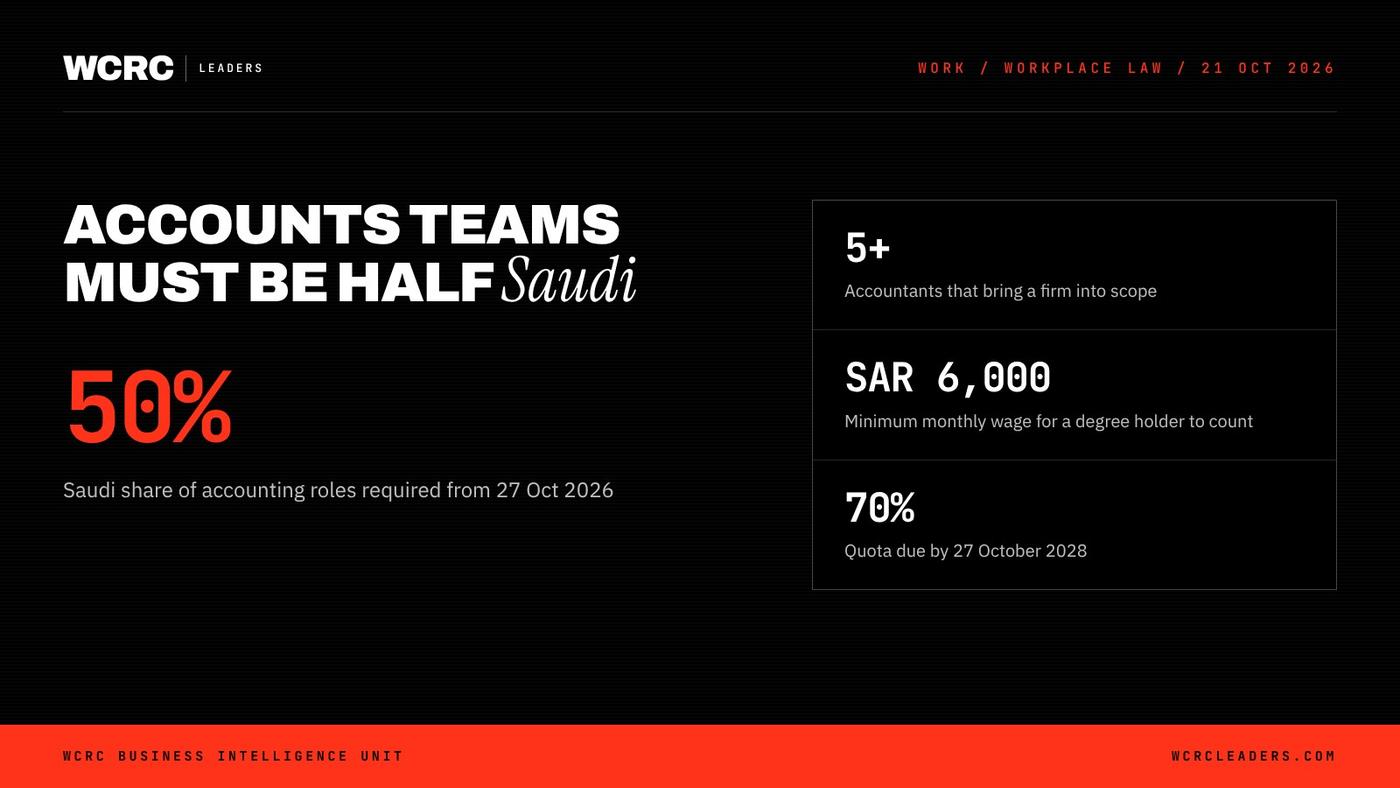
At a glance: WCRC Leaders' assessment: the 50% step is a payroll-data and accreditation test more than a hiring test, and firms that treat it as a headcount exercise will fail it. Ministerial Decision 103108, issued by Saudi Arabia's Ministry of Human Resources and Social Development (HRSD) with the Ministry of Commerce on 26 January 2025, raises the required Saudi share of listed accounting roles to 50% on 27 October 2026, for private establishments with five or more accountants. It climbs to 60% in 2027 and 70% in 2028.
This article is general information, not legal advice; take advice on your own establishment's position.
What exactly changes on 27 October 2026?
The decision localises accounting professions in the Saudi private sector "gradually and in phases over a period of five years", according to HRSD's procedural guide. The first phase began on 27 October 2025 at 40%. Each later step falls on the same date:
| Phase start | Required Saudi share |
|---|---|
| 27 October 2025 | 40% |
| 27 October 2026 | 50% |
| 27 October 2027 | 60% |
| 27 October 2028 | 70% |
The quota applies to private establishments employing five or more workers in the accounting professions listed in the guide. The list, identified by Saudi occupational codes, runs from finance, tax and audit managers to accountants, internal auditors, tax officers and accounts clerks. Accounting offices fall under a separate ministerial framework, which audit and accounting practices should check separately.
Is it 22 October or 27 October?
The official announcement of the package on 26 January 2025 gave a start date of 22 October 2025 for the accounting decision. HRSD's decision page and procedural guide both give 27 October 2025 (5 Jumada al-Awwal 1447), set every later step on 27 October, and describe a nine-month grace period after publication. The ministry's documents are the operative text: plan around Tuesday 27 October 2026.
Who counts as a Saudi accountant?
This is where compliance plans most often slip. Under the guide, a Saudi national counts towards the ratio only if two conditions are met:
- Minimum wage. At least SAR 6,000 a month for a holder of a bachelor's degree or equivalent, or SAR 4,500 for a diploma holder. A Saudi accountant paid below the threshold does not count.
- Professional accreditation. The accountant must hold professional accreditation from the Saudi Organization for Chartered and Professional Accountants (SOCPA). Unaccredited staff are excluded from the calculation.
These conditions are not new. When HRSD first localised accounting roles in December 2020, at 30% for establishments with five or more accountants, it set the same SAR 6,000 and SAR 4,500 thresholds and the same SOCPA requirement. What has changed is the share, and its speed. The guide states that compliance is tracked automatically against social insurance (GOSI) data, so the registered job title and wage are what the system sees.
How is the ratio calculated?
The guide sets out a simple method: count the workers in the listed accounting professions, multiply by the phase percentage, round to the nearest whole number, and compare the result with the number of qualifying Saudis.
Its own worked example for the 50% phase: an establishment with 23 accountants needs 23 × 50% = 11.5, rounded to 12 qualifying Saudis. If it has nine, it must add three. The guide also says the ratio applies whatever the establishment's Nitaqat band, so a firm in a comfortable band under the broader Saudisation programme is not exempt from the accounting quota.
What are the penalties?
The guide states that where an establishment does not comply, penalties are applied under HRSD's executive mechanism for penalties and procedures, and it cites the ministerial decisions that amended that mechanism. Neither the guide nor the January 2025 announcement sets out a penalty amount specific to this decision. CFOs should obtain the current penalty schedule from HRSD rather than rely on figures circulating informally.
The guide also lists support for compliant hiring: help with recruitment and job search, training and qualification for Saudi staff, employment and retention support, and priority access to the ministry's localisation support programmes.
What should CFOs and CHROs do before 27 October?
With days to go, the priority is accuracy, not recruitment drives. A practical sequence:
- Rebuild the count. List every employee whose registered occupation falls in the guide's table, including clerks and assistants who are easily overlooked. If the total is five or more, the quota applies.
- Test each Saudi accountant against both conditions. Check registered wage against the SAR 6,000 or SAR 4,500 threshold, and confirm current SOCPA accreditation. A Saudi employee who fails either test is not counted.
- Reconcile titles with GOSI. Because enforcement relies on linked data, a mismatch between an employee's actual role and the registered occupation can move the ratio in either direction. Correct errors; do not reclassify roles to dodge the list.
- Close the gap with the guide's method. Use the rounding rule to find the exact number of additional qualifying Saudis required at 50%, then at 60% for October 2027.
- Fund accreditation. Sponsoring Saudi graduates through SOCPA accreditation turns existing hires into counted hires. Training lead times mean this is a 2027 decision being taken now.
- Plan expatriate roles with care. Communicate early with affected expatriate staff and keep contract and end-of-service obligations under Saudi labour law in view.
What does it mean for Indian finance shared services?
India is the largest single source of expatriate talent in the Kingdom. The Ministry of External Affairs' population table records about 2.46 million Non-Resident Indians in Saudi Arabia. No official figure exists for how many work as accountants, and WCRC does not estimate one.
The guide applies the quota to workers employed by the Saudi establishment in the listed professions. It does not address outsourcing, contractors or remote work. That silence matters. When HRSD localised customer service roles in 2022, its announcement explicitly covered work outsourced to another party serving the establishment's clients. The accounting decision, as published, contains no such clause.
WCRC analysis: On the published text, finance work performed by a separate entity in India or elsewhere, and not employed by the Saudi establishment, does not appear to enter the Saudi ratio. That keeps offshore shared services a legitimate part of the model for Indian and Asian groups, but not a loophole: the ministry can extend scope, as it did for customer service. Confirm any structure with HRSD or counsel first.
The decision is one part of a wider package. The January 2025 announcement covered 269 professions across pharmacy, dentistry, engineering and accounting, and HRSD's decisions page lists a further procedural guide localising project management professions at 70% from 14 February 2027. For a CHRO, accounting is the template for what follows.
The WCRC View
From the WCRC Business Intelligence Unit
- The call. The 50% step is manageable for firms that already met 40% honestly. The real pressure arrives in 2027 and 2028, when the share rises to 60% and then 70% and the pool of SOCPA-accredited Saudi accountants on qualifying salaries will be tighter and more expensive.
- Who gains. Saudi accounting graduates, SOCPA, and firms that invest early in accreditation pipelines. Indian finance shared-services centres also gain, because transactional work done offshore by a separate entity sits outside the published ratio, while judgement-heavy roles in the Kingdom move to Saudi hands.
- Who loses. Mid-sized employers with eight to thirty accountants and thin Saudi benches, where the rounding rule bites hardest, and expatriate accountants in clerk and junior roles who are easiest to replace.
- What leaders should do now. Boards of Indian, Gulf and Asian groups with Saudi operations should ask management for a single page: the count of listed roles, the counted Saudis after the wage and SOCPA tests, the gap at 50%, 60% and 70%, and the plan to close it. If that page does not exist by 27 October, the risk is a governance one, not only an HR one.
- What we will watch. Any HRSD statement on outsourced accounting work, a penalty schedule specific to this decision, and how the guide's final phase treats smaller establishments.
Related reading: What leaders must do under the UK's employment law changes, Gulf C-suite churn in Q3 2026 and India's two-speed job market.
Quick answers
Q: When does Saudi Arabia's accounting quota rise to 50%? A: On 27 October 2026, under Ministerial Decision 103108, according to HRSD's procedural guide. It rises to 60% on 27 October 2027 and 70% on 27 October 2028.
Q: Which employers are covered? A: Private establishments employing five or more workers in the accounting professions listed in HRSD's guide. Accounting offices fall under a separate framework.
Q: When does a Saudi accountant count towards the quota? A: When paid at least SAR 6,000 a month (bachelor's degree) or SAR 4,500 (diploma) and holding SOCPA professional accreditation.
Q: What are the penalties for non-compliance? A: The guide says penalties apply under HRSD's executive mechanism for penalties and procedures. It does not state an amount specific to this decision.
Filed under