Workplaces
Hyundai's 27% home slump: the boardroom price of a labour dispute
Hyundai Motor kept its margin in the third quarter, but strikes in Korea cut home volume by more than a quarter and forced lower 2026 targets. For boards in India, the Gulf and Asia, the lesson is that industrial relations belong on the risk register, not only on the HR agenda.
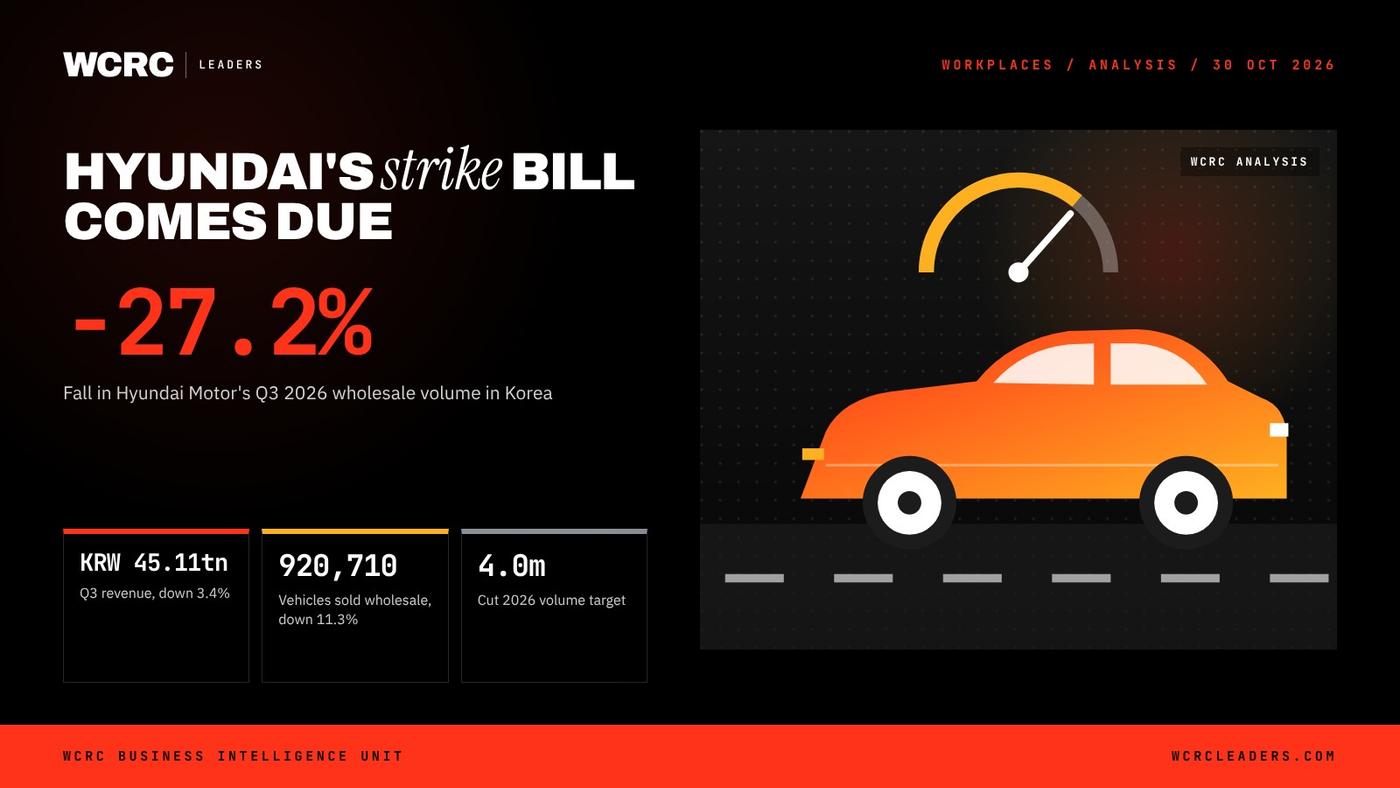
At a glance: WCRC Leaders' assessment: Hyundai's quarter shows that a labour dispute rarely shows up first in the margin; it shows up in lost volume, cut guidance and a smaller investment plan. On 29 October 2026, Hyundai Motor Company reported Q3 revenue of KRW 45.11 trillion, down 3.4%, and wholesale volume of 920,710 units, down 11.3%. Korean volume fell 27.2% as strikes hit domestic production. The company lowered its full-year volume and margin targets and trimmed its automotive investment plan.
What did Hyundai report, and how much was the strike?
Hyundai Motor Company's results for July to September were a split picture. Operating profit rose 5.5% to KRW 2.68 trillion, and the operating margin improved by 0.5 percentage points to 5.9%. The company credited favourable exchange rates, cost savings and a richer mix, helped by hybrid sales. Hybrids made up 18.2% of sales, with 167,414 units, up 3.8%.
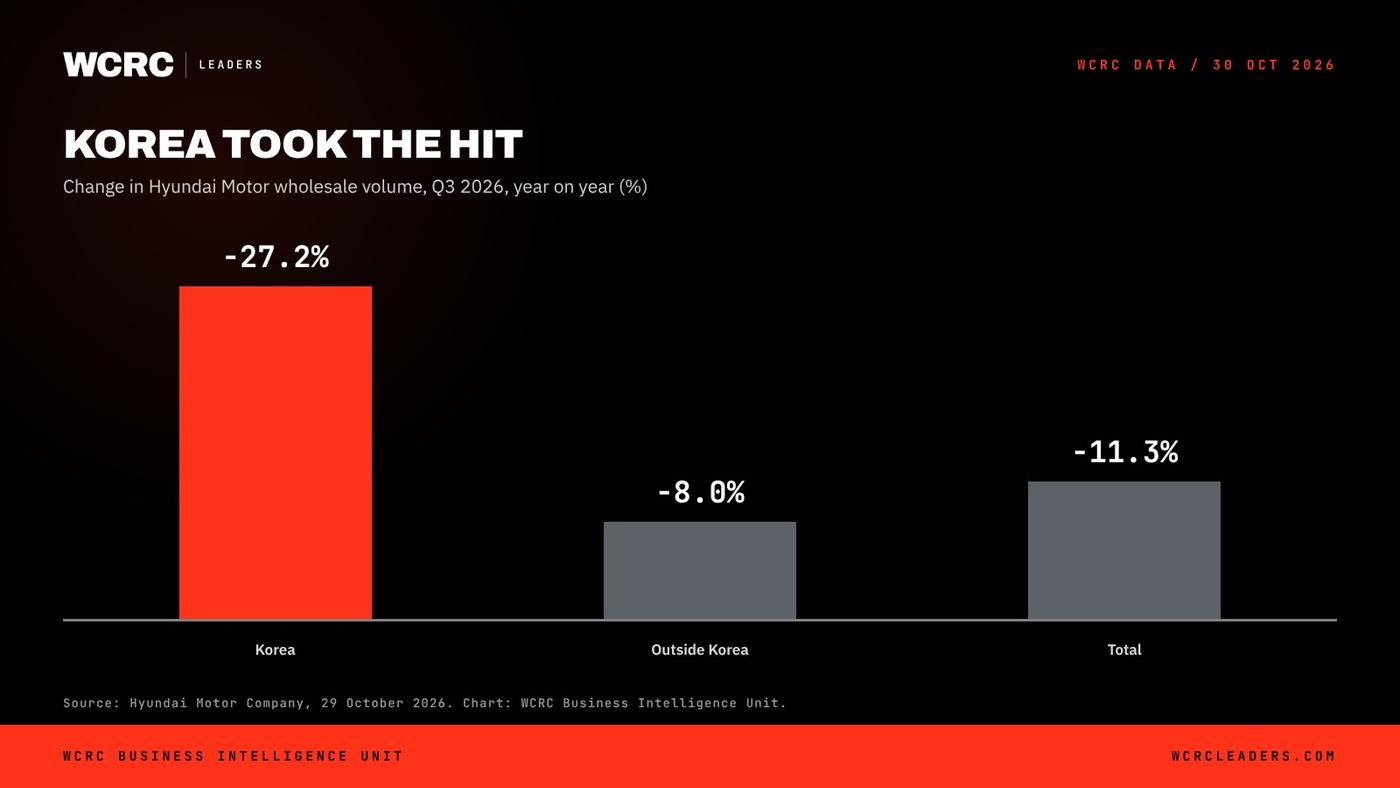
Below the operating line, the picture was weaker. Revenue fell 3.4% to KRW 45.11 trillion. Net profit, including non-controlling interests, fell 24.2% to KRW 1.93 trillion. Global wholesale volume dropped 11.3% to 920,710 units.
The sharpest fall was at home. Hyundai sold 131,468 units in Korea, down 27.2%, which the company said was because "strikes impacted domestic production". Outside Korea, volume fell 8.0% to 789,242 units. The company also cited fewer working days because of holidays, and its release speaks of "strike-related production constraints". WCRC analysis of the reported figures: the Korean decline works out at roughly 49,000 fewer units than a year earlier. Hyundai has not said how much of that came from the strikes and how much from the holiday calendar, and this story does not estimate a strike loss.
The dispute itself was long. The Hyundai Motor branch of the Korean Metal Workers' Union began partial strikes on 13 July after wage talks broke down, and staged a full-day strike on 21 August. Members ratified a deal on 31 August, with 61.55% of the 31,166 who voted in favour. The agreed terms included a KRW 100,000 rise in monthly base pay, a performance bonus of 400% of monthly wages plus KRW 12.7 million in cash, and an agreement to extend the retirement age from 60 to 65 if the relevant laws are changed.
Why did the guidance cut matter more than the quarter?
A weak quarter can be explained away. A cut to full-year targets cannot. Hyundai lowered its 2026 wholesale target to 4 million units from 4.16 million, a reduction of 160,000 units. It cut its consolidated operating margin target to 5.5% to 6.5%, from 6.3% to 7.3%. It kept its revenue growth target of 1.0% to 2.0%.
The most telling change was to investment. Hyundai reduced its automotive investment plan to KRW 16 trillion from KRW 17.8 trillion, a cut of KRW 1.8 trillion. The company linked the revision to weaker global demand, production disruptions and rising raw material prices, and said it "does not signal a deterioration in its underlying business competitiveness or earnings capability". It kept the quarterly dividend at KRW 2,500 per common share.
Read through WCRC's Corporate Value Intelligence framework, the investment cut is the number investors should weigh most. Margin protection through currency and mix is real, but it is partly borrowed from conditions outside management's control. A smaller capital plan, by contrast, is a choice about the future. When a labour dispute is one of several reasons given for spending less on the next generation of products, the cost of the dispute runs well beyond the weeks of lost output.
What does this mean for Hyundai's business in India?
The Indian subsidiary is on a different path. Hyundai Motor India, one of WCRC 1000, India's Most Valuable Enterprises 2026, reported its first quarter above ₹20,000 crore in revenue for July to September, while commodity costs cut its profit by 24%, as WCRC covered in Hyundai India tops ₹20,000 crore revenue as costs cut profit 24%. The company opened its Talegaon plant near Pune on 14 October. Hyundai Motor India was selected among India's Most Loved 250 Workplaces 2026 by the Business Intelligence Unit of WCRC, and Hyundai is a WCRC MegaBrand in mainstream mass-market cars.
Nothing in the parent's release links the Korean strikes to Indian operations. The relevance is strategic. A new plant brings a new workforce, new supervisors and new expectations. The Korean experience shows how quickly pay, bonus and retirement questions can merge into one hard negotiation once trust has worn thin.
What should boards in India, the Gulf and Asia take from it?
The first lesson is about measurement. Most boards see labour relations through headcount, attrition and wage cost. Hyundai's quarter shows the real exposure sits in output, guidance and capital allocation. A board that cannot say how many units, or how much revenue, a week of stoppage would cost has not priced the risk.
The second is about the rules. India's four labour codes, including the Industrial Relations Code, came into force on 21 November 2025, changing how disputes, notices and standing orders are handled. Indian boards with large plant workforces should check that their grievance and negotiation systems have caught up with the new framework, rather than waiting for the first test.
The third is about the Gulf. In WCRC's analysis, the more immediate workforce risk for many Gulf boards is fast-moving policy, as Saudi Arabia's move to a 50% quota for Saudi nationals in accounting roles from 27 October shows, which WCRC set out in a CFO checklist. Gulf buyers of Korean and Indian vehicles and components also carry the supply risk when a supplier's plant stops.
Read through the WCRC Workplace Equity Index, which looks at areas such as transparency and accountability, and trust and belonging, a dispute of this kind is often a trust problem before it is a pay problem. The union's demands at Hyundai went beyond wages to the reinstatement of dismissed members and the retirement age. Those are signals about fairness and job security, which no bonus formula alone will settle.
How should CEOs lead through a dispute like this?
In the terms of SeeClear, a model in WCRC's Guru Management Codex, the first task is to separate fact from projection before a major decision. In a strike, each side tends to see a snake where there may be a rope: management sees an attack on competitiveness, workers see a threat to their future. Leaders who test those beliefs against the numbers, such as the true cost of a bonus point against the true cost of a week's lost output, make better offers sooner.
The Kayaka-Dasoha Value Loop, another model in the same codex, frames workforce strategy around the dignity of honest work in an automated economy. That matters here: the retirement-age question reflects worry about long careers in plants that are adding electrified and automated lines. A CEO who addresses that worry directly, with training and redeployment commitments, removes fuel from the next dispute.
Among WCRC's seven leadership parameters, Resilience Factor and Stakeholder Trust are the two this quarter tested. Hyundai kept its margin, which speaks to resilience. Whether it rebuilds trust on the line before the next wage round will decide whether 2026 is a one-off.
The WCRC View
Hyundai's quarter is a clear case of a labour dispute that the income statement partly hid and the guidance exposed. Operating profit rose, yet the company now expects 160,000 fewer vehicles this year and will invest KRW 1.8 trillion less in its car business.
The gain goes to companies that kept running. Rivals with stable plants and suppliers with spare capacity win orders when a large producer stops, and hybrid demand, which held up for Hyundai, rewards whoever can build steadily.
Boards in India, the Gulf and Asia should do three things now: put a cost on a week of stoppage in their largest plants, review grievance systems against new labour rules such as India's codes, and make trust measures part of the board's workforce review, not only pay and attrition. Read through the Workplace Equity Index and SeeClear, early honesty about job security costs less than a late bonus.
WCRC will watch Hyundai's fourth-quarter production recovery, whether it holds its 4 million target, and how Hyundai Motor India manages hiring and labour relations as Talegaon ramps up. Hyundai is also selected among WCRC's World's 100 Most Powerful Brands by the Business Intelligence Unit of WCRC; the full report and evidence are available from WCRC on request.
WCRC models applied: Corporate Value Intelligence, WCRC Workplace Equity Index, SeeClear (Guru Management Codex), Kayaka-Dasoha Value Loop (Guru Management Codex), WCRC seven leadership parameters.
Quick answers
Q: How much did Hyundai Motor's revenue fall in Q3 2026? A: Revenue fell 3.4% to KRW 45.11 trillion, while operating profit rose 5.5% to KRW 2.68 trillion and net profit fell 24.2% to KRW 1.93 trillion.
Q: How badly did the strikes hit Hyundai's Korean sales? A: Wholesale volume in Korea fell 27.2% to 131,468 units, which the company attributed to strikes affecting domestic production and fewer working days.
Q: What did Hyundai change in its 2026 guidance? A: It cut its volume target to 4 million units from 4.16 million, its operating margin target to 5.5% to 6.5% from 6.3% to 7.3%, and its automotive investment plan to KRW 16 trillion from KRW 17.8 trillion.
Q: How was the dispute settled? A: Union members ratified a wage deal on 31 August 2026, with 61.55% of voters in favour, including a KRW 100,000 monthly base pay rise and a performance bonus.

Saudi Arabia's 50% accountant quota starts 27 October: a CFO checklist
Leading in a low-hire, low-fire market
Fed Beige Book: AI is slowing hiring in 5 of 12 US districts
The UK's employment-law reset is live: a checklist for leaders

California makes AI workforce decisions auditable
The great flattening: companies are cutting managers, not just jobs
Filed under