Workplaces
Singapore adds 27,700 jobs as restructuring cuts climb to 4,800
Asia's headquarters hub is hiring and cutting at the same time. Singapore's latest labour data show net job growth more than doubling in the third quarter, while layoffs in finance, infocomm and manufacturing kept rising on the back of business reorganisation.
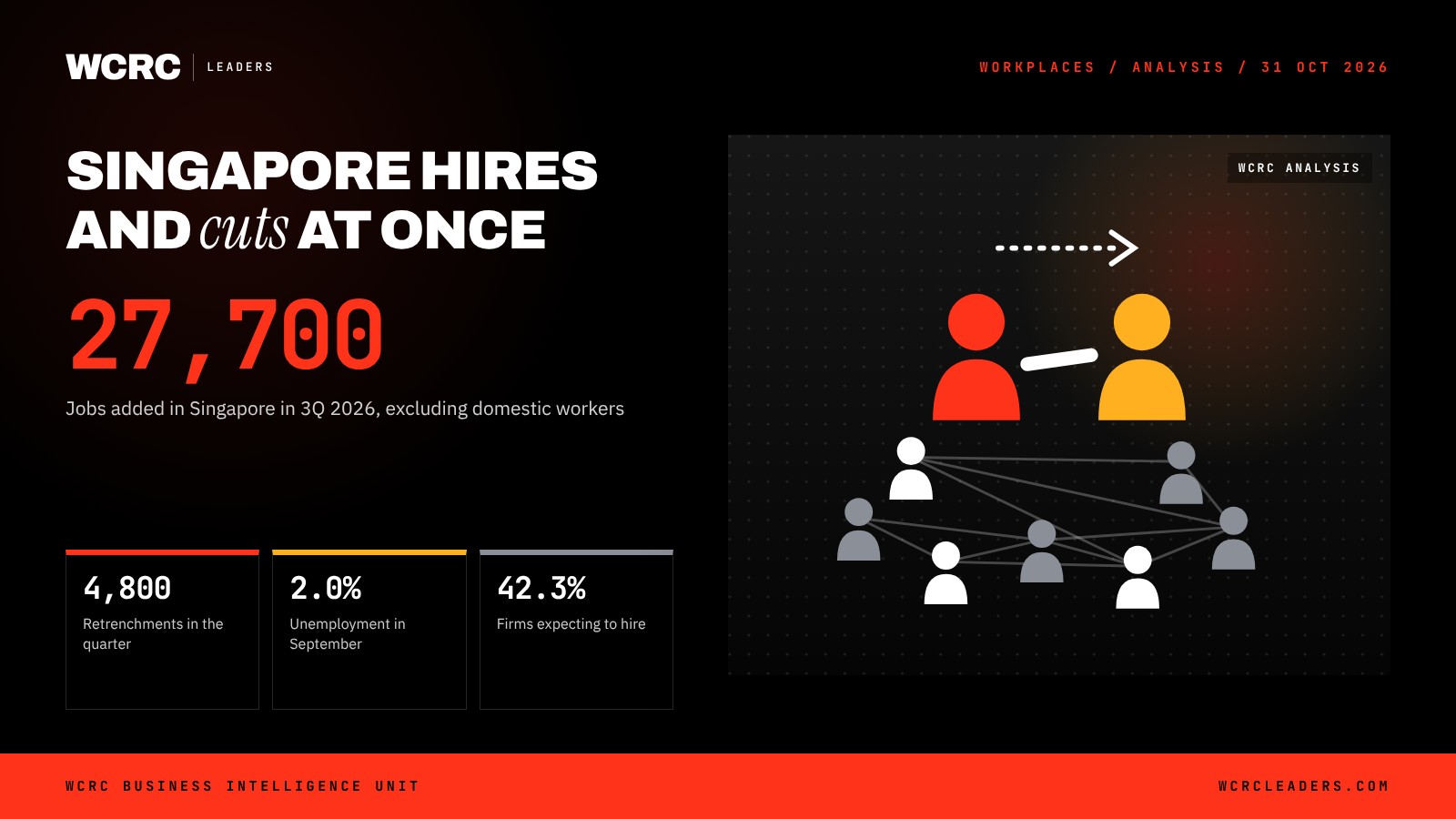
At a glance: WCRC Leaders' assessment: Singapore's third quarter shows that strong hiring and steady white-collar restructuring now run side by side, and employers across India, the Gulf and Asia should plan for both at once rather than treat them as separate cycles. The Ministry of Manpower's advance release of 30 October 2026 put employment growth at 27,700, retrenchments at 4,800 and September unemployment at 2.0%. It flagged "emerging weaknesses in parts of the labour market that warrant close monitoring."
What did Singapore's third-quarter labour numbers show?
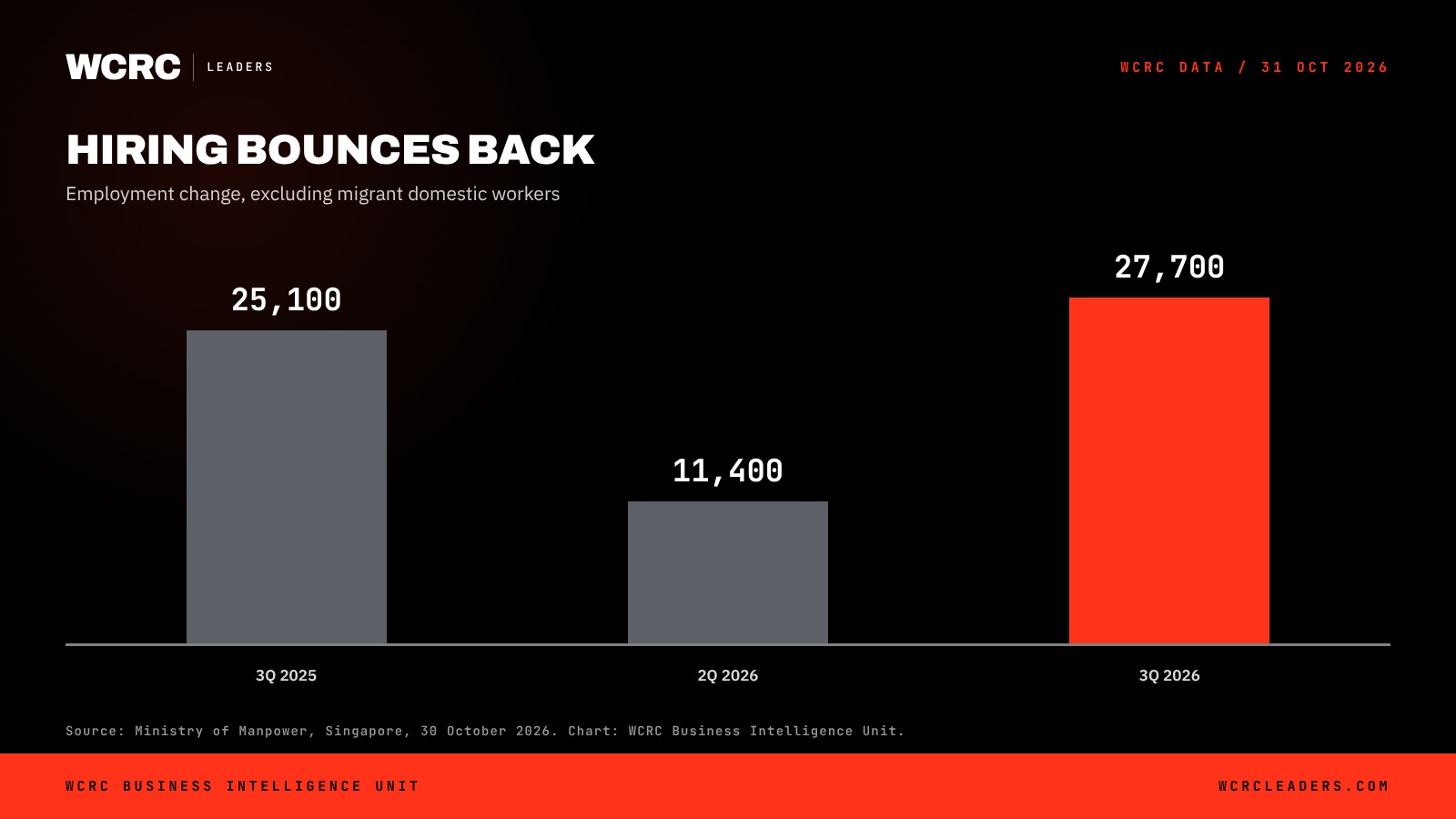
Total employment, excluding migrant domestic workers, grew by 27,700 in the third quarter of 2026, according to the Ministry of Manpower (MOM). That is well above the 11,400 added in the second quarter and the 25,100 added in the same quarter of 2025. Both resident and non-resident employment grew faster than in the previous quarter, though the advance release gives no split between them.
The composition matters more than the headline. MOM said non-resident employment continued to account for the majority of growth, mainly in construction and manufacturing. Resident employment growth was supported mainly by essential and public services. In outward-oriented sectors, growth stayed subdued amid global economic uncertainty.
Retrenchments rose from 4,620 in the second quarter to 4,800 in the third. The incidence held at 2.0 per 1,000 employees. MOM said retrenchments remained elevated in outward-oriented sectors, which its footnotes define as information and communications, financial services and manufacturing, and that "business reorganisation continued to be the main driver of retrenchments."
Unemployment stayed low but edged up for locals. The overall rate in September was unchanged at 2.0%. The resident rate rose to 3.0% from 2.9% in August, and the citizen rate to 3.1% from 3.0%.
The figures are preliminary. MOM will publish its full Labour Market Report for the third quarter in mid-December 2026, with resident and non-resident breakdowns, sector data, vacancies, turnover and the re-entry rates of retrenched residents.
Why are firms hiring and cutting at the same time?
The answer lies in where the jobs are being created and where they are being removed. New roles are concentrated in construction, manufacturing work largely filled by non-residents, and essential and public services. The cuts are concentrated in the sectors that make Singapore a regional headquarters city: banking and finance, technology and the higher-value end of manufacturing.
This is not a new pattern. In the second quarter, retrenchments jumped to 4,620 from 3,830 in the first quarter, and MOM attributed that rise to "business reorganisation and restructuring in outward-oriented sectors." Job vacancies fell to 68,600 in June from 73,300 in March, mainly because of fewer professional, managerial, executive and technical (PMET) openings in financial services and information and communications. The share of retrenched residents back in work within six months slipped to 54.9% in the second quarter from 60.7% in the first.
Put together, the third-quarter release extends a trend that is now two quarters old. In WCRC's analysis, the reorganisation label covers a range of moves: consolidating regional functions, shifting work to lower-cost centres, and redesigning roles as automation and AI take on routine analysis and processing. MOM itself points to "rapid technological change" and says companies will need to keep adapting and investing in their workforce. The data do not break down cuts by cause beyond reorganisation, so the precise role of AI is not yet measurable from this release.
What do the forward indicators say?
The sentiment numbers point in two directions. The share of firms expecting to hire over the next three months rose from 30.5% in August to 42.3% in September. Firms expecting to raise wages rose from 16.9% to 19.9%. Both, MOM noted, remained below July's levels.
At the same time, the share of firms expecting to retrench edged up from 2.8% to 3.1%. MOM said that increase, "alongside higher actual retrenchments, points to emerging weaknesses in parts of the labour market."
In WCRC's reading, this is the signature of a two-speed workforce. Employers want people, but not necessarily the same people, in the same roles, at the same cost. Hiring intent and retrenchment intent are rising together because firms are reshaping their headcount rather than simply growing or shrinking it.
What does this mean for employers in India, the Gulf and Asia?
Singapore matters well beyond its size. It hosts regional headquarters for many multinationals, which means decisions taken there flow directly into global capability centres in India, shared service hubs in Malaysia and the Philippines, and new regional offices in Riyadh, Dubai and Abu Dhabi.
For Indian employers and global capability centres, the message is double-edged. Reorganisation in Singapore can move work towards India, but the same forces that are reshaping finance and technology roles in Singapore are already visible in Indian IT. WCRC has reported on falling junior technical hiring in its coverage of Anthropic's study of entry-level hiring and India's IT pyramid. Work that leaves Singapore will not necessarily arrive in India in the same shape or volume.
For Gulf employers, Singapore offers a template and a warning. The Gulf is competing hard for regional headquarters, and national employment rules are tightening, as WCRC noted in its guide to Saudi Arabia's 50% accountant quota. Singapore shows that a headquarters economy can keep headline employment rising while its professional workforce absorbs repeated rounds of restructuring. Gulf boards building national talent pipelines should plan for that churn from the start.
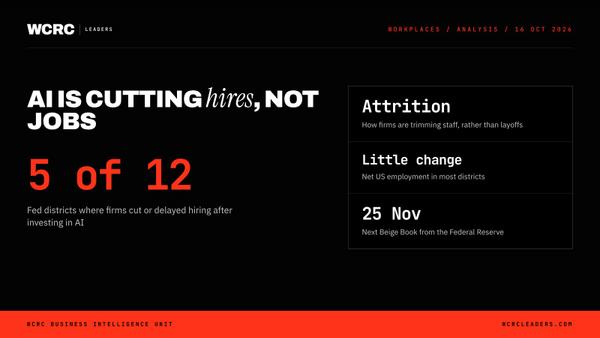
Across Asia, the pattern echoes signals elsewhere. The US Federal Reserve's October survey linked AI investment to slower hiring in several districts, which WCRC covered in its reading of the Beige Book. Singapore's numbers suggest Asia's most open labour market is moving the same way, through reorganisation rather than mass lay-offs.
How should leaders read this through WCRC's workplace models?
Read through WCRC's CultureCrest 5-Parameter Framework, the parameters most at risk in a restructuring quarter are career development and engagement. When firms cut in one function and hire in another, the people who stay watch closely whether there is a credible internal route from a role that is disappearing to one that is growing. If the answer is no, engagement erodes well beyond those directly affected. The fall in Singapore's six-month re-entry rate in the second quarter is a reminder that displaced professionals take longer to land, which raises the stakes on internal redeployment.
The WCRC Workplace Equity Index, which underpins India's Most Loved 250 Workplaces, looks at transparency and accountability, trust and belonging, and psychological safety. In a reorganisation, these are tested in practice. Employees judge whether the reasons for cuts are explained, whether selection is seen as fair, and whether they can raise concerns without fear. WCRC's view is that firms which handle restructuring openly keep the trust they will need when the hiring cycle turns.
On the leadership side, WCRC's Guru Management Codex offers the Kayaka-Dasoha Value Loop, a model on workforce strategy in an automated economy built on the dignity of honest work. In its terms, the question for a CEO is not only how many roles automation can remove, but how the organisation keeps meaningful work for the people whose tasks change. The same codex's SeeClear model, which asks leaders to separate fact from projection before a major decision, is useful here too: a single quarter of rising hiring intent is not a recovery, and a single quarter of rising cuts is not a collapse.
The WCRC View
Singapore's third quarter confirms that hiring and white-collar restructuring are no longer opposite phases of a cycle. They are happening together, in the same economy and often in the same companies. The 27,700 new jobs and the 4,800 retrenchments tell one story about a workforce being reshaped.
The winners are firms that treat workforce planning as continuous. That means mapping which roles are shrinking, which are growing and how people can move between them, before a reorganisation is announced. Read through CultureCrest and the Workplace Equity Index, the firms that lose are those that cut without a visible career route or a clear explanation, because the damage to engagement and trust outlasts the savings.
For CEOs and boards in India, the Gulf and Asia, we recommend three actions now: build an internal mobility plan for every function exposed to automation; ask regional headquarters, especially in Singapore, what reorganisation means for capability centres and hubs elsewhere; and report to the board on redeployment, not just headcount. The Kayaka-Dasoha Value Loop is a fair test: a workforce plan should show how dignity of work is preserved as tasks change.
WCRC will watch MOM's full third-quarter report in mid-December, particularly the six-month re-entry rate of retrenched residents, PMET vacancies in finance and infocomm, and whether the resident unemployment rate holds at or above 3.0%.
WCRC models applied: CultureCrest 5-Parameter Framework, WCRC Workplace Equity Index, Kayaka-Dasoha Value Loop and SeeClear (Guru Management Codex).
Quick answers
Q: How many jobs did Singapore add in the third quarter of 2026? A: Total employment, excluding migrant domestic workers, grew by 27,700, up from 11,400 in the second quarter and 25,100 a year earlier, according to MOM's preliminary figures.
Q: How many workers were retrenched? A: Retrenchments rose to 4,800 from 4,620 in the second quarter, an incidence of 2.0 per 1,000 employees. Business reorganisation was the main driver.
Q: Which sectors saw the most cuts? A: MOM said retrenchments remained elevated in outward-oriented sectors: information and communications, financial services and manufacturing.
Q: What is Singapore's unemployment rate? A: In September 2026 the overall rate was 2.0%, the resident rate 3.0% and the citizen rate 3.1%. The full quarterly report is due in mid-December 2026.
Hyundai's 27% home slump: the boardroom price of a labour dispute

Saudi Arabia's 50% accountant quota starts 27 October: a CFO checklist
Leading in a low-hire, low-fire market
Fed Beige Book: AI is slowing hiring in 5 of 12 US districts

The UK's employment-law reset is live: a checklist for leaders

California makes AI workforce decisions auditable
Filed under