Entertainment and Culture
Spider-Man: Brand New Day at $2.52 billion: the franchise as a MegaBrand
Spider-Man: Brand New Day has grossed $2.52 billion worldwide in three months, making it 2026's biggest film by a distance. It opened to $360 million in North America alone and has earned $63 million in India. Behind the numbers is a lesson Indian studios are starting to act on: a film character can be run like a consumer brand.
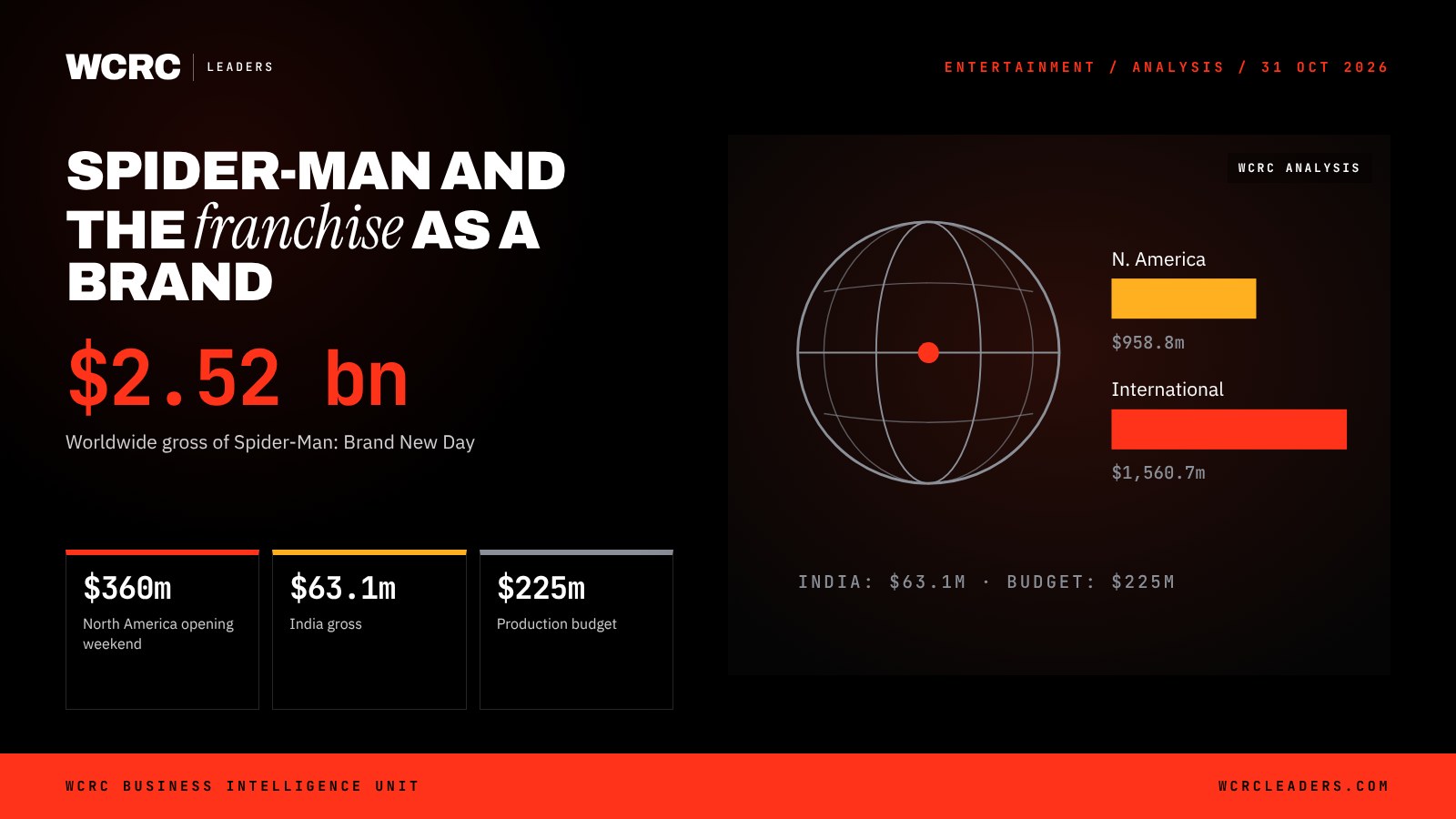
At a glance: WCRC Leaders' assessment: Brand New Day shows what a fully built film brand can do. A character with six decades of recall, two studios sharing it, and a release built around a single global weekend produced a $360 million domestic opening and $2.52 billion worldwide on a $225 million production budget. India, at $63 million, is now a meaningful market for Hollywood franchises.
| Fact | Detail |
|---|---|
| Film | Spider-Man: Brand New Day |
| Release | 31 July 2026 (North America); from 20 July internationally |
| Director | Destin Daniel Cretton |
| Studios | Sony Pictures, Marvel Studios, Columbia Pictures, Pascal Pictures |
| Production budget | $225 million |
| Worldwide gross | $2.52 billion (as of 30 Oct 2026) |
| India gross | $63.1 million (as of 23 Oct 2026) |
What do the numbers say?
The film's domestic total stood at $958.8 million on 29 October and its international total at $1.56 billion on 30 October, for $2.52 billion worldwide. Its North American opening weekend was $360.1 million.
| Market | Gross |
|---|---|
| North America | $958.8 million |
| International | $1,560.7 million |
| Worldwide | $2,519.5 million |
| Of which India | $63.1 million |
On our calculation, international markets supplied 62% of the total, and India alone about 2.5%. That is above The Way of Water's $2.32 billion lifetime gross and places Brand New Day among the highest-grossing films ever made.
The cost side matters as much. A $225 million production budget is large, but the film has earned more than eleven times that at the box office before streaming, television and merchandise are counted.
Why a character behaves like a brand
Read through WCRC's MegaBrands lens, which looks at positioning and recall, consumer trust, product and delivery, and digital soundness, Spider-Man scores where most film properties cannot: recall that crosses generations and countries. The character has been in comics since the 1960s and on screen in three different film series.
WCRC's Brand & Marketing Codex gives two sharper tools. The Distinctiveness Code asks whether a brand is ownable or generic; a red-and-blue suit and a mask need no title card. The Cultural Currency Model asks whether a brand is part of the current public conversation. A $360 million opening weekend is what happens when a brand is the conversation.
The Price Power Model, which measures how much premium a brand can charge before buyers switch, explains the format mix. Franchise films like this sell disproportionately in premium large-format and 3D screens, at higher ticket prices, because audiences treat them as events.
What Indian studios are taking from it
Indian cinema is beginning to plan the same way. Ramayana Part 1, opening on 5 November, is targeting about 59,000 screens worldwide through Sony Pictures, the same distributor behind Brand New Day. Drishyam: The Conclusion showed in October that a trusted story brand can open as big as a star vehicle in India.
The gap is the global layer. Brand New Day earned $63 million in India; few Indian films earn that much in North America. Closing that gap needs what the Brand Stretch Model tests: whether a name that is strong at home can launch credibly in new markets.
The leadership view
Two rival studios sharing one character is unusual. It works only because both sides protect the core brand rather than fight over it. In the terms of WCRC's leadership parameters, that is Stakeholder Trust in practice: partners who keep their promises to each other and to the audience. The Guru Management Codex model SeeClear, which asks leaders to separate fact from projection before a big decision, is the discipline behind franchise planning: release dates and budgets set on evidence of demand, not on hope.
The WCRC View
Brand New Day is the year's proof that the most valuable asset in cinema is not a star or a director but a brand that audiences already trust. India is now a $60 million-plus market for such brands. The next test for Indian studios is to build their own that travel the other way.
WCRC models applied: MegaBrands; Brand & Marketing Codex (Distinctiveness Code, Cultural Currency Model, Price Power Model, Brand Stretch Model); WCRC leadership parameters (Stakeholder Trust); Guru Management Codex (SeeClear).
Drishyam: The Conclusion at ₹580 crore: the last case closes, and the brand wins
Ramayana Part 1: a ₹4,000 crore bet on India's oldest story
Adani Ports raises FY27 capex by ₹3,000 crore as overseas ports surge
Vedanta doubles Gamsberg, and Ramaphosa now wants a zinc smelter
Anchor investors in Indian IPOs: why the 60% book sets the tone

Boston Dynamics picks an AI-model leader to run a robot company
Filed under