Entertainment and Culture
Ramayana Part 1: a ₹4,000 crore bet on India's oldest story
Ramayana: Part 1 opens in India on 5 November with a reported budget of ₹4,000 crore and a target of about 59,000 screens worldwide, more than any Indian film has attempted. Advance sales passed $2 million within a week of bookings opening. The question is no longer whether India will turn up. It is whether the world will.
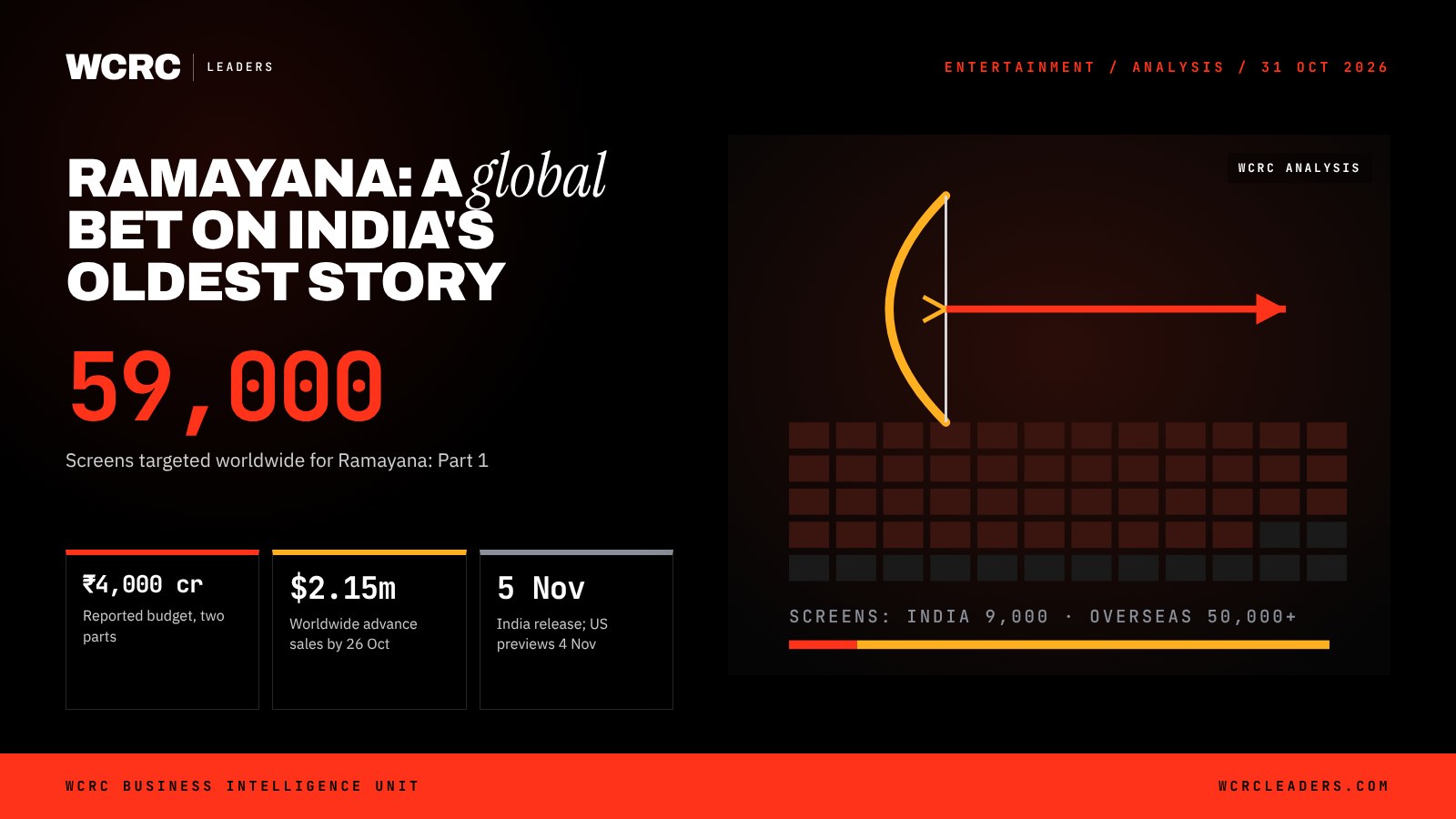
At a glance: WCRC Leaders' assessment: Ramayana Part 1 is the first Indian film built from day one as a global franchise launch, not a domestic hit that travels. About 50,000 of its targeted screens are outside India. Early pre-sales are strong but trail the year's biggest Hindi opener, Dhurandhar: The Revenge, so the overseas opening will decide whether the budget is a bold bet or an overreach.
| Fact | Detail |
|---|---|
| Film | Ramayana: Part 1 |
| Release | 5 November 2026 in India; paid previews in North America on 4 November |
| Director | Nitesh Tiwari |
| Cast | Ranbir Kapoor (Rama), Sai Pallavi (Sita), Yash (Ravana), Sunny Deol, Ravi Dubey, Arun Govil, Lara Dutta, Kajal Aggarwal, Rakul Preet Singh, Vivek Oberoi |
| Producers | Prime Focus Studios, DNEG, Monster Mind Creations |
| Music | Hans Zimmer and A.R. Rahman |
| International distributor | Sony Pictures |
| Part 2 | Slated for Diwali 2027 |
How big is the bet?
The reported budget of ₹4,000 crore is several times the cost of any earlier Indian production, and it is spread across two films. Producer Namit Malhotra has said the trailer passed one billion views in five days, a figure that tells you how much attention the project has bought before a single ticket was torn.
The release plan is just as large. The film is targeting about 59,000 screens worldwide: around 9,000 in India and more than 50,000 overseas. For scale, Pushpa 2: The Rule opened on 12,000 to 13,000 screens and RRR on 10,000 to 11,000. Avatar: The Way of Water opened on roughly 52,000. Ramayana is planning a Hollywood-sized footprint for an Indian story.
The film is also releasing in nearly 50 languages, using DNEG's AI lip-sync technology, and in premium IMAX formats.
What do the advance sales say?
Bookings opened on 20 October. By 26 October, worldwide advance sales had reached about $2.15 million (around ₹20.50 crore), counting the 4 November previews and opening-day sales. India accounted for more than $1.20 million of the opening day, overseas markets for more than $400,000, and North American previews for more than $550,000.
Nearly one lakh tickets sold on India's leading booking platform in about four days, and select IMAX shows sold out despite high prices. On our reading, that is a strong start, but not a record one. Dhurandhar: The Revenge, the biggest Hindi film of 2026 at about ₹1,852 crore worldwide, sold its first-day advance faster, with more than ₹10 crore against Ramayana's ₹5.44 crore in the matching window.
| Advance sales (as of 26 Oct) | Figure |
|---|---|
| Worldwide total | about $2.15 million |
| India, opening day | over $1.20 million |
| Overseas, opening day | over $400,000 |
| North America previews | over $550,000 |
Mythology as a national brand asset
Read through WCRC's MegaBrands lens, which looks at positioning and recall, consumer trust and delivery, the Ramayana is not a new brand at all. It is perhaps the oldest and most widely recalled story brand in India. Arun Govil, who played Rama in the 1987 television series, is in the cast, a deliberate bridge to the version an entire generation still remembers.
That recall is an asset and a risk. In the terms of WCRC's Trust Equity Model, audiences arrive with a fixed idea of how their story should be told, and the pressure a retelling can absorb is limited. The Promise Gap Model, which measures the distance between what a brand claims and what it delivers, will be tested on opening weekend: a billion trailer views is a large promise.
The global plan is a test of the Brand Stretch Model: can a story that every Indian household knows carry itself into markets where it is unfamiliar? Sony's distribution reach and the dubbing in nearly 50 languages are the tools. The overseas opening will be the answer.
The leadership view: building an institution, not a film
Producer Namit Malhotra's DNEG is one of the world's largest visual effects companies, with Hollywood credits. Bringing that capability home to a mythological epic is, in the terms of WCRC's Guru Management Codex, close to a Jaladuta Founder move: using hard-won global capability to build something rooted in Indian tradition and take it outward.
On WCRC's leadership parameters, Global Mindset and Resilience Factor are the two in play. A two-part plan with a year between instalments means the team must hold its nerve through whatever Part 1 earns.
The WCRC View
Ramayana Part 1 is India's clearest attempt yet to build a global film franchise from its own cultural stock. Pre-sales show the home market is engaged, if not yet at record pace. The real verdict lies outside India: if 50,000 overseas screens fill, Indian studios will have a new template; if they do not, the budget will become the story. Either way, the release marks the moment Indian cinema began to plan at Hollywood scale.
WCRC models applied: MegaBrands; Brand & Marketing Codex (Trust Equity Model, Promise Gap Model, Brand Stretch Model); Guru Management Codex (Jaladuta Founder); WCRC leadership parameters (Global Mindset, Resilience Factor).
Spider-Man: Brand New Day at $2.52 billion: the franchise as a MegaBrand
Drishyam: The Conclusion at ₹580 crore: the last case closes, and the brand wins
Adani Ports raises FY27 capex by ₹3,000 crore as overseas ports surge
Vedanta doubles Gamsberg, and Ramaphosa now wants a zinc smelter
Anchor investors in Indian IPOs: why the 60% book sets the tone
Boston Dynamics picks an AI-model leader to run a robot company
Filed under