Workplaces
Fed Beige Book: AI is slowing hiring in 5 of 12 US districts
The US Federal Reserve's October Beige Book puts on the official record what many boards have suspected: companies investing in AI are hiring fewer people. The cuts are quiet ones, through attrition and empty requisitions, and that is exactly why workforce planners in India and the Gulf should pay attention.
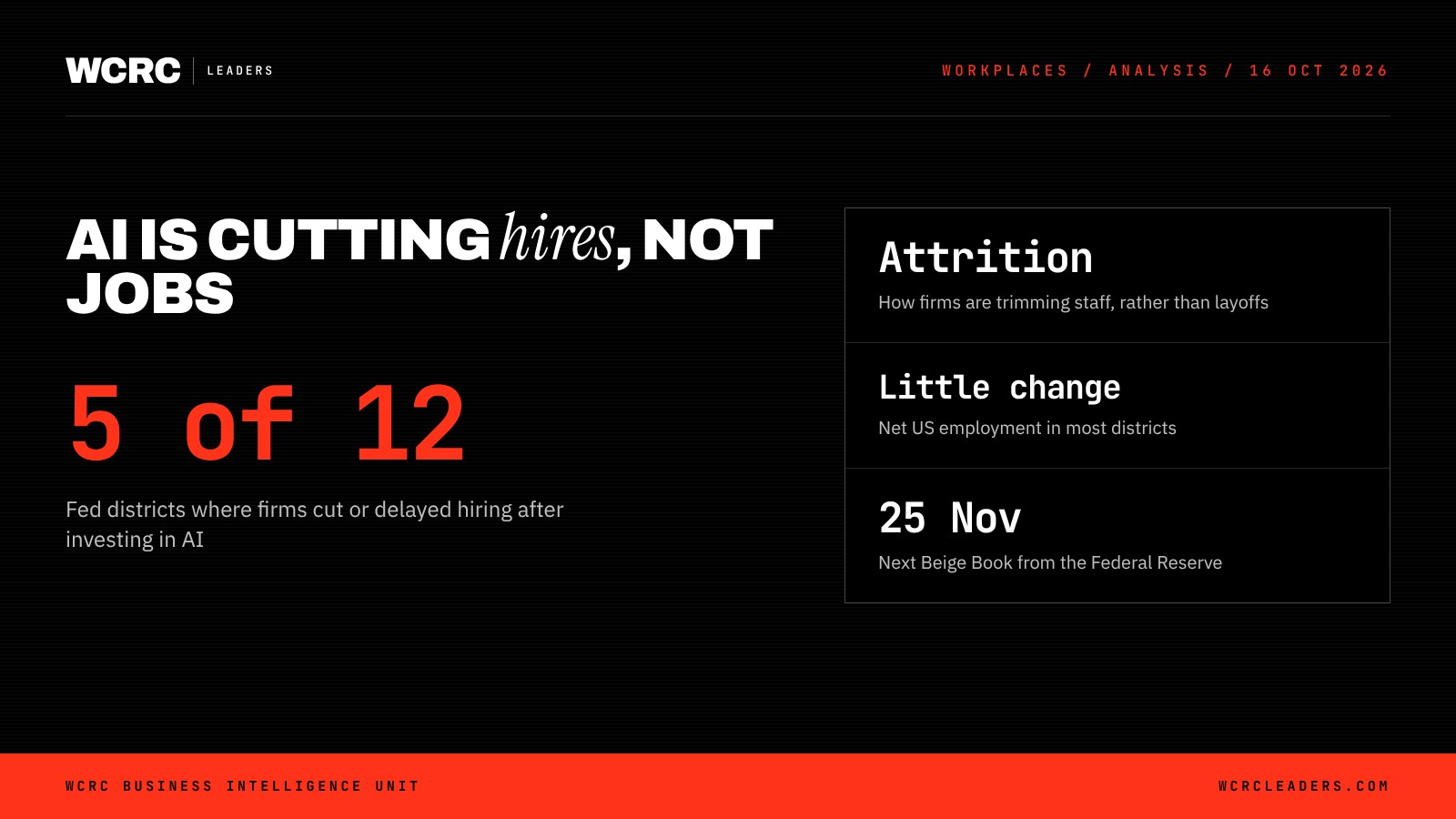
At a glance: WCRC Leaders' assessment: AI's first measurable effect on jobs is not mass layoffs but missing hires, and employers who plan headcount on the old ratio of revenue to people will be caught out. The Federal Reserve's Beige Book, published on 14 October 2026, reports that in five of its 12 districts some firms reduced staff through attrition, delayed hiring or expected fewer new jobs after investing in AI. Overall US employment barely moved. For India's IT services exporters, its global capability centres and Gulf employers, the signal is about the shape of demand, not its collapse.
What did the Beige Book actually say?
The Beige Book is the Fed's summary of what businesses, bankers and community contacts tell its 12 regional banks. The October edition, based on information collected on or before 5 October, carries a line that will be quoted for months. In the national summary, the Fed states: "Five Districts reported that some firms had either reduced staffing levels (through attrition), delayed hiring, or anticipated less job creation after increasing productivity by investing in AI."
The district reports add texture. In New York, "Some larger organizations were beginning to cut selected jobs or hold off on hiring as they integrated AI," and demand for marketing roles softened. In Cleveland, "Two banking contacts said that automation and AI had reduced staffing needs by enhancing the productivity of certain roles." In Minneapolis, "IT staffing contacts reported that artificial intelligence was not causing layoffs but was dampening the creation of new jobs." In Chicago, a business services contact said productivity gains from AI adoption allowed the company to reduce employment through attrition.
Not every district tells the same story. The Atlanta Fed reported that AI implementation broadened across surveyed firms, but that most did not expect it to lead to significant workforce reductions in the near term. The St. Louis report describes productivity gains from automation and data projects without matching growth in headcount.
Is the US job market weakening, or is this something else?
The wider picture is stable rather than falling. The Fed says "Most Districts described little or no net change in overall employment levels," and that labour market conditions were little changed. Only two of the 12 districts reported moderate growth in economic activity, though most said firms kept a positive outlook for the coming months.
Prices, not jobs, dominate the rest of the report. "Higher oil prices permeated all District reports," the Fed notes, with firms citing elevated diesel costs and fuel surcharges moving through supply chains. Eight districts described overall price growth as moderate and three as faster still.
WCRC analysis: put together, this is a labour market in which output holds up while hiring stalls. That pattern fits a "low hire, low fire" economy, one where AI gives employers a reason not to backfill, rather than a reason to cut. It is harder to see in headline unemployment figures, and slower to reverse.
Why does a US survey matter to India's IT services sector?
Because the jobs that US clients are choosing not to create are, in large part, the work India's IT services industry was built to deliver. Marketing operations, bank back-office processing and IT staffing, all named in the October report, are areas where Indian vendors have long supplied people at scale.
The pressure is already visible in Indian numbers. Tata Consultancy Services ended September 2026 with 598,056 employees, according to its second-quarter fact sheet. That is a net addition of 4,258 in the quarter, but only about 4,700 more people than a year earlier, when it had 593,314. Voluntary attrition for IT services stood at 13.3% on a trailing 12-month basis. TCS, ranked first in India's Most Loved 250 Workplaces 2026 by WCRC, is still hiring, but its workforce is barely growing while the business continues to run.
WCRC has tracked how this plays out in India's white-collar market, where AI and machine learning hiring is rising while overall IT services hiring falls. Our report on India's two-speed job market sets out the split by sector, city and experience band.
WCRC analysis: the Beige Book gives clients an official vocabulary for what they are already asking vendors. When a US bank says AI has "reduced staffing needs," the next conversation with its outsourcing partner is about fewer billable people, outcome-based pricing and productivity commitments written into contracts. Pyramid-shaped delivery models, heavy with junior staff, are most exposed.
What does it mean for global capability centres?
GCCs sit on the other side of the same trend. A US company that wants AI-led productivity often needs engineers who can build, run and govern AI systems, and many have chosen to place that capability in their own Indian centres rather than buy it from a vendor.
WCRC analysis: that makes GCCs both a beneficiary and a test case. They gain mandates as parent firms consolidate work in-house. But the same parent firm that is delaying hiring in New York or Cleveland will expect its Indian centre to show the same AI productivity. GCC leaders should expect headcount targets to flatten even as the scope of work grows, and should be ready to show value in output per engineer rather than seats filled.
Where do Gulf employers fit?
The Gulf reads this report in two ways. First, the Fed's line that higher oil prices "permeated all District reports" points to stronger hydrocarbon revenues, which support state-led investment programmes and the hiring that comes with them.
Second, Gulf governments and large employers are among the most aggressive adopters of AI in public services, banking and telecoms, while running national workforce programmes that aim to place more citizens in private-sector jobs. WCRC analysis: if AI dampens the creation of entry-level white-collar roles, as the Minneapolis contacts describe, it hits precisely the jobs those nationalisation programmes count on. Gulf employers will need to decide early whether AI savings are taken as fewer hires or redeployed into roles for national talent. The expatriate professionals, many of them from India, who fill mid-level roles in Gulf finance and technology face the same squeeze on new openings.
Should leaders treat AI as the real cause?
With caution. The Beige Book is anecdotal by design: it records what contacts say, not measured statistics. Five districts reporting "some firms" is a signal, not a count of jobs lost. Some firms have reasons to credit AI for decisions driven by cost or weak demand, a question WCRC examined in AI layoffs: cause or cover story?.
What makes the October report notable is the mechanism it describes. Firms are not announcing AI layoffs. They are letting attrition do the work and not opening new roles. That is how a structural shift tends to start, and it is why planning teams that wait for redundancy headlines will be late. Our earlier piece on leading in a low-hire, low-fire market covers how to manage teams under those conditions.
The WCRC View
The call. The Beige Book marks a shift from forecasts about AI and jobs to reported behaviour. The first casualty is the new hire, not the existing employee. Boards should assume that AI-driven productivity will show up first as a lower hiring rate, and plan accordingly.
Who gains and who loses. Companies that can turn AI spending into output without adding people will widen margins. Vendors still selling time and materials, and entry-level graduates in marketing, back-office finance and routine IT, are most exposed. GCCs and specialist AI talent gain, provided they can prove productivity.
What India's IT leaders should do now. Rework pricing toward outcomes before clients force it. Retrain mid-level staff into delivery roles for AI systems. Be honest with campus hires about the shape of the pyramid, because a smaller intake handled well protects an employer brand that took years to build.
What GCC and Gulf leaders should do now. Set headcount plans against output measures, not seat counts. In the Gulf, decide explicitly how AI savings will interact with nationalisation targets, rather than letting the two policies collide.
What WCRC will watch next. The Federal Open Market Committee meets on 27 and 28 October; any comment from the Fed chair on AI and hiring will matter. The next Beige Book is due on 25 November, and the key test is whether the count of districts reporting AI-linked hiring restraint rises above five. We will also track third-quarter headcount disclosures from India's largest IT services companies for further signs of flat workforces on steady revenue.
Quick answers
Q: What is the Beige Book? A: A summary of economic conditions published eight times a year by the US Federal Reserve, based on reports from business and community contacts gathered by its 12 regional Reserve Banks.
Q: What did the October 2026 Beige Book say about AI? A: That five of the 12 districts reported some firms reducing staff through attrition, delaying hiring or expecting fewer new jobs after investing in AI to raise productivity.
Q: Is AI causing mass layoffs in the US? A: Not on this evidence. The Minneapolis report says AI was not causing layoffs but was dampening job creation, and most districts described little or no net change in overall employment.
Q: When is the next Beige Book? A: The Federal Reserve has scheduled the next release for 25 November 2026.
Filed under