Workplaces
India's DA rise to 63%: the pay signal every employer should read
India's Cabinet has added 3 percentage points to dearness allowance for central government staff and pensioners, at a cost of ₹10,016.10 crore a year. With wholesale fuel inflation above 25%, the state has just set the floor for 2027 pay conversations.
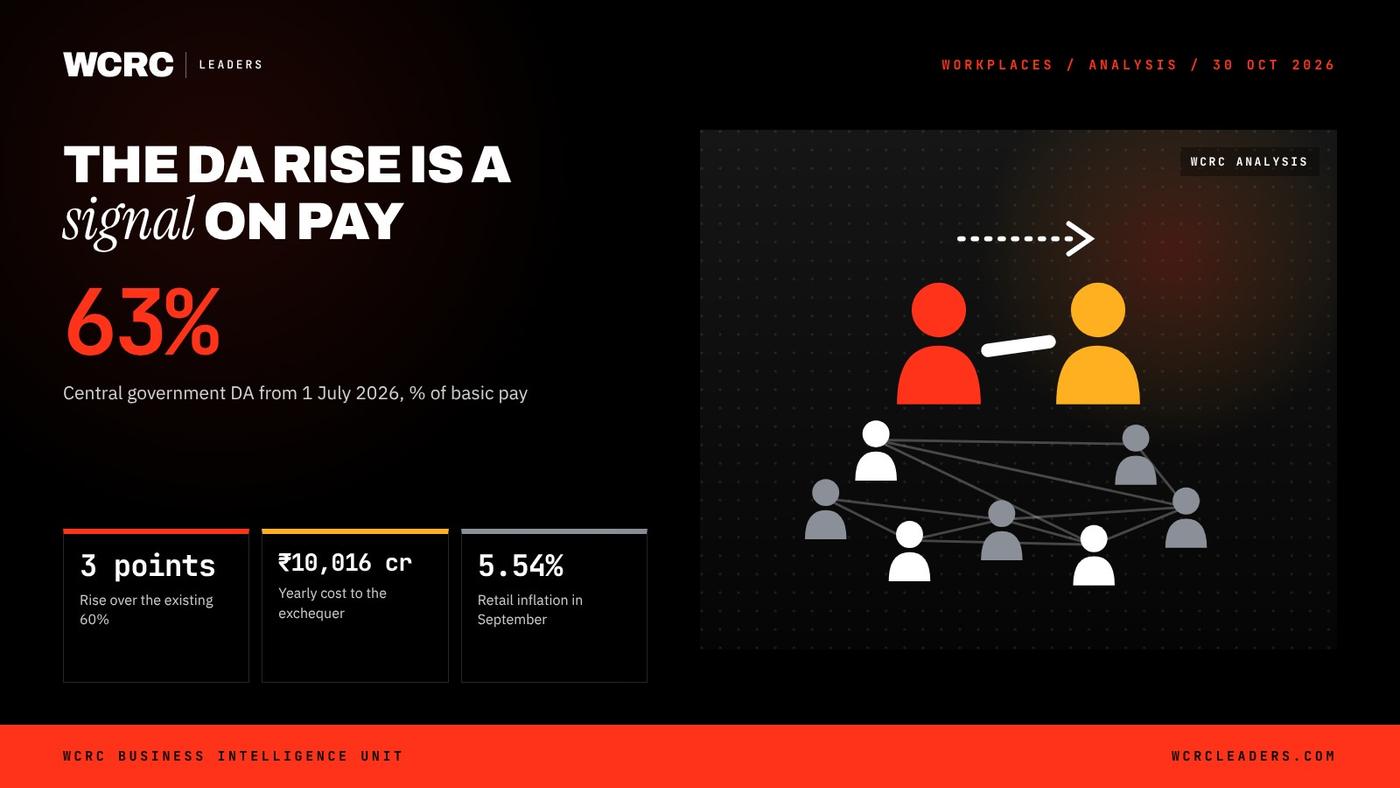
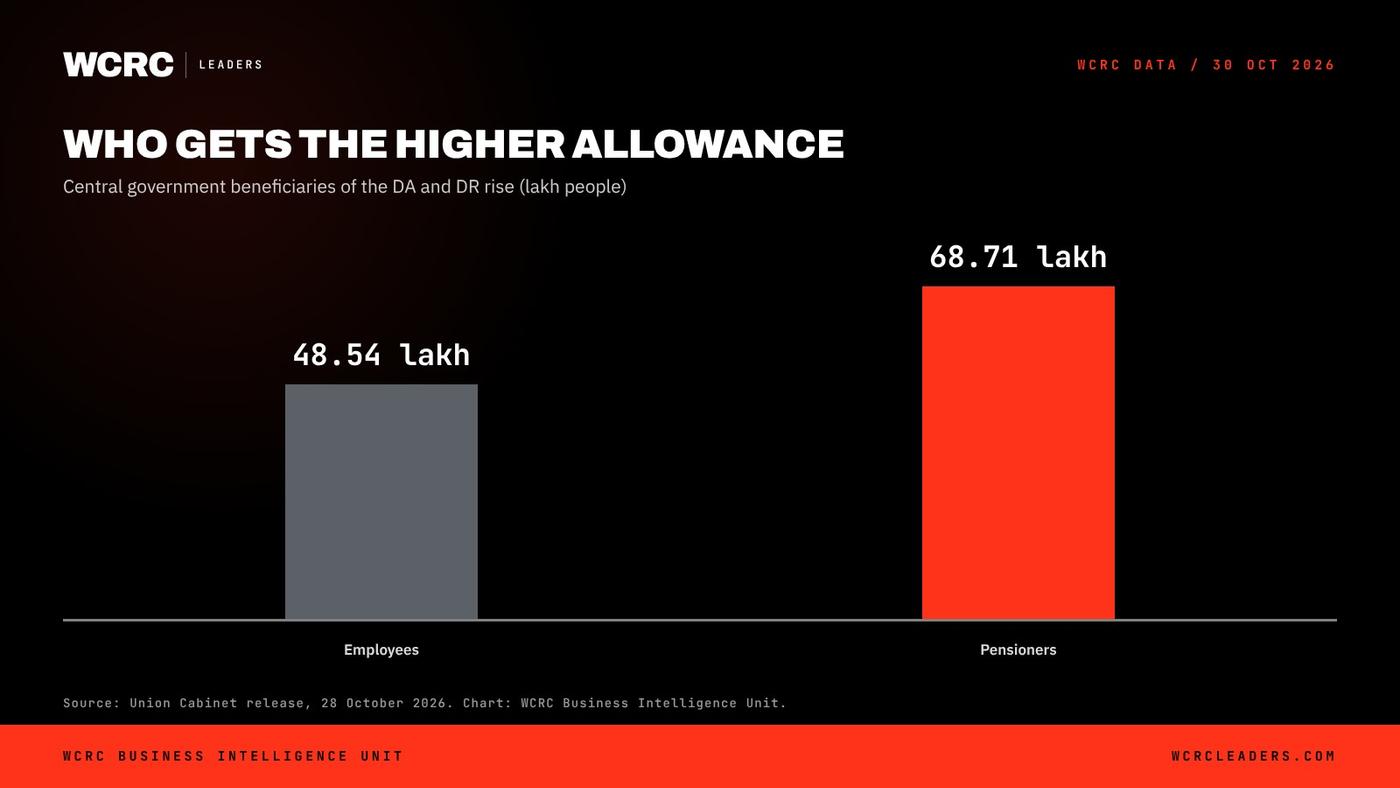
At a glance: WCRC Leaders' assessment: the 63% DA decision is a cost-of-living floor, not a raise, and employers who budget below it in 2027 will be read by their people as cutting real pay. On 28 October 2026 the Union Cabinet approved a 3-point rise in dearness allowance and dearness relief from 1 July 2026, over the existing 60% of basic pay or pension. It covers about 48.54 lakh central government employees and 68.71 lakh pensioners. Retail inflation was 5.54% in September, and the 8th Central Pay Commission is still at work.
What exactly did the Cabinet approve?
The Union Cabinet approved an additional instalment of dearness allowance (DA) for central government employees and dearness relief (DR) for pensioners, effective 1 July 2026. The Press Information Bureau release of 28 October 2026 describes it as "an increase of 3% over the existing rates of 60% of the Basic Pay/Pension", which takes the rate to 63%.
The combined cost to the exchequer is ₹10,016.10 crore a year. The government says the rise follows the accepted formula based on the recommendations of the 7th Central Pay Commission. About 48.54 lakh serving employees and 68.71 lakh pensioners benefit.
This is the second instalment of 2026. On 18 April the Cabinet approved a 2-point rise from 1 January 2026, taking DA from 58% to 60%, at an annual cost of ₹6,791.24 crore for about 50.46 lakh employees and 68.27 lakh pensioners, according to the earlier release.
Two details in those numbers deserve a board's attention. First, the July rise is 3 points against 2 in January, so the formula is now passing through faster price growth. Second, the count of serving employees fell from about 50.46 lakh to about 48.54 lakh between the two releases, while pensioners rose from about 68.27 lakh to 68.71 lakh. The state now pays relief to roughly 1.4 pensioners for every serving employee.
Why does a government allowance matter to private employers?
Because it is the most visible inflation adjustment in India's labour market, and it lands just as prices are climbing. The September 2026 consumer price release from the Ministry of Statistics and Programme Implementation put retail inflation at 5.54%, up from 4.83% in August. Food inflation rose to 7.74% from 5.97%. Rural retail inflation reached 6.08%, against 4.88% in cities. The cost of operating personal transport rose 7.46% year on year.
Upstream pressure is sharper. Wholesale inflation reached 11.39% in September, up from 9.92% in August, and fuel and power inflation hit 25.85%, according to the Ministry of Commerce and Industry. WCRC has set out what that means for margins in India's 11.39% wholesale inflation: the margin squeeze is here.
The fuel shock has a clear source. In March, the government cut excise duty by ₹10 a litre on petrol and diesel after Brent-linked crude rose from about $70 to about $122 a barrel within roughly a month, tied to the conflict in West Asia. Delhi pump prices still rose: petrol went from ₹94.77 to ₹102.12 a litre and diesel from ₹87.67 to ₹95.20 between March and June 2026, the Ministry of Petroleum and Natural Gas reported.
Employees do not read wholesale indices. They read pump prices, grocery bills and what the government gives its own staff. When India's largest employer adjusts pay for prices twice a year by a published formula, it creates a reference point that private staff, unions and state governments all use.
How big is the adjustment in practice?
Analysis by WCRC Leaders, using the release figures only: the July instalment works out to roughly ₹8,540 a year per beneficiary on average across employees and pensioners. For an individual, the move from 60% to 63% lifts basic pay plus DA by about 1.9%. Across the full year from 58% to 63%, the lift is about 3.2%.
That matters for how employers frame their own numbers. A private-sector increment of 7% or 8% looks generous beside a 3-point DA rise. But DA is not the government's annual increment; it is a cost-of-living top-up that sits on top of its own pay progression. The honest comparison for a private employer is not "our raise against their DA" but "our raise against what our people now spend on food, fuel and commuting".
Where does the 8th Pay Commission fit?
The DA rise is still being paid under the 7th Central Pay Commission formula, and that structure is due for review. The Cabinet approved the terms of reference of the 8th Central Pay Commission on 28 October 2025. The commission was constituted by notification on 3 November 2025, chaired by a former Supreme Court judge, and must report within 18 months of its constitution, with interim reports possible, according to its official website. In 2026 it has held stakeholder visits in Jaipur, Chandigarh, Bengaluru and Mumbai.
The government's release noted that pay commission recommendations would normally take effect from 1 January 2026, based on the usual ten-year cycle. That is an expectation, not a confirmed date. Its terms of reference ask it to weigh fiscal prudence, the unfunded cost of non-contributory pensions, the impact on state finances and, notably, pay and working conditions in public sector undertakings and the private sector. Private employers are, in other words, part of the evidence base.
What should Gulf and Asian employers of Indian talent take from it?
For Gulf employers, the DA decision is a home-market signal. Indian workers in the Gulf measure their packages against what the same skills and security would earn at home, and their families feel Indian food and fuel inflation directly. When the Indian state lifts cost-of-living pay twice in a year, the case for a Gulf employer to hold allowances flat weakens. Gulf boards are already rebuilding workforce plans under nationalisation rules, as WCRC set out in Saudi Arabia's 50% accountant quota: a CFO checklist. Retaining the Indian talent they still need will depend partly on how they treat inflation.
For Asian firms with Indian operations, the signal is about budget sequencing. Global pay budgets are often set at headquarters in one currency. A flat regional increment can leave Indian staff behind when Indian inflation runs above the regional average.
How should employers read this through WCRC's workplace models?
Read through WCRC's CultureCrest framework, which looks at impact on people, innovation, environment, career development and engagement, the DA decision is a test of "impact on people". A pay review that ignores visible food and fuel inflation tells staff that the company has noticed the cost of living less than the government has. That hits engagement before it hits attrition data.
Through the transparency and accountability lens of WCRC's Workplace Equity Index, which underpins India's Most Loved 250 Workplaces, the government's process has one quality private employers rarely match: it is published. Employees know the formula exists and know when the instalment lands. Companies that will not adjust as much can still explain their reasoning, and the trust and belonging that dimension describes depends more on that explanation than on the headline number.
In the terms of SeeClear, a model in WCRC's Guru Management Codex, leaders should separate fact from projection before setting 2027 budgets. The fact is a 3-point DA rise and 5.54% retail inflation. The projection, in both directions, is that private pay must match the state, or that the pressure will fade on its own. Neither is established.
The WCRC View
The WCRC Business Intelligence Unit's call is that the 63% DA decision resets the minimum credible pay message in India for 2027. It is not a benchmark for increments. It is a public statement of how much living costs have risen, and employees will use it that way.
Who gains: central government staff and pensioners, and private employers who move early with clear explanations. Who loses: employers in labour-intensive, low-margin sectors where wholesale fuel costs are squeezing the same budgets that must now absorb pay pressure.
What leaders should do now: CEOs and CHROs in India should model 2027 pay against food and transport inflation, not headline CPI alone, and publish the logic to staff. Gulf employers of Indian workers should review cost-of-living allowances before the next renewal cycle. Asian headquarters should stop applying flat regional increments to Indian teams.
Boards should ask one question. Measured against WCRC's seven leadership parameters, especially Stakeholder Trust and People Leadership, would our people describe our pay decision as fair, given what the state has just done for its own?
What WCRC will watch next: the October CPI print on 12 November, the October wholesale data on 16 November, and any interim report from the 8th Central Pay Commission, which would move the reference point again.
WCRC models applied: CultureCrest 5-Parameter Framework, WCRC Workplace Equity Index, SeeClear (Guru Management Codex), WCRC seven leadership parameters.
Quick answers
Q: What is the new dearness allowance rate for central government employees? A: The Cabinet approved a 3-point rise over the existing 60% of basic pay or pension, effective 1 July 2026, taking DA and DR to 63%.
Q: How many people benefit and what does it cost? A: About 48.54 lakh central government employees and 68.71 lakh pensioners. The combined cost is ₹10,016.10 crore a year.
Q: Is this linked to the 8th Pay Commission? A: No. The rise follows the formula based on the 7th Central Pay Commission. The 8th Commission, constituted on 3 November 2025, must report within 18 months of constitution.
Q: What was India's retail inflation when the rise was announced? A: Retail inflation was 5.54% in September 2026, up from 4.83% in August, with food inflation at 7.74%.
Hyundai's 27% home slump: the boardroom price of a labour dispute

Saudi Arabia's 50% accountant quota starts 27 October: a CFO checklist
Leading in a low-hire, low-fire market
Fed Beige Book: AI is slowing hiring in 5 of 12 US districts

The UK's employment-law reset is live: a checklist for leaders

California makes AI workforce decisions auditable
Filed under