Workplaces
Hexaware hands CEO role to Vivek Jetley after 12-year Keech era
Vivek Jetley took charge of Hexaware Technologies on 28 October, the same day the company reported 4.3% dollar revenue growth, a thinner margin and 1,381 more people on the payroll. The handover from Srikrishna "Keech" Ramakarthikeyan is a test of whether an AI-first services firm can change its leader without losing the people it is built on.
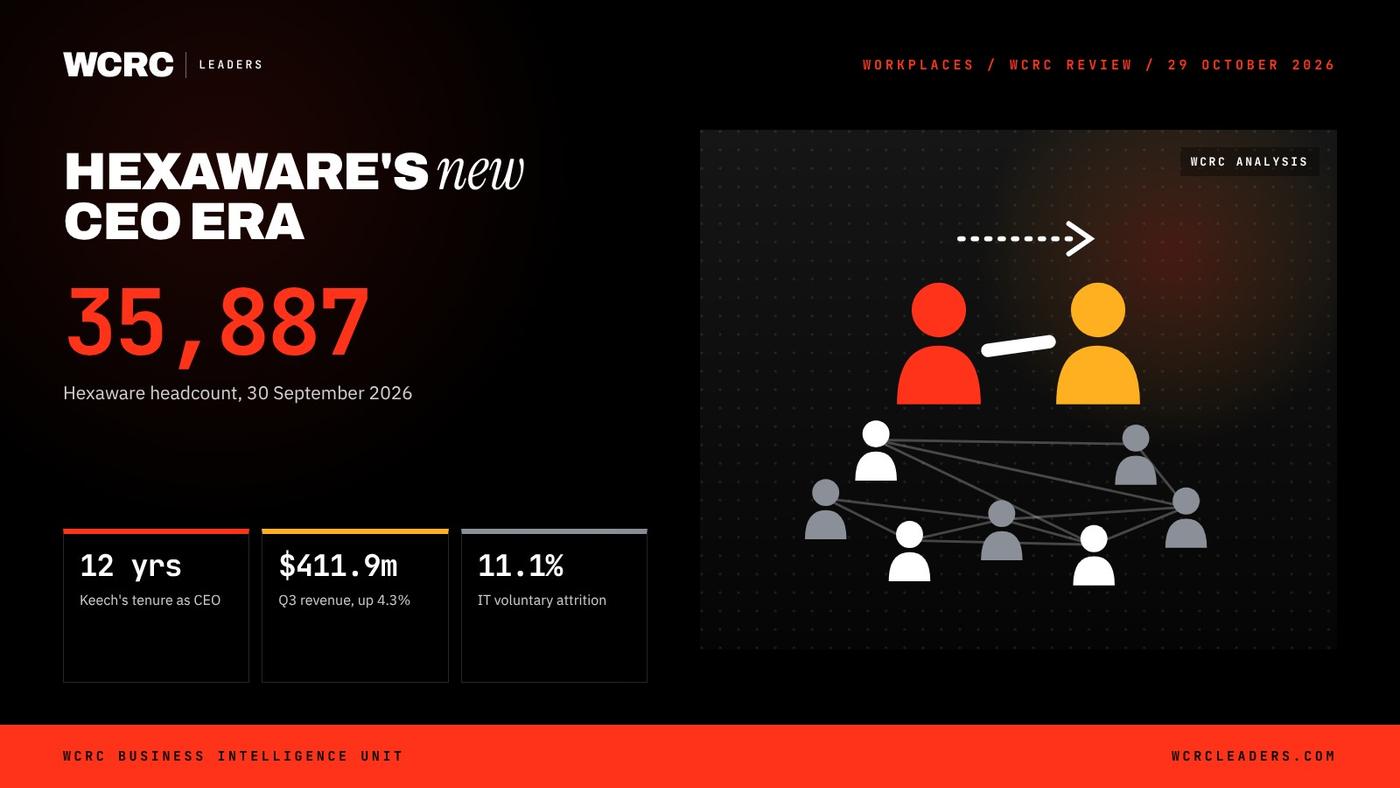
At a glance: WCRC Leaders' assessment: Hexaware's succession is orderly and well signalled, but Vivek Jetley inherits a slow-growth, people-heavy business at the exact moment AI is rewriting the services workforce, so his first test is cultural, not financial. On 28 October 2026, Keech stepped down as CEO and board member after 12 years and became Senior Advisor. Hexaware reported September-quarter revenue of $411.9 million, up 4.3% year on year, with adjusted EBIT margin down 88 basis points to 13.8% and headcount at 35,887.
What changed at the top of Hexaware?
Hexaware Technologies, one of WCRC 1000, India's Most Valuable Enterprises 2026, announced on 2 September 2026 that Vivek Jetley would join as CEO Designate and take over as chief executive on 28 October. Srikrishna Ramakarthikeyan, known as Keech, stepped down as CEO and as a member of the board on the same date, after leading the company for 12 years. He stays on as Senior Advisor.
Jetley comes from EXL, where he was President leading the Insurance, Healthcare and Life Sciences businesses, and earlier head of EXL analytics. He joined EXL in 2006 when it acquired Inductis, where he had been a partner, and spent about two decades there. Hexaware's release credits him with more than 25 years in AI and data, enterprise transformation and strategy.
The private equity firm Carlyle remains a major shareholder. Sandra Horbach, a Hexaware board member and Chair of Americas Corporate Private Equity at Carlyle, said: "As a major shareholder in Hexaware, Carlyle is excited to support Vivek as he steps into this role, and thanks Keech for his contributions to Hexaware over the past 12 years."
Keech said: "I am proud of what we have achieved together and confident that the company is well positioned for continued success."
WCRC analysis: Eight weeks between announcement and handover, an outgoing chief who stays as adviser, and a public endorsement from the controlling investor are the marks of a planned succession, not a forced one.
What did the September quarter show?
For the quarter to 30 September 2026, Hexaware reported:
- Revenue of $411.9 million, up 4.3% year on year and 1.6% on the quarter; up 4.5% year on year in constant currency. In rupees, ₹3,933 crore, up 12.9%.
- EBIT of ₹479 crore, down 6.5% year on year. Adjusted EBIT margin was 13.8%, up 17 basis points on the quarter but down 88 basis points on a year earlier.
- Profit after tax of ₹429 crore, up 16.1% year on year and 30.0% on the quarter.
- Clients paying more than $20 million a year rose to 17 from 16.
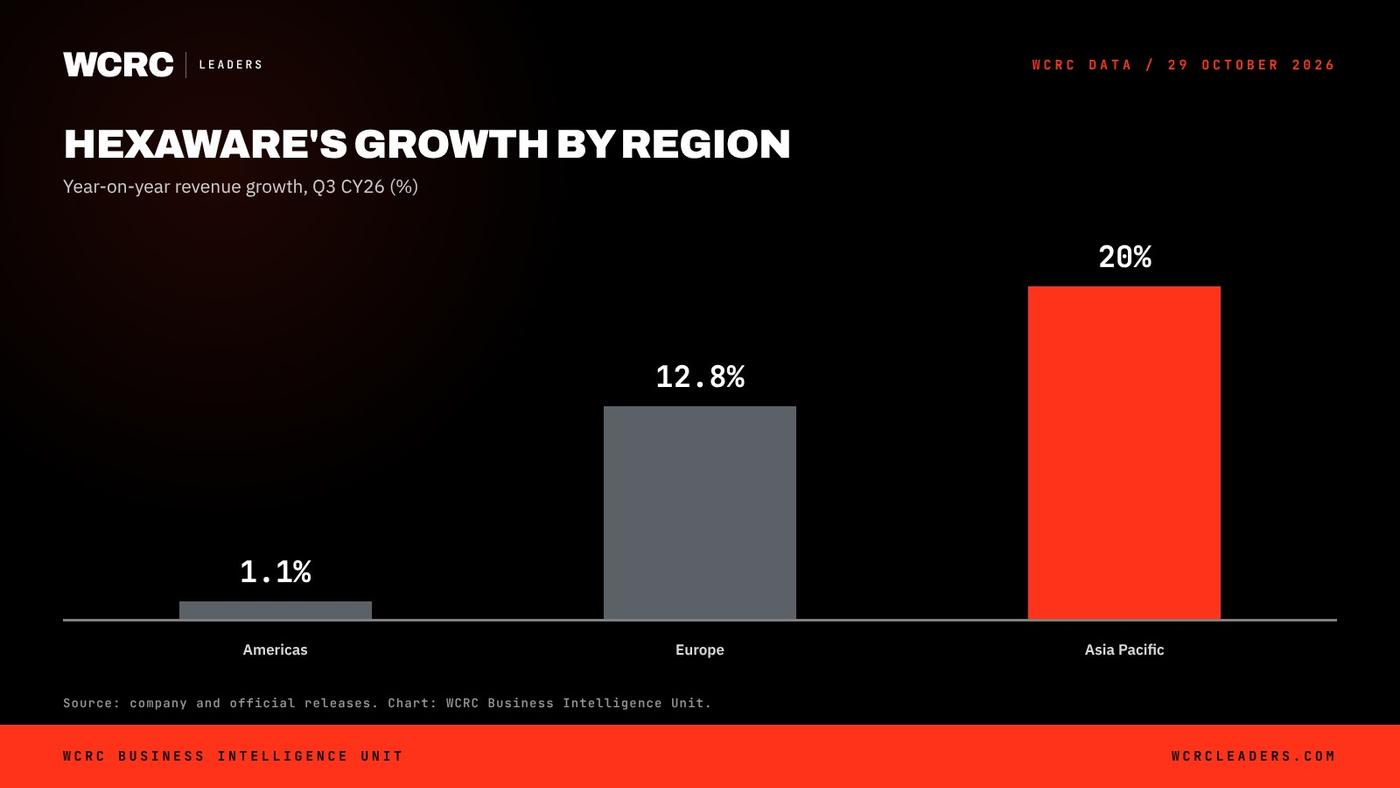
The geography split is the sharpest signal. Revenue from the Americas grew just 1.1% year on year, against 12.8% in Europe and 20.0% in Asia Pacific. Travel and Transportation revenue fell 8.5%.
Chief Financial Officer Vikash Jain said the focus now is "to carry the momentum from our stronger businesses into broader growth".
WCRC analysis: Profit rose while operating profit fell, so the gain in profit after tax came from items below EBIT rather than from the core business. The rupee figure of 12.9% growth also flatters: most of the gap to the 4.3% dollar figure is currency.
What does the workforce data tell us?
Hexaware ended September with 35,887 people, a net addition of 1,381 in the quarter. Only 386 were in IT, so most hiring was outside the IT workforce. IT voluntary attrition was 11.1% and IT utilisation 84.9%.
A year earlier, headcount was 33,590, IT attrition 11.4% and utilisation 83.8%.
WCRC analysis: On those figures, headcount grew about 6.8% in a year while dollar revenue grew 4.3%. Attrition edged down and utilisation up: a stable base, but not yet the "AI-first" productivity curve the company's own positioning promises, where revenue should start to pull away from headcount.
Hexaware was named among India's Most Loved 250 Workplaces 2026 by the Business Intelligence Unit of WCRC, a list built on WCRC's Workplace Equity Index, which looks at psychological safety, representation and inclusion, equitable opportunity, transparency and accountability, and trust and belonging. The full report and evidence are available from WCRC on request. WCRC analysis: trust and belonging are exactly what a CEO change puts at risk, and exactly what Jetley needs intact before he redesigns how work is done.
What has Jetley said, and how does it read?
In the results release, his first statement as CEO, Jetley said: "What attracted me to Hexaware is its talented people, deep client relationships, and entrepreneurial culture." He added: "With AI creating new possibilities for enterprises across industries, I believe we have a tremendous opportunity to build on these strengths."
In September he said: "We are at a defining moment for IT services, as AI adoption fundamentally changes how services are delivered, how capabilities are built and how enterprises create value."
Read through WCRC's seven leadership parameters, three are in play from day one:
- Vision Quotient. Jetley has named the destination, an AI-led services company, but not yet what happens to the pyramid of people beneath it.
- People Leadership. He put people first in his first sentence as CEO. That is the right order. In an AI transition, the people who must build the new delivery model are the same people whose roles it changes.
- Stakeholder Trust. Carlyle's endorsement, a staying predecessor and 17 clients above $20 million give him a trust buffer. The Americas, growing at 1.1%, is where that trust has to turn into revenue.
What does AI mean for Hexaware's people?
This is the question every Indian IT services board faces this year. WCRC has tracked India's two-speed job market, where AI roles rise while IT services hiring falls, and how peers such as Infosys have cut guidance even as AI revenue grows.
In the terms of the Kayaka-Dasoha Value Loop, a model in WCRC's Guru Management Codex that frames workforce strategy in an automated economy around the dignity of honest work, Jetley's challenge is to make AI raise the value of each person's work rather than simply reduce the number of people. The quarter's wins, including an "AI use case factory" for a US infrastructure provider, show where that new work lies. In the terms of ServeHeart, another Guru Management Codex model, about serve-first leadership that holds as routine work is automated, an outside CEO earns the right to change a team by visibly serving it first.
Read through the CultureCrest 5-Parameter Framework, whose parameters include innovation, career development and engagement, the test is whether Hexaware's people see AI as a career path or a threat. Attrition at 11.1% suggests, for now, they are staying.
What does it mean for CEOs and boards in India, the Gulf and Asia?
For Indian IT boards, Hexaware offers a template for succession under private equity ownership: a long notice period, an external hire with domain depth, and an outgoing leader kept close. It echoes ManpowerGroup's CEO handover as AI reshapes work.
For Gulf clients, a Middle East bank among the quarter's wins shows Indian mid-tier firms chasing regional work hard.
For Asian employers, the lesson is in the workforce numbers: no one can claim an AI-first model while headcount outgrows revenue.
The WCRC View
The call. Hexaware has executed a clean, well-signalled succession. But Jetley inherits a business growing at about 4% in dollars, with a margin down 88 basis points and headcount rising faster than revenue. His mandate is clear; his margin for error is thin.
Who gains. Clients in Europe and Asia Pacific, where Hexaware is growing fastest, and employees with AI and data skills under a CEO who built analytics businesses.
Who is exposed. The Americas book, growing at 1.1%, and the travel vertical, down 8.5%. And any part of the workforce whose work AI can absorb before Hexaware finds it new work.
What leaders should do now. Treat a CEO change as a People Leadership event first. Protect the trust and belonging that WCRC's Workplace Equity Index looks for, and say early what AI means for careers. Test AI plans against the Kayaka-Dasoha Value Loop, and track revenue against headcount.
What WCRC will watch. Americas growth by the March 2027 quarter, adjusted EBIT margin against its year-ago level, IT attrition through Jetley's first two quarters, and whether revenue starts to outgrow headcount.
WCRC models applied: Seven leadership parameters (Vision Quotient, People Leadership, Stakeholder Trust); Kayaka-Dasoha Value Loop and ServeHeart (Guru Management Codex); CultureCrest 5-Parameter Framework; Workplace Equity Index.
Quick answers
Q: Who is Hexaware's new CEO? A: Vivek Jetley, CEO from 28 October 2026, previously President at EXL leading its Insurance, Healthcare and Life Sciences businesses.
Q: What happened to Srikrishna "Keech" Ramakarthikeyan? A: He stepped down as CEO and board member on 28 October 2026 after 12 years leading Hexaware, and stays on as Senior Advisor.
Q: What were Hexaware's September-quarter results? A: Revenue of $411.9 million, up 4.3% year on year; adjusted EBIT margin of 13.8%, down 88 basis points; profit after tax up 16.1% to ₹429 crore.
Q: How many people does Hexaware employ? A: 35,887 at 30 September 2026, after a net addition of 1,381 in the quarter. IT voluntary attrition was 11.1% and IT utilisation 84.9%.
AI layoffs: cause or cover story?
The great flattening: companies are cutting managers, not just jobs
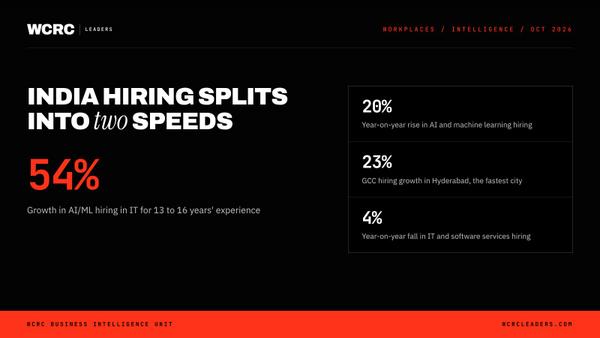
India's two-speed job market: AI roles and GCCs up, IT services down

Saudi Arabia's 50% accountant quota starts 27 October: a CFO checklist
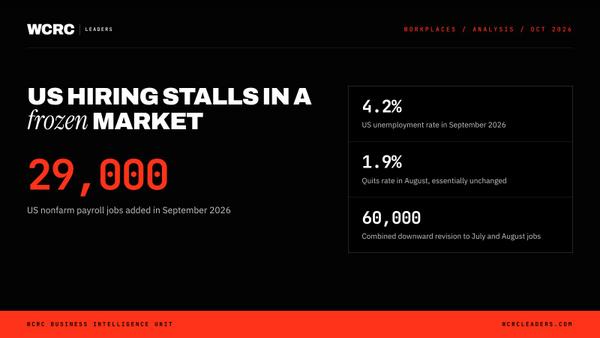
Leading in a low-hire, low-fire market
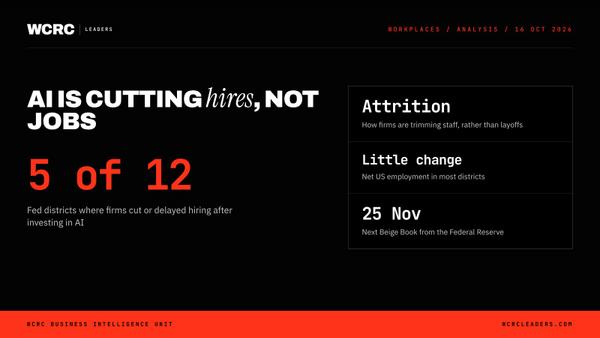
Fed Beige Book: AI is slowing hiring in 5 of 12 US districts
Filed under