People
ManpowerGroup hands its top job to Becky Frankiewicz as AI reshapes work
One of the world's largest staffing companies has named its strategy chief as its next chief executive, with Jonas Prising staying on as Executive Chair. The choice tells boards a good deal about what the talent business now values in a leader.
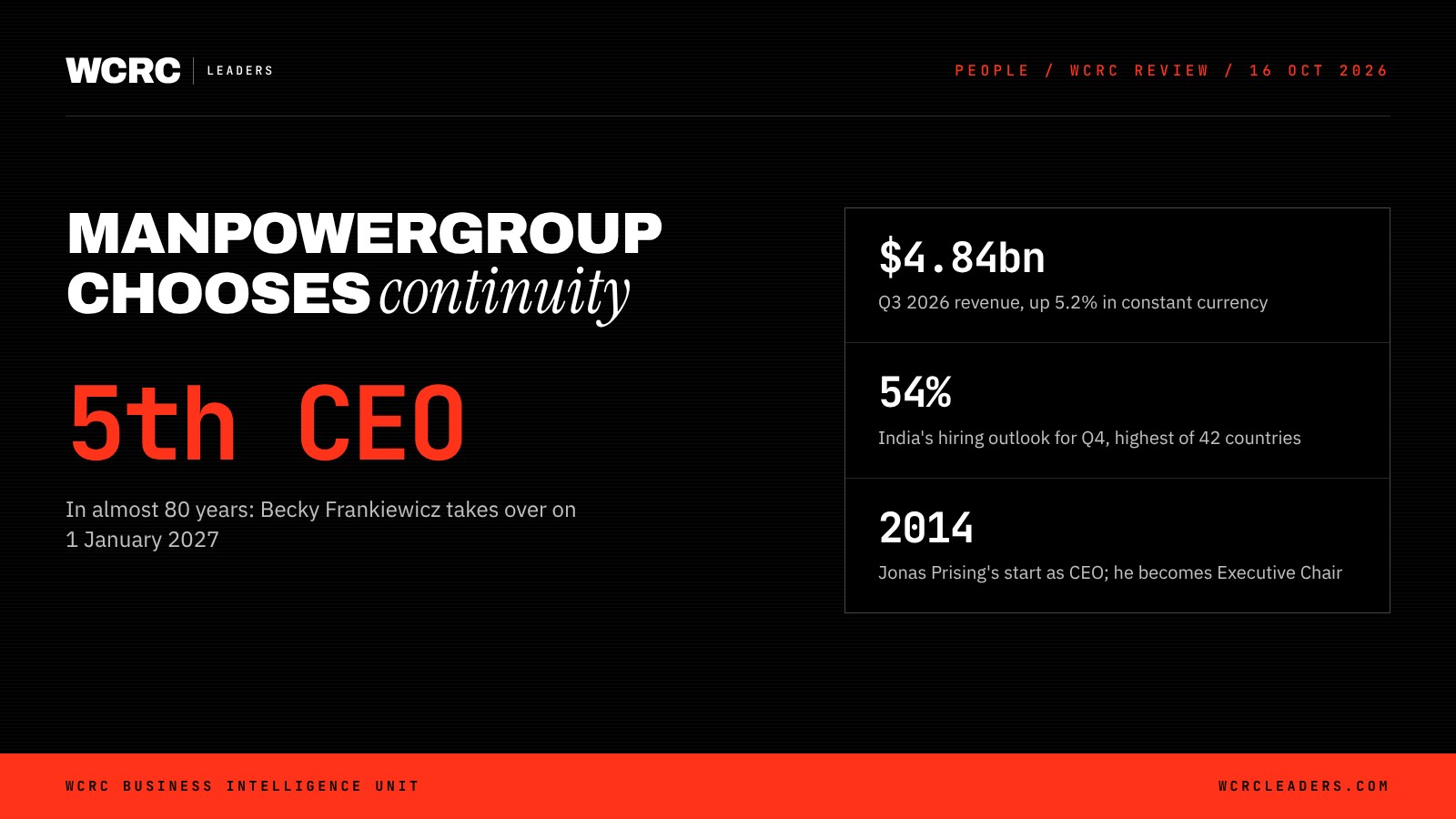
At a glance: WCRC Leaders' assessment: ManpowerGroup has chosen continuity of strategy over a reset, and the real test is whether its AI programme can lift margins before the executive-chair overlap blurs who is in charge. On 15 October 2026 the company said Becky Frankiewicz, President and Chief Strategy Officer, will become CEO and join the board on 1 January 2027. Jonas Prising, CEO since 2014, becomes Executive Chair. She will be the fifth CEO in the company's almost 80-year history, taking over as AI changes how employers hire.
What exactly did ManpowerGroup announce?
ManpowerGroup announced on 15 October 2026, from its Milwaukee headquarters, that Becky Frankiewicz will succeed Jonas Prising as chief executive on 1 January 2027 and will join the board. Prising, who has led the company since 2014, moves to Executive Chair of the Board on the same date.
The board framed the move as the result of a long process. "Following an extensive succession planning process, we are very pleased to endorse Becky as the next CEO for ManpowerGroup," said Julie Howard, the board's Lead Director. The release credits Prising with building a more digital, diversified and resilient business and with widening its higher-value talent and workforce management services.
Prising was equally clear about the handover. "I have every confidence in Becky as she leads ManpowerGroup into its next chapter," he said, adding: "I look forward to working closely with her to ensure a seamless transition."
Who is Becky Frankiewicz?
Frankiewicz is an insider, but not a lifer. She joined ManpowerGroup in July 2017 as President of North America, later becoming Chief Commercial Officer and President of ManpowerGroup North America. In June 2025 she was named President and Chief Strategy Officer, a role in which, the company says, she has led commercial strategy, shaped long-term strategy and driven AI integration across its three brands: Manpower, Experis and Talent Solutions.
Before ManpowerGroup she led Quaker Foods North America, which the company describes as one of PepsiCo's largest subsidiaries. She began her career in strategic consulting at Deloitte and Andersen Consulting and also worked at Procter & Gamble. She has sat on the board of Energizer Holdings since January 2020.
Her own statement points to pace rather than a change of direction. "As we enter our next chapter, we have a significant opportunity to accelerate our strategy," she said.
That profile matters: a consumer-goods general manager who has run AI integration is a different kind of staffing CEO.
What shape is the business in?
Results published the same day give the new team a firm base. For the three months to 30 September 2026, ManpowerGroup reported revenue of $4.84bn, up 4.4% as reported and 5.2% in constant currency. Diluted earnings per share rose to $0.71 from $0.38 a year earlier. Excluding one-off items, adjusted earnings per share were $1.01, up 24% in constant currency.
"Our performance to date reinforces our confidence that 2026 is an inflection point for the business," Prising said in the results release. The company pointed to share gains for the Manpower brand in the US and said US Experis, its IT professional resourcing arm, had returned to growth. It guided fourth-quarter diluted earnings per share of $1.03 to $1.13.
How is ManpowerGroup positioning itself on AI?
The firm's public line is that AI changes jobs more than it removes them. In February 2026, presenting its global talent shortage survey of 39,063 employers in 41 countries, Prising said that "AI is not replacing jobs, it is reshaping work". That survey found 72% of employers struggled to find the talent they needed, and for the first time ranked AI model and application development (20%) and AI literacy (19%) as the hardest skills to find.
Its quarterly hiring survey for October to December 2026 adds nuance. Among employers planning to cut staff, a soft economy weighed more than AI or automation; 62% of employers adding staff cited changing roles and skills as the main driver. "Over the next five years, the defining challenge will be redesigning work at scale," Prising said in the 8 September release.
Inside the company, the annual report describes AI being applied across its Talent Solutions offerings and its PowerSuite HR technology platform, while also flagging the risk that clients use AI to automate tasks now done by its associates. That two-sided exposure is the core of the job Frankiewicz inherits: AI is both a product to sell and a threat to the volume business underneath it.
Why does this matter for India and the Gulf?
ManpowerGroup reports India and the Middle East inside its Asia Pacific Middle East (APME) segment. The annual report names Japan and India as the segment's largest operations. APME revenue in the third quarter was $514.9m, up 4.3% in constant currency, though operating unit profit fell 10.2% to $23.9m.
Demand signals in both regions are strong. In the company's survey for the fourth quarter of 2026, India posted a Net Employment Outlook of 54%, the highest of 42 countries and well above the global figure of 29%. The UAE came in at 41%, among the five strongest markets. The Indian reading was drawn from 3,055 employers.
The company's roots in both markets are long. In India it built its IT professional resourcing business partly through Web Development Company, a Kolkata-based IT services firm it fully owned by 2012 under the Experis brand. In the Gulf it bought Clarendon Parker Middle East in 2008, adding offices in the UAE, Saudi Arabia, Bahrain, Kuwait and Qatar. Its Indian executive team lists Sandeep Gulati as Managing Director, India and Middle East.
For leaders in these markets, the practical point is that a global supplier of contract labour and recruitment is about to be run by an executive whose stated agenda is faster AI integration. Clients should expect more automated sourcing and screening, and more pricing tied to outcomes rather than headcount.
Does the executive-chair handover help or hinder?
ManpowerGroup follows a pattern WCRC has tracked this month. As we reported in The executive-chair handover is becoming the default, Stryker, General Dynamics and Highmark Health all named internal presidents as CEO from 1 January 2027 and kept the outgoing chief on as an executive chair. ManpowerGroup's announcement matches that template on every point: an internal president, the same start date and a long-serving predecessor of 12 years staying in an executive role.
The model buys continuity; its risk is two people with operating authority. The release does not say how long Prising will serve as Executive Chair or how decision rights will be split.
Contrast that with India's banking sector, where HDFC Bank went outside for its next chief, as we covered in HDFC Bank hires its next chief executive from its biggest rival. Different boards are reaching different answers to the same question: how much change does the next era need?
The WCRC View
Analysis from the WCRC Business Intelligence Unit.
- Our call: this is a strategy-continuity appointment, and a sensible one. Frankiewicz has co-run the transformation she is now asked to speed up. The board is betting that execution, not a new direction, is what the company lacks.
- Who gains: clients wanting a staffing partner with real AI tooling, and Experis, whose IT resourcing work sits closest to the AI skills shortage the company's own data describes. India, with the strongest hiring outlook in the survey, is a natural proving ground.
- The open question is governance. An executive chair with 12 years in charge casts a long shadow. ManpowerGroup's board should publish an end date or review point for the role and set out who owns which decisions. Silence invites staff and investors to guess.
- What leaders should do now: CEOs and CHROs in India and the Gulf who buy contract labour or recruitment services should ask suppliers, ManpowerGroup included, for a clear account of where AI is used in screening, how outcomes are audited and how pricing will change. Boards planning their own successions should note how quickly the executive-chair model is spreading, and write the decision rights down before announcing it.
- What WCRC will watch: the fourth-quarter results due in early 2027, the first under the new structure; any word on the length of Prising's term as Executive Chair; and whether APME profit recovers alongside India's hiring demand. For the wider jobs picture, see our analysis of India's two-speed job market and whether AI layoffs are cause or cover story.
Quick answers
Q: Who is ManpowerGroup's next CEO? A: Becky Frankiewicz, currently President and Chief Strategy Officer, becomes CEO and joins the board on 1 January 2027.
Q: What happens to Jonas Prising? A: Prising, CEO since 2014, becomes Executive Chair of the Board on 1 January 2027.
Q: How did ManpowerGroup perform in the third quarter of 2026? A: Revenue was $4.84bn, up 5.2% in constant currency, with adjusted earnings per share of $1.01, up 24% in constant currency.
Q: How strong is hiring demand in India according to ManpowerGroup? A: India's Net Employment Outlook for the fourth quarter of 2026 is 54%, the highest of 42 countries surveyed; the global figure is 29%.
Filed under