People
Noel Tata hands Trent to Bahram Vakil as a written rule takes effect
Trent's chairman of long standing retires on 11 November under the Tata Group Governance Guidelines, with a corporate lawyer taking the chair and two new directors joining a day after a record quarter. The handover is a working lesson in how a rule, not a mood, can move power at a flagship.
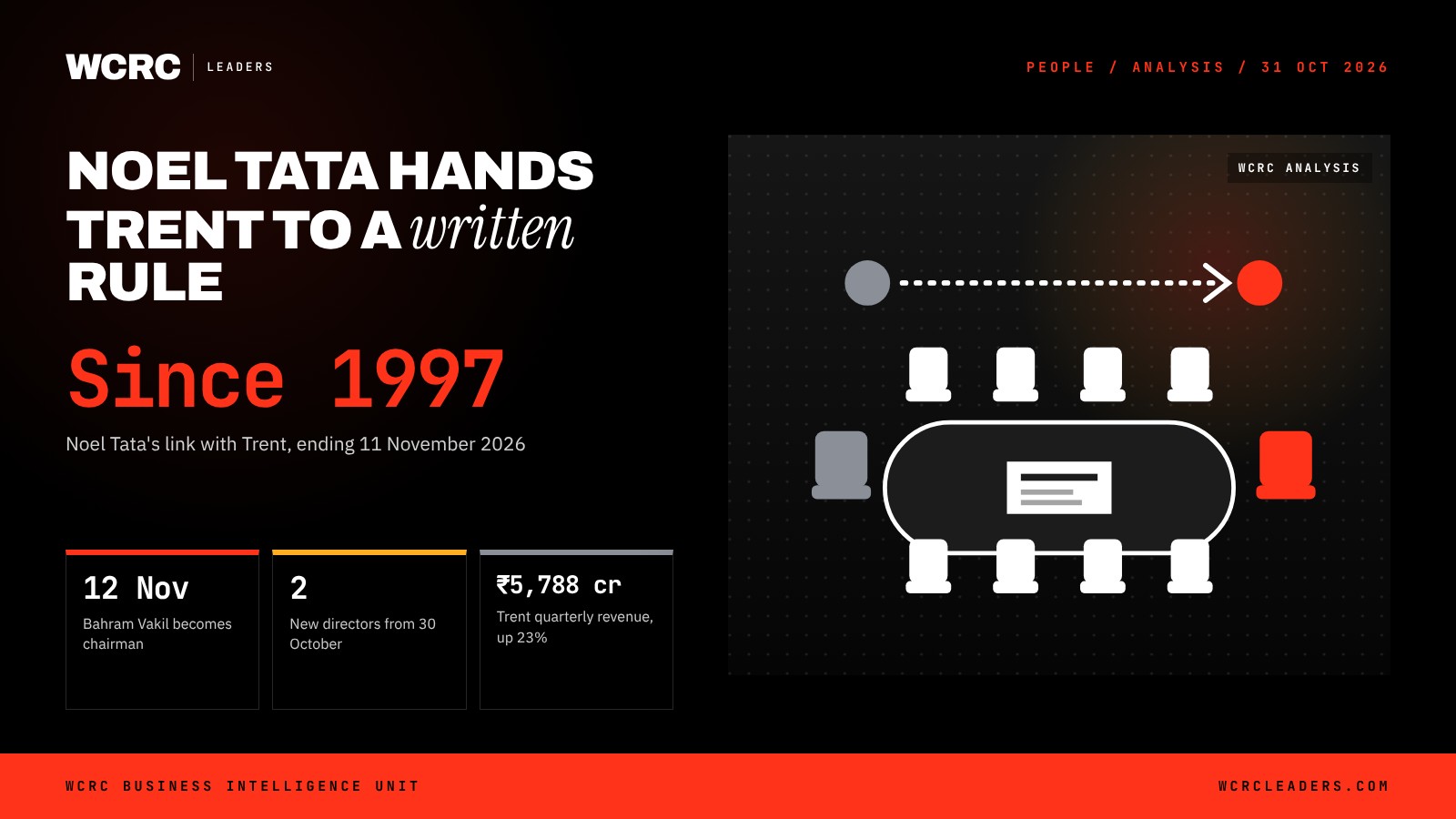
At a glance: WCRC Leaders' assessment: Trent shows that a written retirement rule, applied in a strong quarter, is the cleanest way to hand over a flagship, because it takes the question of timing out of the boardroom. Noel N Tata retires as chairman and director at the close of business on 11 November 2026 and becomes Chairman Emeritus on 12 November. Bahram Vakil, a co-founder of AZB & Partners, becomes chairman. Rajiv Dube and Kalpana Merchant join the board from 30 October.
What did Trent announce?
On 29 October 2026, the board of Trent, one of WCRC 1000, India's Most Valuable Enterprises 2026, approved four changes and disclosed them to the exchanges under Regulation 30 of SEBI's listing rules.
First, Noel N Tata will retire from the office of chairman and director "with effect from the close of business hours on 11th November 2026". The filing says this is "in accordance with" the Tata Group Governance Guidelines, which Trent has adopted and which "prescribe the requirements related to Board Composition, Board Committees and the retirement of directors." It records that Mr Tata "has been associated with the Company since 1997". The board has named him Chairman Emeritus from 12 November.
Second, Bahram Vakil becomes chairman from 12 November 2026. AZB & Partners describes him as one of the firm's founding partners; his work spans banking and finance, mergers and acquisitions, and restructuring and insolvency, and he served on the committee that drafted India's Insolvency and Bankruptcy Code, 2016.
Third, Rajiv Dube joins as an additional director in the non-executive, non-independent category from 30 October, subject to shareholder approval. The filing describes more than 40 years of experience across sectors, including senior roles at Tata Motors and a period as an executive director on the board of the Aditya Birla group.
Fourth, Kalpana Merchant joins as an independent director for three years, from 30 October 2026 to 29 October 2029, also subject to shareholder approval. She brings more than 45 years in law, with partner roles at Kanga & Co., AZB & Partners and Jerome Merchant + Partners. The filing states that none of the three incoming office holders is related to any other director.
What rule is being applied?
Trent's filing cites the guidelines but does not quote an age. The published version of the Tata Group Governance Guidelines, titled "Guidelines for Tata companies on Board Effectiveness" and posted by Tata Motors, sets out the retirement ages plainly: managing and executive directors hold office up to 65, non-independent non-executive directors retire at 70, and independent directors at 75.
That matters more than the number. A group-wide rule that each listed company adopts on its own board means the exit is set in advance, applies to every director in the same category, and does not depend on surname, performance or sentiment. Indian listing rules and company law already set some limits on directors' age and tenure. A group code can go further, and this one decides the timing before anyone has to ask.
Why does the timing look so clean?
Because the business is handing over from strength. Trent's Q2 FY27 release, published the same afternoon, reported standalone revenue from operations of ₹5,788 crore for the quarter to 30 September 2026, up 23% year on year. Standalone operating EBITDA rose 37% to ₹791 crore and the operating EBIT margin widened to 11.6% from 10.5%. Consolidated revenue was ₹5,873 crore, up 22%.
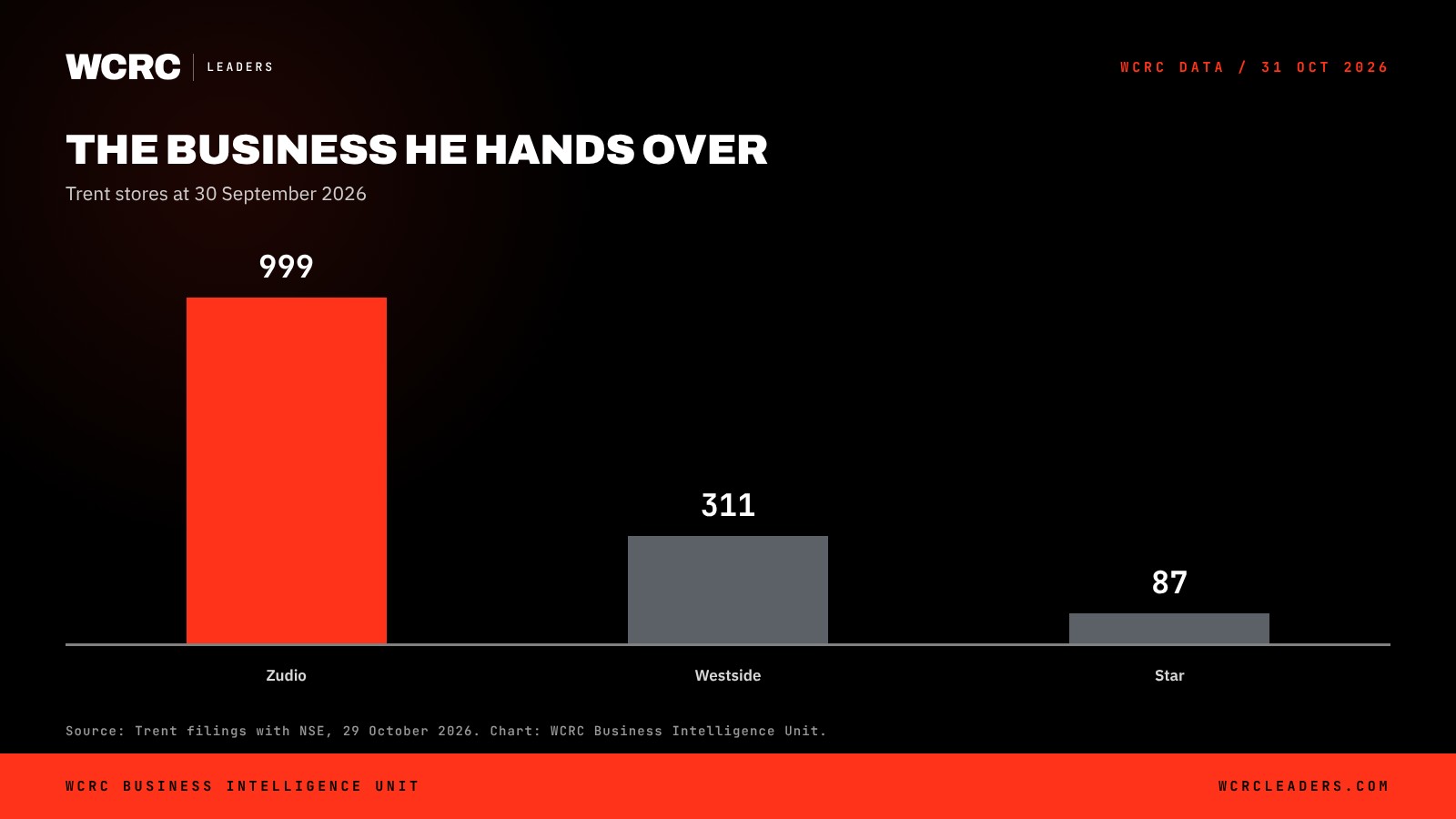
Trent ended September with 311 stores of Westside, a WCRC MegaBrand in department stores, and 999 stores of Zudio, a WCRC MegaBrand in fast fashion and value apparel, including seven in the UAE. It opened its 1,000th Zudio store during the quarter, and its fashion formats now reach 339 cities, three of them in the UAE. Star, the food and grocery business, has 87 stores in 13 cities, with own brands and products at over 74% of revenue.
In his last results message as chairman, Mr Tata said: "It has been a privilege to witness Trent's transformation from a fledgling entrant in the fashion sector into one of its leading players, distinguished by strong growth, profitability and capital efficiency." He added: "Yet, I firmly believe that Trent's best days lie ahead," and named three goals for the company: strengthening its lifestyle position, building a significant presence in food and grocery, and emerging as "a meaningful exporter".
How does the new board change the balance?
This is analysis. Read through WCRC's seven leadership parameters, the handover moves the weight from one dimension to others. A long-serving chairman tied to the company since 1997 carries Vision Quotient and Impact Index: the story of what Trent became. A chairman drawn from corporate law, joined by an independent director with 45 years in law, points the board towards Stakeholder Trust and Resilience Factor: process, disclosure and the discipline to absorb shocks. Rajiv Dube's operating record across Tata Motors and the Aditya Birla group adds industrial depth in the non-independent seat.
For a company whose own chairman sets out food and grocery and exports as the next chapters, a board strong on contracts, capital markets and dispute resolution fits the risks those chapters bring.
WCRC's Leadership Equity Matrix research looks at leadership equity: how much of an organisation's standing rests on the leaders at the top and how that equity is passed on. In its terms, the title of Chairman Emeritus keeps continuity and institutional memory visible while the formal authority moves to Mr Vakil on a fixed date.
What should boards in India, the Gulf and Asia take from it?
The first lesson is to write the rule before it is needed. In the terms of SeeClear, a model in WCRC's Guru Management Codex, the job is to separate fact from projection: a retirement age is a fact the market can price, while a vague promise of "orderly succession" invites projection.
The second is to apply the rule in good times. A chair who leaves after a 23% revenue quarter leaves on a high, and the successor inherits momentum rather than a repair job. Our coverage of Bajaj General's CEO change as a 15-year cap ended an era and of why the executive-chair handover is becoming the default shows the same pattern: fixed limits produce calmer transitions.
For Gulf family groups listing companies on regional exchanges, and for Asian conglomerates with a patriarch or matriarch in the chair, the Trent model offers a template: a group code, adopted company by company, that covers board composition, committees and retirement together. The lesson is to write the exit down before it is needed.
The WCRC View
WCRC Leaders' Business Intelligence Unit reads Trent's announcement as a model handover for a family-led group's flagship, and the lesson is in the process, not the personalities.
- What it means. A written rule, applied on a fixed date and disclosed in plain terms, removes the single biggest source of succession risk: uncertainty over when. Trent's filing names the rule, the date, the successor and the honorific role in one page.
- Who gains. Shareholders gain predictability. The new chair gains a business in its strongest phase. Through WCRC's Governance Shield, from the Brand & Marketing Codex, the Westside and Zudio brands gain board-level protection of reputation from a chair whose career is built on governance and law.
- What leaders should do now. Boards in India, the Gulf and Asia without a written retirement and tenure policy should adopt one this financial year, cover the chair as well as executives, and pair it with a defined emeritus or advisory role so that experience stays close without holding authority.
- What we will watch. Shareholder approval of Mr Dube and Ms Merchant, how the board under Mr Vakil frames the food and grocery and export ambitions, and whether Zudio's UAE presence grows beyond seven stores. Trent (Westside) is also among India's Most Loved 250 Workplaces 2026, selected by the Business Intelligence Unit of WCRC, so how the change is felt by store teams is worth watching too.
WCRC models applied: Seven leadership parameters, Leadership Equity Matrix, SeeClear (Guru Management Codex), Governance Shield (Brand & Marketing Codex).
Quick answers
Q: When does Noel Tata retire as Trent chairman? A: At the close of business on 11 November 2026. He becomes Chairman Emeritus from 12 November 2026.
Q: Why is he retiring? A: Trent's filing says the retirement is in accordance with the Tata Group Governance Guidelines, which the company has adopted and which set requirements on board composition, committees and the retirement of directors.
Q: Who is Trent's new chairman? A: Bahram Vakil, a founding partner of the law firm AZB & Partners, takes the chair from 12 November 2026.
Q: Who else joined the Trent board? A: Rajiv Dube as a non-executive, non-independent director and Kalpana Merchant as an independent director for three years, both from 30 October 2026 and subject to shareholder approval.

Boston Dynamics picks an AI-model leader to run a robot company
Bajaj General picks Deepak Reddy as 15-year cap ends Singhel era

Noel Tata wants Tata Trusts to build institutions, not just fund them

Anup Bagchi starts at HDFC Bank with a ₹35.9cr target pay package
Firsts and exits: women at the top this month

The Gulf's C-suite churn
Filed under