Editorial
Mukesh Ambani vs Elon Musk: The Starlink Challenge That Could Redefine India's Digital Sovereignty
From telecom dominance to satellite sovereignty: why Reliance Jio's next great leadership challenge is not simply to compete with Starlink, but to help India build a world-class indigenous space communications ecosystem.
Leadership Intelligence & Strategic Analysis
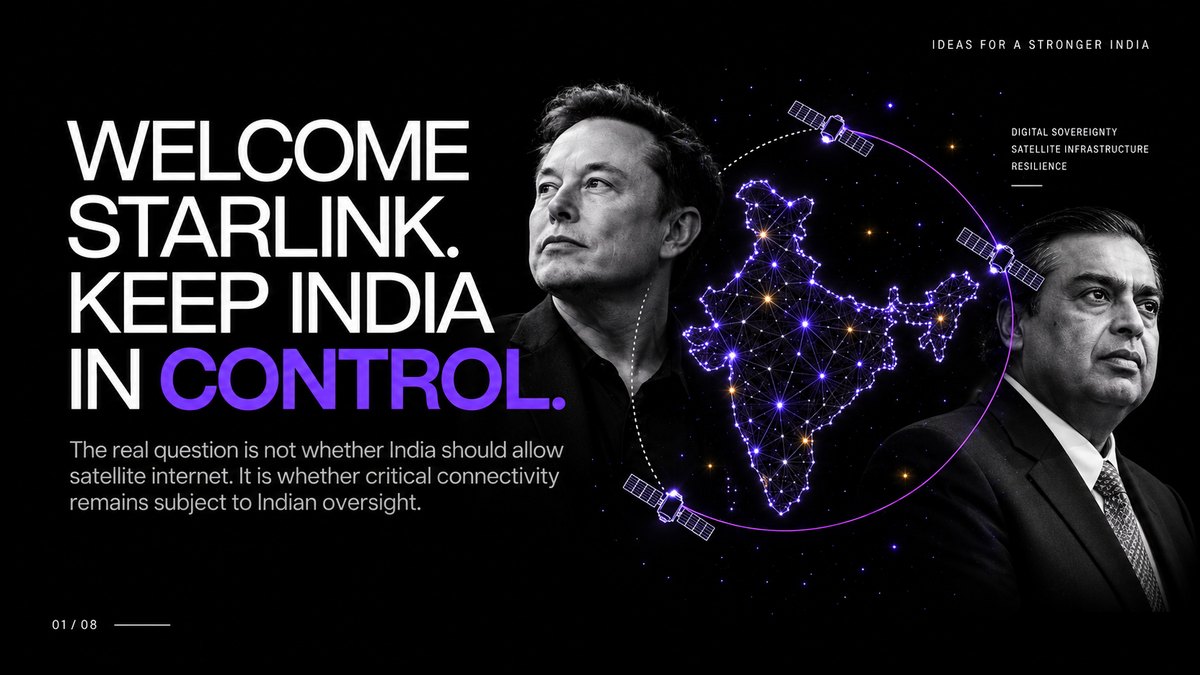
The central question: can India welcome Starlink without compromising technological sovereignty?
India can benefit from Starlink’s satellite internet technology while reducing national security risks through enforceable regulation, diversified networks and indigenous communications capabilities. Reliance Jio’s proposed 1,600-satellite network represents a potentially significant step towards domestic capability, but its success will depend on actual deployment, technological competitiveness and commercial execution.
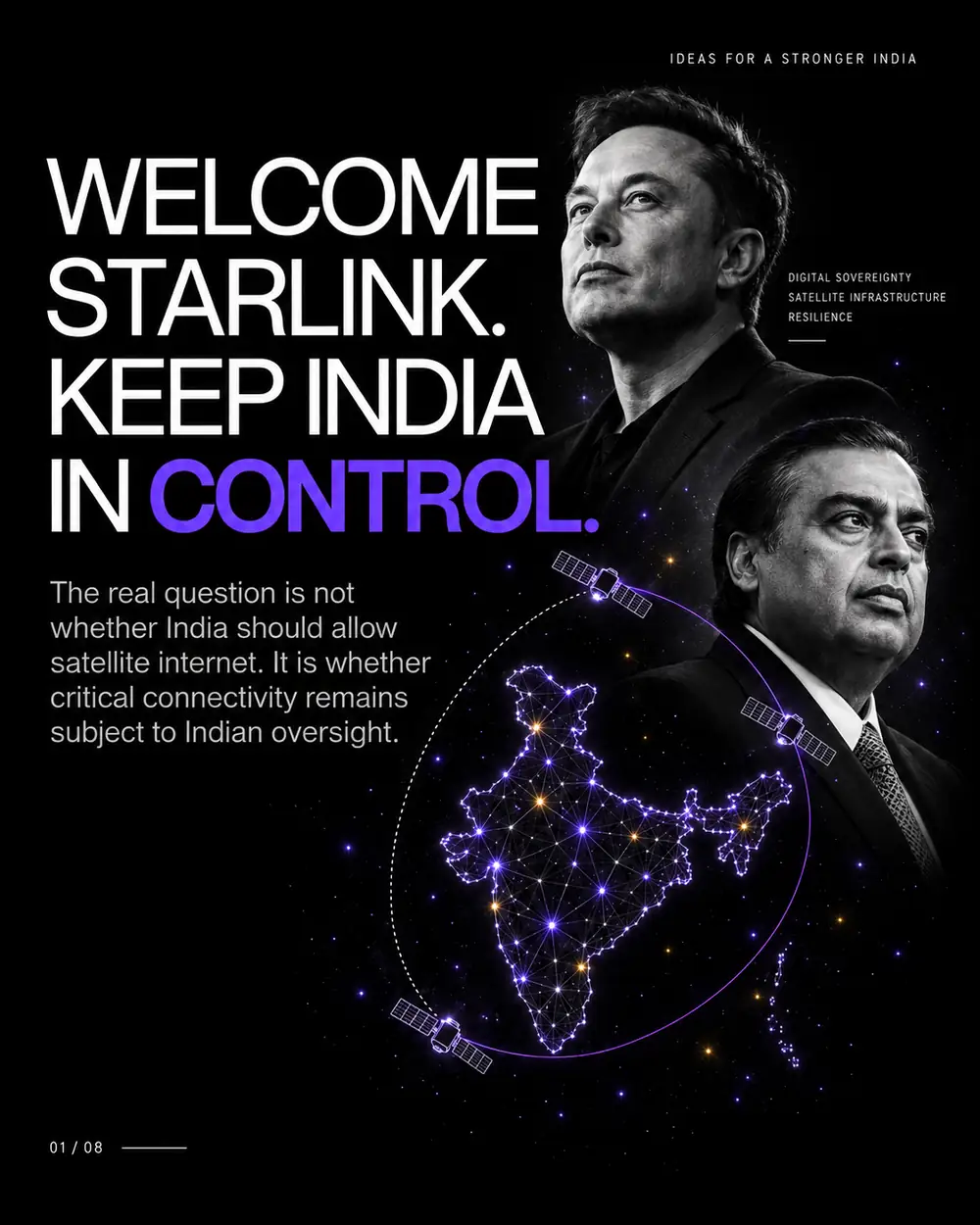
The question is no longer whether satellite internet will reshape India’s digital future.
It is who will build, operate and ultimately control the infrastructure on which that future depends.
At the centre of this rapidly evolving industry stand two of the world’s most consequential business leaders: Mukesh Ambani, Chairman and Managing Director of Reliance Industries, and Elon Musk, the entrepreneur behind SpaceX and Starlink.
Their approaches to technological scale have been profoundly different.
Ambani built a telecommunications platform that transformed India’s data economy by making connectivity available at enormous scale.
Musk built a space infrastructure enterprise that dramatically changed the economics of launching satellites and delivering broadband from orbit.
Now those two industrial models are converging.
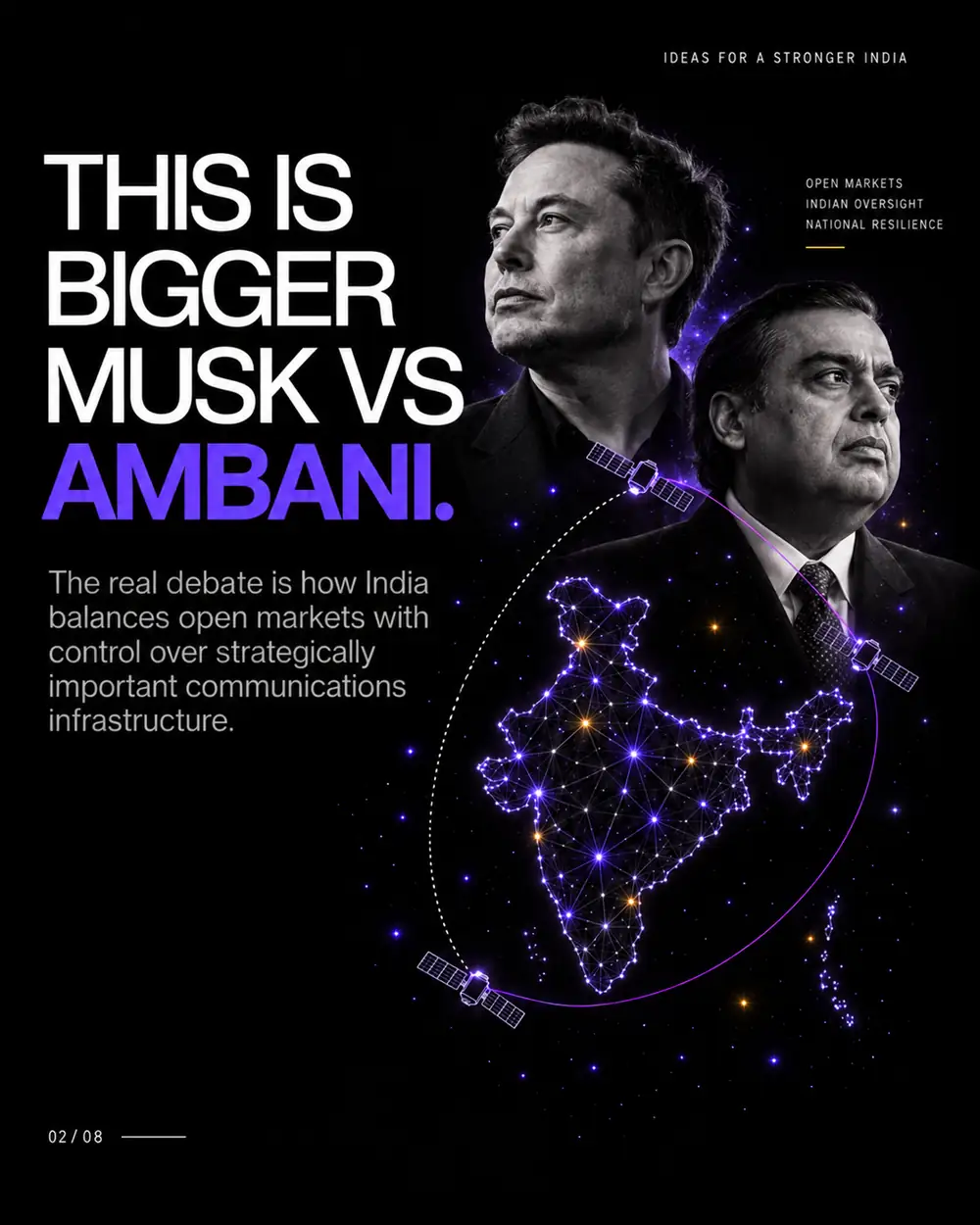
The resulting confrontation is not simply another contest for market share. It brings together questions of technological leadership, infrastructure control, capital allocation, national security and India’s place in the next generation of the global digital economy.
For Mukesh Ambani, the significance extends beyond defending Reliance Jio’s position in Indian telecommunications.
It raises a far more consequential leadership question:
Can Reliance move from being India’s most influential telecommunications enterprise to becoming an architect of globally competitive, Indian-controlled space communications infrastructure?
That is the leadership challenge WCRC Leaders examines.
What happened between Elon Musk and Mukesh Ambani in October 2026?
The dispute escalated in early October when Elon Musk publicly criticised the delays surrounding Starlink’s commercial launch in India.
Musk suggested that powerful Indian business interests were obstructing Starlink’s entry and subsequently questioned Mukesh Ambani’s influence.
India’s Communications Minister, Jyotiraditya Scindia, rejected the suggestion that the government was protecting a monopoly.
According to Reuters’ October 9 report, Musk provided no evidence supporting his allegations against Ambani.
The government maintained that Starlink, Reliance Jio’s satellite business and Eutelsat OneWeb were at broadly comparable regulatory stages, requiring compliance with security conditions and spectrum assignment before commercial operations.
That distinction matters.
Starlink has received an operating licence, but a licence is not the same as unconditional authorisation to commence commercial services.
Satellite communications involve spectrum management, security responsibilities, gateway infrastructure and other regulatory requirements that may differ from ordinary terrestrial internet services.
The regulatory process must nevertheless remain predictable, transparent and consistent.
India has legitimate reasons to examine the security implications of commercial satellite constellations. It also has an obligation to ensure that national security is not used to disguise anticompetitive behaviour.
Neither unverified allegations of corporate interference nor assertions of national interest should be accepted without scrutiny.
For WCRC Leaders, the larger story lies elsewhere.
The controversy has exposed how strategic the next generation of communications technology is becoming, and how quickly the traditional boundaries between telecom operators and space technology companies are disappearing.
Why Starlink is a serious competitive challenge to Reliance Jio
Starlink’s competitive advantage begins with a technological model that differs fundamentally from conventional telecommunications.
A traditional mobile network relies on towers, radio spectrum, transmission infrastructure, fibre backhaul, ground-based switching systems and extensive distribution networks.
A low-Earth-orbit satellite network adds a different layer: satellites capable of delivering connectivity across large geographical areas, including locations where terrestrial deployment is difficult or economically unattractive.
SpaceX combines satellite design, satellite manufacturing, reusable launch vehicles, ground infrastructure and network software within a highly integrated industrial system.
This integration is strategically important.
The cost of sending satellites into orbit, the frequency of launches, the ability to replenish the constellation and the sophistication of the user equipment all influence the commercial economics of satellite broadband.
Starlink has already demonstrated this model in multiple international markets.
But its ambitions no longer end with satellite dishes serving remote customers.
On October 9, 2026, Reuters reported that SpaceX had agreed to acquire Grain Management’s nationwide 800 MHz portfolio, up to 14 megahertz of paired low-band US spectrum, subject to regulatory approval. The companies did not disclose financial terms; the Wall Street Journal reported the price at approximately $8 billion, citing people familiar with the transaction.
The transaction reflects SpaceX’s growing interest in integrating satellite services with conventional mobile communications.
The deal concerns the United States, not Indian spectrum rights. Nevertheless, it illustrates a broader technological direction: satellite connectivity and terrestrial mobile networks are becoming increasingly interconnected.
For Reliance Jio, this changes the competitive landscape.
A satellite provider may begin by serving areas beyond the reach of telecom towers, but emerging direct-to-device technologies could eventually allow satellite networks to complement, and compete for selected services with, traditional mobile operators.
There are still important technical limitations. Satellite-to-phone connectivity faces challenges involving capacity, indoor reception, spectrum availability, handset compatibility and economics. It cannot simply be assumed that satellites will replace high-density urban 5G networks.
But the direction of technological development is unmistakable.
The next global telecommunications competitor may not look like a telecommunications company at all.
That is why Mukesh Ambani cannot view Starlink purely through the lens of today’s broadband market.
The strategic challenge reaches into the architecture of tomorrow’s connectivity.
Mukesh Ambani’s Jio revolution: from affordable data to national digital infrastructure
To understand Reliance’s opportunity, it is necessary to understand the leadership achievement that created Jio.
Mukesh Ambani’s most consequential contribution to Indian telecommunications was not simply building another operator.
It was changing the scale and economics of internet access.
Jio’s investment in nationwide digital infrastructure helped accelerate India’s transition towards widespread mobile broadband usage.
The implications extended into digital payments, consumer services, entertainment, education, online commerce and enterprise technology.
By June 2026, Jio reported more than 533 million subscribers, including approximately 285 million Jio True5G users. Jio Platforms recorded quarterly EBITDA of ₹20,865 crore and average revenue per user of ₹215.6, according to Reliance’s July 2026 results.
These numbers reflect an enterprise with substantial operating scale, commercial reach and infrastructure experience.
Yet terrestrial network scale does not automatically translate into space technology leadership.
Satellite broadband demands additional capabilities: spacecraft engineering, payload design, orbital operations, spectrum coordination, launch capacity and specialised ground systems.
The required capital, engineering cycle and competitive economics differ significantly from building mobile networks.
This is where the next chapter of Ambani’s leadership becomes especially interesting.
Reliance possesses the advantages of a massive distribution platform, established telecommunications infrastructure, a substantial enterprise customer ecosystem and access to industrial partnerships.
It must now determine how those advantages can be translated into a competitive presence in an industry where SpaceX already has a significant technological head start.
The question is no longer simply how much infrastructure Reliance can deploy.
It is how much underlying technology the company can help develop, own and control.
Reliance’s proposed 1,600-satellite constellation: a strategic turning point?
At India Mobile Congress 2026, Reliance Jio presented its vision for sovereign satellite connectivity.
According to Mint’s October 8 report, Jio showcased a proposed network involving approximately 1,600 low-Earth-orbit satellites, supported by 23 ground stations in India.
The proposal is intended to extend connectivity to remote villages, island territories, border regions and areas where conventional infrastructure is difficult to deploy.
The network would also be integrated with existing terrestrial infrastructure.
The announcement is significant because it indicates a strategic ambition beyond purchasing satellite capacity from foreign operators.
However, the constellation remains proposed. The announced satellite and ground-station figures are not evidence that the complete system has been built, deployed or placed in commercial operation.
An operational constellation of this scale would require sustained investment, reliable launch access, sophisticated manufacturing capabilities, regulatory clearances, ground-network integration and substantial operational expertise.
The announcement should therefore be evaluated as an industrial strategy rather than as an already achieved technological milestone.
There is another revealing dimension.
In March 2025, Reliance Jio announced an agreement with SpaceX to make Starlink services available to Indian customers, subject to regulatory approvals.
This creates a more complex picture than the familiar narrative of Musk versus Ambani.
Reliance can potentially distribute satellite capacity from global providers while developing its own domestic capabilities.
In June 2026, SpaceNews reported that Jio was pursuing a strategy involving leased capacity from international satellite constellations alongside development of a sovereign low-Earth-orbit network.
The strategic question is whether Reliance can use international partnerships as a bridge towards a differentiated Indian technology platform rather than become permanently dependent on externally controlled infrastructure.
In global technology industries, companies frequently compete, collaborate and purchase from one another simultaneously.
Strong leadership requires recognising when partnership accelerates capability and when excessive dependence may weaken long-term strategic flexibility.
Is Starlink a national security threat to India?
Starlink presents potential national security risks because critical connectivity could depend on satellite infrastructure, software controls and operational decisions outside India’s direct control. These risks concern sovereignty, service availability, network verification and data governance. They do not establish that Starlink has conducted espionage or deliberately compromised Indian security.
This distinction is essential to a serious policy discussion.
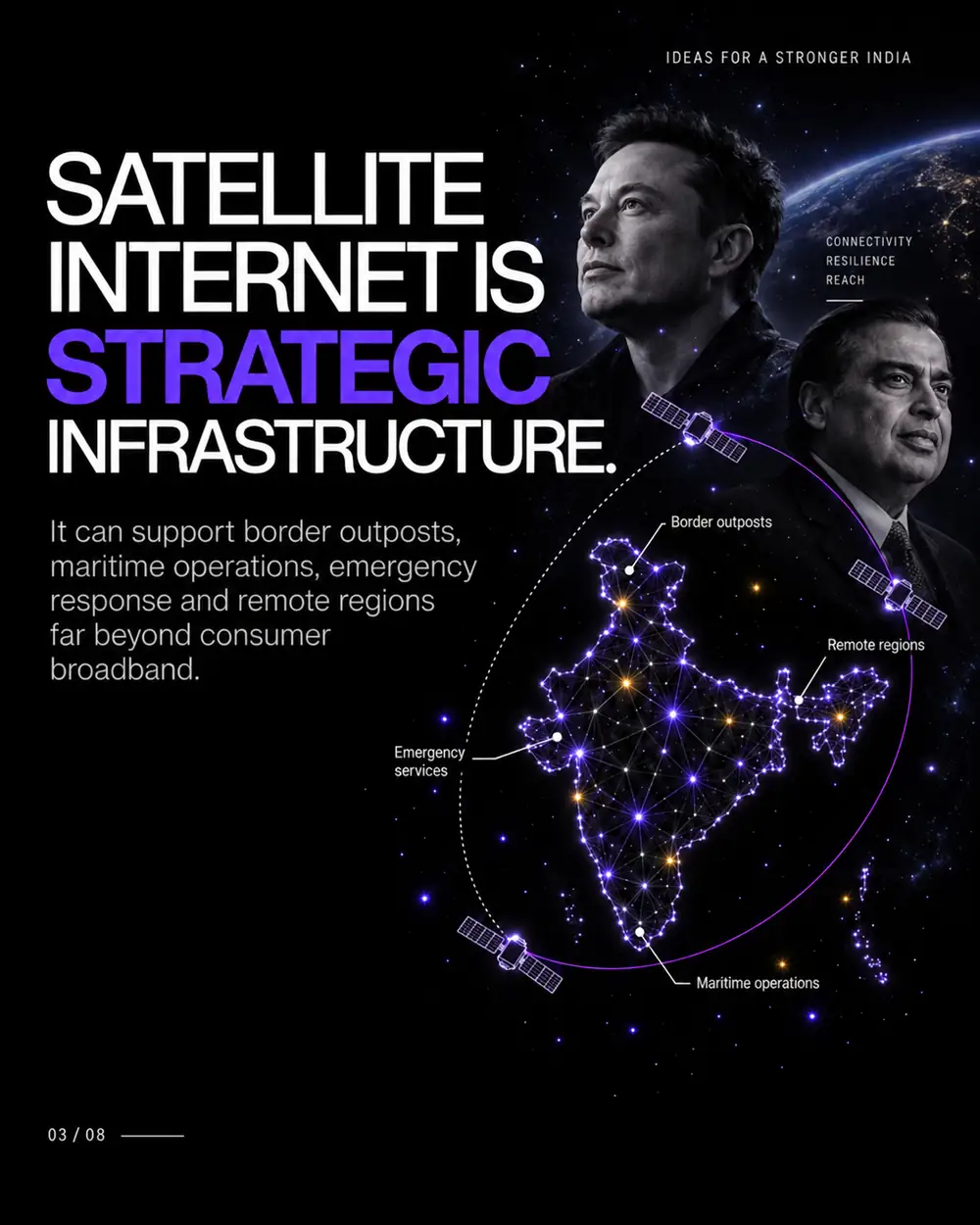
Satellite networks can serve consumer broadband customers, but they may also support strategic applications including disaster response, maritime communications, remote operations and potentially sensitive institutional connectivity.
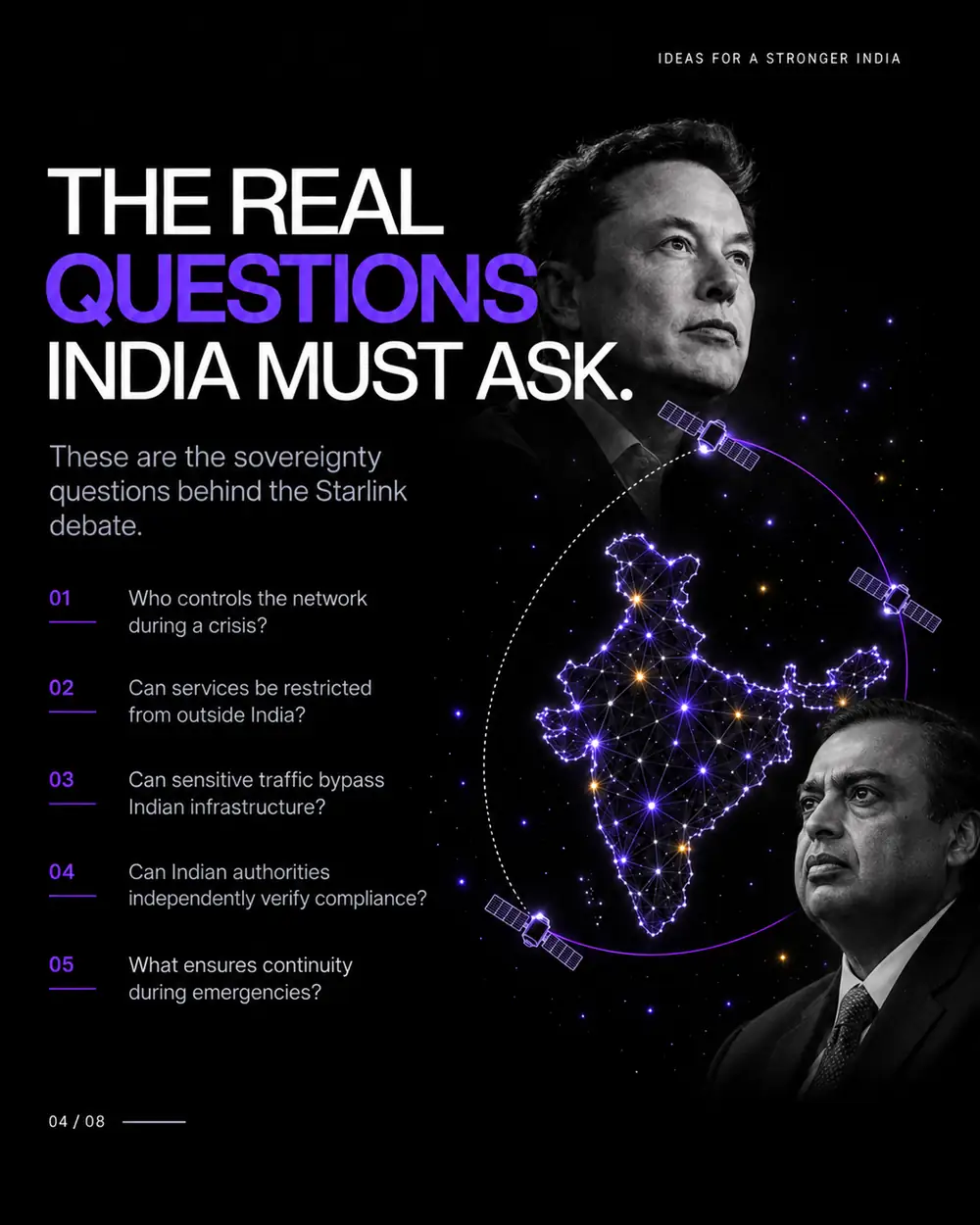
Four areas deserve close examination.
Operational control and service continuity
A satellite constellation depends on infrastructure controlled by its operator.
Even where national licensing conditions apply, governments may lack the technical ability to guarantee continued operation during a crisis.
Contracts and regulatory obligations can create enforceable legal responsibilities, but they are not substitutes for independent operational resilience.
Traffic routing and data governance
Satellite networks may use gateways and links between spacecraft to move communications across geographical boundaries.
Authorities must understand how sensitive traffic is handled, where it is routed and which entities can access relevant operational information.
Indian requirements can impose restrictions, but the ability to verify technical compliance independently remains important.
Emergency access and network restrictions
Governments may require satellite operators to support lawful restrictions, emergency communications and national security coordination.
Such requirements must be clearly defined, independently governed and compatible with applicable rights and data-protection safeguards.
Dependence on foreign-controlled infrastructure
A foreign-owned constellation may remain subject to decisions, laws and strategic interests outside India.
The risk is not unique to Starlink. It can arise wherever critical services depend on infrastructure that a country cannot adequately monitor, diversify or replace.
An April 2026 study by the Takshashila Institution examined these concerns in detail.
The study highlighted limitations in independently verifying compliance with some satellite network requirements and recommended strengthening domestic connectivity, monitoring infrastructure and provider diversification.
Its recommendations represent a policy assessment, not proof of misconduct by Starlink.
The practical lesson is that national security cannot depend exclusively on the promises of an operator.
It must also be supported by technical resilience, independent oversight, workable regulation and alternative connectivity options.
The Ukraine example: when privately operated connectivity becomes strategically important
The war in Ukraine exposed the growing military and strategic significance of commercial satellite networks.
Starlink provided important communications capabilities during periods when terrestrial infrastructure was damaged or disrupted.
But the conflict also raised questions about who ultimately controls services that become essential to national operations.
In July 2025, Reuters reported allegations that restrictions on Starlink coverage during a Ukrainian counteroffensive in 2022 disrupted military communications.
SpaceX disputed aspects of the account.
The episode should not be treated as proof of wrongdoing in India. It does, however, illustrate the consequences of relying on privately operated communications infrastructure during geopolitical crises.
For India, the central question is not whether all foreign providers should be excluded.
It is whether essential communications can continue when individual providers, infrastructure systems or supply chains become unavailable.
That is an argument for redundancy and independent capability, not technological isolation.
WCRC Intelligence and analysis: what the Starlink challenge means for Mukesh Ambani’s leadership
The Starlink controversy presents a distinctive test of industrial leadership.
Mukesh Ambani has previously demonstrated the ability to transform an established market through large-scale investment, infrastructure development and aggressive execution.
But space communications will test a different set of leadership capabilities.
The first is technological depth. Reliance must determine whether it can progress beyond operating and distributing communications networks towards building proprietary expertise in the underlying space systems.
The second is industrial ecosystem creation. No single corporate group is likely to develop every satellite component, semiconductor, payload, propulsion system and advanced communications application internally. Reliance’s ability to work with innovative Indian companies could prove strategically important.
The third is competitive adaptability. Starlink may be a competitor in one market, a technology supplier in another and a distribution partner in a third. Managing these overlapping relationships requires disciplined strategic thinking rather than a conventional defensive response.
The fourth is capital allocation. Satellite constellations demand significant upfront investment, complex risk management and long-term financial commitments. Reliance must establish whether the economics of its proposed satellite network can justify the capital required.
The fifth is national and international relevance. A truly consequential Indian satellite enterprise should eventually compete beyond the domestic market, supplying products and services to customers across multiple countries.
These dimensions collectively represent a broader leadership transition: from scaling connectivity services to developing the industrial capacity behind connectivity itself.
For Ambani, the opportunity is to extend Jio’s legacy into a field where national capability, commercial opportunity and advanced engineering intersect.
But success will depend on execution rather than corporate size or public positioning.
The five indigenous technology capabilities India should build
The opportunity extends far beyond Reliance.
India should develop an industrial ecosystem that combines public research, private investment, advanced manufacturing, domestic demand and international technological partnerships.
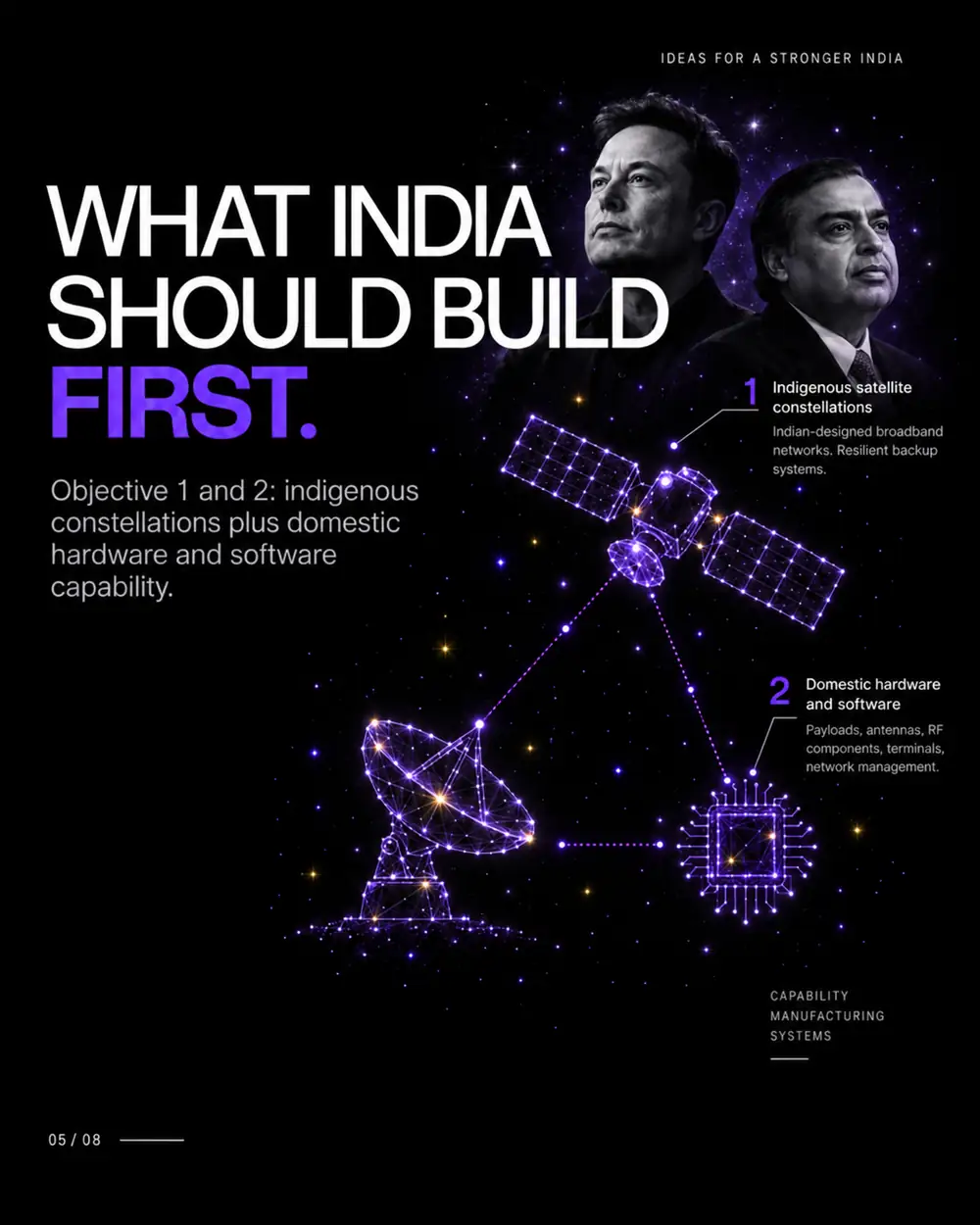
1. Indian-designed satellite constellations
India needs greater capacity to design, manufacture, launch and operate low-Earth-orbit broadband satellites.
That includes communication payloads, power systems, precision manufacturing, propulsion, orbital software and constellation management.
Domestic ownership of important technologies can increase supply-chain resilience and bargaining power.
2. Satellite chips, antennas and ground equipment
Phased-array antennas, radio-frequency semiconductor components, affordable user terminals and advanced ground stations represent substantial commercial opportunities.
India could develop domestic manufacturing platforms capable of supplying both Indian satellite networks and international customers.
This would require long-term investment in design capabilities, testing infrastructure and competitive production economics.
3. Direct-to-device satellite communication
India should develop technologies that allow compatible mobile devices to communicate with satellites, particularly for emergency messaging and connectivity in underserved regions.
This will require collaboration among telecom operators, semiconductor developers, satellite manufacturers and regulatory institutions.
Indian 5G and future 6G development should account for non-terrestrial networks, while NavIC can contribute relevant navigation and timing capabilities.
4. A scalable private space industry
India needs globally competitive capacity across satellite manufacturing, launch services, advanced propulsion, software and ground infrastructure.
The opportunity is already emerging.
According to an August 2026 Government of India factsheet, the number of registered Indian space startups had increased to approximately 440.
The challenge is converting this ecosystem into sustained production, reliable customer contracts and globally competitive technology exports.
5. An integrated and resilient national communications network
India’s strategic infrastructure should combine fibre, terrestrial mobile networks, satellite communications, cloud platforms and cybersecurity.
The priority is not merely more coverage.
It is continuity, interoperability, security and the capacity to recover when part of the system fails.
An effective national architecture would distribute critical functions across multiple systems and providers rather than concentrate dependence in one network.
Why the next great Indian space enterprise must be bigger than Reliance
Reliance can help anchor India’s satellite communications ecosystem, but no single company should define it.
ISRO brings decades of engineering expertise, mission experience and technological research.
IN-SPACe provides an institutional pathway for private participation in India’s space sector.
Indian industrial manufacturers, research institutions, telecom operators and startups are developing specialised capabilities across electronics, propulsion, communications systems, satellites and launch technologies.
These organisations can collectively create a more competitive technology ecosystem.
The commercial opportunities extend beyond the Indian broadband market.
Indian enterprises could eventually supply satellites, subsystems, user terminals, cybersecurity software, ground equipment and integrated communications solutions to international customers.
This requires an important shift in ambition.
India should not define self-reliance as the absence of foreign technology.
It should define it through genuine domestic capability, diversified supply chains, technical competence and the ability to make independent decisions when strategic circumstances demand them.
Such an approach also benefits from competition.
Foreign companies can bring technologies, investment and international experience. Indian firms must have the opportunity, and the responsibility, to improve their products and economics in response.
A strong domestic industry should ultimately be capable of competing because of its innovation and efficiency, not because rivals have been artificially excluded.
The competitive balance: why India needs both open markets and sovereign capability
Satellite internet could deliver meaningful benefits for India.
Rural communities, islands, mountainous areas, remote industrial facilities and emergency-response operations may gain new connectivity options.
But demand will depend on affordability, service quality, terminal prices, reliability and the practical availability of terrestrial alternatives.

Satellite broadband will not necessarily be the most economical solution for every Indian household.
Terrestrial fibre and mobile networks remain essential, particularly in densely populated areas.
A sound national strategy should therefore focus on using the appropriate technologies for different needs rather than assuming any one network can replace all others.
Competition should be encouraged through transparent spectrum policies, consistent security requirements and regulatory certainty.
At the same time, governments and companies should invest in infrastructure that reduces concentration risk.
The objective is not to protect Reliance from Starlink.
It is to ensure that Indian users, businesses and institutions are not dependent on one provider for services whose interruption could have major consequences.
This principle applies equally to foreign corporations and Indian incumbents.
What should Mukesh Ambani do next?
Reliance’s strategic response could focus on three interconnected priorities.
First, the group needs to translate its satellite ambitions into a credible operational roadmap, with measurable technology milestones, commercial use cases and disciplined capital commitments.
Second, Reliance can use its existing telecommunications infrastructure and customer ecosystem to create demand for satellite services while building deeper Indian technical and manufacturing capabilities.
Third, it can encourage specialised Indian technology companies to participate in the broader satellite value chain, helping create an industrial ecosystem rather than simply another vertically integrated service provider.
The leadership challenge is to balance near-term commercial opportunity with long-term technological development.
Starlink’s advantage lies in its existing scale, integration and accumulated operational experience.
Reliance’s advantage lies in its domestic distribution, existing network, customer relationships, financial capabilities and knowledge of Indian market conditions.
Those strengths are not identical.
The opportunity is to build a complementary but competitive operating model suited to India’s geography, infrastructure, industrial ecosystem and security priorities.
WCRC leadership perspective: the next Jio revolution could begin in space
Great industrial leadership is often defined by recognising when an existing business model is approaching its next transformation.
Mukesh Ambani recognised the extraordinary economic possibilities of widespread mobile data connectivity.
Elon Musk recognised that reusable launch technology, satellite manufacturing and network integration could make space-based communications commercially scalable.
Both achievements demonstrate the importance of combining technology with an industrial system capable of operating at scale.
The next chapter will test whether established telecommunications leaders can adapt quickly enough as space infrastructure becomes a more central part of the global digital economy.
For Reliance, the challenge is not to prevent technological disruption.
It is to participate in shaping it.
For India, the opportunity is to develop world-class companies that contribute to global communications technology while preserving national security, consumer choice and infrastructure resilience.
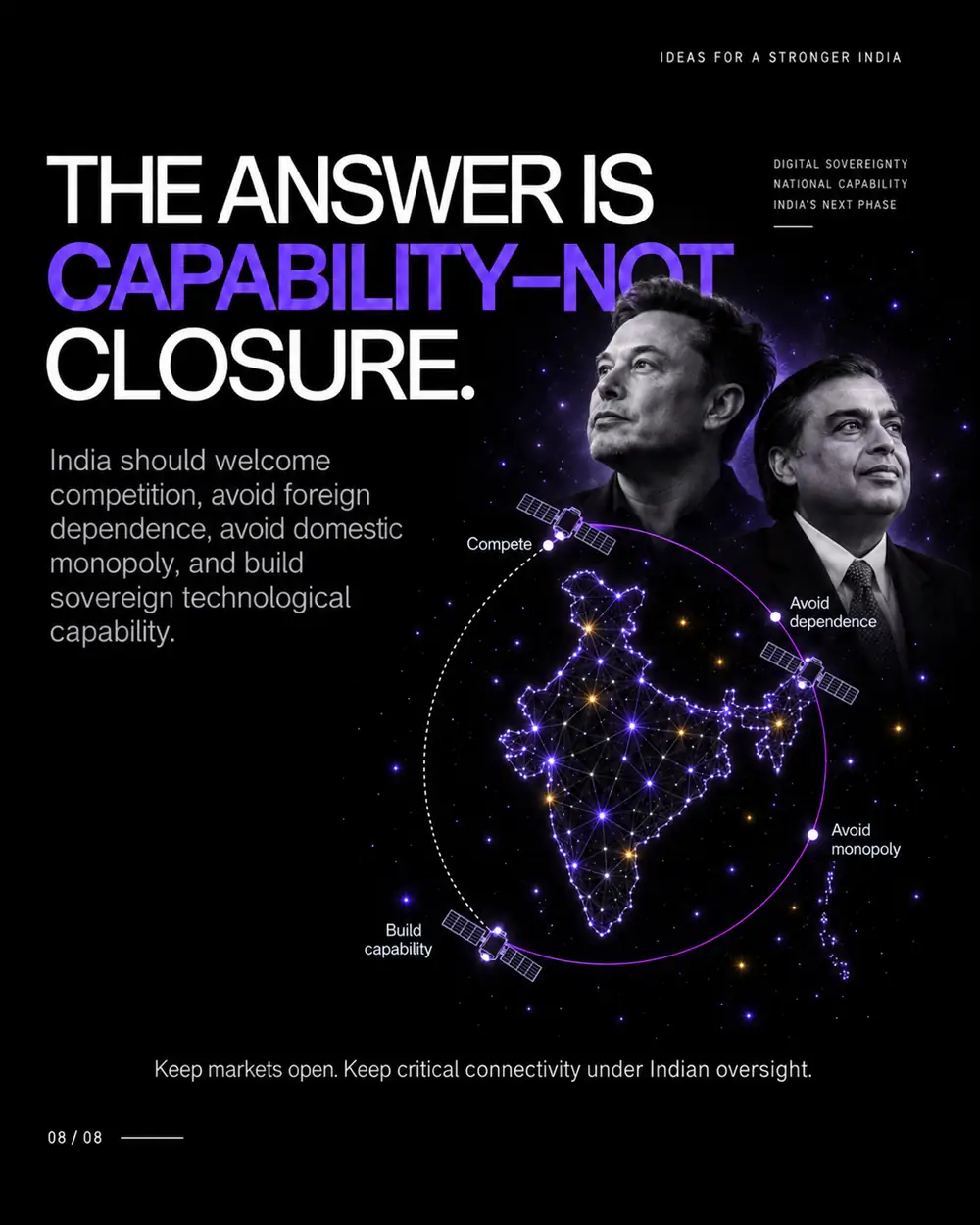
The strongest response to Starlink is neither fear nor exclusion. It is the capacity to compete, collaborate where appropriate, and build technologies India can independently operate and improve.
India’s markets can remain open.
Its digital infrastructure can remain subject to enforceable Indian oversight.
And its industrial ambitions can extend well beyond its borders.
The question is whether this moment becomes another confrontation over market access, or the beginning of an Indian satellite communications industry capable of competing with the world.
That will ultimately be a more meaningful measure of leadership than the outcome of any dispute between two billionaires.
Frequently asked questions
Why are Elon Musk and Mukesh Ambani in a dispute over Starlink in India?
Elon Musk publicly criticised delays to Starlink’s commercial launch in India and suggested that Mukesh Ambani was exerting influence to obstruct competition. India rejected the allegations, and no public evidence establishing improper interference by Ambani was presented in the October 9 Reuters report. The wider dispute involves satellite market access, competition and regulatory compliance.
Is Starlink allowed to operate in India in October 2026?
Starlink has received a licence, but its commercial launch remains subject to security compliance requirements and spectrum assignment. Other licensed satellite communications providers are also subject to regulatory conditions.
Is Reliance Jio developing its own satellite internet network?
Yes. Reliance Jio showcased a proposed low-Earth-orbit constellation of approximately 1,600 satellites and 23 Indian ground stations at India Mobile Congress 2026. This remains a proposed network, not a fully deployed operational constellation.
Did Reliance Jio partner with Starlink?
Yes. Reliance Jio announced a distribution agreement with SpaceX in March 2025 to offer Starlink broadband services in India, subject to regulatory approvals. This commercial relationship exists alongside their broader competitive interests.
Why does Starlink raise national security concerns for India?
The principal potential risks concern operational control, traffic routing, data governance, regulatory verification and the continuity of critical communications during emergencies. These risks are associated with dependence on foreign-controlled infrastructure; they are not proof of espionage or misconduct by Starlink in India.
Can Starlink replace Reliance Jio’s 5G network?
Satellite internet can complement terrestrial networks, particularly in remote and underserved regions. Emerging direct-to-device technology may increase overlap with conventional mobile services. However, satellite capacity, spectrum, cost and technical limitations mean it should not currently be assumed that Starlink can replace dense terrestrial 5G networks at scale.
What technologies should India develop to compete in satellite communications?
India should expand indigenous capabilities in low-Earth-orbit satellite constellations, radio-frequency semiconductors, phased-array antennas, ground stations, direct-to-device communications, launch systems, network-management software and cybersecurity.
What is the leadership opportunity for Mukesh Ambani?
Mukesh Ambani’s opportunity is to extend Reliance’s digital infrastructure capabilities into a commercially competitive satellite communications ecosystem. Success would require technological depth, partnerships, capital discipline, domestic manufacturing capability and international competitiveness.
Editorial sources and evidence
- Reuters, 9 October 2026 — India rejects Musk’s allegations against Ambani
- Mint, 8 October 2026 — Jio’s proposed 1,600-satellite network
- Reliance Industries, 12 March 2025 — Jio and SpaceX agreement
- Reuters, 9 October 2026 — SpaceX’s low-band spectrum expansion
- Takshashila Institution, April 2026 — Starlink and Risks for India
- Reuters, July 2025 — Investigation into Starlink operations in Ukraine
- Reliance Industries — Q1 FY2026–27 results
- Government of India, August 2026 — Strengthening India’s Space Sovereignty
Editorial note: this article is WCRC Leaders’ independent strategic analysis based on publicly available reporting and institutional sources. Forward-looking industry assessments are analytical interpretations, not guarantees or announcements of operational capability. The article does not imply an interview with Mukesh Ambani, Elon Musk or their organisations.
Filed under