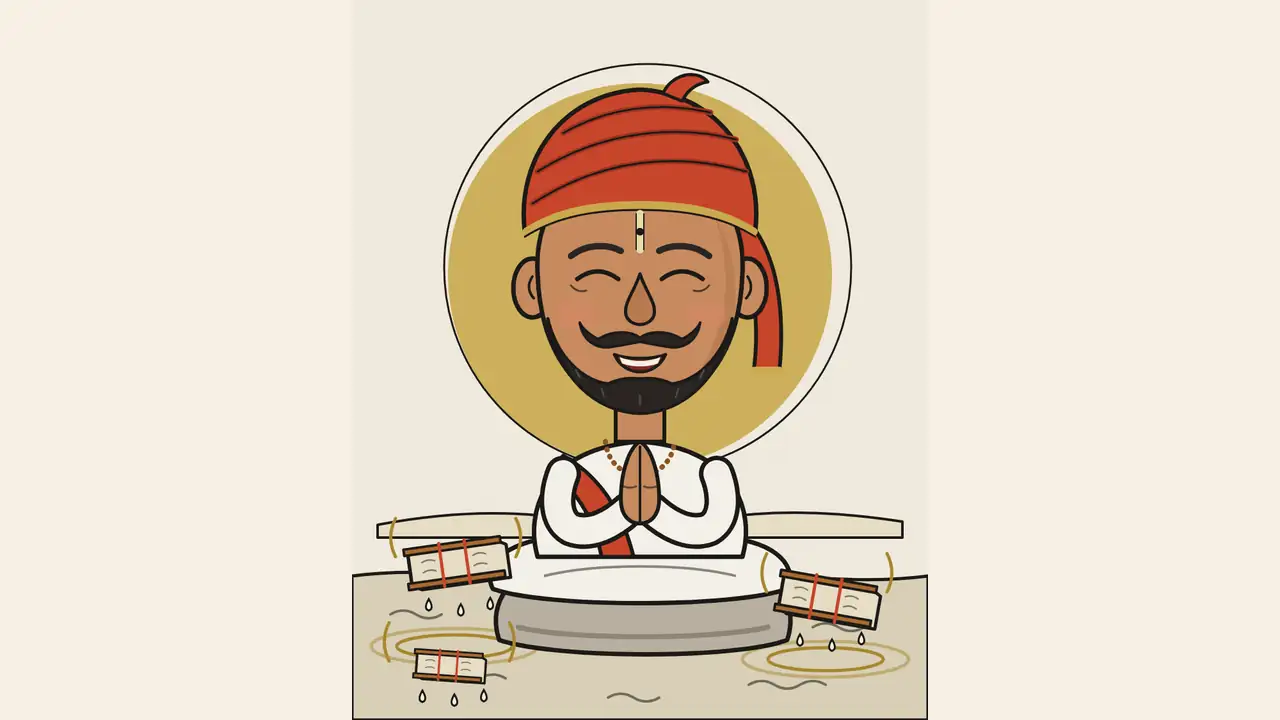
Original illustration drawn for WCRC. © Abhimanyu Ghosh & WCRC.
Spirituality · The Bhakti Saints · No. 11 of 27
Sant Tukaram, the failed grain trader whose songs would not stay underwater
A Dehu shopkeeper lost his business in a famine and saw his life's work thrown into a river. How he answered is the most useful lesson in this series for any leader whose work has just been rejected.
WCRC Consulting · Strategy into execution
Implement these strategies inside your organisation
Deep analysis of where your organisation stands and a strategic implementation of The WCRC Indrayani Resilience Model, built for your leadership team, culture and business.
Models created exclusively by Abhimanyu Ghosh; proprietary to Abhimanyu Ghosh and WCRC. WCRC's consulting service is not connected with, or endorsed by, any teacher, tradition or organisation discussed here.
Dates
c. 1608 – c. 1650
Region
Dehu, Pune district, Maharashtra
Tradition
Bhakti
WCRC model
WCRC-GLC-11
The model in one line
When your work is sunk, hold steady and let it resurface.
The WCRC Indrayani Resilience Model™ · anchored in जे का रंजले गांजले । त्यासि म्हणे जो आपुले ... तोचि साधु ओळखावा । देव तेथेचि जाणावा (Whoever calls the troubled and oppressed his own, know him as a true saint; know that God is right there), Tukaram Gatha, abhang 204
A grain shop in Dehu, a famine and a second life
Sant Tukaram was born, by Britannica's reckoning, around 1608 in Dehu, a village on the Indrayani river near Pune. Other years have been proposed, among them 1568, 1577 and 1598, and no one can settle the matter. What is not in doubt is the household he came from: grain traders and farmers of the Kunbi-Maratha community, devoted to Vitthal of Pandharpur for generations.
He was still in his teens when his parents died and the shop and the household became his to run. Then, around 1629 and 1630, a severe famine struck the Deccan. His first wife, Rakhumabai, died, and so did a son. The business failed. A young man who had been raised to trade grain found his trade gone.
Plenty of people break at that point. Tukaram changed direction. Through the 1630s he turned away from commerce, studied the saints who had come before him and spent long stretches meditating on Bhandara hill near Dehu. Tradition says he received initiation in a dream from a teacher named Babaji Chaitanya, also called Raghava Chaitanya, who gave him the name-mantra "Rama Krishna Hari". In another dream, devotees recount, the saint Namdev and Vitthal himself asked him to compose.
He did. His abhangs, short devotional songs in everyday Marathi, spread through his kirtans among ordinary people. The collected Tukaram Gatha holds somewhere between 4,000 and 4,600 of them; a government edition of 1873 printed 4,607. He is counted as heir to Jnaneshwar, Namdev and Eknath, and his disciple Bahinabai became a poet-saint in her own right.
His end is remembered differently by different people. Varkari devotees hold that around 1650 he departed from Dehu bodily for Vaikuntha, and they keep the day as Tukaram Beej. Other accounts exist, and historians have not resolved them. This chapter takes the devotional account as what it is: a belief held with great love, and the reason there is no samadhi shrine to visit.
The troubled are his own: what Tukaram asks of people in charge
Most of Tukaram's teaching is about devotion, and a leadership book should be careful about borrowing it. Three of his ideas, though, speak directly to anyone who holds power over other people's work and livelihoods.
जे का रंजले गांजले । त्यासि म्हणे जो आपुले ... तोचि साधु ओळखावा । देव तेथेचि जाणावा (Whoever calls the troubled and oppressed his own, know him as a true saint; know that God is right there.)
Sant Tukaram, Tukaram Gatha, abhang 204 (Warkari Rojnishi edition); English rendering prepared for this series
The first is in that abhang. Holiness, for Tukaram, is located in a specific act: claiming the suffering person as your own. The test is relational and practical. It asks where you stand when someone is hurt, and whether you treat their trouble as yours or as theirs.
The second is a line the Prime Minister quoted at Dehu in 2022: "उंच नीच काही नेणे भगवंत", God knows nothing of high and low. Tukaram taught that God does not see caste or status, and that before God only devotion counts. He said this as a man who had himself been told he had no right to interpret scripture. In an organisation, the equivalent claim is uncomfortable and simple. The care a person receives in a bad moment should not depend on their grade.
The third idea is quieter, and it makes room for ordinary life. Scholars who summarise his teaching, Sadanand More among them, describe a householder's life lived truthfully and kindly as itself a form of bhakti. He also taught that the name of God, sung with love in your own language, is enough, with no costly ritual required. Both ideas strip away ceremony and leave conduct. A leader who absorbs this stops looking for the grand gesture and starts paying attention to daily behaviour.
Thirteen days on a stone by the Indrayani
The story devotees tell most often is the one about his notebooks. Devotees recount that a learned man objected to a non-Brahmin explaining scripture, and that Tukaram was made to sink his abhang notebooks in the Indrayani. Years of work went under the water.
His response, as devotees tell it, was to sit on a stone at Dehu, fasting and praying, for thirteen days. Tradition holds that at the end of that time the notebooks floated up unharmed.
Readers will take the resurfacing as they choose. The behaviour around it needs no miracle to be instructive. A man whose life's work had been publicly rejected by people with more social authority than he had chose to absorb the loss, stay where he was and keep faith with the work. Nothing in the story has him attacking his critics or rewriting the songs to please them. His tradition also remembers that the work had people who kept it: Santaji Jagnade is named as one who preserved his abhangs.
The stone is still there. Varkaris bow to it before they set out on the walk to Pandharpur, and on 14 June 2022 the Shila Mandir built around it at Dehu was dedicated by the Prime Minister. It is unusual for a place of pilgrimage to honour the low point of a life. This one does. The opposition he faced came from some orthodox voices of his own time, and the lesson belongs to everyone, whatever community they come from.
When a machine makes your craft look cheap
Tukaram's notebooks were sunk by human critics. The next wave of devalued work will often be sunk by a price change. When software can produce a draft, a design or an analysis at a fraction of the old cost, years of hard-won skill can look worthless in a single budget meeting.
The economists Acemoglu and Restrepo argued in 2019 that automation "always reduces the labor share in value added and may reduce labor demand even as it raises productivity". The World Economic Forum's Future of Jobs Report 2025 says workers can expect that two-fifths (39%) of their existing skill sets will be transformed or become outdated over the 2025 to 2030 period. Behind both numbers are teams who will watch work they were proud of being shelved or cut.
How a leader behaves in that moment matters more than the restructuring slide. Heifetz and Laurie, writing in Harvard Business Review, list regulating distress and protecting voices of leadership from below among the principles of adaptive work. Tukaram's refusal to rank people before God reads very close to the second of those. If the people closest to the work are the ones with the least status, their view of what is worth saving is easily lost.
There is also a harder point. Some work will not resurface, and pretending otherwise is unkind. The Tukaram stance does not promise vindication. It asks the leader to keep the record honest, keep the people close and keep sound work ready, so that whatever does deserve to come back has somewhere to come back from.
The WCRC Indrayani Resilience Model
Created by Abhimanyu Ghosh · A proprietary model of Abhimanyu Ghosh and WCRC
WCRC calls this the Indrayani Resilience Model. It takes its name from the river that swallowed Tukaram's notebooks and, as tradition holds, gave them back. The curve in the diagram above traces the shape: work is offered, work is sunk, the leader holds steady, the work resurfaces and trust is restored. The five building blocks below are the behaviours that keep the bottom of that curve from becoming permanent: absorb the rejection, hold integrity, stay close to those who suffer, give no weight to high and low, and let the work resurface. It is a model for the weeks after a no, and it scores highest on stakeholder trust and resilience.
The Indrayani Resilience Model is a playbook for dignified resilience when work is rejected or devalued. The leader absorbs the blow without bitterness, keeps integrity intact and stays close to the people who are suffering, while the quality of the work makes its case over time. Rank and status carry no weight in deciding who deserves care.
Fig. 1The WCRC Indrayani Resilience Model™
© Abhimanyu Ghosh & WCRC
The building blocks
01Absorb the rejection
Take the loss fully and without denial, and resist the urge to strike back.
In practiceAfter a major rejection, the CEO holds the public response and meets the affected team in person first.
02Hold integrity
Stay true to the work and to your own conduct, with no bitterness towards critics.
In practiceThe leader refuses shortcuts or attacks on critics to regain favour, and records honestly what was right and wrong in the work.
03Stay close to those who sufferJe ka ranjale ganjale
Treat the troubled and oppressed as your own; that is where the leader belongs during a setback.
In practiceWhen cuts or rejections land, the leader spends time with the most affected people and funds their recovery.
04No high and lowUnch nich
Care and voice do not depend on rank or status.
In practiceRecovery plans take input from every level, and frontline people get the same hearing as senior ones.
05Let the work resurface
Sound work proves itself in time if it is kept and kept ready; tradition holds that Santaji Jagnade preserved Tukaram's abhangs.
In practiceRejected work is documented and preserved, and brought back when conditions change.
The week after the board says no
Picture a CEO whose flagship programme has just been cancelled by the board, or whose product has been publicly panned, or whose division has been told to cut a third of its people. The instinct in that first week is to defend: brief the press, call the friendly analyst, explain why the critics are wrong. The Indrayani model asks for the opposite sequence. Go to the people who built the work first, in person, and say nothing outside until you have.
That is a decision about order, and it is harder than it sounds. The operating model below sets it out as a protocol. As a personal habit, it means noticing the moment you reach for your phone to defend yourself and asking whether the team has heard from you yet.
The second demand is on temper. Tukaram sat on the stone, and the story gives him no words of anger for the men who sank his books. A CEO under attack will be tempted to cut a corner to win back favour, or to discredit a critic. The model treats both as failures of integrity, even when they work. Write down honestly what was right and wrong in the rejected work, including the strongest criticism you received. That record protects you from self-pity and from self-righteousness at the same time.
The blind spot is endurance. Leaders who admire this story sometimes conclude that they should absorb every blow alone. The model's failure modes name it plainly: the leader wears out with no one sharing the load. Tukaram, tradition says, had Santaji Jagnade. You need a few people around you who are allowed to carry part of the weight, and who will tell you when holding steady has turned into waiting for the world to admit it was wrong.
A rejected pitch is a river, too
Founders meet the Indrayani more often than anyone. A term sheet withdrawn, a pilot customer gone, a launch that lands to silence: in a small company each of these can feel like the notebooks going under.
The model is unusually practical at this scale. On the day the rejection lands, meet the whole team, before you post anything. Keep one shared folder of shelved work with an honest note on each item: what it was, why it was turned down, what you would change. Many founders throw this material away out of embarrassment. In two years some of it may be exactly what a different market wants.
Watch who gets heard in the recovery. In a ten-person start-up the newest engineer or the support lead often knows most clearly what customers actually valued in the rejected product. Tukaram's line about high and low applies with special force when there are only a handful of people and the founder's voice drowns the others without meaning to.
A founder should also be honest about the family cost. Tukaram's own crisis began with famine and bereavement before it became a story about songs. Founders carry setbacks home. Telling the people at home what has happened, and asking for help, belongs to holding steady.
What a board should ask after the cut
In a large company, setbacks are distributed. A product line is closed in one country, a research programme is defunded in another, a plant is sold. The people affected are often far from head office, and the first they hear is a press release. The Indrayani model asks group leadership to reverse that pattern across every unit, so that people hit by a decision hear about it from a senior leader in person.
Boards have a specific role here. They approve the cuts, so they should ask how the people who carried them were treated. Three questions do most of the work. How many days passed between the announcement and a senior leader meeting the affected teams? How many of the people we wanted to keep left in the next six months? What happened to the work we shelved, and has anyone looked at it since?
The model's KPIs are built around those questions, and the trust measure draws on Mayer, Davis and Schoorman's well-known account of what makes a party trustworthy: ability, benevolence and integrity. A board that sees trust hold through a hard year has evidence that its leaders did more than survive.
The risk at this scale is theatre. A tour of affected sites, photographed and then forgotten, does more damage than no visit at all. The test is whether frontline suggestions made during those visits were adopted, and whether people were told plainly why others were not.
The business model
Inside a company, the model runs on three inputs that most organisations already have and rarely use well: work that has been rejected or cut, an honest record of its quality, and the people who were hurt by the decision. The practices turn those into something useful. Leaders pause before any outside response, spend their time with the affected teams, hear every level equally in the recovery, and preserve rejected work for later. The outputs are a composed public response, retained talent and an archive of reusable work, and over time the company earns a reputation for keeping its integrity under pressure.
Fig. 2Operating model: running the WCRC Indrayani Resilience Model
© Abhimanyu Ghosh & WCRC
Inputs
What the company commits
- Work rejected, devalued or cut
- An honest record of the work's quality
- People hurt by the setback
Practices
What leaders do, repeatedly
- Pause, then respond without blaming critics
- Spend leadership time with affected people
- Hear every level equally in recovery
- Preserve rejected work for later revival
Outputs
What changes in the work
- A composed public response
- Key people retained
- An archive of reusable work
Outcomes
What the enterprise gains
- Trust that survives the setback
- Faster recovery when conditions turn
- Reputation for integrity under pressure
The benefit model
The people who gain most from this model are those with the least protection when work is lost: junior staff, frontline teams and people whose skills a new technology has just made cheaper. They learn that leaders will stand beside them whatever their rank. The leader gains too, by coming through a rejection without carrying bitterness into the next decision. Customers deal with a firm that does not cut corners to recover, and investors see setbacks handled calmly, with valuable work preserved so recovery does not start from zero.
Fig. 3Benefit model: who gains what
© Abhimanyu Ghosh & WCRC
The leader
The leader comes through rejection with credibility intact and without carrying bitterness into the next decision.
Employees
People see that leaders stand beside them when work is lost, whatever their rank.
Customers
Customers deal with a company that keeps its standards when under attack and does not cut corners to recover.
Investors
Setbacks are handled calmly and valuable work is preserved, so recovery does not start from zero.
Society
The model shows that people whose work is devalued can respond with dignity, and that care should not follow status.
Fig. 4Where the model moves the needle
© Abhimanyu Ghosh & WCRC
- Vision Quotient
- ●●●●●
- Impact Index
- ●●●●●
- Innovation Score
- ●●●●●
- People Leadership
- ●●●●●
- Stakeholder Trust
- ●●●●●
- Resilience Factor
- ●●●●●
- Global Mindset
- ●●●●●
How to implement the WCRC Indrayani Resilience Model
Your first move
Pick the most recent piece of work that was rejected or cut, meet the people who built it in person, and ask what they need before saying anything in public.
If you are the founder or CEO
- 1
Hold the public response
When a major rejection lands, wait before any outside statement and meet the affected team face to face first, within the same week. In a small company that is the whole team; in a large one it is the unit that carried the loss.
- 2
Write an honest record
Within a fortnight of the setback, write down plainly what was right and wrong in the work, with no blame for critics. Share it with the core team and keep it on file.
- 3
Refuse shortcuts to regain favour
Each time pressure builds to win back approval with a cut corner or an attack on a critic, say no and explain why to the people around you. Hold integrity as a personal rule, not a team policy.
- 4
Sit with the most affected
Block time every week during a setback to be with the people hit hardest, at whatever rank, and fund what they need to recover. A founder does this directly; a group CEO visits the worst-hit sites in person.
- 5
Revisit shelved work quarterly
Once a quarter, review the archive of rejected work with the relevant heads and ask whether conditions have changed enough to bring any of it back. Let the work resurface on its merit.
Rolling it out across the company
| Step | Owner | What the company puts in place |
|---|---|---|
| 01Map recent setbacks and fallout | CEO office with CHRO | List the rejections, cuts and devalued projects of the past year and check who left, how fast leaders reached those affected and what was kept. This sets the baseline for regretted attrition and time to leadership contact. |
| 02Pilot on the next setback | Head of the affected business unit | Run the full sequence on the next real setback in one unit: absorb the rejection, hold integrity, stay close to those who suffer, hear every level, archive the work. Review what held and what did not within 30 days. |
| 03Write a setback protocol | CEO office and communications | Make it policy that after a major rejection a senior leader meets the affected teams before any public response, and that recovery plans collect input from every level. Add an archive step so rejected work is documented and stored for revival. |
| 04Train managers in equal hearing | CHRO and all people managers | Teach managers to run recovery sessions where frontline people get the same hearing as senior ones, and to respond to valid criticism without self-righteousness. Use real past setbacks as the case material. |
| 05Track the five setback KPIs | CHRO with finance | Report regretted attrition after setbacks, time to leadership contact, frontline voice in recovery, revival of shelved work and the trust survey after each major event. Review them with the leadership team every quarter. |
| 06Scale and guard against passivity | CEO and board | Extend the protocol to every unit once the pilot shows retention and trust holding, and check each year that holding steady has not become waiting for vindication. Make sure the load is shared so no single leader absorbs every blow. |
The execution roadmap
Four phases, each closed by a gate. Do not move on until the gate is met.
Days 0–30
Phase 1 · Diagnose and commit
Find out how the company has treated people and work after recent setbacks, and commit the leadership team to a different response.
- List every rejection, cut and devalued project of the past year, and record who left afterwards and how many days passed before a senior leader met the affected team.
- Run the trust survey on leaders' ability, benevolence and integrity now, so there is a pre-event reading before the next setback lands.
- Open the archive of rejected work: for each shelved project, write an honest record of what was right and wrong in it, with no blame for critics.
- Agree a one-page setback charter in the leadership team: absorb the rejection, meet the affected team before any public response, and never attack critics to regain favour.
Deliverable
A setback baseline covering the past year, the first entries in the archive of rejected work, and a signed setback charter.
Gate to proceed
Baseline recorded for all five KPIs, and every member of the leadership team has signed the setback charter.
Days 31–90
Phase 2 · Pilot and prove
Prove the full sequence on one real setback in one business unit.
- On the next rejection or cut in the pilot unit, the unit head meets the affected team in person before any outside statement is made.
- Run a recovery session under the 'No high and low' rule, logging every suggestion by the level it came from and which ones are adopted.
- The unit head blocks weekly time with the people hit hardest and funds what they need to recover, to stay close to those who suffer.
- Within a fortnight, write the honest record of the work that was sunk and file it in the archive so it can resurface later.
Deliverable
A pilot review covering what held and what did not, with the honest record, the suggestion log and the archive entry attached.
Gate to proceed
In the pilot setback, leadership contact came before any public response, frontline suggestions were logged and some adopted, and regretted attrition in the pilot team is no worse than the baseline.
Days 91–180
Phase 3 · Embed and scale
Make the setback protocol the standard way every unit responds to rejection.
- Write the setback protocol into policy: a senior leader meets the affected teams before any public response, and recovery plans take input from every level.
- Train all people managers in equal hearing, using the company's own past setbacks as case material.
- Start a quarterly review of the archive with the relevant heads, so shelved work has an owner and a decision date.
- Set up a rota so that no single leader absorbs every blow, and the load of staying close to affected teams is shared.
Deliverable
An approved setback protocol, a trained manager group and an archive register with an owner for each item.
Gate to proceed
Every unit has either handled a real setback under the protocol or rehearsed it on a past case, and time to leadership contact is reported for each unit.
Month 7 onwards
Phase 4 · Sustain and renew
Keep resilience honest over years, so holding steady never turns into waiting for vindication.
- Once a year, check each archived item: is the work being improved, or only waiting for critics to change their minds?
- Track revival of shelved work over a two to three year horizon and report it with the other setback KPIs.
- Repeat the trust survey after every major setback and compare it with the reading taken before.
- Rotate the setback lead role so the practice does not depend on one person's temperament.
Deliverable
An annual resilience review to the board covering the five setback KPIs and the state of the archive.
Gate to proceed
Trust after setbacks holds at or above the pre-event reading, and every archived item has had a revive, rework or close decision within the year.
Governance
- Sponsor
- The CEO, because the model depends on the most senior person holding back the public response and being seen with the people who carried the loss.
- Lead
- The CHRO, who owns the setback protocol, the archive register and the five KPIs.
- Review forum
- The leadership meeting reviews any active setback every month and the archive every quarter; the board receives an annual resilience review.
- Decision rights
- The lead can trigger the protocol, convene recovery sessions and add work to the archive; any public statement, recovery funding or decision to revive shelved work goes to the sponsor.
Operating rhythm
- WeeklyDuring any active setback, the responsible leader spends time with the most affected team and records what they asked for.
- MonthlyRecovery sessions report which frontline suggestions were adopted and which were declined, with reasons given back to the people who made them.
- QuarterlyThe archive review: heads go through shelved work and decide whether conditions have changed enough to bring any of it back.
- AnnuallyThe passivity check and trust comparison: archived items are tested for real improvement, and survey readings before and after each setback are compared.
Implementation risks and how to handle them
| Risk | Early warning | Mitigation |
|---|---|---|
| Leaders speak to the press or investors before meeting the team, because the urge to defend the work is strong. | Public statements are dated earlier than the first meeting with the affected team. | Communications sign-off requires written confirmation that the in-person meeting has already taken place. |
| Staff read leadership visits as theatre while cuts continue around them. | Pulse comments mention visits with no follow-through, and logged frontline suggestions show none adopted. | Publish which suggestions were adopted and why others were not, and fund the recovery items leaders promised in those visits. |
| Managers game regretted attrition by relabelling departures as unregretted after the event. | The share of exits classed as unregretted rises sharply after setbacks. | Fix who counts as a regretted loss in the talent review before any setback, and audit the labels afterwards. |
| Integrity hardens into self-righteousness, and valid criticism of the sunk work is dismissed. | Honest records list only what was right in the work, and critics' points are absent from recovery plans. | Require each honest record to state at least the strongest criticism received and the response to it, reviewed by someone outside the unit. |
By stage of company
Startup
Founder-led, under ~50 people
The founder meets the whole team the day a major pitch, deal or product is rejected, and keeps one shared folder of shelved work with a short honest note on each item. Recovery input comes from everyone in a single open meeting.
Scale-up
~50 to 1,000 people
The setback protocol is written down, the CHRO owns it, and managers are trained to run recovery sessions where every level gets the same hearing. The archive becomes a register with owners and a quarterly review.
Enterprise
Large or listed company
Every business unit runs the protocol, group leaders visit the worst-hit sites in person, and the trust survey runs before and after each major event. The board receives an annual resilience review and checks that no single leader is absorbing every setback.
Are you ready?
- Do our senior leaders meet the people hit by a setback before they speak to the outside world?
- Do we keep an honest written record of rejected work and the reasons it failed?
- Do frontline people get the same hearing as senior ones when we plan a recovery?
What success looks like at 12 months
- After a major rejection, affected teams hear from a senior leader in person before they read about it outside.
- Frontline people say their ideas shaped the recovery plan and can name ones that were adopted.
- Work shelved during a setback has been revived, reworked or deliberately closed, rather than forgotten in a folder.
Habits to start this quarter
- 1
Find your last sunk notebook
Before the month is out, name the most recent piece of your own work that was rejected, whether a proposal, a hire or a strategy. Write one honest paragraph on what was right and wrong in it, including the strongest criticism you heard. Keep it where you will see it again.
- 2
Delay your defence by a day
The next time your work is criticised in public or by your board, wait twenty-four hours before you reply to anyone outside the team. Use the time to speak to the people who did the work.
- 3
Give the junior voice the first word
In your next review of something that went wrong, ask the most junior person in the room to speak first, and do not respond until three people have spoken. Notice how often their view changes yours.
- 4
Keep a short list of the hardest-hit
During any setback this quarter, keep a written list of the five people most affected by it, at any level. Check each week whether you have spoken to each of them, and what they asked for.
- 5
Name the person who shares the load
Tell one colleague, explicitly, that you want them to share the weight of the next setback with you and to tell you when holding steady has become waiting to be proved right.
What to measure
| Leading indicator | How to measure it |
|---|---|
| Regretted attrition after setbacks | Departures of staff the company wanted to keep in the six months after a major rejection or cut, compared with the baseline. |
| Time to leadership contact | Days from a setback being announced to a senior leader meeting the most affected teams in person. |
| Frontline voice in recovery | Share of recovery-plan suggestions that came from non-managers, and share of those adopted. |
| Revival of shelved work | Share of archived projects or assets later reused or relaunched, tracked over two to three years. |
| Trust after setbacks | Survey items on leaders' ability, benevolence and integrity (Mayer, Davis and Schoorman), compared before and after the event. |
Where the model goes wrong
- Holding steady becomes passivity: waiting for vindication instead of improving the work.
- Integrity hardens into self-righteousness that dismisses criticism that is valid.
- The leader absorbs every blow alone and wears out, with no one sharing the load.
The stone is still there
WCRC's view is that the Indrayani model fits a decade in which more good work will be devalued than at any time in recent memory, by markets, by critics and by machines. Leaders cannot stop that. They can decide how they behave when it happens, and that behaviour is what their people will remember long after the decision itself is forgotten.
Tukaram's tradition chose to build a temple around the place where he sat in defeat. Leaders should take the hint. People judge you by where you sit when the work goes under.
Powerfacts
- Who was Sant Tukaram and why does he matter to leaders?
- Sant Tukaram was a 17th-century Varkari poet-saint from Dehu, near Pune, who wrote thousands of Marathi abhangs after losing his grain business in a famine. Devotees recount that critics made him sink his notebooks in the Indrayani river and that he sat fasting for 13 days until they resurfaced. His response, steady and without retaliation, is the basis of the WCRC Indrayani Resilience Model.
- What is the WCRC Indrayani Resilience Model?
- It is WCRC's model for leading after work has been rejected, cut or devalued. The leader absorbs the rejection, holds integrity, stays close to the people who suffer, gives every rank the same hearing and preserves sound work so it can resurface. It is drawn from Tukaram's abhang 204 and his teaching that God knows nothing of high and low.
- Why is the Indrayani model relevant as AI changes work?
- The World Economic Forum's Future of Jobs Report 2025 says workers can expect two-fifths (39%) of their existing skill sets to be transformed or become outdated over 2025 to 2030. Many teams will see work they valued lose its worth quickly. The model gives leaders a way to keep trust and talent through those losses.
Sources
- Tukaram, Encyclopaedia Britannica
- PM in Pune: About the Shila Mandir at Dehu, Press Information Bureau, Government of India
- PM's address at the inauguration of the Sant Tukaram Maharaj temple, Dehu, PMIndia
- Tukaram, New World Encyclopedia
- जे का रंजले गांजले, Dr Sadanand More
- Abhang 204 and 2376, Sartha Gatha, Warkari Rojnishi
- Automation and new tasks: How technology displaces and reinstates labor (Acemoglu and Restrepo, 2019), Journal of Economic Perspectives
- The Future of Jobs Report 2025, World Economic Forum
- The work of leadership (Heifetz and Laurie, 1997), Harvard Business Review
- An Integrative Model of Organizational Trust (Mayer, Davis and Schoorman, 1995), Academy of Management Review
Read Sant Tukaram's life and teachings on Gurushakti.
The WCRC Indrayani Resilience Model™ (WCRC-GLC-11) is part of The WCRC Guru Leadership Codex™. Created exclusively by Abhimanyu Ghosh; a proprietary model of Abhimanyu Ghosh and WCRC. © 2026 Abhimanyu Ghosh and World Centre for Research and Consulting. All rights reserved.