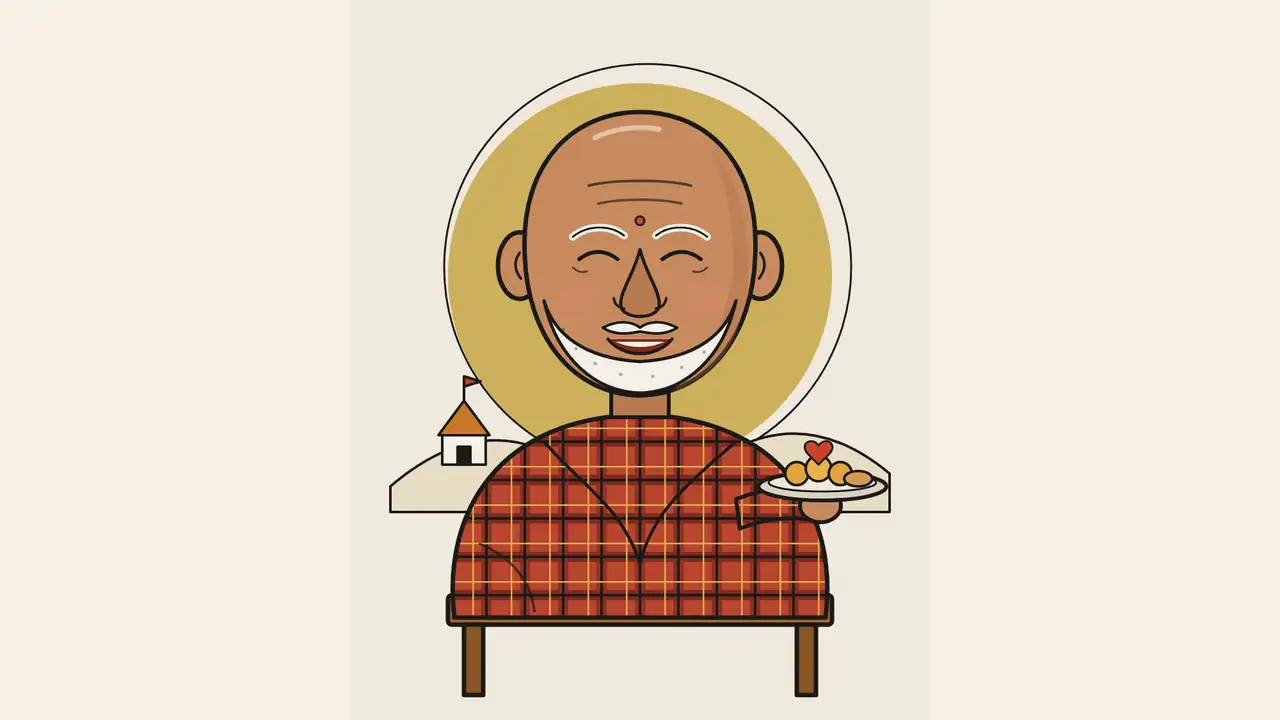
Original illustration drawn for WCRC. © Abhimanyu Ghosh & WCRC.
Spirituality · The Modern Sages · No. 26 of 27
Neem Karoli Baba and the leader who feeds people first
A wandering devotee of Hanuman left no books and no formal lineage, only ashrams where everyone who arrived was fed. His example asks leaders to meet people's real needs before asking anything of them.
WCRC Consulting · Strategy into execution
Implement these strategies inside your organisation
Deep analysis of where your organisation stands and a strategic implementation of The WCRC ServeHeart Model, built for your leadership team, culture and business.
Models created exclusively by Abhimanyu Ghosh; proprietary to Abhimanyu Ghosh and WCRC. WCRC's consulting service is not connected with, or endorsed by, any teacher, tradition or organisation discussed here.
Dates
c. 1900 – 1973
Region
Kainchi Dham, Uttarakhand
Tradition
Bhakti
WCRC model
WCRC-GLC-26
The model in one line
Serve first, lead quietly.
The WCRC ServeHeart Model™ · anchored in "Love everyone, serve everyone, remember God" (as summarised by Ram Dass)
A wanderer with many names
Neem Karoli Baba was born, by tradition, around 1900 in Akbarpur village in the Firozabad district of Uttar Pradesh, into a Brahmin family. His birth name is given as Lakshmi Narayan Sharma, or in some accounts Lakshman Narayan Sharma. The year is traditional rather than documented, which suits a life that left few papers behind.
He was married young, at about eleven, and soon left home to wander as a sadhu. The early decades are known mostly through the names he picked up along the way: Lakshman Das, Handi Wala Baba, Tikonia Wala Baba. He practised austerities in several places, including Vavania near Morbi in Gujarat. A stay near the village of Neeb Karori in Farrukhabad district gave him the name by which the world now knows him. No formal guru or lineage is recorded, and his spiritual training is undocumented.
At his father's request he returned to family life and helped raise two sons and a daughter, though he kept travelling. His devotees called him Maharajji. He was a devotee of Hanuman and of Ram, and those around him regarded him as a siddha, a perfected one.
In 1962 he began work at Kainchi, near Bhowali in the Nainital district of what is now Uttarakhand, and in 1964 a Hanuman temple was consecrated there. By the late 1960s Western seekers were arriving, and Ram Dass, formerly Richard Alpert, carried his name around the world through Be Here Now (1971). He died in the early hours of 11 September 1973 in a hospital in Vrindavan; some sources give 10 September. In 1976 a murti was consecrated at the Kainchi memorial temple. He wrote nothing. His teaching survives in the accounts of devotees, Ram Dass's Miracle of Love (1979) among them.
Feeding before preaching
His teaching can be told in few words, and devotees have tried. Ram Dass gathered it into a single line that is now widely repeated.
Love everyone, serve everyone, remember God.
Neem Karoli Baba's teaching, as summarised by Ram Dass, Miracle of Love (1979)
The line is a summary by a devotee, and it is best read as one. What makes it useful to a leader is the order of practice behind it, as the Maharajji Seva Trust describes his ashrams. Before any instruction came food. He constantly urged devotees to feed the hungry, and prasad, blessed food shared with whoever arrived, sat at the centre of ashram life. Devotion followed in the plainest forms: chanting Ram's name and reciting the Hanuman Chalisa, which he presented as the simplest path to God.
Two further convictions shaped how he treated people. The NKB Meditation Foundation records his teaching that every person is a form of God, so that the poor visitor and the powerful one were owed the same regard. And the Divine Life Society's account notes that he owned almost nothing beyond a blanket and moved freely, showing that peace does not depend on possessions.
Put those together and a pattern of leadership appears that rests on care rather than on authority. He wrote no books and no formal lineage is recorded for him, yet devotees in India and abroad gathered around him. Anyone who has run a team knows how rare care without conditions is, and how hard it is to fake.
A platform at Kainchi
The defining moment of his life is small to the eye. In 1962 work began at Kainchi with a simple raised platform, a chabutra, at the site. On 15 June 1964 the Hanuman temple at Kainchi Dham was consecrated. That date is still kept every year with a large fair and the distribution of prasad to the crowds who come.
Consider what that means as an institution. More than half a century later, the place still marks its founding day by feeding the people who turn up. The founder is gone, the founding date is a feast, and the ritual at its heart is hospitality. Many founders of companies would be pleased to leave behind a culture half as clear about what it is for.
Devotees also recount stories of a different kind. They say he was once put off a train near Neeb Karori for travelling without a ticket, and that the train would not move again until officials invited him back aboard. They tell of a small offering of fruit that was shared out and somehow stretched to many more people than it should have. These are devotees' accounts and are told here as such. Notice which story the institution chose to keep alive in its calendar. It is the one about feeding.
The ServeHeart Model takes Kainchi as its proof. Service that becomes the habit of a place, kept by people who never met the founder, is the most reliable sign that it was real in the first place.
The blanket and the algorithm
Automation removes tasks. It does not remove people's needs, and in many workplaces it makes them louder: for a hearing, for clarity about what their job now is, for someone to notice that they are struggling. A leader who owns little and attends fully to the person in front of them has an advantage no system can copy.
Robert Greenleaf, who introduced the term servant leadership in his 1970 essay The Servant as Leader, proposed a test: do those served grow as persons, and do they, while being served, become "healthier, wiser, freer, more autonomous"? It is a test of outcomes in people, and no tool can pass it on a leader's behalf.
Erik Brynjolfsson has warned of a "Turing Trap": an excessive focus on building AI that imitates and automates human work, rather than AI that augments human capability. Read through the ServeHeart Model, the question for every AI deployment is whether it feeds people's capability or simply replaces it. A serve-first leader asks that before signing the contract.
The urgency is real. Gallup's State of the Global Workplace 2026 report says global employee engagement fell to 20% in 2025, down from a peak of 23% in 2022. Machines will not reverse that number. People who feel served by their leaders might.
The WCRC ServeHeart Model
Created by Abhimanyu Ghosh · A proprietary model of Abhimanyu Ghosh and WCRC
WCRC calls this the WCRC ServeHeart Model. It reads Neem Karoli Baba's example as a cycle with five steps. Care begins with Love, giving every person, at every level, full regard. It shows itself in Serve, asking what people need to do their best work and supplying it. Its most literal form is Feed people, meeting basic needs such as time, tools, fair pay, a meal and a hearing before anything else. Hold lightly keeps the leader free of titles, possessions and the hunger for credit, as he was free of almost everything but a blanket. Remember keeps the larger purpose in view so that service does not slide into routine. Each turn of the cycle strengthens the next, which is why the diagram above draws it as a loop. The model is WCRC's interpretation for leaders; it does not speak for his devotees or the trusts that keep his ashrams.
Leadership begins with care for people, shows itself as practical service, and is held steady by remembering the larger purpose. Feeding people is the most literal form of that service, and holding possessions lightly keeps the leader free of the need for credit. Each turn of the cycle strengthens the next.
Fig. 1The WCRC ServeHeart Model™
© Abhimanyu Ghosh & WCRC
The building blocks
01LovePrem
Treat every person, at every level, as worthy of full regard.
In practiceGreet the newest employee with the same attention as the largest shareholder.
02ServeSeva
Ask what people need to do their best work and supply it.
In practiceOpen each one-to-one by asking what is blocking the other person.
03Feed people
Meet basic needs first: time, tools, fair pay, a meal, a hearing.
In practiceFix one practical hardship for staff or community each month.
04Hold lightly
Keep few possessions, titles and claims to credit.
In practicePass public credit for a success to the team that delivered it.
05RememberSmaran
Keep the larger purpose in view so service does not become routine.
In practiceBegin leadership meetings by naming who the work is finally for.
The chief executive as host
A host notices who has not eaten. That is the posture this model asks of a chief executive, and it changes ordinary decisions. A one-to-one opens with the question of what is blocking the other person, and closes with a commitment to remove something. A site visit spends as much attention on the newest hire as on the plant manager. Budget conversations ask whether basic welfare is in order before any money goes to perks.
The habit that matters most is the direction of credit. Jim Collins, writing in the Harvard Business Review on what he calls Level 5 leadership, describes these leaders' tendency to give credit to others while assigning blame to themselves. Neem Karoli Baba held so little that there was nothing for credit to attach to. A chief executive can practise a version of that freedom by naming the team in every announcement of success and standing alone in every explanation of failure.
The blind spot is easy to miss. Service-first leadership can slide into the avoidance of hard calls, because the leader wants to remain the person who gives. The model's failure modes name this directly: quiet leadership becomes absence. Feeding people includes telling them the truth about the business, closing what has to close and paying people fairly when you do.
A second blind spot is exhaustion. Leaders who take service seriously sometimes treat their own collapse as proof of devotion. It is a poor example to set, and it leaves the organisation dependent on one tired person, which is the opposite of what he left behind at Kainchi.
Founders and the pull of the spotlight
Young companies are built on the founder's visibility. Investors back the founder, the press profiles the founder, and the early team often joined because of the founder. All of this pulls against the Hold lightly step, and for good reasons. The model does not ask a founder to disappear.
It asks for something smaller and more practical. Each month, fix one real hardship for someone on the team, yourself, not through a policy. Ask in every one-to-one what is in the way. Keep the titles few and the special privileges fewer. When the company wins a customer, let the person who did the work tell the story at the all-hands.
Feeding people has a literal meaning in a small company too. If you run a twenty-person startup where people work late, someone should be making sure they eat. It is a small thing, and small things are how a culture is set before anyone writes it down.
The deeper reason concerns key-person risk. A company that depends on the founder's personality is fragile. One that runs on habits of service the founder started, and that others now keep, is a company an investor can back with more confidence, and one the founder can eventually step away from.
A kitchen that outlives its founder
Kainchi Dham still distributes prasad every 15 June, more than five decades after he died. For a large company, the parallel question is whether its service habits would survive a change of chief executive. Boards are well placed to ask it, because they are the part of the company that is meant to outlast any one leader.
Directors can test the model with plain evidence. Are staff-raised hardships logged and resolved, and how quickly? In public statements, does credit flow to named teams or to the executive floor? Do engagement surveys show that people feel their managers help them do their best work? Is the company's community service real feeding and welfare, or publicity?
That last question guards against the model's most cynical failure, in which feeding people turns into patronage or a photograph. The test is whether real needs are met, and the measure is the people served, never the coverage.
Large companies also have a structural temptation to fund perks while basic welfare lags behind: a new café in head office while contract staff wait weeks for payment. The ServeHeart Model reverses that order. The operating model and playbook below set out how to find unmet needs first, pilot needs-first one-to-ones, and guard against the burnout that serious service can bring.
The business model
Inside a company, the ServeHeart Model runs on three inputs: leaders willing to serve before being served, time deliberately set aside for people's needs, and a purpose stated in human terms rather than financial ones. Those inputs drive four practices: one-to-ones that start with needs, basic welfare fixed before perks, credit passed down and blame taken up, and the purpose recalled at every leadership forum. The outputs are people who feel seen, teams that treat customers the way they themselves are treated, and less dependence on any one leader's ego. Over time that compounds into loyalty, lower attrition, trust across stakeholders and a service culture that does not need its founder in the room. The operating model below lays out each stage.
Fig. 2Operating model: running the WCRC ServeHeart Model
© Abhimanyu Ghosh & WCRC
Inputs
What the company commits
- Leaders willing to serve before being served
- Time set aside for people's needs
- A purpose stated in human terms
Practices
What leaders do, repeatedly
- Needs-first one-to-ones
- Basic welfare fixed before perks
- Credit passed down, blame taken up
- Purpose recalled at every leadership forum
Outputs
What changes in the work
- People who feel seen and supported
- Teams that serve customers the same way
- Low dependence on the leader's ego
Outcomes
What the enterprise gains
- Deep loyalty and lower attrition
- Trust across stakeholders
- A service culture that outlasts the founder
The benefit model
The leader gains a kind of freedom, because the need to be noticed falls away and more attention is left for the work and the people. Employees have their basic needs met first and see credit come to them, and they give more in return. Customers are served by people who have themselves been served well, and the difference shows. Investors back a culture with low key-person risk, because it rests on habits rather than on one personality. Society gains a company that looks after the people around it as a matter of course.
Fig. 3Benefit model: who gains what
© Abhimanyu Ghosh & WCRC
The leader
Is freed from the need to be noticed, which leaves more attention for the work and the people.
Employees
Have their basic needs met first and see credit flow to them, which makes them willing to give more.
Customers
Are served by people who have themselves been served well, and it shows in how they are treated.
Investors
Back a culture with low key-person risk, because it rests on habits of service rather than one personality.
Society
Gains a company that feeds and looks after the people around it as a matter of course.
Fig. 4Where the model moves the needle
© Abhimanyu Ghosh & WCRC
- Vision Quotient
- ●●●●●
- Impact Index
- ●●●●●
- Innovation Score
- ●●●●●
- People Leadership
- ●●●●●
- Stakeholder Trust
- ●●●●●
- Resilience Factor
- ●●●●●
- Global Mindset
- ●●●●●
How to implement the WCRC ServeHeart Model
Your first move
Open every one-to-one this week by asking what is blocking the other person, and fix one of those blockers yourself by Friday.
If you are the founder or CEO
- 1
Ask what blocks people
From the first week, open each one-to-one by asking what is in the way of the other person's best work and write it down. Close the loop on it at your next meeting.
- 2
Greet everyone equally
Give the newest employee the same attention and time you give the largest shareholder or customer. In a large company, make this visible on site visits and in town halls.
- 3
Fix one hardship monthly
Each month, personally see that one practical hardship for staff or community is fixed: time, tools, fair pay, a meal, a hearing. Basic needs come before perks.
- 4
Pass credit down
In every announcement of a success, name the team that delivered it and take the blame yourself when things go wrong. Hold few titles and claims to credit.
- 5
Name who the work is for
Begin every leadership meeting by naming who the work is finally for, so service does not slide into routine. Pair service with hard decisions and do not use quiet leadership to avoid them.
Rolling it out across the company
| Step | Owner | What the company puts in place |
|---|---|---|
| 01Find unmet basic needs | CHRO with operations head | Survey and interview staff on practical blockers and hardships, and check engagement data on whether managers help people do their best work. This sets the baseline for needs-resolution rate and felt support. |
| 02Pilot needs-first one-to-ones | One business head | In one unit, run one-to-ones that open with blockers, log every need raised, and set a period within which each must be resolved or answered. Review the log monthly with the unit head. |
| 03Embed welfare and credit rules | CHRO and communications head | Put basic welfare fixes ahead of perks in budget rules, and set a communications standard that names teams in credits. Add needs resolution and credit-sharing to manager reviews and promotion criteria. |
| 04Train managers to serve | Learning and development head | Train all people managers to run needs-first one-to-ones and to resolve blockers within their own authority. Teach them where service ends and hard decisions, including on poor performance, still have to be made. |
| 05Track service KPIs | CHRO | Report needs-resolution rate, credit direction in communications, felt support by team and community service hours every quarter. Watch for community work turning into publicity or patronage. |
| 06Scale and guard against burnout | CEO and executive team | Extend needs-first one-to-ones to every team once the pilot shows faster resolution and higher felt support. Each year, review leaders' own workloads so service does not become martyrdom. |
The execution roadmap
Four phases, each closed by a gate. Do not move on until the gate is met.
Days 0–30
Phase 1 · Diagnose and commit
Find the practical blockers and hardships people face and how far managers help them now.
- Survey and interview staff on blockers and basic needs for the Feed people component.
- Pull the engagement item on whether managers help people do their best work, by team.
- Count named credits to teams and to senior leaders in recent communications for the Hold lightly component.
- Have the CEO open every one-to-one with the Serve question about what is blocking the other person.
Deliverable
A list of unmet basic needs, baselines for felt support and credit direction, and the CEO's first log of blockers raised.
Gate to proceed
Baseline recorded for needs-resolution rate, felt support and credit direction, and the CEO has closed the loop on blockers raised in one-to-ones.
Days 31–90
Phase 2 · Pilot and prove
Prove in one unit that needs-first one-to-ones resolve blockers faster and raise felt support.
- Run one-to-ones in one unit that open with blockers and log every need raised.
- Set a period within which each need must be resolved or answered.
- Fix one practical hardship each month in the unit before any new perk.
- Open the unit's leadership meetings by naming who the work is finally for, for the Remember component.
Deliverable
A needs log for the pilot unit showing items raised, resolved and answered within the set period.
Gate to proceed
The pilot unit has logged and answered every need within the set period, and felt support in the unit has been measured again.
Days 91–180
Phase 3 · Embed and scale
Make needs-first service, welfare before perks and credit passed down the company norm.
- Extend needs-first one-to-ones to every team.
- Put basic welfare fixes ahead of perks in budget rules.
- Set a communications standard that names teams in credits and leaders in blame.
- Add needs resolution and credit-sharing to manager reviews and promotion criteria.
Deliverable
A company needs log, revised budget rules and a communications credit standard.
Gate to proceed
All teams log needs from one-to-ones, and the credit direction count shows teams named in success announcements.
Month 7 onwards
Phase 4 · Sustain and renew
Keep service real and sustainable so it neither burns out leaders nor becomes publicity.
- Review leaders' own workloads every year so service does not become martyrdom.
- Check community feeding and welfare work for publicity or patronage.
- Confirm hard decisions, including on poor performance, are still being made.
- Renew the statement of who the work is finally for.
Deliverable
An annual service review for the executive team covering all four KPIs and leader workloads.
Gate to proceed
The executive team has reviewed leader workloads and hard decisions within the year alongside the service KPIs.
Governance
- Sponsor
- The CEO, whose own one-to-ones and credit habits set the tone everyone else follows.
- Lead
- The CHRO, who runs the needs log, welfare budget rules and manager training.
- Review forum
- The needs log is reviewed monthly by unit heads and the four KPIs go to the executive team every quarter.
- Decision rights
- Managers resolve needs within their own authority and the CHRO can approve welfare fixes within budget; changes to pay or policy go to the CEO.
Operating rhythm
- WeeklyEvery one-to-one opens with what is blocking the other person, and the answer is logged.
- MonthlyEach leader sees one practical hardship for staff or community fixed, and unit heads review the needs log.
- QuarterlyReport on needs-resolution rate, credit direction, felt support and community service hours.
- AnnuallyExecutive review of leaders' own workloads, hard decisions taken and whether community work has stayed free of publicity.
Implementation risks and how to handle them
| Risk | Early warning | Mitigation |
|---|---|---|
| Managers ask about blockers but do not act, and people stop raising them. | The number of needs raised falls while the resolution rate stays low. | Publish resolution times by team and give managers authority to fix common blockers directly. |
| Quiet, serving leadership becomes a way to avoid hard decisions. | Performance problems stay unresolved and teams report unclear direction. | Review hard decisions taken alongside the service KPIs in every leadership review. |
| Feeding people and community work turn into publicity or patronage. | Community events are planned around coverage rather than need. | Choose community work from needs raised by staff and the community, and limit external promotion. |
| Leaders burn out serving everyone and call it devotion. | Senior leaders work long hours on welfare items while core duties slip. | Delegate needs resolution to managers and review leader workloads each year. |
By stage of company
Startup
Founder-led, under ~50 people
The founder asks every person each week what is in their way and fixes small hardships directly. Credit for wins goes to the team by name in every update to investors and customers.
Scale-up
~50 to 1,000 people
Needs-first one-to-ones become a manager standard with a shared log, and welfare comes before perks in budgets. HR trains managers on where service ends and hard decisions begin.
Enterprise
Large or listed company
Needs resolution and credit direction are reported by business unit, and community service is planned from local need. The board reviews whether leaders take blame publicly and pass credit down.
Are you ready?
- Are our leaders willing to ask what blocks people and act on the answer within a set period?
- Will we fix basic welfare gaps before adding perks?
- Are we prepared to give public credit to teams and take blame at the top?
What success looks like at 12 months
- People raise blockers freely because they expect them to be answered.
- Success announcements name the teams who delivered, and senior leaders take public responsibility for failures.
- Basic welfare gaps are closed before new perks are announced.
Habits to start this quarter
- 1
Keep a hardship list
Keep a private list of the practical difficulties your people mention, from a broken laptop to a delayed reimbursement. Each Friday, look at it and choose one you will personally see resolved next week.
- 2
Eat with someone new
Once a week, share a meal or a tea with someone you do not usually work with, at any level. Ask about their work and listen more than you speak.
- 3
Count your credits
Before you send any announcement of a success this quarter, count the named people in it and the times you mention yourself. Adjust until the team outnumbers you.
- 4
Give one thing away
Each month, hand one privilege, title or visible task to someone who would grow from it. Note what changed for them.
- 5
Name who it is for
Start your own working day by writing one line on who your work is finally for. Read it again before your hardest meeting.
What to measure
| Leading indicator | How to measure it |
|---|---|
| Needs-resolution rate | Share of staff-raised blockers or hardships resolved within a set period, logged from one-to-ones. |
| Credit direction | In internal and external communications, count named credits given to teams versus to senior leaders. |
| Felt support | Engagement survey item on whether the respondent's manager helps them do their best work, tracked by team. |
| Community service hours | Hours of staff time given to community feeding or welfare work, from volunteering records. |
Where the model goes wrong
- Service becomes martyrdom: the leader exhausts themselves and calls it devotion.
- Quiet leadership becomes absence, and hard decisions are avoided.
- Feeding people turns into publicity or patronage instead of meeting real needs.
Who eats first
WCRC's view is that Neem Karoli Baba's example is one of the clearest in Indian spiritual life for a modern executive, precisely because it asks for so little theory. He did not write a doctrine of leadership. He fed people, held almost nothing, treated each person as a form of God and kept his mind on Ram. The institution he left behind still feeds people every year on its founding day.
Leaders who want to know whether their culture is real can ask the question every host asks, and every kitchen answers. Who has not eaten yet? Serve them first, and the rest of the work gets easier.
Powerfacts
- Who was Neem Karoli Baba?
- Neem Karoli Baba (c. 1900–1973) was a Hindu devotee of Hanuman and Ram, born in Akbarpur, Uttar Pradesh, who wandered for years as a sadhu before founding the Hanuman temple at Kainchi Dham near Bhowali. He urged devotees to feed the hungry, owned almost nothing and is known worldwide through the writings of Ram Dass.
- What is The WCRC ServeHeart Model?
- It is WCRC's leadership model based on Neem Karoli Baba's example of service. It runs as a cycle of five steps: give every person full regard, serve their needs, meet basic needs first, hold titles and credit lightly, and keep the larger purpose in view.
- Why is Kainchi Dham's 15 June fair relevant to leaders?
- The Hanuman temple at Kainchi Dham was consecrated on 15 June 1964, and the date is still kept each year with a large fair and the distribution of prasad. It shows how a habit of service can outlast its founder, which is the test WCRC applies to company cultures.
Sources
- Who is Neem Karoli Baba?, Maharajji Seva Trust
- Sri Neem Karoli Baba, The Divine Life Society
- NKB Meditation Foundation, NKB Meditation Foundation
- Miracle of Love (1979), Ram Dass
- What is Servant Leadership? (Greenleaf, The Servant as Leader, 1970), Robert K. Greenleaf Center for Servant Leadership
- Level 5 Leadership: The Triumph of Humility and Fierce Resolve (Collins), Harvard Business Review
- The Turing Trap: The Promise and Peril of Human-Like Artificial Intelligence (Brynjolfsson, 2022), Daedalus
- State of the Global Workplace: 2026 Report, Gallup
Read Neem Karoli Baba's life and teachings on Gurushakti.
The WCRC ServeHeart Model™ (WCRC-GLC-26) is part of The WCRC Guru Leadership Codex™. Created exclusively by Abhimanyu Ghosh; a proprietary model of Abhimanyu Ghosh and WCRC. © 2026 Abhimanyu Ghosh and World Centre for Research and Consulting. All rights reserved.