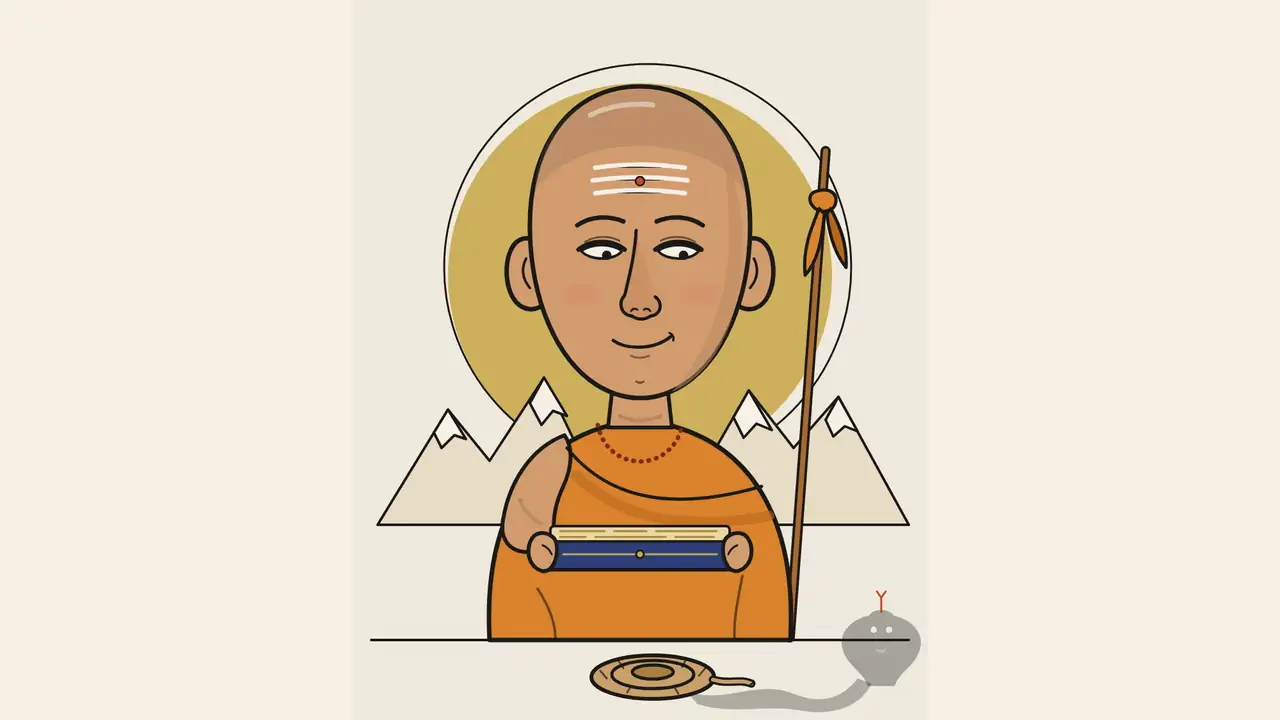
Original illustration drawn for WCRC. © Abhimanyu Ghosh & WCRC.
Spirituality · The Classical Acharyas · No. 01 of 27
Adi Shankaracharya and the snake in the boardroom: why most leadership errors begin as errors of sight
A monk from Kaladi argued that suffering starts when we lay a false picture over what is really there. For leaders who decide on dashboards, forecasts and machine outputs, that is a working description of risk.
WCRC Consulting · Strategy into execution
Implement these strategies inside your organisation
Deep analysis of where your organisation stands and a strategic implementation of The WCRC SeeClear Model, built for your leadership team, culture and business.
Models created exclusively by Abhimanyu Ghosh; proprietary to Abhimanyu Ghosh and WCRC. WCRC's consulting service is not connected with, or endorsed by, any teacher, tradition or organisation discussed here.
Dates
Traditionally dated to the 8th century CE
Region
Kaladi, Kerala
Tradition
Advaita
WCRC model
WCRC-GLC-01
The model in one line
See the rope before you fight the snake.
The WCRC SeeClear Model™ · anchored in Adhyasa (superimposition): mistaking a rope for a snake
A short life from Kaladi to Kedarnath
Adi Shankaracharya lived for about 32 years, and the institutions that carry his name have lasted well over a thousand. That gap between a short life and a long legacy is the first thing a leader should notice about him. Most scholars place him in the 8th century CE; the Sringeri matha gives his birth as 788 CE. The Kanchi Kamakoti Peetham holds a far earlier chronology, beginning in 509 BCE. Both views are held with conviction, and this chapter follows the scholarly dating while respecting the older one.
He was born at Kaladi, on the Purna river (today's Periyar) in Kerala, to Shivaguru and Aryamba, a Nambudiri family. His father died while he was still a child. The boy mastered the Vedas very young, and tradition says that at about the age of eight he asked his mother for permission to become a sannyasi, a monk who renounces household life.
On the banks of the Narmada he found his teacher, Govinda Bhagavatpada, himself a disciple of Gaudapada, and was initiated. At Kashi he wrote the commentaries, or bhashyas, on the Brahma Sutras, the Bhagavad Gita and the principal Upanishads that scholars broadly accept as his own, along with the Upadeshasahasri. Many hymns, including Bhaja Govindam and Nirvana Shatakam, are traditionally attributed to him; the attribution is not settled.
The traditional chronology, drawn from Sringeri's Madhaviya Shankara Digvijayam, then moves quickly. A long debate with the scholar Mandana Mishra, judged by Ubhaya Bharati, ends with Mandana becoming his disciple under the name Sureshvara. He founds the matha at Sringeri and installs the goddess Sharada there. He goes home to Kaladi to perform his dying mother's last rites, as he had promised. After debates in Kashmir he ascends the Sarvajna Peetha, the Throne of Omniscience. His last travels take him to Badrinath and Kedarnath.
Where he died is also held differently. Sringeri and most mathas say he disappeared at Kedarnath, where a samadhi shrine stands behind the temple. The Kanchi tradition holds that he attained siddhi at Kanchipuram. Tradition credits him with the amnaya mathas at Sringeri, Dwarka, Puri and Jyotirmath, and Kanchi also claims him as its founder. How many seats he established is a live question between those institutions, and a reader from outside does well to leave it with them.
Rope, snake and the cost of a wrong picture
Shankara's teaching rests on a short set of claims, which the Stanford Encyclopedia of Philosophy sets out with care. Brahman, one consciousness, underlies everything. The world of change depends on it and is not real in the final sense, in its own right. Your deepest self, the Atman, is that same consciousness, and is neither the body nor the mind.
The idea that matters most to a leader is adhyasa, usually translated as superimposition. We suffer, Shankara argued, because we lay one thing over another and then react to the overlay. His image is a coil of rope that a walker takes for a snake. The fear is real. The heart races. Yet nothing in the situation called for it, and no amount of fighting the snake helps, because there was never a snake to fight.
People sometimes compress this into the line that the world is false. That is a misreading, and his tradition is careful about it. The traditional summary, found in a text whose authorship is doubtful, says Brahman is real and the world is appearance. Appearance here means dependent, and not real in the final sense. The world is there to be dealt with; it simply is not the last word on what exists.
His remedy was knowledge. Direct understanding, gained through scripture, a teacher and sustained reflection, removes the ignorance that produced the overlay. Liberation, in his language, is realised and never manufactured; the work is to stop obscuring it. He also held that worship and selfless duty prepare the mind for that understanding, which is why hymns to Govinda, Shiva and Devi sit beside dense commentary in the tradition that follows him.
Translate the rope and the snake into a quarterly review and the fit is uncomfortable. A margin dip becomes a crisis because the last dip was one. A quiet subordinate becomes disloyal because quiet once meant that. A competitor's launch becomes an existential threat because the chair said so first. In each case the facts are a rope, and the room is busy fighting a snake it painted itself.
The man at Kashi who asked which one should move
Devotees recount a meeting at Kashi. Shankara, by then a teacher of rank, met a chandala, a man whom the society of his time treated as an outcaste, and asked him to step out of the way.
The man answered with a question of his own. Should the body move away from a body, he asked, or the self from the self, when that self is the same in all? The question turned Shankara's own teaching back on him. Here was the scholar of non-duality acting on a superimposition of rank, and a stranger had seen it before he did.
Shankara bowed to him. The tradition holds that he then composed the Manisha Panchakam, verses on seeing one self in every person, whatever their station. The story is told with reverence by Sringeri, and it is worth telling with the same respect here: the person who corrected the teacher is the hero of it.
Notice the order of events. He saw, he acknowledged, he acted, and then he wrote it down in a form others could learn from. That sequence is the spine of the operating model in this chapter. It also answers the question every senior leader should ask after a mistake: was the error in the facts, or in what I laid over them?
When the dashboard looks like a snake
Leaders now decide on a constant flow of synthesised material: dashboards, forecasts, summaries and recommendations generated by software. According to the 2026 AI Index from Stanford's Institute for Human-Centered Artificial Intelligence, organisational AI adoption rose to 88% of surveyed organisations in 2025. The output arrives fluent and confident. Fluency is exactly the quality that makes a superimposition hard to spot.
A model's output can be a rope that looks like a snake, or a snake that looks like a rope. It can flag a risk that is a pattern artefact, or present a weak inference in the same calm tone as a hard number. The machine adds its own overlay to the data, and then the reader adds theirs to the machine.
Psychology has spent decades describing the reader's half of that problem. In Thinking, Fast and Slow (2011), Nobel laureate Daniel Kahneman describes two modes of thought: System 1, fast and intuitive, and System 2, slower and more deliberate. A confident chart speaks straight to the fast system. Kahneman, Olivier Sibony and Cass Sunstein add a second layer in Noise, where they define noise as unwanted variability in judgements that should be identical. Two executives reading the same AI summary can reach opposite conclusions, and the same executive can read it differently on a Monday and a Friday.
Shankara's test is simpler than any of the tooling. Before acting on a machine output, a leader asks three things: what here is observed, what here is assumed, and who has gone to the root to check. The technology changes every year. The habit of separating the rope from the snake does not need to.
The WCRC SeeClear Model
Created by Abhimanyu Ghosh · A proprietary model of Abhimanyu Ghosh and WCRC
WCRC calls this the SeeClear Model. It treats most leadership failure as a failure of perception: decisions made on what a team has projected onto a situation, and too little on what is there. The diagram above sets out its five moves as a cycle around clear sight: observe the situation in its own terms, separate fact from projection, enquire to the root with a dissenting voice present, act once the projection has cleared, and build the insight into the institution so it outlives the person. The last move is Shankara's own. A teacher who lived about 32 years is remembered through seats of learning that are still active, and WCRC's model asks the same of a leader's best judgement.
The SeeClear Model treats most leadership failure as a failure of perception: leaders react to what they have projected onto a situation instead of what is there. It asks a leader to observe, separate fact from projection, enquire to the root, act on what is real, and then build the insight into the institution so it outlasts the person.
Fig. 1The WCRC SeeClear Model™
© Abhimanyu Ghosh & WCRC
The building blocks
01ObserveDarshana (seeing)
Look at the situation as it is before forming a view: data, people, events, in their own terms.
In practiceBefore a major decision, the CEO asks for the raw facts first and the recommendation second.
02Separate fact from projectionAdhyasa audit
Name the fears, hopes, past wounds and status assumptions the team has laid over the facts, the snake drawn on the rope.
In practiceIn each strategy review, the CEO lists which claims are observed and which are assumed, and labels them openly.
03Enquire to the rootVichara (enquiry)
Keep asking what lies beneath a symptom until the cause is clear, with a trusted teacher, adviser or dissenting voice in the room.
In practiceThe CEO assigns one person to argue the opposite case before any irreversible commitment.
04Act on what is real
Decide and move once projection has been cleared; clear sight exists to serve action, and endless analysis is its own projection.
In practiceThe CEO records the decision, the facts it rests on and the date it will be checked.
05Institutionalise the insightMatha (seat of teaching)
Shankara's tradition is carried by the mathas, not by one life of about 32 years. A leader builds the habit of clear sight into structures that outlive any one person.
In practiceThe CEO turns the review questions into a standing decision checklist used across business units.
The CEO goes first, or the audit becomes a weapon
The SeeClear Model fails fastest at the top. Labelling other people's claims as assumptions is pleasant work for a chief executive; having your own labelled in front of colleagues is not. Yet the Kashi story runs in one direction only. The senior person was corrected, and the senior person bowed. A CEO who audits everyone's projections except their own turns the model into a tool of internal politics, which the failure modes listed with the model name plainly.
The decisions it changes are the expensive, hard-to-reverse ones: a large capital commitment, an acquisition, the exit from a market, the appointment of a successor. These are the moments when a leader's history is most likely to be laid over the facts. A previous acquisition that went well becomes the template for one that shares nothing with it. A past betrayal colours a new partner.
Research gives the CEO a ready instrument. In a June 2011 Harvard Business Review article, Kahneman, Dan Lovallo and Sibony proposed a 12-question checklist for leaders to detect biases in a team's recommendation before making a big decision. The SeeClear Model puts that kind of discipline into a broader frame, with one addition from Shankara: the person reviewing the recommendation is also a source of projection, and must be checked too.
Three blind spots recur. The first is speed mistaken for decisiveness, where acting before seeing feels like strength. The second is the reverse, enquiry used as a reason never to act; endless analysis is its own superimposition, a fear laid over the facts. The third is status. Bad news travels upward only when the people below believe evidence counts for more than rank, and they learn that by watching what happens to the last person who brought it.
Founders and the snakes they draw after midnight
A founder's mind is a projection engine by necessity. Building a company means seeing what is not yet there and persuading others to see it too. The same faculty, left unchecked, sees threats that are not there and opportunities that never will be.
If you are running a forty-person start-up, the rope-and-snake problem usually shows up in three places. A single lost customer becomes evidence that the product is failing. A single enthusiastic investor becomes evidence of product-market fit. A co-founder's silence in a meeting becomes evidence of a split. Each reading may be right. None should be acted on before the facts have been separated from the fear or the hope.
The model's founder guidance is deliberately light. Ask for the facts in person before you ask for anyone's view. Keep a simple record of irreversible bets and what they rested on. Have a co-founder or early hire argue the opposite case before a key hire, a fundraise or a change of market.
Shankara's life offers founders a second, gentler point. He took sannyasa as a boy, and tradition makes a point of remembering him for going back to cremate his mother when the neighbours would not help. Renunciation, in his tradition, was an inner act, never a licence to neglect the people who depended on him. Founders who tell themselves that the company justifies every broken promise at home are laying a snake over a rope of their own.
Boards, seats of learning and judgement that survives a tenure
The fifth move of the SeeClear Model is the one large companies most often skip. A capable chief executive develops sharp judgement, uses it for a decade, and takes it with them when they leave. The board then discovers that the organisation's clear sight belonged to one person.
Shankara's tradition solved the succession problem by building seats of learning. Sringeri, Dwarka, Puri and Jyotirmath, with Kanchi holding its own account, each carry the teaching forward. Whatever one's view of the disputed details, the principle is plain: the teaching was put into structures, and the structures outlasted the founder by many centuries.
For a board, the equivalent structures are ordinary and unglamorous. A paper template that separates observed facts from assumptions. A rule that no irreversible commitment is approved without a documented opposing case. A decision log that records what each major call rested on, and a review that returns to it when the facts change. The playbook below assigns these to the company secretary and the audit or risk committee, where they belong.
- Ask, of every major paper, which claims are observed and which are assumed.
- Ask who argued the opposite case, and whether their view was heard in full.
- Ask when the decision will be checked against the facts it rested on.
- Ask which AI-assisted recommendations were checked against source data, and by whom.
Directors who ask these four questions every quarter will notice something within a year. Papers become shorter. Reversals become faster and less personal. And the organisation begins to remember why it made its choices, which is the only defence a company has against repeating the same projection under a new chief executive.
The business model
Inside a company, the SeeClear operating model runs on three inputs: raw data and front-line reports, dissenting views put on the record, and leaders prepared to question themselves. Those inputs feed a small set of habits in the review cycle, chiefly labelling facts against assumptions, enquiring to the root before large commitments, and reviewing decisions afterwards against the facts they were approved on. The outputs are modest and visible, such as shorter board papers and a written trail of decision logic. Over time they add up to better capital allocation and judgement that survives a change of leadership, as the operating model below shows.
Fig. 2Operating model: running the WCRC SeeClear Model
© Abhimanyu Ghosh & WCRC
Inputs
What the company commits
- Raw data and front-line reports
- Dissenting views on record
- Leaders willing to question themselves
Practices
What leaders do, repeatedly
- Fact-versus-assumption labelling in reviews
- Root-cause enquiry before major commitments
- Pre-decision bias checklist
- Post-decision review against original facts
Outputs
What changes in the work
- Fewer decisions built on untested assumptions
- Shorter, clearer board papers
- A written record of decision logic
Outcomes
What the enterprise gains
- Better capital allocation
- Earlier detection of strategic errors
- Judgement that survives leadership change
The benefit model
The leader gains first, through fewer avoidable mistakes and the ability to explain every major call by the facts it stood on. Employees gain when they see that evidence outranks seniority, because that is what makes it safe to bring bad news early. Customers gain from products built on what they actually do, and investors from reasoning they can trace and errors that are admitted quickly. Society gains from institutions that check their assumptions about people before acting on them, which is the Kashi lesson applied at scale. The benefit model below sets out each group in turn.
Fig. 3Benefit model: who gains what
© Abhimanyu Ghosh & WCRC
The leader
The leader carries fewer avoidable mistakes and can explain every major decision by the facts it stood on.
Employees
People see that evidence counts more than rank, so they bring bad news and unpopular data earlier.
Customers
Products and services respond to what customers actually do and say, not to what the company assumes they want.
Investors
Investors get decisions with traceable reasoning and a management team that admits and corrects errors quickly.
Society
Institutions that check their own projections are less likely to harm people through careless assumptions about them.
Fig. 4Where the model moves the needle
© Abhimanyu Ghosh & WCRC
- Vision Quotient
- ●●●●●
- Impact Index
- ●●●●●
- Innovation Score
- ●●●●●
- People Leadership
- ●●●●●
- Stakeholder Trust
- ●●●●●
- Resilience Factor
- ●●●●●
- Global Mindset
- ●●●●●
How to implement the WCRC SeeClear Model
Your first move
On Monday, ask for the raw facts behind your next major decision before anyone sends you a recommendation.
If you are the founder or CEO
- 1
Ask for facts first
In the first week, require every decision paper that reaches you to open with observed facts and put the recommendation after them. Founders of small firms can ask for this in person; CEOs of large ones should write it into the paper template.
- 2
Label your own assumptions
In each strategy review, say aloud which of your own claims are observed and which are assumed before you label anyone else's. This keeps the adhyasa audit from becoming a weapon in internal politics.
- 3
Appoint a standing dissenter
Before each irreversible commitment, name one person to argue the opposite case and hear them out in full in the meeting. Rotate the role every quarter so dissent does not become one person's identity.
- 4
Record and date decisions
For every major decision, write down the decision, the facts it rests on and the date it will be checked, and keep the log yourself. Revisit each entry on its date and say openly if the facts have changed.
- 5
Set a limit on enquiry
Agree a decision date at the start of each enquiry so vichara serves action and does not become paralysis. Each month, check which decisions you are delaying in the name of more analysis.
Rolling it out across the company
| Step | Owner | What the company puts in place |
|---|---|---|
| 01Audit recent decision papers | CEO office with the company secretary | Review the last quarter's board and executive papers and mark which claims were observed and which were assumed. This sets the starting point for the assumption labelling rate. |
| 02Pilot in one review forum | CEO and one business head | Run fact-versus-assumption labelling and a documented opposing case in one unit's strategy reviews for a quarter. Small companies can pilot this in the weekly leadership meeting. |
| 03Embed the decision checklist | CEO office and board | Turn the review questions into a standing pre-decision checklist attached to every capital request and board paper, followed by a post-decision review against the original facts. Make assumption labelling a condition for a paper to be tabled. |
| 04Train managers in root-cause enquiry | CHRO with business heads | Teach all people managers to separate fact from projection, run root-cause enquiry and argue the opposite case without personal attack. Include how to check AI-assisted recommendations against source data. |
| 05Track the clear-sight KPIs | Company secretary and CFO | Report assumption labelling rate, decision reversal lead time, dissent on record and AI output verification to the board every quarter. Treat a fall in dissent on record as a warning sign. |
| 06Scale and refresh the checklist | Board | Extend the checklist to every business unit once the pilot shows clearer papers, and review it every year so it does not harden into a form to fill. Retire questions that no longer prompt real enquiry. |
The execution roadmap
Four phases, each closed by a gate. Do not move on until the gate is met.
Days 0–30
Phase 1 · Diagnose and commit
Establish how far current decisions rest on projection instead of observed fact.
- Audit last quarter's board and executive papers, marking each material claim as observed or assumed (the adhyasa audit).
- In the next strategy review, the CEO labels their own claims as observed or assumed before labelling anyone else's.
- Open a decision log recording each major decision, the facts it rests on and the date it will be checked (Act on what is real).
- Choose one business unit's strategy review as the pilot forum and name its first standing dissenter for the Enquire to the root step.
Deliverable
An assumption baseline drawn from last quarter's papers, and an open decision log.
Gate to proceed
Baseline recorded for every KPI (or a written note of why one cannot yet be measured), the decision log is open, and the pilot unit head has agreed to run labelled reviews.
Days 31–90
Phase 2 · Pilot and prove
Show in one review forum that labelled facts and a documented opposing case give clearer decisions without slowing them.
- Apply fact-versus-assumption labelling to every paper tabled in the pilot unit's reviews.
- Require a documented opposing case before any irreversible commitment, argued in full in the meeting.
- Agree a decision date at the start of each enquiry so vichara ends in action.
- Log every AI-assisted recommendation and check it against source data before it reaches a decision.
Deliverable
A pilot review pack: labelled papers, opposing cases on file and a first post-decision review against the original facts.
Gate to proceed
Every irreversible commitment in the pilot unit has a documented opposing case on file, AI output verification is logged for each AI-assisted recommendation, and no pilot decision ran past its agreed decision date for want of more analysis.
Days 91–180
Phase 3 · Embed and scale
Make the clear-sight checklist a condition for tabling any capital request or board paper.
- Turn the pilot review questions into a standing pre-decision checklist (Institutionalise the insight).
- Train people managers in root-cause enquiry, arguing the opposite case without personal attack, and checking AI output against source data.
- Extend assumption labelling and documented opposing cases to every business unit's reviews.
- Start quarterly post-decision reviews that compare outcomes with the facts each decision was approved on.
Deliverable
A board-approved decision checklist and the first quarterly clear-sight KPI report to the board.
Gate to proceed
The company secretary confirms assumption labelling on every board paper tabled in the quarter, and the board has received its first report on all four clear-sight KPIs.
Month 7 onwards
Phase 4 · Sustain and renew
Keep the enquiry alive so the checklist does not harden into a form to fill.
- Review the checklist every year and retire or rewrite questions that no longer prompt real enquiry.
- Rotate the standing dissenter role every quarter across senior people.
- The CEO reopens their own logged decisions when the facts change and says so openly.
- Track decision reversal lead time from post-decision reviews as the main sign that clear sight is working.
Deliverable
An annually refreshed checklist and a decision log covering every major decision since launch.
Gate to proceed
Decision reversal lead time is stable or shortening in post-decision reviews, and the annual checklist review has rewritten or retired questions that had stopped prompting enquiry.
Governance
- Sponsor
- The CEO, because projection starts at the top and only the CEO can have their own assumptions labelled in public without the exercise turning into internal politics.
- Lead
- The company secretary, who already controls what reaches the board and can check labelling and opposing cases on every paper.
- Review forum
- Monthly in the executive committee for the pilot and the decision log; quarterly at the board's audit or risk committee for the clear-sight KPIs.
- Decision rights
- The lead can send back any paper that lacks assumption labelling or a documented opposing case; changes to the checklist itself and any exemption for an urgent decision go to the CEO.
Operating rhythm
- DailyDecision owners log each AI-assisted recommendation with the source data they checked it against.
- WeeklyThe CEO reviews decision log entries that have reached their check date and reopens any whose facts have changed.
- MonthlyThe executive committee opens with one past decision examined against its original facts, observed and assumed claims marked.
- QuarterlyThe standing dissenter role rotates, and the board receives the assumption labelling, reversal lead time, dissent and AI verification figures.
- AnnuallyThe checklist is reviewed and questions that no longer prompt real enquiry are retired.
Implementation risks and how to handle them
| Risk | Early warning | Mitigation |
|---|---|---|
| Enquiry turns into paralysis, and more analysis becomes the reason never to commit. | Decisions are pushed past their agreed decision dates with the note 'pending more data'. | Fix the decision date when the enquiry opens, and have the CEO decide on the available facts any item that misses its date. |
| The audit is used on others but not on the top, so it becomes a weapon in internal politics. | Junior authors' papers arrive heavily labelled while the CEO's and senior leaders' proposals come through unlabelled. | Put the CEO's own papers through the check first, and have the company secretary report labelling by author seniority. |
| Authors game the labelling rate by marking every claim as observed. | The labelling rate looks healthy, yet post-decision reviews keep finding untested assumptions behind approved decisions. | Sample papers each quarter and trace a set of 'observed' claims back to their source data. |
| Dissent becomes a ritual, especially where contradicting a senior person is culturally hard. | Opposing cases are always written by the most junior person present and never change or shape a decision. | Rotate the dissenter role among senior people, allow written dissent before the meeting, and record where dissent altered a decision. |
By stage of company
Startup
Founder-led, under ~50 people
The founder asks for facts first in person and keeps the decision log in a shared document, with the weekly team meeting as the review forum. A co-founder or early hire argues the opposite case on every irreversible bet, such as a key hire, a fundraise or a change of market.
Scale-up
~50 to 1,000 people
The decision paper template carries an observed and an assumed section, checked by the CFO or chief of staff before leadership meetings. Labelling and opposing cases spread unit by unit after one pilot, with managers trained in root-cause enquiry.
Enterprise
Large or listed company
The company secretary makes labelling a condition for tabling board papers and capital requests, and the audit or risk committee reviews the clear-sight KPIs each quarter. The board asks for post-decision reviews of major investments against the facts on which they were approved.
Are you ready?
- Will the leadership team accept having its own assumptions labelled in front of colleagues?
- Is someone willing to argue the opposite case before major commitments without fear of penalty?
- Do we keep a written record of why major decisions were made?
What success looks like at 12 months
- Board papers open with observed facts, and directors ask 'observed or assumed?' without being prompted.
- Leaders reverse a decision openly when its facts change, and the decision log shows the reasoning.
- AI-assisted recommendations reach the executive committee together with the source data they were checked against.
Habits to start this quarter
- 1
Name the mood before the meeting
Before any meeting where you expect to be angry or anxious, take two minutes alone and write one line: what am I afraid this will turn out to be? Read it back after the meeting and see whether the fear matched the facts. Over a quarter you will learn which of your snakes recur.
- 2
Restate the alarming number in plain words
When a figure on a dashboard or an AI summary alarms you, restate it in one plain sentence without adjectives before you react. If you cannot say where the number came from, you have found the first thing to check.
- 3
Spend an hour where your rank buys nothing
Once a month, spend an hour with front-line staff, customers or suppliers in a setting where your title carries no weight. Listen for the claim that contradicts your picture, and thank the person who makes it. The Kashi story is about who gets to correct whom.
- 4
Read one source, not the summary
Each week, choose one important report and read the underlying source instead of the briefing note. Shankara's remedy was direct knowledge through study and reflection. A leader who only reads summaries is reading someone else's superimposition.
- 5
Keep one promise you cannot delegate
Choose one commitment outside work, to a parent, a child or a friend, and keep it this quarter without exception. The monk who left home still went back for his mother. Clear sight about work is easier when your private life is not quietly falling behind.
What to measure
| Leading indicator | How to measure it |
|---|---|
| Assumption labelling rate | Share of board and executive papers that separate observed facts from assumptions, checked by the company secretary each quarter. |
| Decision reversal lead time | Average time between a decision going wrong and the leadership formally acknowledging it, taken from post-decision reviews. |
| Dissent on record | Share of major decisions with a documented opposing case before approval. |
| AI output verification | Share of AI-assisted recommendations in material decisions that were independently checked against source data, logged by the decision owner. |
Where the model goes wrong
- Clear sight turns into paralysis: endless enquiry used as a reason never to act.
- The leader audits everyone's projections except their own, and the model becomes a weapon in internal politics.
- The checklist is institutionalised as a form to fill, and the actual enquiry stops.
The rope was always a rope
WCRC's view is that the most expensive errors in business are rarely failures of intelligence or effort. They are failures of sight, made by capable people reacting to a picture they laid over the facts themselves. Shankara gave that failure a name more than a thousand years ago and offered a remedy that asks for nothing exotic: look, separate what you see from what you fear, ask until you reach the root, act, and leave the habit behind in structures that outlast you.
The leaders who will do best with machines that speak confidently are the ones who have practised that discipline on themselves first. The snake you fight in the boardroom is usually yours; put down the stick and look again at the rope.
Powerfacts
- What did Adi Shankaracharya mean by mistaking a rope for a snake?
- Adi Shankaracharya used the image of a rope seen as a snake to explain adhyasa, or superimposition: we suffer because we lay a false picture over what is really there. The fear is real, but its object is not. In his Advaita Vedanta, direct knowledge removes the overlay.
- What is the WCRC SeeClear Model?
- The WCRC SeeClear Model is a leadership framework drawn from Shankara's teaching on superimposition. It asks leaders to observe, separate fact from projection, enquire to the root, act on what is real, and build the habit into the institution. It treats most leadership failure as a failure of perception.
- When did Adi Shankaracharya live?
- Most scholars place Adi Shankaracharya in the 8th century CE, and the Sringeri matha gives 788 CE for his birth. The Kanchi Kamakoti Peetham holds an earlier chronology beginning in 509 BCE. Tradition agrees that he lived only about 32 years.
Sources
- Shankara, Encyclopaedia Britannica
- Śaṅkara, Stanford Encyclopedia of Philosophy
- Abridged Madhaviya Shankara Digvijayam, Sringeri Sharada Peetham
- About the Peetham, Shri Kanchi Kamakoti Peetham
- The 2026 AI Index Report, Chapter 4: Economy, Stanford Institute for Human-Centered Artificial Intelligence
- Thinking, Fast and Slow (2011), Daniel Kahneman, Farrar, Straus and Giroux
- Noise: A Flaw in Human Judgment (2021), Kahneman, Sibony and Sunstein, Little, Brown Spark
- Before you make that big decision (2011), Kahneman, Lovallo and Sibony, Harvard Business Review
Read Adi Shankaracharya's life and teachings on Gurushakti.
The WCRC SeeClear Model™ (WCRC-GLC-01) is part of The WCRC Guru Leadership Codex™. Created exclusively by Abhimanyu Ghosh; a proprietary model of Abhimanyu Ghosh and WCRC. © 2026 Abhimanyu Ghosh and World Centre for Research and Consulting. All rights reserved.