Business
DIP Holding IPO: the UAE's first 2026 listing bets on AED 700m dividends
Dubai Investments is selling a fifth of the company that owns Dubai Investments Park, in what it calls the UAE's first IPO of 2026. The pitch is income, not growth, and it arrives while the Gulf economy is still shrinking from the regional war.
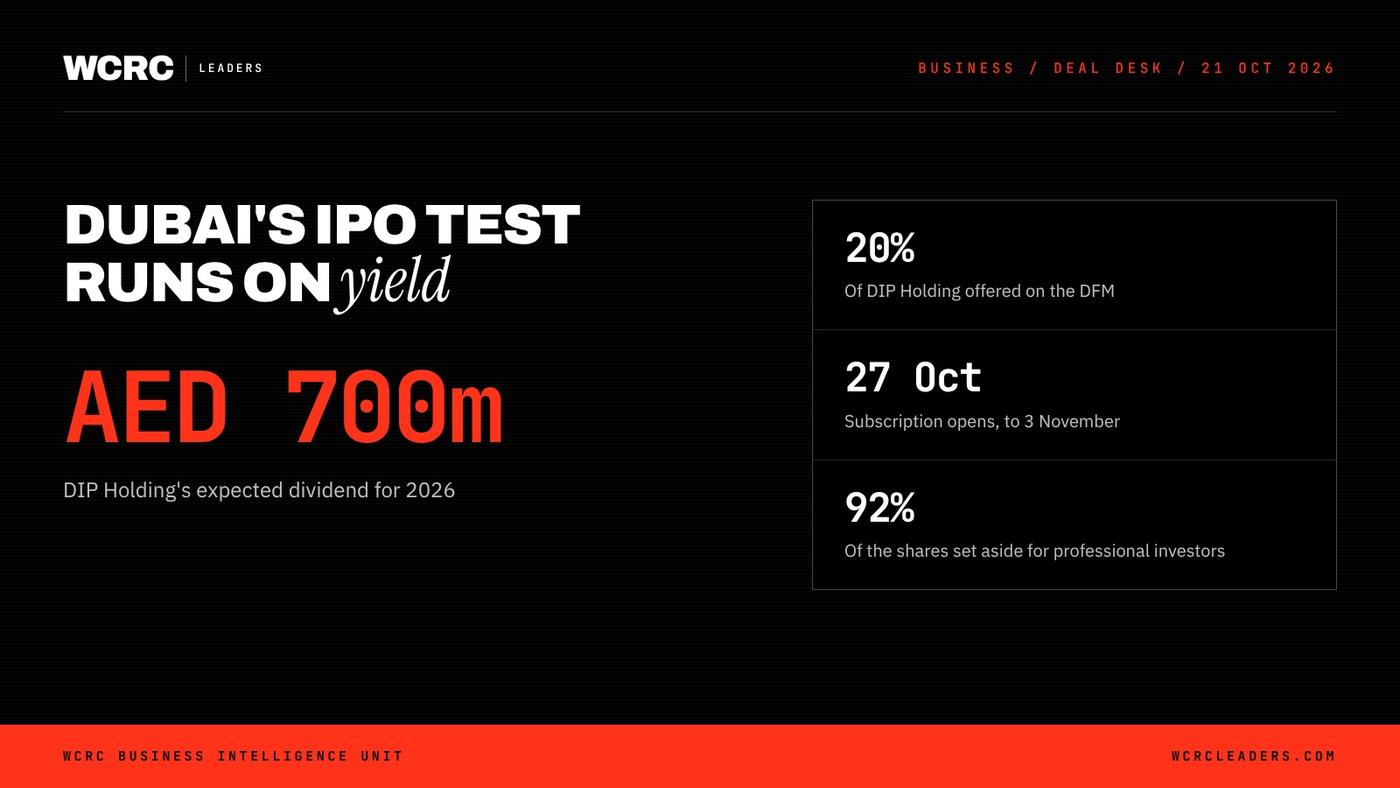
At a glance: WCRC Leaders' assessment: DIP Holding is the right kind of deal to reopen a shut market, a near-full industrial landlord paying out almost all its cash, but it will prove that investors want yield, not that they are ready for risk again. Dubai Investments announced on 19 October that it will sell 1,735,243,300 existing DIP Holding shares, 20% of the company, on the Dubai Financial Market. Subscription runs from 27 October to 3 November, with listing expected on or around 11 November. The price range is due on 27 October.
What exactly is being sold?
DIP Holding Plc is the parent of Dubai Investments Park Development Company, which runs Dubai Investments Park, a 23 million square metre district in the south of the emirate. Dubai Investments, the listed group incorporated in 1995, owns all of it today and is the sole selling shareholder.
This is a pure secondary sale. DIP Holding receives nothing. Dubai Investments says it will use the proceeds mainly for expansion and general corporate purposes. The prospectus shows DIP Holding is incorporated in the Dubai International Financial Centre and has 8,676,216,500 shares in issue, each with a nominal value of AED 0.20.
The book is weighted heavily towards institutions. According to the offer website and prospectus, the shares are split as follows:
- First Tranche, retail and other eligible investors: 5%, or 86,762,165 shares, with a guaranteed minimum allocation of 2,000 shares.
- Second Tranche, professional investors: 92%, or 1,596,423,836 shares.
- Third Tranche, Dubai Investments group employees: 1%, with a guaranteed 5,000 shares.
- Fourth Tranche, individual Dubai Investments shareholders: 2%, for those holding shares by 26 October, with a record date of 28 October.
The joint bookrunners are Emirates NBD Capital, HSBC Bank Middle East, Abu Dhabi Commercial Bank, EFG Hermes UAE and Dubai Islamic Bank. Emirates NBD is lead receiving bank. Dubai Investments will be locked up for 180 days after listing under the planned underwriting agreement.
No valuation or price range has been published. WCRC will not estimate one.
What does the business actually earn?
DIP is a ground-rent and services platform. It leases land to about 1,000 tenants, who in turn hold around 5,700 sub-leases, and the district is home to more than 150,000 residents. Ground-lease occupancy was about 99.9% at 30 June 2026.
In 2025 the company reported revenue of AED 960 million and adjusted EBITDA of AED 678 million. In the first half of 2026 it reported revenue of AED 492 million and adjusted EBITDA of AED 355 million, a 72% margin, with cash conversion of 97%.
The headline promise is the dividend. Dubai Investments says DIP Holding expects to pay AED 700 million for 2026, AED 725 million for 2027 and AED 750 million for 2028, in semi-annual instalments, subject to approvals. The first post-listing payment, AED 350 million for the second half of 2026, is due in April 2027, and IPO buyers are expected to receive it for the full half-year. Before the offer, DIP paid a AED 100 million dividend to Dubai Investments on 30 September 2026.
WCRC analysis: the 2026 dividend is larger than the whole of 2025's adjusted EBITDA, and close to the first half's EBITDA doubled. On the share count, AED 700 million equals roughly 8.1 fils a share, rising to about 8.6 fils in 2028, growth of a little under 4% a year. Buyers are offered nearly all operating cash, with modest growth on top. The growth levers Dubai Investments names are contractual ground-rent repricing, more subleasing and moving plots to higher-value uses.
Khalid bin Kalban, Vice Chairman and CEO of Dubai Investments and Chairman of DIP Holding, called the park "a clear example of a long-term vision realised" and said: "The proposed IPO represents a natural next step in the Company's evolution."
Why does this deal matter for Gulf markets now?
Because the UAE has not had an IPO all year. Dubai Investments' own release calls this the country's first of 2026.
The reason is the war. The World Bank's regional economic update of 6 October projects GCC real GDP to contract by 4.3% in 2026. It says the closure of the Strait of Hormuz "transformed a regional conflict into a global energy shock", one that, unlike earlier oil shocks, has hit Gulf exporters hardest. Gulf oil output fell from about 26 million barrels a day before the conflict to about 16 million in March, and has only partly recovered. The Bank also notes damage to tourism, aviation and logistics. It expects a rebound in 2027 as trade routes reopen.
Into that, Dubai Investments has chosen an asset with almost no tenant vacancy, contracted land rents and no construction or commodity risk to speak of. Mr bin Kalban framed the timing directly, saying the IPO comes "at a time when Dubai's capital markets continue to demonstrate depth and maturity."
WCRC analysis: a yield-led industrial landlord is the safest possible test of whether the window has reopened. If it is well covered, the lesson for bankers will be narrow: investors will buy visible cash in a downturn. It will not yet show appetite for growth stories, consumer names or companies exposed to shipping and energy volumes.
How is this different from Jio Platforms?
Jio Platforms' public issue in India this week is a fresh issue, with new money going into the company to fund growth. DIP Holding raises nothing for itself: a parent is monetising a mature asset and handing buyers a fixed income schedule. One sells a growth story, the other a coupon in equity form. Boards should not read them as a single regional "IPO window" signal.
What does it mean for Indian companies in Dubai?
For Indian groups that run warehousing, trading or light manufacturing from leased land or sub-leased units in districts such as DIP, three things change once the landlord is listed.
First, rent behaviour. The offer documents name contractual ground-rent repricing as a growth driver. A listed owner with a published dividend schedule has every incentive to apply it in full. Occupiers should map their own repricing dates and terms now.
Second, information. A listing brings regular disclosure on occupancy and repricing, useful data for tenants' own negotiations.
Third, opportunity. Indian promoters with UAE treasuries seeking dirham income gain a new listed option.
What should boards planning Gulf listings take from it?
The structure is a template. A DIFC-incorporated holding company, listed on the DFM, sold as a secondary carve-out by a listed parent, with 92% of shares aimed at professional investors, a small retail slice, a 180-day parent lock-up and a dividend schedule fixed for three years before the price is even set.
For Indian and Asian groups weighing a Dubai listing for a Gulf subsidiary, the message is that, in this market, income visibility is doing the selling. Companies without a clear payout story may need to wait for the recovery the World Bank expects in 2027, or build one.
Related: the Gulf's C-suite churn and the UAE-Saudi rail and grid pact.
The WCRC View
The call. DIP Holding is a well-chosen first deal for a market that has had no IPO all year. A near-full landlord with a 72% margin and a fixed dividend path is about as close to a bond as equity gets. Read a strong book as proof of appetite for yield, not as an all-clear.
Who gains. Dubai Investments gains cash and a market value for its biggest asset while keeping 80% control. Buyers gain dirham income; their main risk is that almost all operating cash is paid out, leaving thin cover if the economy weakens further.
Who should watch carefully. Tenants. Indian and Asian occupiers in Dubai industrial districts should review lease terms before the next repricing cycle.
What leaders should do now. Boards with Gulf subsidiaries should model what a three-year committed dividend would look like for their own business. That, more than a growth story, is what this market is buying.
What WCRC will watch next. The price range and implied yield on 27 October; the subscription multiple when the books close on 3 November; the final price on 4 November; first-day trading around 11 November; and whether any other UAE issuer files before year-end.
Quick answers
Q: What is DIP Holding? A: The DIFC-incorporated owner of the 23 million square metre Dubai Investments Park, wholly owned by Dubai Investments until the IPO.
Q: How many shares are on offer and who gets the money? A: 1,735,243,300 existing shares, 20% of the company. All proceeds go to the seller, Dubai Investments.
Q: When can investors subscribe? A: From 27 October to 3 November 2026. The price range is due on 27 October, the final price on 4 November, and listing on the Dubai Financial Market on or around 11 November.
Q: What dividends has the company promised? A: An expected AED 700 million for 2026, AED 725 million for 2027 and AED 750 million for 2028, paid semi-annually and subject to approvals. The first, AED 350 million, is due in April 2027.
Filed under