Editorial
Can We Still Trust What We See?
For most of our lives, photographs and videos carried a basic assumption: something happened. AI is weakening that assumption. The greatest danger may not be that we believe everything that is fake — but that we begin doubting everything that is real.

The Coming Crisis of Proof in the Age of AI · Ideas for a More Trusted World
For most of my life, seeing was a form of evidence.
A photograph might not tell the whole story. A video could be taken out of context. People could lie about what had happened.
But if you actually saw someone speaking on camera, there was at least a reasonable assumption that the person had spoken.
AI is quietly breaking that assumption.
And I think we may be underestimating what that means.
The obvious fear is that we will believe things that are fake.
My greater worry is the opposite.
What happens when we stop believing things that are real?
That, to me, is the more profound crisis.
The problem is no longer simply fake content
Deepfakes are synthetic or manipulated images, audio and video that can convincingly represent events that did not happen as presented.
They are becoming better.
Unfortunately, our ability to identify them is not improving at the same speed.
A 2024 meta-analysis covering 56 studies and more than 86,000 participants found overall human deepfake-detection accuracy of about 55.5%. The researchers found that, across different kinds of synthetic media, unaided human detection was often close to chance. Training and technological assistance improved performance, but simply trusting our eyes was unreliable.
That number should make us think.
Not panic.
Think.
Because there is a human being on the other side of every conversation about synthetic media.
Imagine discovering a video of yourself saying something you never said.
Imagine being an employee confronted with fabricated evidence.
Imagine receiving an urgent audio message apparently from somebody you love and having to decide, in seconds, whether the voice is really theirs.
And then imagine the other side of the problem.
Something real happens to you.
You have evidence.
And somebody simply says:
“It’s AI.”
The technology capable of manufacturing false evidence also gives people a new way to reject genuine evidence.
That changes much more than social media.
It changes the meaning of proof.
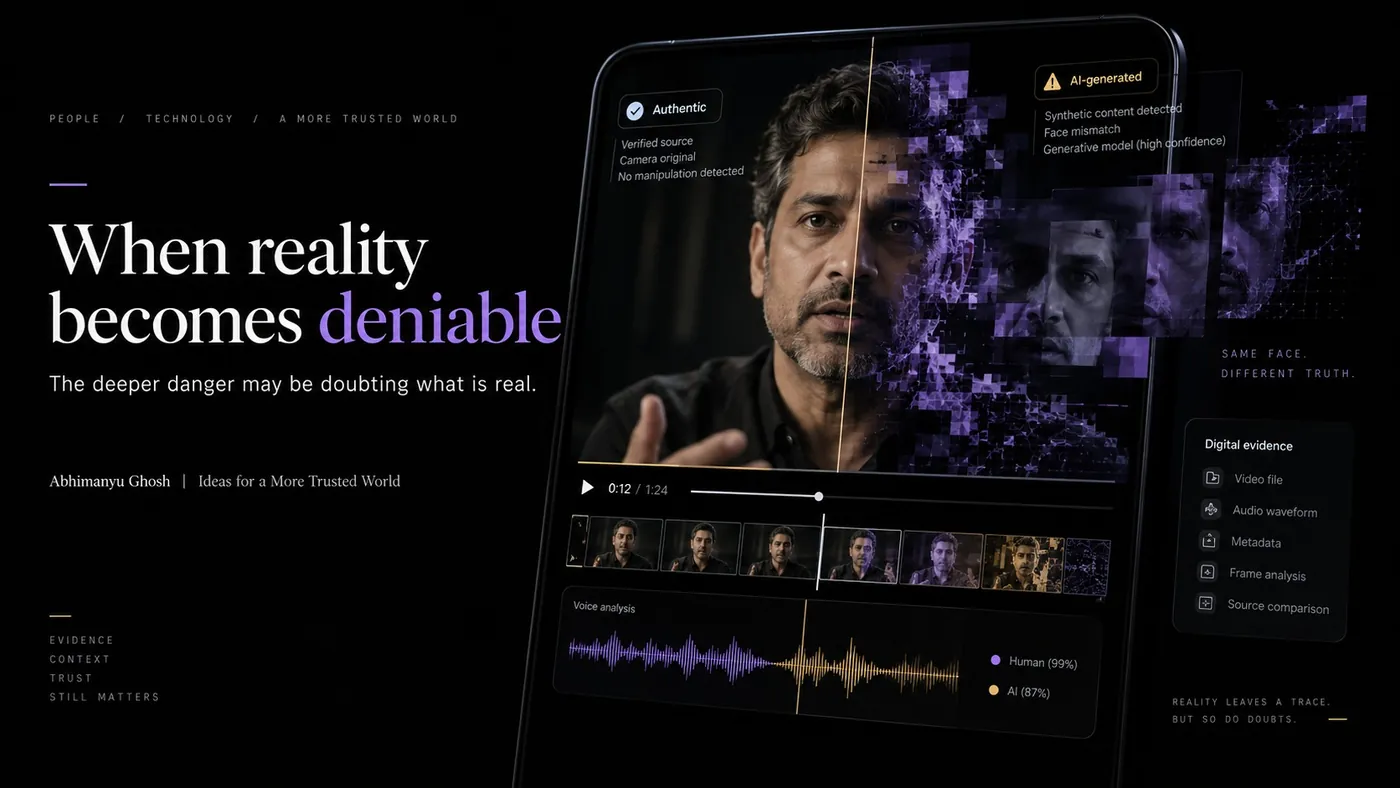
The danger is not that we will believe every fake
I don’t think people will suddenly believe everything they encounter online.
I suspect something more complicated will happen.
We may become suspicious of almost everything.
The World Economic Forum’s Global Risks Report 2026 identifies misinformation and disinformation among the major short-term global risks and cites widespread concern about distinguishing truth from falsehood online.
But this is not only a geopolitical problem.
Trust is what allows ordinary life to function without requiring each of us to investigate everything ourselves.
We trust that the bank message really came from our bank.
That the person calling us is who they claim to be.
That the leader appearing in a video actually said those words.
That the photograph attached to a report belongs to the event being described.
We cannot individually verify the entire world before breakfast.
Society works because somewhere between blind faith and permanent suspicion, we have relationships, institutions and systems that help us decide what deserves belief.
AI is putting pressure on that middle ground.
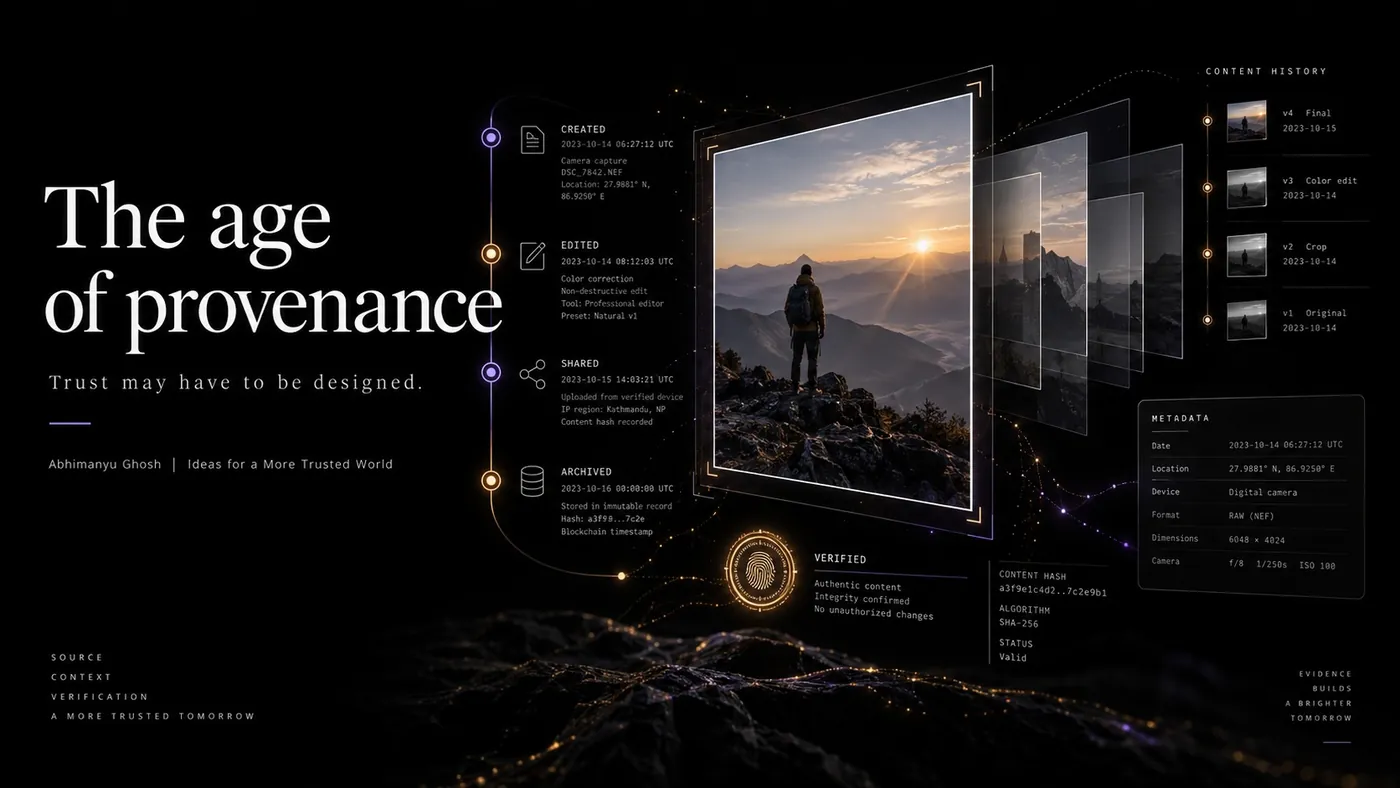
We may be entering the age of provenance
For years, organisations have asked:
How do we influence perception?
I think another question will become increasingly important:
How do we establish origin?
Where did this image come from?
Who created it?
Has it been altered?
Is this really the organisation speaking?
Can the public verify that?
This is where technologies such as Content Credentials become important.
The Coalition for Content Provenance and Authenticity, or C2PA, is developing standards designed to preserve information about the source and history of digital content.
In simple terms, provenance can help us understand where a digital asset came from and what happened to it afterwards.
But there is an important distinction.
Provenance is not truth.
Knowing where a photograph originated does not tell us whether the interpretation attached to it is fair.
Authentic video can still be misleading.
Real statistics can be presented dishonestly.
A genuine statement can be stripped of its context.
Technology may help us establish authenticity.
Human judgement will still have to establish meaning.
That is why I don’t believe the answer to the AI trust problem will come from another piece of software alone.
Trust may become something we have to design
This has significant consequences for leadership.
A few years from now, organisations may need to think about authentication with the same seriousness with which they think about cybersecurity today.
Can people verify that an important statement really came from the CEO?
Does the company have a clearly identifiable source for official information?
What happens if a convincing fake begins circulating?
Who has the authority to respond?
Can a false claim be corrected quickly without making a genuine victim spend days proving that reality occurred?
Those questions belong in boardrooms.
But they also require compassion.
When organisations discuss misinformation, we often speak in the language of risk.
Reputational risk.
Cyber risk.
Political risk.
Financial risk.
There is another word we should use more often:
People.
Somebody can lose a reputation they spent twenty years building.
Someone can be frightened into sending money.
A teenager can have their face placed into content they never consented to.
A family can receive a message designed to exploit the fact that they love one another.
It is worth remembering this when we talk excitedly about what generative technology can do.
Capability and responsibility should grow together.
Reputation will mean more than managing perception
This is particularly important to the work I do around reputation.
At WCRC Intelligence, we examine brands, leaders, organisations and the different dimensions through which stakeholders experience and evaluate them.
Trust and reputation are already closely connected.
But the AI era introduces another dimension.
An organisation may soon have to establish not only:
“Why should you believe us?”
but also:
“How do you know this is actually us?”
That is an extraordinary shift.
Reputation was traditionally built through behaviour accumulated over time.
It still will be.
But perhaps that long record of behaviour will become even more valuable precisely because individual pieces of digital content become easier to manufacture.
When appearances become cheap, consistency becomes expensive.
When anybody can create the image of credibility, actually behaving credibly may become more valuable.
And that gives me some hope.
Perhaps trust will become more human, not less
There is a temptation to conclude that an AI world will simply become a world in which nobody can trust anything.
I don’t think that outcome is inevitable.
We may instead become more careful about what trust is based on.
Not one photograph.
Not one viral clip.
Not one charismatic statement.
But a pattern.
Does this person behave consistently?
Does this organisation correct itself when it gets something wrong?
Can its claims be checked?
Does it make verification easy?
Is there somebody accountable at the other end?
Perhaps AI will force us to rediscover something we should have understood already:
Trust was never supposed to mean believing everything we see.
Trust is confidence built from evidence, behaviour and experience over time.
Machines can imitate appearances remarkably well.
They can imitate voices.
Faces.
Styles.
Authority.
What remains much harder to manufacture is a history of keeping promises.
And perhaps that will become one of the defining forms of value in the years ahead.
For generations we have said:
Seeing is believing.
I think we are entering a world that requires a more thoughtful sentence:
Seeing will no longer be enough. Trust will have to be earned, verified and lived.
That is not only a technology challenge.
It is a human one.
And ultimately, building a more trusted world has always been a human responsibility.
About the author
Abhimanyu Ghosh is Founder & Chairman of WCRC. He works at the intersection of business, leadership, reputation and human potential. Through Ideas for a More Trusted World, he explores big questions shaping business and society, supported by research and evidence. He writes separately at abhimanyughosh.com.
Explore the research and reputation work of WCRC Intelligence →
Evidence and further reading
Figures and conclusions below belong to the organisations that published them and are not WCRC research.
- Deepfake detection research — Computers in Human Behavior Reports, 2024
- World Economic Forum — Global Risks Report 2026
- C2PA — Content Credentials and digital provenance specifications
- OpenAI — Advancing content provenance
Filed under