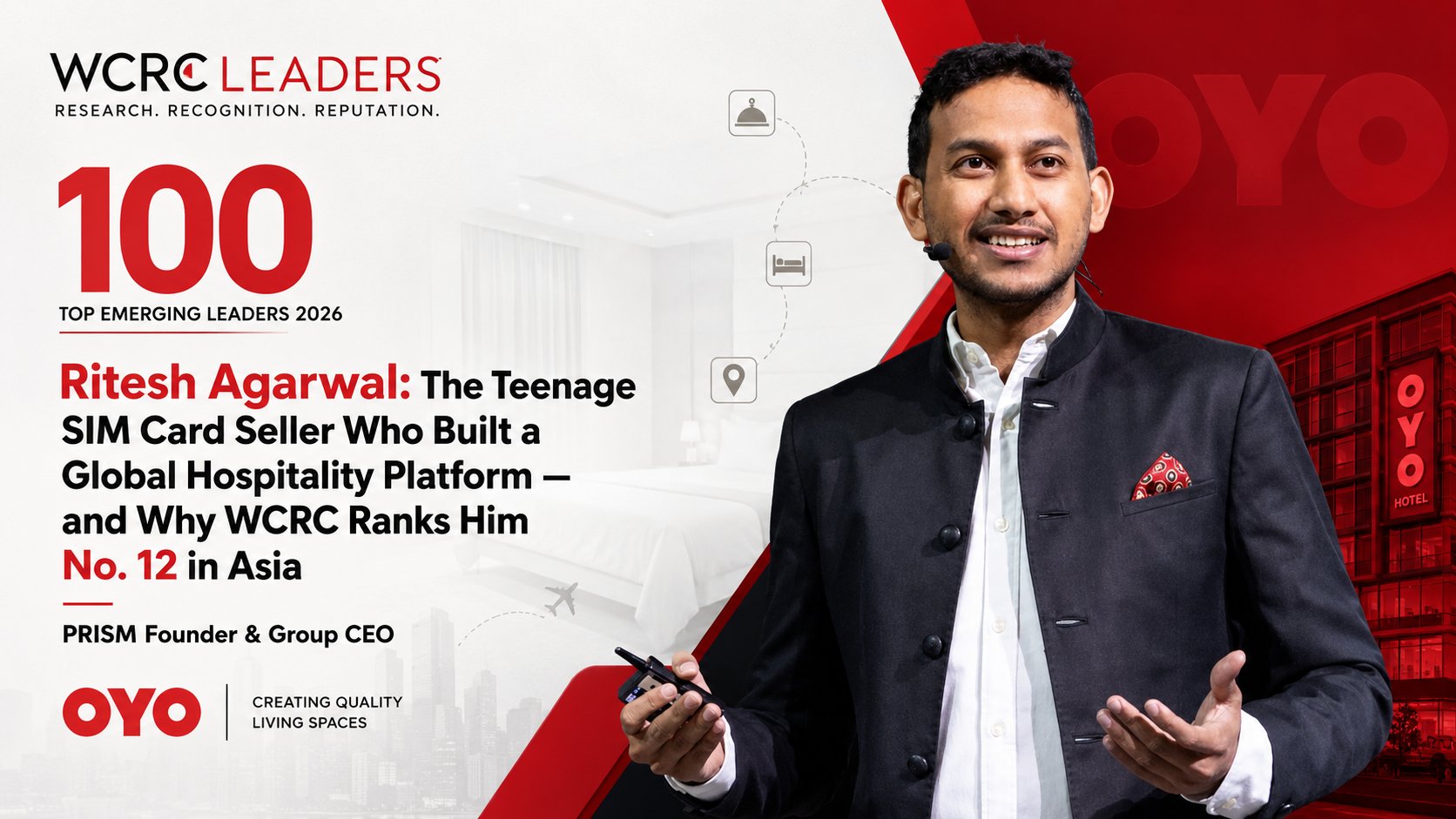
Leadership · Asia Top 100 Emerging Leaders 2026
Ritesh Agarwal: The Teenage SIM Card Seller Who Built a Global Hospitality Platform — and Why WCRC Ranks Him No. 12 in Asia
From a Thiel Fellowship application in a cyber café to a third IPO attempt: PRISM's Founder & Group CEO at No. 12 on WCRC's Asia Top 100 Emerging Leaders 2026.
628/700
Composite score
95
Vision Quotient
847
Qualified candidates
18
Nations assessed
Editor's note: WCRC's Asia Top 100 Emerging Leaders 2026 research, published in August 2026, lists Ritesh Agarwal as “Founder & CEO, OYO Rooms.” In September 2025, the company's parent, Oravel Stays, rebranded corporately as PRISM, with OYO continuing as the primary consumer-facing brand within a wider portfolio. His current LinkedIn designation is Founder & Group CEO, PRISM. This piece reflects that current structure.
Most unicorn founders have a college dropout story. Ritesh Agarwal's starts earlier and stranger: a teenager from a small town in Odisha who was selling SIM cards before he'd even reached the age most of his eventual investors were finishing their MBAs. WCRC's Asia Top 100 Emerging Leaders 2026 research has scored him 628 out of 700 — twelfth overall in a field of 847 qualified candidates across 18 nations, with a Vision Quotient of 95, one of the highest in the entire cohort.
From Bissam Cuttack to a Cyber Café Application
Agarwal was born on November 16, 1993, in Bissam Cuttack, a small town in Odisha, and grew up in nearby Rayagada and Titilagarh, where his family ran a small shop. He began working entrepreneurially as a teenager, selling SIM cards before he'd finished school, and moved to Delhi in 2011 to attend college — a stint that didn't last long. He dropped out to pursue a hotel-booking platform called Oravel, incubated through the Venture Nursery program, born directly out of his own experience as a solo teenage traveler staying in small, inconsistent hotels and guest houses across India.
In 2013, at nineteen, Agarwal applied to the Thiel Fellowship — Peter Thiel's program offering $100,000 grants to young entrepreneurs willing to skip or leave college entirely — after learning about it, by his own account, in a cyber café. He became the first Indian, and one of the first Asian residents generally, to be accepted. The fellowship's $100,000 became the seed capital that let him pivot Oravel into OYO Rooms, launched in Gurgaon in May 2013 with a franchise-style model: standardizing quality, amenities and booking reliability across a network of small, independently owned hotels that had previously operated with wildly inconsistent standards.
Scaling Fast, Then Rebuilding Under Pressure
OYO's early growth was rapid by any standard — a Series A of $24 million within two years of its initial funding, a $1 billion raise by September 2018 that helped fund international expansion into China and beyond, and a valuation that reportedly reached $5 billion off the back of that raise. In 2018, Agarwal became India's youngest self-made billionaire, and by 2020, at 26, the world's second-youngest self-made billionaire.
That growth came with real strain. OYO's franchise-heavy model, built on rapid partner acquisition, generated persistent friction with hotel owners over revenue guarantees and operational control, and the COVID-19 pandemic hit the hospitality sector generally — and a company still working through unresolved quality-control and partner-relationship issues specifically — especially hard. Agarwal's response was a multi-year restructuring rather than a quick fix: tightening quality control, renegotiating partner terms, and reshaping the business toward more sustainable unit economics rather than growth at any cost. That period is a meaningful part of the record behind his current standing — a founder who scaled aggressively, hit a genuinely difficult stretch, and rebuilt the operating model rather than exiting or diluting his role.
From Budget Hotel App to Global Hospitality Platform
The rebuild shows up clearly in what the company has become. In 2024, OYO's parent acquired G6 Hospitality — the American chain operating Motel 6 and Studio 6 — from Blackstone Real Estate, in a deal reported around $525 million, extending the platform's reach directly into the US budget hospitality market rather than only India and emerging Asia. By December 2025, the platform spanned roughly 293,500 storefronts across more than 35 countries: about 24,300 hotels, 124,700 homes, and 144,600 listings, organized across three distinct verticals — Hotels (OYO, Townhouse, Palette, Sunday, plus Motel 6 and Studio 6 in the US), Homes (European vacation rental brands including Belvilla, DanCenter and Checkmyguest), and Listings (a subscription product for property owners), alongside adjacent businesses in weddings, co-working and events.
That expansion culminated in the September 2025 corporate rebrand: Oravel Stays, the parent entity, became PRISM, selected from more than 6,000 submissions in a global naming competition, while OYO remained the primary consumer-facing brand. Agarwal framed the rebrand directly to shareholders: “Great companies and missions are born and founded more than once,” he wrote, describing it as a moment of reinvention rather than a cosmetic exercise. The name itself reflects a structural reality — PRISM now operates as a portfolio-led umbrella brand across multiple hospitality categories and geographies, not a single budget-hotel product.
The financial turnaround underlying that rebrand is the more consequential part of the story. The company posted twelve consecutive profitable quarters heading into FY25, reported a ₹244.8 crore profit for that fiscal year, and a ₹748 crore profit for the nine months to December 2025 — a genuine reversal from the loss-making years that followed its most aggressive growth phase. As of that period, more than 83% of revenue was coming from outside India, a marked shift from OYO's origins as a domestically focused Indian startup. In June 2026, PRISM filed an updated ₹6,650 crore IPO prospectus with SEBI — its third attempt at a public listing after filings in 2021 and 2024 were withdrawn — structured entirely as a fresh issue, with roughly 75% of proceeds earmarked to repay debt at its Singapore subsidiary rather than fund new expansion, at a targeted valuation of $7-8 billion.
What WCRC's Data Adds
WCRC's Asia Top 100 Emerging Leaders framework scores candidates across seven parameters — Vision Quotient, Impact Index, Innovation Score, People Leadership, Stakeholder Trust, Resilience Factor and Global Mindset — applied through a five-stage process of nomination, eligibility screening, independent evaluator scoring, editorial panel review and final verification.
Agarwal's standout figure is a Vision Quotient of 95. WCRC's own citation credits him with becoming one of the world's youngest self-made billionaires by reinventing budget hospitality, attracting SoftBank's largest single cheque in Asia, and attributes the score to strategic imagination that consistently outpaces conventional hospitality logic. That framing fits the arc reasonably well, though the more recent chapter — the debt-funded IPO structure, the deliberate pivot toward profitability over pure growth, the G6 acquisition into a mature US market rather than another emerging one — reads less like imaginative reinvention and more like disciplined institutional maturity. Both are real achievements; they're just different registers, and the second one arguably required more restraint than the first required imagination.
The Company He's Keeping
Agarwal sits within WCRC's Indian Subcontinent cohort — 46 of the 100 ranked leaders this year, the largest of the three sub-regions, dominated by founder-led consumer and fintech stories. His immediate company includes Zomato/Eternal's Deepinder Goyal (rank 17, 626/700) and Paytm's Vijay Shekhar Sharma (rank 25, 615/700) — both fellow Indian consumer-internet founders who took companies public and then had to defend those valuations through subsequent volatility, a trajectory Agarwal's own pending IPO will now test directly.
What separates his position within that group is the international weight of the business by the time it reaches public markets. Where Zomato and Paytm remain substantially India-centric even after their listings, PRISM now generates the majority of its revenue outside India — a structurally different kind of company going public than most of the founder stories surrounding him in this ranking.
The Throughline
Strip away the billionaire-at-26 headline and what's left is a career with a harder middle chapter than most retrospectives dwell on: a teenager who taught himself to build a hospitality business from a cyber café application, scaled it recklessly fast, hit a genuine operational and financial crisis compounded by a global pandemic, and then spent years rebuilding toward profitability and international scale before attempting, for a third time, to take the company public. WCRC's 628-point score and its 95 in Vision Quotient are measuring the founding imagination. What comes next — a debt-reduction-focused IPO, under a new corporate name, on a platform now majority-funded by revenue from outside the country where it started — is a test of whether that same founder can run a mature, profitable public company as convincingly as he built a fast-growing private one.